Every forex trade eventually comes down to one question: how much money did that price movement actually put in or take out of my account? A pips to dollars calculator answers that question instantly, converting the abstract language of decimal-place shifts into the currency figure that actually matters — the one sitting in your trading account.
This guide covers what a pip represents, how the underlying conversion math works, how it shifts across different instruments, and the mistakes that quietly throw the numbers off if you’re not paying attention.
The Gap Between “Pips Moved” and “Money Made”
Watching a chart tick 30 pips in your favor feels good, but it tells you almost nothing on its own. Thirty pips on a micro lot might mean three dollars. The same 30 pips on two standard lots could mean six hundred. The chart shows you price movement; only a pips-to-dollars conversion shows you what that movement is actually worth.
This gap is exactly where undisciplined trading tends to start — sizing decisions made on gut feel rather than a concrete dollar figure, stop-losses placed at “a level that looks right” rather than one calculated against an actual risk budget. A pip-to-dollar conversion tool exists to close that gap before a trade goes live, not after.
What a Pip Actually Is
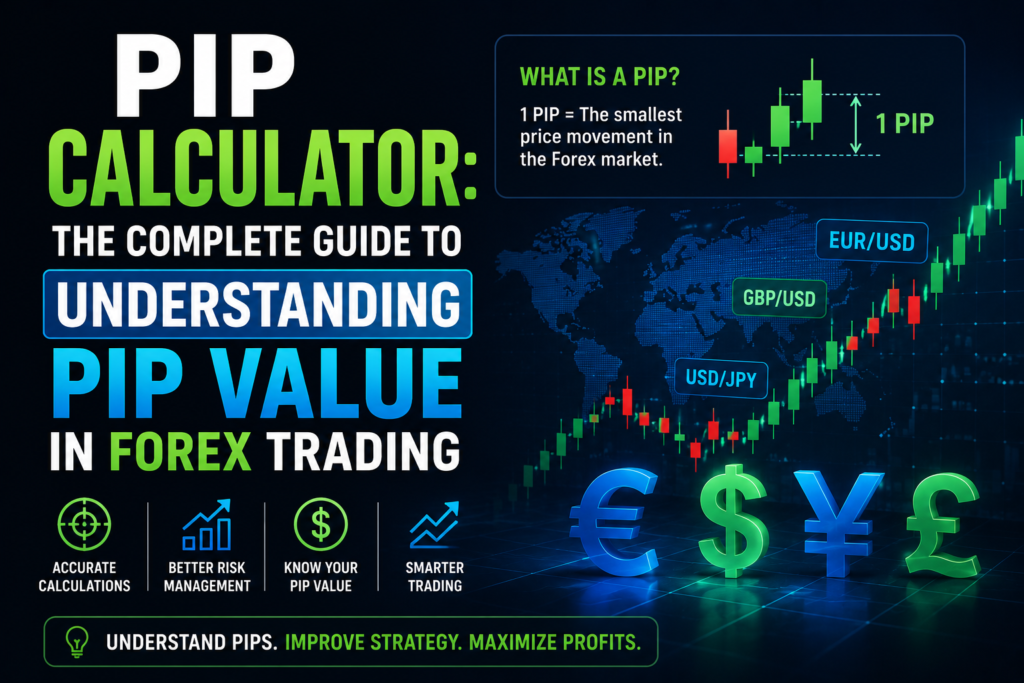
“Pip” stands for percentage in point — the smallest standardized price movement recognized in a currency pair. For most major pairs, one pip sits at the fourth decimal place (0.0001). Japanese yen pairs use a different convention entirely, placing a pip at the second decimal (0.01) because of how the currency is quoted.
This standardization is what allows a shared vocabulary across brokers and pairs. Without it, “the market moved a lot” would carry no comparable meaning between a EUR/USD trade and a USD/JPY trade — the numbers wouldn’t be measuring the same thing.
Pip value itself is never fixed. It shifts constantly with the live exchange rate, your chosen lot size, and the currency pair you’re trading — which is precisely why relying on memory or a static reference number is risky, and why converting the figure freshly for every trade earns its place as a habit rather than an occasional lookup.
Why the Conversion Matters So Much
Converting pips into dollars isn’t a bookkeeping formality — it’s central to how experienced traders actually plan and evaluate trades:
- It shows the real financial weight of any given price move, rather than an abstract decimal shift.
- It makes different currency pairs and lot sizes directly comparable, so risk can be evaluated consistently across your whole trading plan.
- It’s the only reliable basis for setting a stop-loss or take-profit level that actually corresponds to an amount of money you’re comfortable risking.
As a quick illustration: buying 10,000 units of EUR/USD at 1.0801 and selling at 1.0811 nets a 10-pip gain — and on that lot size, roughly $10 of realized profit. The pip count alone tells you the market moved; the dollar figure tells you what that move was worth to you specifically.
The Formula Behind Every Pip Conversion
Strip away the interface of any pips to dollars calculator, and the same core formula is running underneath:
Pip Value = (One Pip × Lot Size) ÷ Exchange Rate
Worked example: One standard lot of EUR/USD at an exchange rate of 1.1000: (0.0001 × 100,000) ÷ 1.1000 ≈ $9.09 per pip
Every additional pip the price moves adds or subtracts that same $9.09 — which is the number a proper pips to dollars calculator returns instantly, adjusted automatically for whichever pair and size you enter.
Running the Calculator: A Practical Walkthrough
Step 1 — Select your currency pair. Pip conventions differ by instrument: forex majors use four decimal places (pip = 0.0001), JPY pairs use two (pip = 0.01), gold typically treats a pip as a $0.10 move per 0.01 price change on a standard lot, and index instruments like US30 or NAS100 measure movement in full points rather than pips at all. For gold specifically, a dedicated XAUUSD pip calculator accounts for this correctly; for indices, an indices pip calculator handles the point-based conversion.
Step 2 — Enter lot size and trade volume. This single input has the largest effect on your result. A 50-pip move on a standard lot equals roughly $500; the same 50-pip move on a micro lot equals about $5. Reviewing lot size tools for forex traders is worth doing if scaling position size correctly isn’t yet second nature.
Step 3 — Set your account currency. A USD account gets a direct dollar figure. Accounts in GBP, EUR, or INR trigger an automatic conversion using the live exchange rate — a step that matters considerably for traders operating outside USD-denominated accounts, since risk in rupee or pound terms can look quite different from the raw dollar number.
Step 4 — Calculate. The output typically includes pip value per lot in your account currency, total profit or loss based on pips gained or lost, and how that value scales across different lot sizes.
Step 5 — Apply the result to risk management. This is where the tool earns its keep: setting a stop-loss distance based on the dollar risk you’re actually willing to accept, sizing your position to stay within a fixed percentage of your account, and confirming your take-profit target lines up with a sensible risk-reward ratio. A risk reward calculator pairs naturally with this step for full trade planning.
Pip-to-Dollar Values Across Different Instruments
EUR/USD. The world’s most traded pair. At a standard lot size near a 1.08 exchange rate: 1 pip ≈ $9.26, 10 pips ≈ $92.60, 50 pips ≈ $463.
GBP/JPY. A notably volatile cross pair. Because JPY pairs use two decimal places, pip value on a standard lot typically runs $6–$8 depending on the live rate.
USD/JPY. Adjusts automatically for yen conventions — a standard-lot pip runs close to $9.10 at typical current rates.
XAU/USD (Gold). Quoted in dollars per troy ounce. A one-pip move (0.01) on a standard lot equals roughly $1; a full dollar move (100 pips) equals $100 per lot.
US30 (Dow Jones). Measured per index point rather than a standard pip — one point on a standard lot is typically worth $1, so a 100-point move equals $100 per lot.
NAS100. Follows similar point-based logic to US30, with its own volatility profile worth accounting for separately.
Crypto (BTC, ETH, XRP). Pip-equivalent values here are generally larger and considerably more volatile than traditional forex, so a dedicated crypto pip calculator is worth using rather than forcing standard forex assumptions onto digital assets.
Silver (XAG/USD). Uses the same underlying formula as gold, but with a different contract size — worth checking separately rather than assuming identical figures.
Where the Calculator Pays Off Most: Risk Management
Setting a stop-loss from a dollar limit. If your maximum acceptable loss on a trade is $100 and your pip value is $10 (standard lot EUR/USD), your stop-loss ceiling is 10 pips. If your analysis genuinely calls for a wider 30-pip stop, the fix isn’t ignoring your risk limit — it’s dropping to a mini lot, where 30 pips equals a comparable $30 of risk.
Sizing a position from a fixed risk budget. Position Size = Account Risk ($) ÷ (Stop-Loss in Pips × Pip Value). Example: a $500 account risking 1% ($5 max loss), a 10-pip stop, and a micro-lot pip value of $0.10 works out to $5 ÷ (10 × $0.10) = 5 micro lots.
Accounting for leverage. Leverage amplifies exposure, not pip value itself — a 10:1 leveraged mini-lot position behaves like a standard lot in terms of dollar-per-pip impact. Checking your effective leverage before entering, alongside your pip conversion figures, keeps this distinction clear.
Projecting profit targets. If EUR/USD is entered at 1.0800 with each pip worth $9.26, a 50-pip target projects to roughly $463 in profit, while a 20-pip stop represents about $185 of risk — a 2.5:1 risk-reward ratio, generally considered a healthy setup.
Mistakes That Quietly Break the Math
Wrong decimal place assumptions. Applying a four-decimal pip convention to a JPY pair (or vice versa) throws the result off by a full factor of 100.
Confusing pips with pipettes. A pipette is one-tenth of a pip, at the fifth decimal place. Reading pipette movement as full pips inflates your apparent profit substantially.
Using a stale exchange rate. Pip value shifts with every rate change — a figure calculated an hour earlier may already be meaningfully out of date by the time you actually enter a trade.
Mixing lot sizes in one calculation. Scaling into a position across multiple entries at different sizes requires calculating each position’s pip value separately, not blending them into a single estimate.
Ignoring exotic-pair specifics. Pairs like USD/ZAR carry pip values that look nothing like the majors — a dedicated calculator for that specific pair avoids the error of assuming standard values transfer over.
Forgetting spread. A 2-pip spread against a $10 pip value means your position opens roughly $20 in the red before the market has moved at all — a cost that belongs in your profit projection, not an afterthought.
Where This Gets More Complex: Volatility, Currency, and Overnight Costs
During high-impact news events. Around releases like NFP, FOMC, or CPI, spreads can widen sharply, and a position that normally risks $50 can briefly carry meaningfully more exposure if execution spread jumps from 1 pip to several. Recalculating right before news-driven trades is worth the extra step.
For traders outside USD accounts. An Indian trader, for instance, faces an added conversion layer — a $10 standard-lot pip translates to a notably different rupee figure depending on the live USD/INR rate, which shifts the effective risk picture in local-currency terms.
For funded/prop-firm traders. Strict daily drawdown limits mean pip exposure across every open position needs tracking collectively, not per-trade in isolation — a 5% drawdown limit on a large funded account still translates into a hard pip ceiling once you do the conversion.
Overnight holding costs. Swap fees function as an additional pip-equivalent cost on positions held past the trading day, quietly eating into a gain that looked larger on the chart than it ended up being in the account.
Where Traders Commonly Cross-Check These Numbers

Several established platforms offer their own pip-value tools, each with a slightly different focus — some emphasize a clean, all-in-one interface aimed at both beginners and professionals, others are known specifically for calculation accuracy and risk-planning integration, and still others build pip tools into a broader trading-education ecosystem with regular updates and transparent methodology. Cross-referencing a couple of these alongside your primary pips to dollars calculator is a reasonable habit, particularly when trading a less common pair.
Frequently Asked Questions
What is pip value in forex trading? It’s the dollar (or account-currency) amount that a single pip of price movement represents for a specific trade size and pair — the figure that determines exactly how much a given move gains or costs you.
How do I calculate pip value manually? Pip Value = (0.0001 × Lot Size) ÷ Exchange Rate — substitute 0.01 for JPY pairs. This is the same formula every pips to dollars calculator runs behind the scenes.
How much is 50 pips in dollars? On a standard lot of EUR/USD: roughly $500. Mini lot: about $50. Micro lot: around $5.
How much is 100 pips worth? Standard lot: about $1,000. Mini lot: about $100. Micro lot: about $10. Nano lot: about $1.
Does pip value change between currency pairs? Yes — it depends on the pair’s exchange rate and quote currency structure, so a pip on USD/JPY is never worth the same dollar amount as a pip on EUR/USD at an identical lot size.
How do I read pip movement in MetaTrader? MT4/MT5 typically display movement in a “points” column — multiply that figure by your pair’s pip size to get an accurate pip count rather than assuming points and pips are interchangeable.
What’s the pip value for gold (XAUUSD)? On a standard lot, one pip (a 0.01 price move) is worth about $1, so a full 100-pip move works out to roughly $100 per lot.
How many pips should I be targeting per trade? It depends heavily on strategy — scalpers often target 5–15 pips, day traders 20–50, and swing traders 50–200 or more. The pip count matters less on its own than the dollar value relative to the risk taken to get there.
Can a pips to dollars calculator handle crypto positions? Yes, following the same underlying logic, though pip-equivalent sizes and volatility are considerably larger — a dedicated crypto-specific tool is generally more accurate than adapting a standard forex calculator.
What exactly is a pipette? One-tenth of a full pip, appearing at the fifth decimal place. Some brokers quote spreads in pipettes rather than whole pips, which is worth confirming so you’re not misreading your actual cost.
Building a Complete Pre-Trade Checklist
A pips to dollars calculator works best as one piece of a larger routine rather than a standalone step. Paired with a margin calculator to confirm capital requirements, a position size calculator to translate risk tolerance into an actual lot size, a risk-reward calculator to validate whether a setup is worth taking at all, and a stop-loss distance tool to place exits with precision, the pip conversion becomes the connective figure that ties every other calculation together.
Who Actually Benefits From This
Newer traders use it to build a concrete sense of how much real money is attached to a given price movement before ever risking live capital — a foundational habit worth forming early rather than after a costly mistake.
Intermediate traders lean on it to validate that stop-loss distances genuinely match their intended dollar risk, rather than relying on a distance that simply “looks right” on the chart.
Advanced and funded-account traders use it to manage total pip exposure across multiple simultaneous positions, keeping combined risk inside strict drawdown limits.
Traders operating outside USD accounts rely on it specifically to bridge dollar-denominated pip figures into their own local-currency risk picture, which can shift meaningfully with exchange rate movement.
Final Thoughts
A pips to dollars calculator isn’t an optional convenience — it’s close to a prerequisite for trading with any real discipline. Every trade placed without a clear sense of pip value in real money is, functionally, a trade placed on incomplete information. Make the conversion a fixed part of your pre-trade routine, pair it with proper position sizing and risk-reward planning, and the numbers stop being an afterthought and start being the foundation the rest of your trading plan is actually built on.
This article is for educational purposes only and does not constitute financial advice. Trading forex involves substantial risk — always do your own research before entering a position.