
Pip is an important term in forex trading, so it is necessary for you as a trader to know how to calculate pips in forex to manage your risk effectively and make correct trading decisions. It does not matter if you are a beginner or a trader looking forward to enhancing your trading skill; pip calculation is essential to compute the potential profit or loss in the trade.
This blog will teach you the step-by-step process of pip calculation, explain how many pips per trade different trading styles typically target, and demonstrate how to calculate pip profit in forex with real-world examples. Additionally, you will learn about pip movement in forex pairs and how to interpret these changes to make smarter trading decisions. By the end of this blog, you’ll be confident to accurately calculate pips and improve your trading strategy.
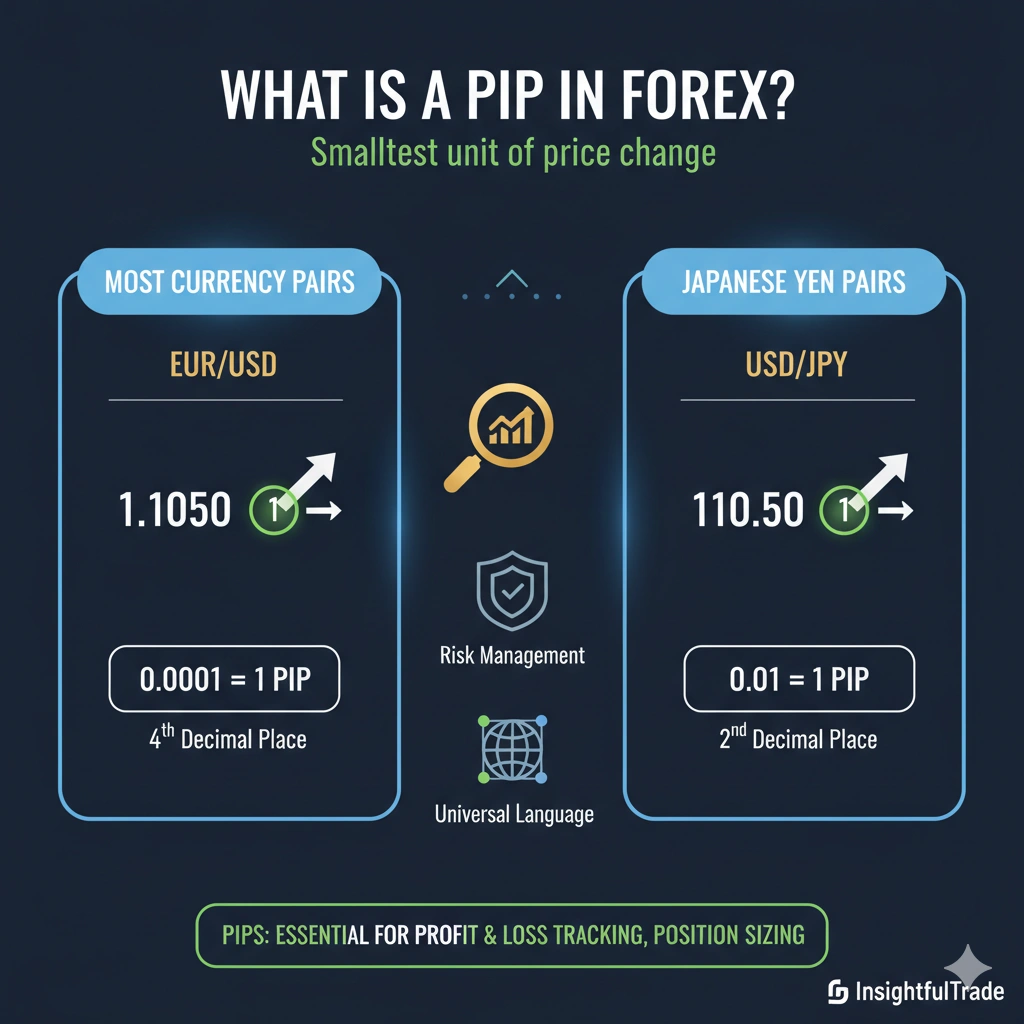
What is a pip in forex trading, and why is it important?
The smallest unit of change in the price movement of the currency pairs is called a pip, which stands for “percentage in points.” In most of the currency pairs, pip points equal 0.0001, the fourth decimal, except in the case of the Japanese yen, where the pip equals 0.01, the second decimal yen.
A pip is important because:
- This is a universal proposal for the evaluated telecom language, making it easier for all traders to communicate and analyze business.
- Pips are important in risk management, helping to determine the basis for rate price shares at stop-loss and take-profit levels.
- Using pips timing trading indicators, position sizing, and adjustments makes short-term calculations reliable and trustworthy.
- The forex market is very volatile for you to enter without knowledge of concepts like pips and tracking profits and losses; otherwise, you would be inconsistent and confused.
In short, to become a profitable forex trader, understand what a pip is and how it affects your risk management, position sizing, and entry and exit in the trade.
How is a pip defined for most currency pairs versus pairs involving the Japanese yen?
Most currency pairs have defined pips except for the pairs involving Japanese yen due to its unique quoted prices.
Most of the currency pairs, like EUR/USD, GBP/USD, and AUD/USD, are valued at four decimal places, and a pip is the smallest movement—0.0001. So if EUR/USD goes from 1.1050 to 1.1051, that 0.0001 change equals one pip.
But pairs with the Japanese Yen (JPY) are different. They’re quoted to two decimal places, and a pip is 0.01. For example, if USD/JPY moves from 110.50 to 110.51, that 0.01 change is one pip.
What is the pip calculation formula in forex trading?
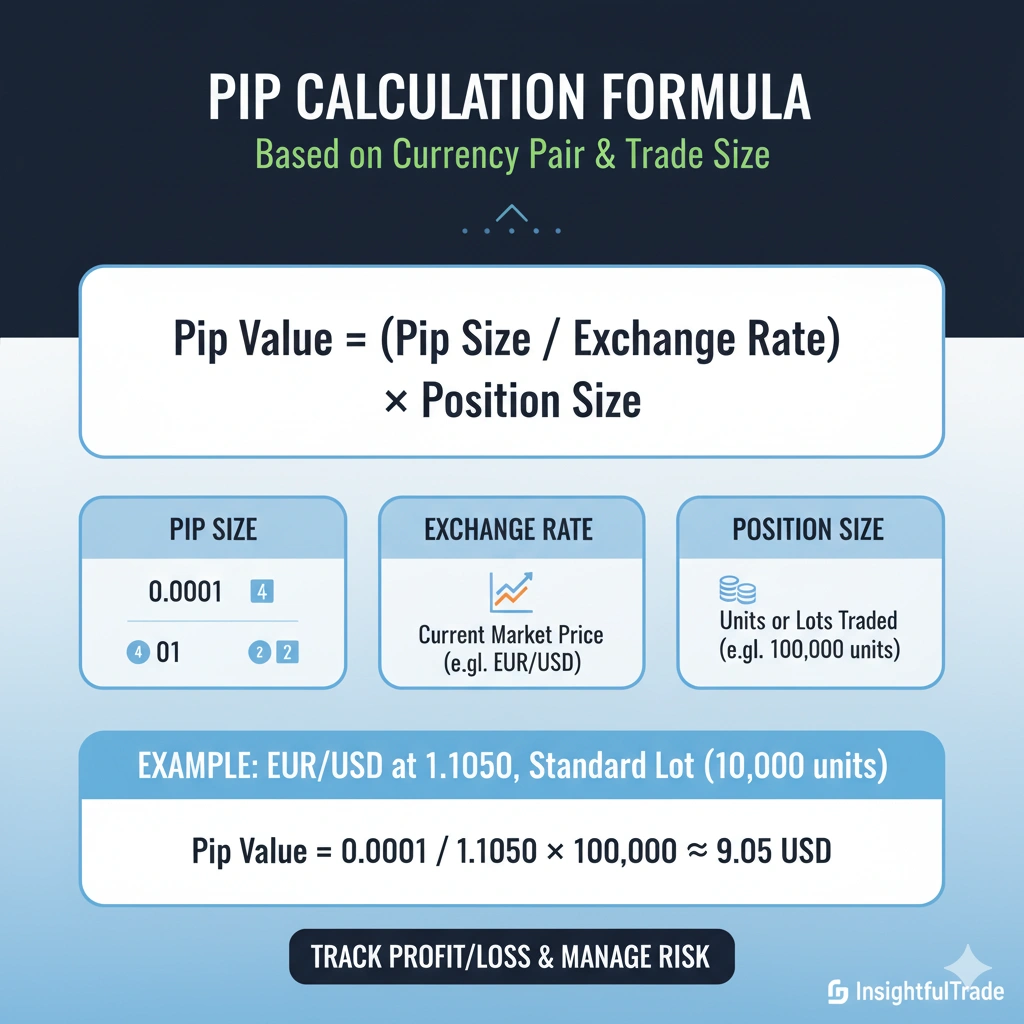
The pip calculation formula in forex trading is based on the currency pair and trade size, and the formula used to calculate the value of a pip is:
Pip Value = (Pip Size / Exchange Rate) × Position Size
Where:
- Pip Size is typically 0.0001 for most currency pairs and 0.01 for pairs involving the Japanese Yen.
- Exchange Rate is the current market price of the currency pair.
- Position Size is the number of units or lots traded (e.g., 100,000 units in a standard lot).
For example, if you are trading EUR/USD at an exchange rate of 1.1050 with a standard lot size (100,000 units):
Pip Value = 0.0001 / 1.1050 × 100,000 ≈ 9.05 USD
- If the currency pair is the same as your account currency (for example in USD), this is the pip value per pip move.
- In case of different account currency from the currency pair you need to convert the pip value to the account currency using the exchange rates.
- It is necessary for you to understand how pip value calculation helps in computing the actual profit or loss based on the trade size and currency pair involved.
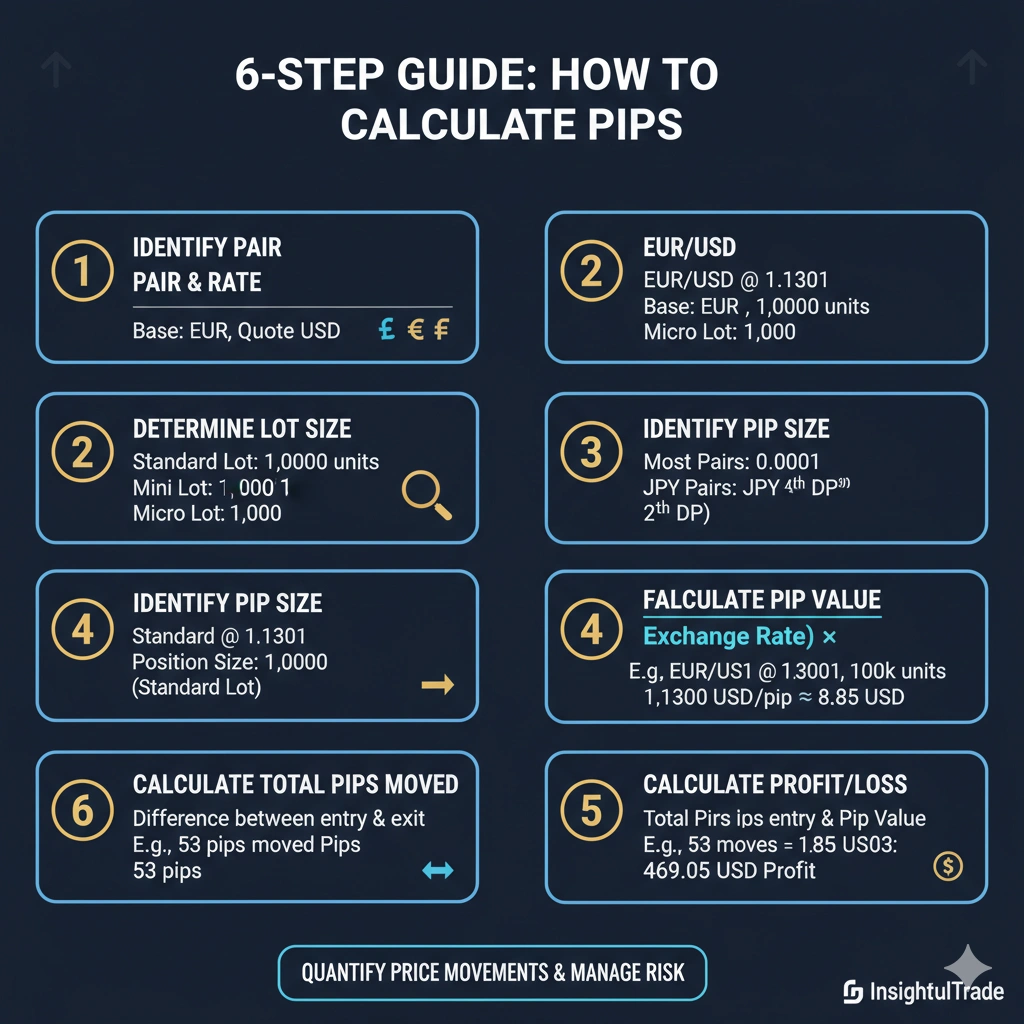
Step-by-Step Guide: How to Calculate Pips in Forex Trading
1. Identify the Currency Pair and Exchange Rate
Set the currency you’re trading forex with and note its current exchange rate. Identify which currency is the base and which is the quote currency. For example, in EUR/USD, EUR is the base and USD is the quote.
2. Determine the Lot Size
Know your trade size. Standard lot sizes are 100,000 units, mini lot sizes are 10,000 units, and micro lot sizes are 1,000 units.
3. Identify the Pip Size
In Forex normally pips for currency pairs are up to four decimal places, so a pip is typically 0.0001. For pairs involving the Japanese yen, a pip is 0.01, as they are recommended to be quoted up to two decimal places.
4. Calculate the Pip Value
Use the formula:
Pip Value=(Pip Size / Exchange Rate)×Lot Size
For example, if EUR/USD is trading at 1.1301, a standard lot (100,000 units):
Pip Value = 0.0001 / 1.1301 × 100,000 = 8.85 USD
5. Calculate Total Pips Moved
Find the difference between the entry and exit prices in terms of pips. For instance, if EUR/USD moves from 1.1300 to 1.1353, the move is 53 pips.
6. Calculate Profit or Loss
Multiply the total pips moved by the pip value to determine the monetary profit or loss.
For 53 pips gained on a standard lot:
53×8.85=469.05 USD profit
This step-by-step approach enables traders to quantify price movements, manage risk, and calculate trading outcomes accurately across different currency pairs and trade sizes.
How many pips per trade are generally targeted by different types of traders (scalpers, day traders, swing traders)?
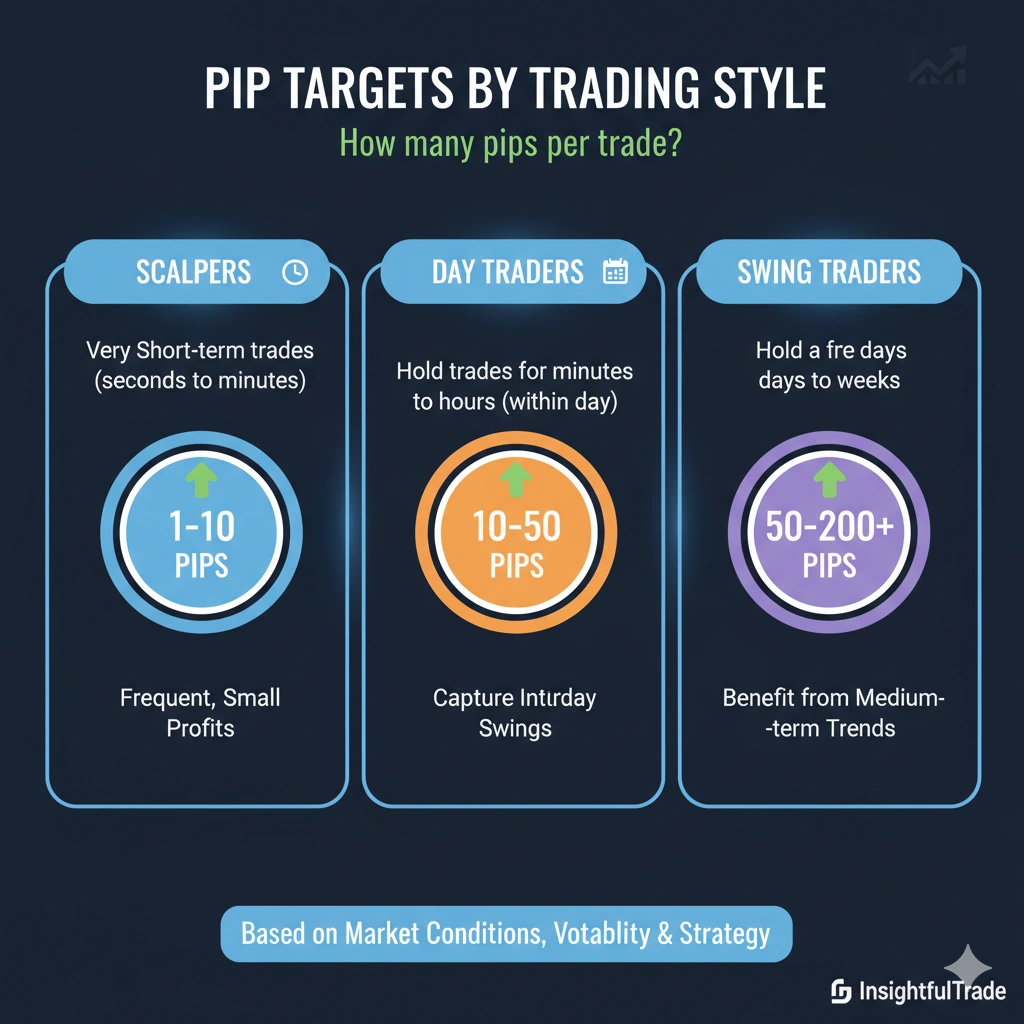
The number of pips targeted per trade varies significantly based on the trading style:
- Scalpers: it aims for small pip movements like between 1 to 10 pips. Scalping refers to quick and short trades, in which traders exit the trade with small profit on the minor price movement more frequently throughout the trading session.
- Day Traders: Usually these trades have a target between 10 to 50 pips. In this traders hold their position within the same trading day, also referred as intraday trading.
- Swing Traders: In this traders hold their position for more than a day targeting for larger pip movement, generally ranging from 50 to 200 pips or more per trade to earn medium to high range profits.
This whole thing is based on the market conditions, currency pairs traded, volatility, risk tolerance, and individual trading strategies. Once you understand your trading style it will be easier for you to determine realistic pip targets and appropriate risk management.
How does pip movement in forex pairs impact potential profit or loss?
Pip movement in forex pairs directly impacts the potential profit or loss because each pip represents a defined amount of price change. The total profit or loss of a trade is calculated by multiplying the number of pips the market moves by the value of each pip and the size of the trade (lots traded).
For example, if the price of EUR/USD moves 50 pips in your favor and your pip value is $10 per pip for a standard lot (100,000 units), your profit would be:
50 pips × 10 USD / pip = 500 USD
Conversely, if the price moves against you by 50 pips, the loss would be $500.
It is important to understand why pip value and pip movement is crucial because on its bases you can decide whether the chosen equity should be in your portfolio or not based on its fluctuation in monetary terms.
Factors such as lot size, the currency pair being traded, and leverage also affect the financial impact of a pip movement, but the basic relationship is:
- More pip movement means greater potential profit or loss.
- Less pip movement means smaller profit or loss.
Thus, pips movement translates directly into solid profits or losses, shaping your trading dynamics and strategy adjustments.
FAQs
1. What is a pip in forex trading?
A pip is the smallest standard unit of price movement in currency pairs, usually representing 0.0001 for most pairs and 0.01 for Japanese Yen pairs.
2. How is pip value calculated?
Pip value is calculated using the formula:
Pip Value = (Pip Size / Exchange Rate) × Position Size
It varies based on currency pair, lot size, and exchange rate.
3. Why does the exchange rate affect pip value?
Because pip value is inversely proportional to the exchange rate, when the rate rises, pip value decreases, and when it falls, pip value increases.
4. How do I calculate pip profit or loss?
Pip profit or loss is calculated by multiplying the number of pips moved by the pip value and trade size:
Profit/Loss = Pip Movement × Pip Value × Number of Lots
5. How many pips per trade do different traders target?
Scalpers target 1-10 pips, day traders aim for 10-50 pips, and swing traders look for 50-200+ pips per trade.
Conclusion
In the end, it’s important for you to master the art of calculating pip if you want to manage your risk effectively, and commute potential profit or loss involved in the trade. With the Insightful Trade’s guidance, you will learn and practice the pip mechanics and understand how to calculate pip value considering different currency pairs, exchange rates, and trade sizes. It highlights all common negative points that you need to avoid, helping you enhance your accuracy and confidence in your trading decisions. With its clear examples for various trading patterns and precise explanation over the complex concepts it helps you improve your risk management and optimizing trade outcomes, contributing significantly to your long-term trading success.
Overall, InsightfulTrade’s website is a valuable resource for you if you are looking to build a solid foundation in pip calculation and forex trading fundamentals.
Author: Kumkum Chandak
Experience: 3+ Years in Trading Research & Market Content Strategy
Kumkum Chandak is a trading content strategist and market research writer who specializes in simplifying technical analysis, trading tools, and strategy-driven educational content. Her work is optimized for EEAT, accuracy, and user intent, ensuring every article delivers practical insights for traders of all levels.
Risk Disclaimer:
All content is strictly educational and not financial advice. Trading involves substantial risk. Always perform your own analysis or consult a professional advisor.
Last Updated: 17 November 2025