
Forex trading is a game played in fractions of a cent — and yet those fractions decide whether an account grows or bleeds out. The FXTM Pip Value Calculator exists precisely for that gap between “the market moved a little” and “here’s exactly what that move cost or earned me.” This guide walks through what a pip actually is, how the calculator gets you from a raw price change to a real number, and how to build that habit into every trade you place.
The Fraction That Decides Everything
New traders often underestimate how much weight a single decimal place carries. A price tick that looks negligible on a chart — say, 1.1050 nudging to 1.1051 — can represent real money the moment a lot size is attached to it. Multiply that same tiny shift across a standard lot, and the “negligible” move suddenly means ten dollars. Multiply it across dozens of open positions, and pip awareness stops being optional.
This is the entire reason a dedicated pip value tool exists: not because the math is impossible by hand, but because doing it reliably, quickly, and repeatedly across different pairs and lot sizes is exactly the kind of task a calculator handles better than a stressed trader watching a live chart.
Defining a Pip, Properly
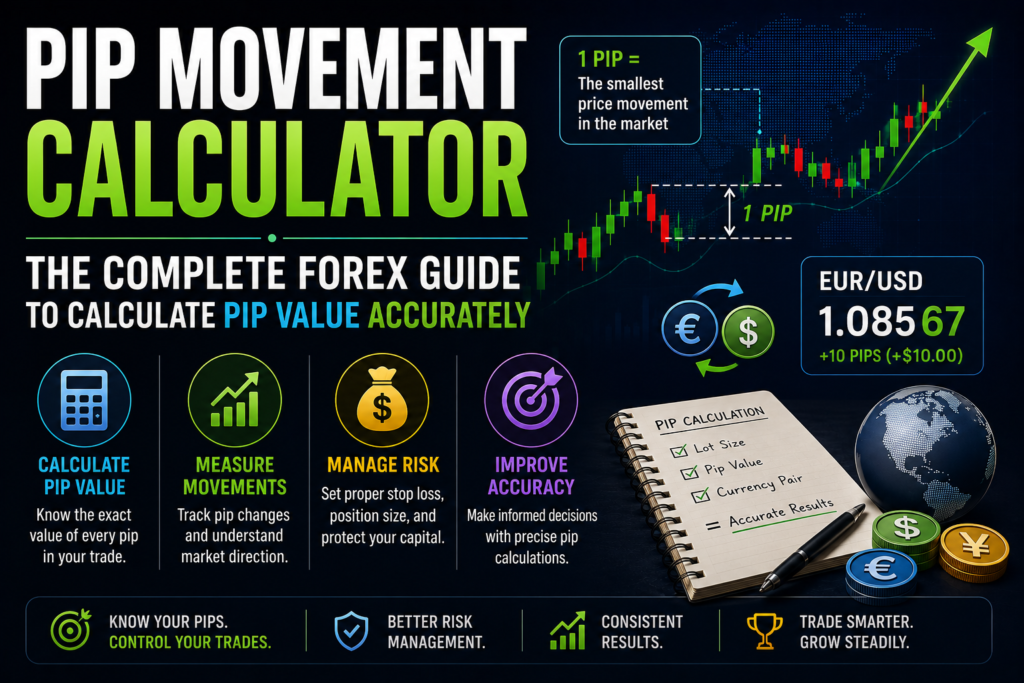
A pip is the smallest conventionally recognized unit of price change for a currency pair. For most pairs, that unit sits at the fourth decimal place — 0.0001. Pairs involving the Japanese yen break from that convention, using the second decimal place, 0.01, instead.
This standardization matters because it gives traders — regardless of broker, account size, or currency pair — a common reference point for describing how far a market has moved. Without it, “the market moved a lot today” would be a meaningless phrase; with it, that movement becomes a specific, comparable, quantifiable figure.
Why Pip Value Sits at the Center of Every Trade Decision
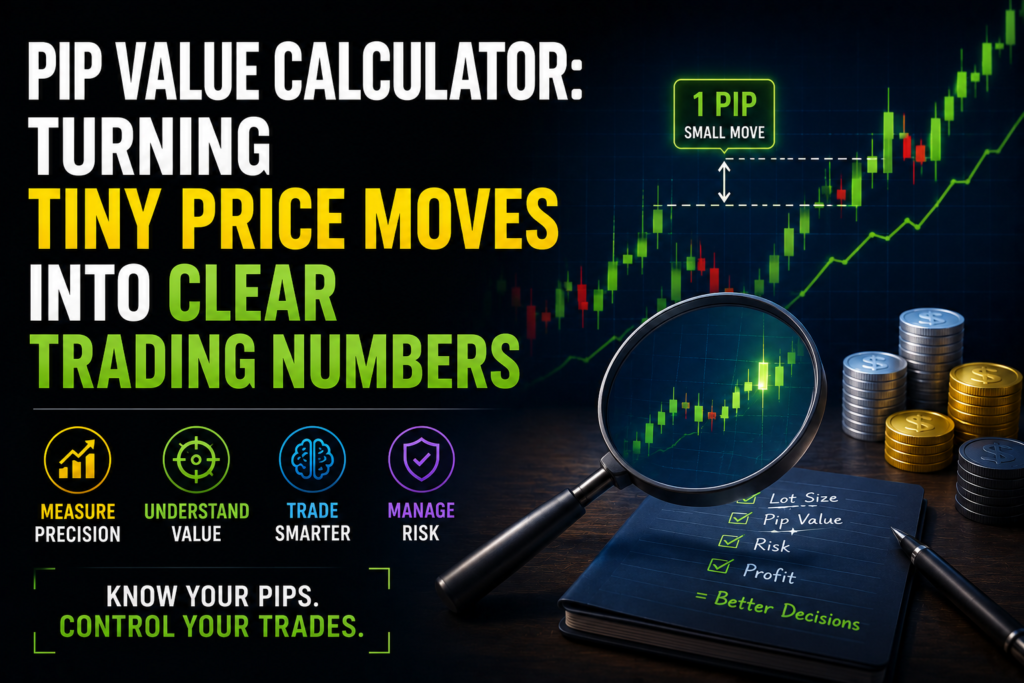
Pip value isn’t a peripheral statistic — it’s the translation layer between chart movement and account impact. Knowing what a single pip is worth, given your lot size and pair, tells you directly how much risk you’re carrying and how much upside a favorable move represents.
Take EUR/USD as an illustrative case: on a standard-sized position, one pip typically corresponds to about a dollar of movement per micro-lot unit scaled up. Traders who understand this relationship can protect their capital deliberately — setting stops and targets based on real dollar exposure — rather than reacting emotionally once a trade is already open and moving against them.
What the FXTM Pip Value Calculator Actually Does
At its core, the FXTM Pip Value Calculator takes the manual conversion work out of pip calculation and returns an answer instantly. A few things it’s specifically built to handle:
Live, currency-adjusted results. It converts raw pip movement into your account’s actual currency in real time, rather than leaving you to do that conversion separately.
Risk-planning support. Once you know precise pip value, setting a stop-loss or take-profit level in dollar (or euro, or pound) terms becomes a straightforward calculation instead of an estimate.
Accessibility across experience levels. The tool is equally useful for a trader placing their first position and one managing a portfolio of open trades — the underlying need for accurate numbers doesn’t change with experience.
Error reduction. Manual pip conversion across multiple pairs and lot sizes is exactly the kind of repetitive calculation where human error creeps in. Automating it removes that risk entirely.
Put together, the calculator functions less like a novelty tool and more like a pre-trade checkpoint — the step that turns “I think this trade is reasonably sized” into “I know exactly what this trade is worth per pip.”
Why a Structured Pip Value Guide Is Worth Following
Pip calculation involves more moving parts than it first appears — decimal conventions, live exchange rate conversion, and account currency adjustments all stack together. A structured guide paired with the calculator itself solves a few specific problems:
- It simplifies what would otherwise be a multi-step manual conversion into something you can follow without needing to remember every formula from memory.
- It supports more disciplined risk management by giving you consistent, comparable pip values across different pairs and lot sizes, rather than rough mental estimates that vary in accuracy.
- It saves meaningful time — the kind that matters most in fast-moving markets where a delayed decision can be as costly as a wrong one.
Calculating Pip Value Step by Step
Here’s the practical workflow for getting an accurate reading from the calculator:
Step 1 — Choose your currency pair. Select whichever pair you’re trading — EUR/USD, USD/JPY, or otherwise. This determines your pip size (0.0001 or 0.01) automatically.
Step 2 — Enter your lot size. Standard lot equals 100,000 units, mini lot equals 10,000, and micro lot equals 1,000. Your chosen size scales the resulting pip value directly.
Step 3 — Set your account currency. Choose USD, EUR, GBP, or whichever currency your account is actually funded in, so the output reflects real money rather than a generic figure.
Step 4 — Let the calculator run the numbers. Using live market rates, it returns your pip value instantly, adjusted for pair, size, and currency all at once.
Sample Results Across Different Setups
| Currency Pair | Account Currency | Lot Size | Calculated Pip Value |
|---|---|---|---|
| EUR/USD | USD | 1 lot | $10 per pip |
| USD/JPY | USD | 0.1 lot | ~$9.15 per pip |
| EUR/GBP | EUR | 1 lot | €8.76 per pip |
| GBP/USD | USD | 0.01 lot | $0.01 per pip |
| AUD/USD | AUD | 0.5 lot | A$5 per pip |
Notice how much these figures swing across pairs and sizes — which is exactly the point. A pip is never a fixed dollar amount; it’s always relative to the specific trade in front of you.
Using the Calculator for Practical Trade Planning
Beyond a single pip-value lookup, the tool works well as a broader planning aid. Enter the pair, your intended trade size, and your entry or exit levels, and it can surface related figures — potential profit, required capital, and more — in one pass. Used consistently, this turns trade planning from a series of separate mental estimates into one coherent, numbers-backed process.
The habit worth building is simple: check pip value before deciding on position size, not after a trade is already open and you’re trying to make sense of a running profit-and-loss figure.
Working Through a USD-Quoted Pair Manually
Even with a calculator handling the heavy lifting, it’s worth understanding the underlying math — it makes the calculator’s output easier to sanity-check.
For pairs where the US dollar is the second currency, the formula is:
Pip Value = (0.0001 ÷ Exchange Rate) × Trade Size
Example: USD/CAD trading at 1.2829, with a 100,000-unit position: (0.0001 ÷ 1.2829) × 100,000 ≈ $7.79 per pip
That means every single pip of movement on this particular trade is worth roughly $7.79 — a figure that shifts as the exchange rate itself moves throughout the session.
Pipettes: The Layer Beneath a Pip

Below the standard pip sits a finer unit — the pipette, representing one-tenth of a pip. Where a pip typically sits at the fourth decimal place (0.0001), a pipette sits at the fifth (0.00001).
Example: If EUR/USD shifts from 1.10542 to 1.10547, that’s a five-pipette move — equivalent to half of one full pip.
Displaying this extra decimal gives traders a more granular view of price action, which matters most for those trading tight spreads or scalping small, fast movements where a full pip’s worth of precision would obscure meaningful detail.
Getting the Most Out of the Calculator
A few habits that make the tool more useful in practice:
- Recheck before large trades. Pip value shifts as exchange rates move, so a figure calculated an hour ago may no longer be current by the time you actually enter.
- Match lot size to intention, not habit. It’s easy to default to a familiar lot size out of routine — instead, let your calculated pip value guide the size that actually fits your risk tolerance for that specific trade.
- Use it as a stop-loss planning tool, not just a curiosity check. Knowing pip value in isolation is only half useful; pairing it with your intended stop distance turns it into an actual risk figure.
- Treat account currency as non-negotiable. Skipping the currency-conversion step and reading a USD-denominated figure while trading from a EUR account produces a number that looks precise but doesn’t reflect your actual exposure.
Frequently Asked Questions
Why does pip value matter in forex trading? Knowing what a pip is worth tells you exactly how much money a given price movement represents, which is the basis for setting sensible stop-losses, take-profits, and position sizes.
How do I set my account currency in the calculator? Select your currency from the tool’s dropdown menu — the resulting pip value automatically adjusts to reflect that currency.
Is the calculator accurate across all currency pairs? Yes, provided the currency pair, trade size, and account currency are entered correctly — accuracy depends entirely on correct inputs, since the underlying live-rate conversion handles the rest.
How are pipettes shown in the results? Pipettes appear as an additional decimal place beyond the standard pip, giving a more precise readout of small price movements.
What exactly is a pip in forex trading? It’s the standard unit of price movement for a currency pair — the fourth decimal place for most pairs, the second for JPY pairs — used to measure and compare exchange rate changes consistently.
Does the calculator account for lot size automatically? Yes — entering your lot size (standard, mini, or micro) scales the resulting pip value proportionally, without requiring any separate manual adjustment.
Can this replace manual pip calculation entirely? For live trading, yes — there’s little reason to do the conversion by hand once a reliable calculator is available. Manual calculation still has value for building initial understanding of how the formula works, but day-to-day it’s the slower, more error-prone option.
Final Thoughts
The FXTM Pip Value Calculator isn’t just a convenience feature bolted onto a trading platform — it’s the tool that makes disciplined position sizing and risk management actually practical, trade after trade. Once pip value stops being a rough guess and becomes a precise figure you check before every entry, trading decisions get measurably clearer: sized correctly, planned deliberately, and far less dependent on hoping the math works out after the fact.
Make checking pip value a fixed part of your pre-trade routine, and the rest of your risk management — stop-loss placement, position sizing, profit expectations — starts working from solid ground instead of estimation.
This article is for educational purposes only and does not constitute financial advice. Trading forex involves substantial risk — always do your own research before entering a position.