
Trading forex from the UK adds a layer most global guides skip entirely: your account, your risk limits, and your profit targets are all denominated in pounds, not dollars. A pip calculator for UK traders is built specifically to close that gap — converting raw pip movement into GBP terms so every risk decision reflects the currency you actually trade with.
This guide covers what makes GBP-based pip calculation different, how to use a pip calculator for UK-specific pairs correctly, and the mistakes that most commonly throw off pound-denominated risk figures.
Why GBP Traders Need a Different Approach
Most forex education defaults to USD examples — pip value tables, worked calculations, everything quoted in dollars. That’s a problem the moment your account is actually funded in pounds, because a pip value calculated in USD doesn’t tell you what a trade is genuinely costing or earning you unless it’s converted to GBP first.
A pip calculator for UK traders solves this directly: rather than reading a dollar figure and mentally converting it, you get pip value expressed in pounds from the outset, calculated against your actual account currency and the live exchange rate. That distinction matters more than it might first appear — a rough mental conversion done under time pressure is exactly where small errors creep into risk management.
What a Pip Represents, and Why It Still Matters in GBP
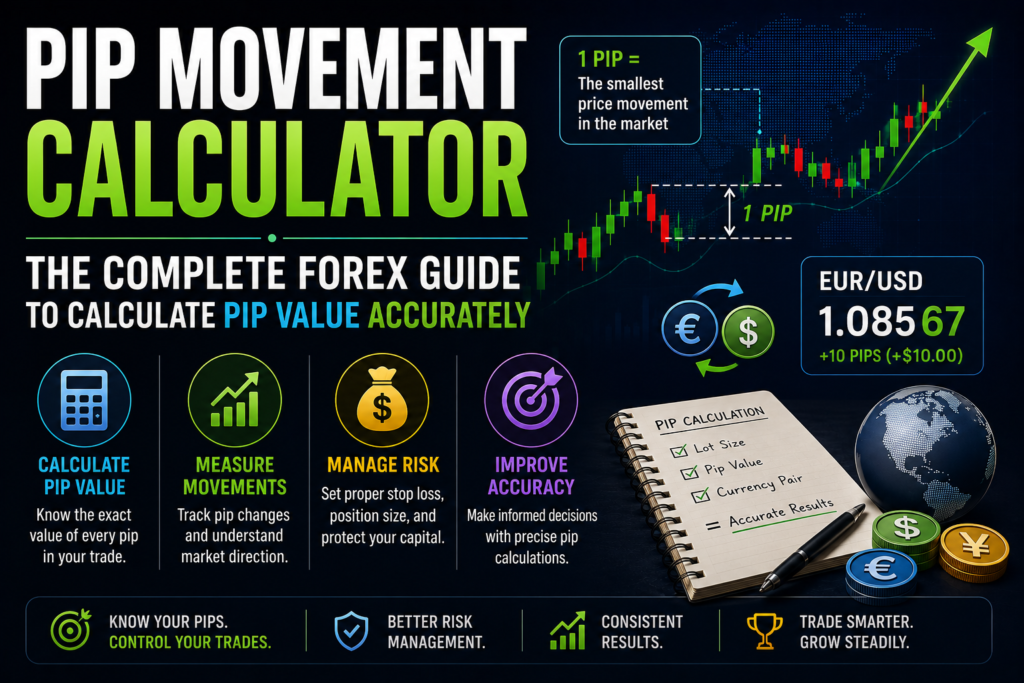
A pip is the smallest standardized price movement recognized in a currency pair — the fourth decimal place (0.0001) for most pairs, and the second decimal place (0.01) for pairs involving the Japanese yen. This convention doesn’t change based on your account currency; what changes is the monetary value attached to that movement once it’s translated into pounds.
For a UK trader, this means the underlying mechanics of pip measurement are identical to anywhere else in the world — the difference is entirely in the final conversion step, where a proper pip calculator for UK accounts handles the GBP translation automatically rather than leaving it to guesswork.
How Pip Value Shifts With GBP Accounts and GBP Pairs
Pip value isn’t static, and for GBP-based traders it moves for a couple of specific reasons worth understanding individually:
Your account currency sets the frame. When your account is denominated in GBP, every pip’s value gets expressed in pounds from the start, which keeps your sense of risk grounded in the currency you’re actually managing.
GBP-based pairs respond to exchange rate shifts. Pairs like GBP/USD and EUR/GBP move in response to how the counter currency behaves — meaning the pound value of a single pip isn’t fixed, it drifts as the underlying rate does.
Lot size scales the outcome. A larger lot size means a proportionally larger pip value in pounds — the relationship is direct and linear.
Live rates matter more than they seem to. Even a small shift in the current exchange rate can meaningfully change your GBP-per-pip figure, which is exactly why recalculating before a trade — rather than trusting an earlier estimate — is worth the extra few seconds.
What to Look for in a UK-Focused Pip Calculator
Not every pip tool is built with UK traders specifically in mind. A few features are worth prioritizing:
Direct GBP display. The best tools show pip value straight in pounds for GBP accounts, removing the need for a separate mental conversion step and keeping your running P&L consistently in the currency you actually trade with.
Live, frequently refreshed rates. Because GBP-per-pip value shifts with the market, a calculator drawing on stale or infrequently updated rates can quietly produce a figure that’s already out of date by the time you act on it.
Solid coverage of GBP pairs. GBP/USD, EUR/GBP, GBP/JPY, and other pound-based pairs should all be supported cleanly, since these are the pairs where UK traders most need accurate, currency-matched figures.
Using the Calculator on GBP/USD, EUR/GBP, and GBP/JPY
Running a calculation for the UK’s most commonly traded GBP pairs follows a consistent process:
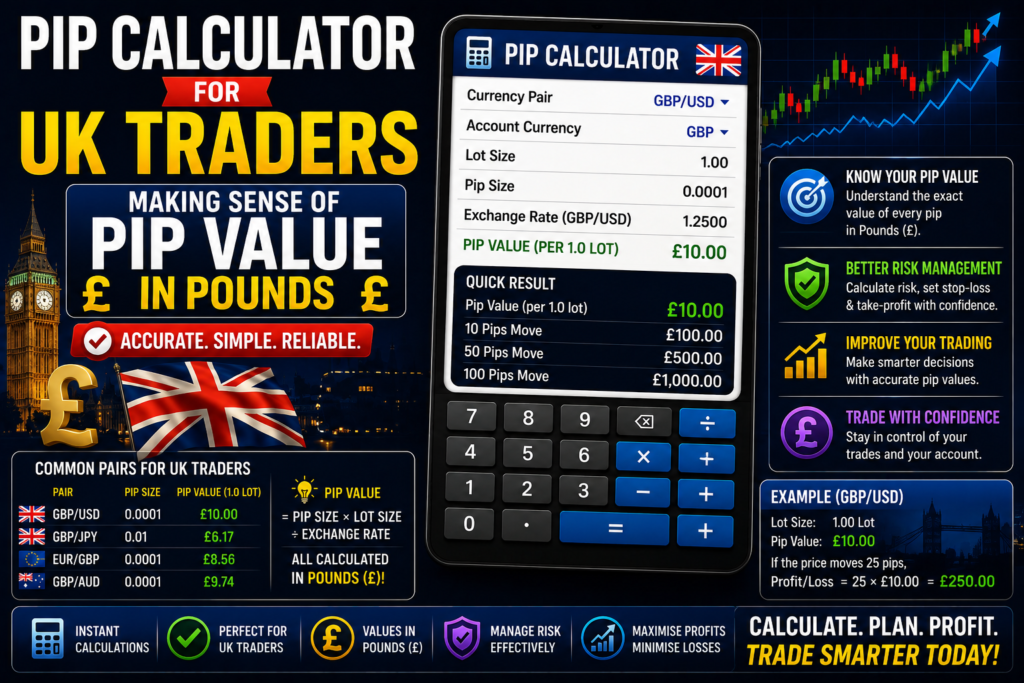
Step 1 — Choose your pair and confirm your account currency. Select GBP/USD, EUR/GBP, GBP/JPY, or whichever pair you’re trading, and make sure your account currency is set to GBP.
Step 2 — Enter your trade size. Standard lot (100,000 units), mini lot (10,000 units), or micro lot (1,000 units) — this scales your resulting pip value directly.
Step 3 — Confirm the correct pip size for the pair. Most pairs use 0.0001; GBP/JPY, like other yen pairs, uses 0.01 instead. Getting this wrong is one of the most common calculation errors UK traders make.
Step 4 — Let the calculator return your GBP pip value. With those inputs set, the tool returns a precise pound figure — useful immediately for sizing a position and setting stops or targets in terms you can directly relate to your account balance.
Step 5 — Recalculate whenever rates move meaningfully. Because GBP pip value shifts with the exchange rate, refreshing your inputs before entering a trade — rather than relying on a number checked earlier in the session — keeps your risk figures accurate.
Converting Pip Value to Pounds: A Practical Walkthrough
1. Select your inputs. Pick your GBP-based pair, confirm your account currency as GBP, and choose your trade volume.
2. Identify the pip size. 0.0001 for most pairs; 0.01 for GBP/JPY and other yen crosses.
3. Calculate and convert. Multiply the standard pip value by your lot size, then convert into GBP using the current exchange rate if the calculation initially returns a figure in another currency.
4. Apply the result to your risk decisions. Translate your GBP-per-pip figure directly into pound-denominated stop-loss and take-profit levels, and refresh the calculation whenever the market rate shifts meaningfully — keeping your risk consistently aligned with your actual GBP risk tolerance rather than a stale estimate.
Real-World GBP Pip Values Across Major Pairs
Pip value in pounds isn’t uniform across pairs — it depends on the pair’s pip size, its quote currency, and the live GBP exchange rate against the counter currency. A few points worth keeping in mind:
- Most major pairs use a pip size of 0.0001; GBP/JPY uses 0.01, in line with standard yen-pair conventions.
- Actual pound value per pip depends on your trade volume — whether that’s a standard lot (100,000 units), mini lot (10,000), or micro lot (1,000).
- As GBP strengthens against a counter currency, the pound value per pip on that pair tends to shift accordingly — and weakens in the opposite direction — which is exactly why a live rate feed matters more than a fixed reference table.
The Regulatory Context Worth Knowing
For UK-based traders, using a proper pip calculator for UK accounts connects to more than just personal risk management — it also supports the kind of cost transparency the FCA expects from trading activity. Understanding your exact GBP exposure per pip helps ensure position sizes stay reasonable and genuinely understood, rather than approximated, which aligns naturally with the broader principle of trading with clearly disclosed, comprehensible costs and risks.
Common Mistakes UK Traders Make With Pip Calculations
Mixing up pip sizes between pairs. Applying the standard 0.0001 convention to GBP/JPY (which uses 0.01) throws the resulting value off by a full factor of 100 — a surprisingly common and entirely avoidable error.
Skipping GBP conversion entirely. A pip calculator returning a figure in USD or another currency, left unconverted, gives a UK trader a number that looks precise but doesn’t actually reflect their real pound-denominated risk.
Relying on outdated exchange rates. Since pip value moves with the live rate, a figure calculated even an hour earlier can already be meaningfully off — always refresh before a trade that matters.
Overlooking lot size entirely. Ignoring how significantly lot size scales pip value leads directly to positions sized incorrectly relative to actual intended risk.
How Lot Size Affects Pip Value for UK Traders

Lot size has a direct, proportional effect on pip value in pounds — the larger the position, the larger the pound impact of a single pip movement. On a standard lot (100,000 units) of GBP/USD, one pip typically represents somewhere around £7–£8 depending on the live rate; scale down to a mini lot (10,000 units) and that same pip movement represents roughly a tenth of that figure. Understanding this relationship precisely is what allows a UK trader to size a position deliberately, rather than approximately, against their actual account balance.
Frequently Asked Questions
What’s a common mistake when using a pip calculator for UK trading? Confusing pip sizes between pairs — particularly forgetting that GBP/JPY and other yen pairs use 0.01 instead of the standard 0.0001.
Why does pip value need converting to GBP specifically? Without that conversion, you’re working from a figure denominated in another currency, which makes it easy to misjudge your actual pound-based risk on a trade.
Can a GBP-focused pip calculator genuinely improve trading outcomes? Yes — it provides an accurate pound figure for pip value, which allows position sizes, stop-losses, and targets to be set against real, pound-based risk tolerance rather than an approximation.
What happens if lot size gets overlooked in the calculation? Pip value ends up significantly miscalculated, which typically leads to a position sized incorrectly relative to the risk actually intended — a mistake that can compound quickly across several trades.
Do GBP pip values stay constant throughout the trading day? No — because they depend on the live exchange rate between GBP and the pair’s counter currency, pip value in pounds shifts as the market moves, sometimes meaningfully during volatile sessions.
Final Thoughts
Using a pip calculator for UK trading properly comes down to a few consistent habits: always confirm the correct pip size for the pair you’re trading, make sure results are genuinely converted into GBP rather than left in another currency, and refresh your inputs whenever exchange rates move rather than relying on an earlier calculation. Get those three things right consistently, and sizing trades, setting stop-losses, and managing risk all become considerably more precise — grounded in pounds, the currency your account actually lives in, rather than an approximation borrowed from a dollar-first guide.
This article is for educational purposes only and does not constitute financial advice. Trading forex involves substantial risk — always do your own research or consult a professional advisor before making trading decisions.