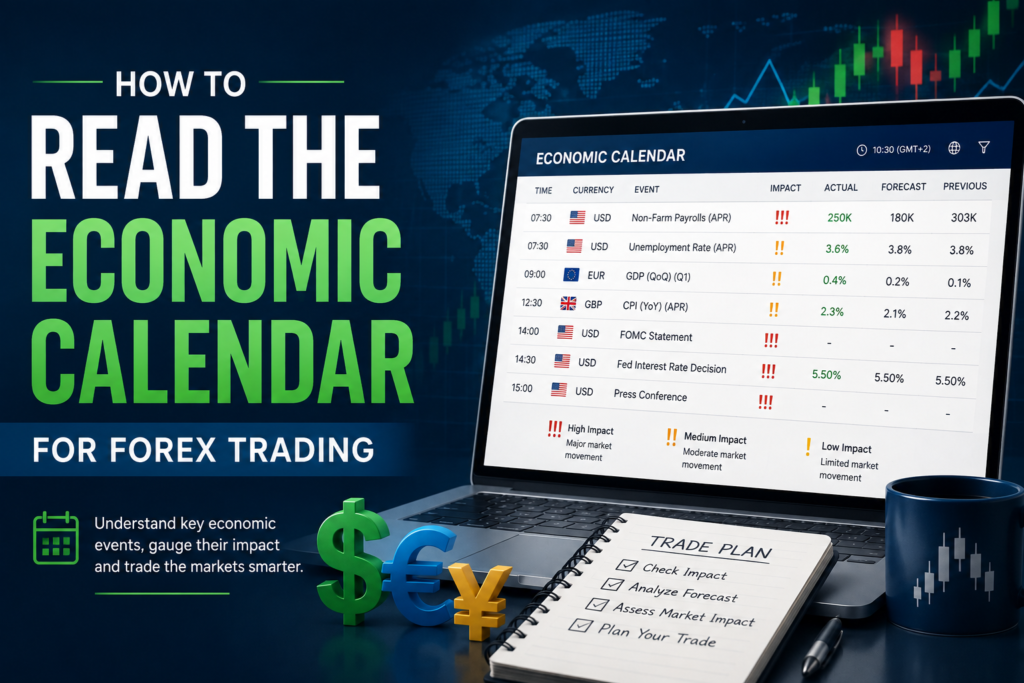
For anyone serious about currency trading, learning how to read economic calendar data is one of the most valuable skills you can develop. Currency prices don’t move at random. They respond to scheduled releases of economic data, central bank announcements, and political events. The traders who consistently anticipate these moves are usually the ones who have mastered the economic calendar and know exactly what to look for before a release hits the wire.
This guide walks you through everything you need to understand the tool, interpret its data correctly, and turn scheduled events into informed trading decisions.
What Is an Economic Calendar?
An economic calendar is a scheduled list of upcoming economic events, data releases, and announcements that can affect financial markets. For currency traders, the economic calendar forex version highlights releases that specifically move exchange rates: inflation figures, employment reports, interest rate decisions, GDP growth, and dozens of other indicators.
Think of it as a timetable for market volatility. Each entry tells you when a release is due, which country or currency it affects, how significant it is expected to be, and what analysts are predicting. Most reputable brokers and financial sites offer a free calendar, including Forex Factory, Investing.com, DailyFX, and Myfxbook.
Understanding how to read economic calendar entries turns a wall of numbers into a clear picture of where opportunity and risk are concentrated during your trading week.
Why the Economic Calendar Matters in Forex
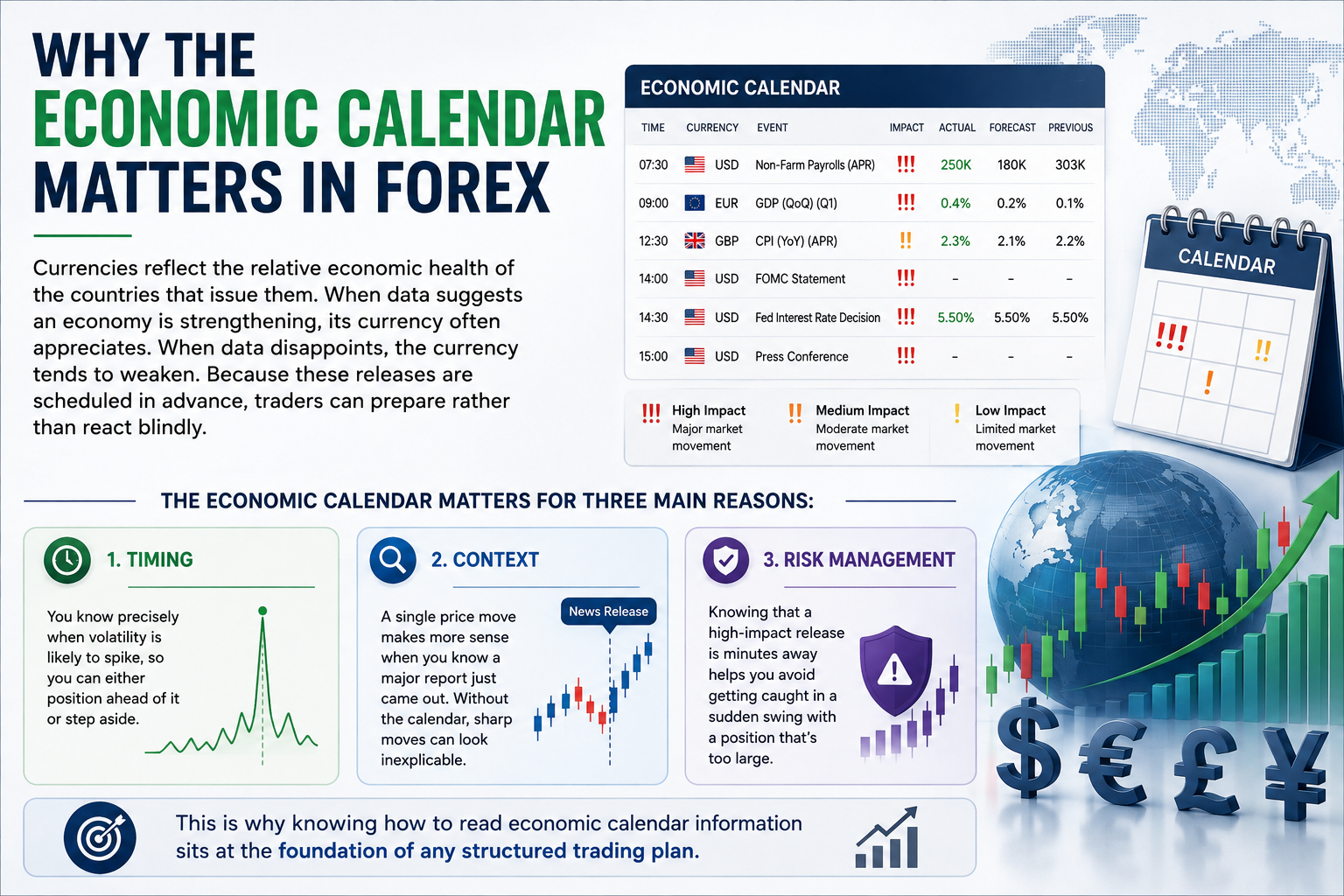
Currencies reflect the relative economic health of the countries that issue them. When data suggests an economy is strengthening, its currency often appreciates. When data disappoints, the currency tends to weaken. Because these releases are scheduled in advance, traders can prepare rather than react blindly.
The economic calendar matters for three main reasons:
Timing. You know precisely when volatility is likely to spike, so you can either position ahead of it or step aside.
Context. A single price move makes more sense when you know a major report just came out. Without the calendar, sharp moves can look inexplicable.
Risk management. Knowing that a high-impact release is minutes away helps you avoid getting caught in a sudden swing with a position that’s too large.
This is why knowing how to read economic calendar information sits at the foundation of any structured trading plan.
The Key Columns You Need to Understand
Every economic calendar is organized into columns. While layouts vary slightly between providers, the core fields are consistent. Learning how to read economic calendar columns is mostly about understanding what each one is telling you.
Date and Time
The first thing to check is when the event occurs. Calendars usually display times in a default zone (often GMT or your broker’s server time), so always confirm the settings match your local time. Missing a release by an hour because of a time-zone error is a common and avoidable mistake.
Currency
This column shows which currency the event affects. A U.S. non-farm payrolls report is tagged USD, a Bank of England decision is tagged GBP, and so on. If you trade EUR/USD, you care about both EUR and USD events.
Impact Level
Most calendars rate each event’s expected impact using colors or symbols: high, medium, or low. High impact news forex releases are typically shown in red and deserve the most attention because they can trigger large, fast moves. Learning to filter by impact level is central to how to read economic calendar data efficiently.
Actual, Forecast, and Previous
These three numbers are the heart of any release, and interpreting them correctly is where real skill comes in. We’ll break them down in detail below.
Actual vs. Forecast vs. Previous
Once you understand these three figures, most of the calendar becomes readable at a glance.
Previous is the value from the last time this indicator was reported. It gives you a baseline for comparison.
Forecast is the consensus estimate from economists ahead of the release. Markets tend to price in the forecast before the number even comes out.
Actual is the real figure once it’s published. This is what moves the market.
The critical insight is that markets react to the surprise, not the raw number. If actual data comes in close to the forecast, the reaction is usually muted because traders already expected it. If the actual figure deviates sharply from the forecast, that’s when volatility explodes.
For example, if the forecast for U.S. job growth is 180,000 and the actual comes in at 320,000, the dollar is likely to strengthen quickly because the economy looks far healthier than expected. A weak reading well below forecast would do the opposite. This forecast-versus-actual gap is the single most important concept in how to read economic calendar releases.
High-Impact Events Every Forex Trader Watches
Not all releases carry the same weight. When you’re identifying high impact news forex events, a handful of reports consistently dominate. Prioritizing these makes your calendar review faster and sharper.
Interest rate decisions. Central bank rate announcements from the Federal Reserve, European Central Bank, Bank of England, and others are among the most powerful market movers. Rate changes and forward guidance directly influence currency demand.
Employment data. The U.S. non-farm payrolls (NFP) report, released on the first Friday of each month, is famous for causing sharp moves across dollar pairs. Employment figures signal economic momentum.
Inflation reports. Consumer Price Index (CPI) and Producer Price Index (PPI) data heavily influence central bank policy expectations, making them high-priority releases.
Gross Domestic Product (GDP). GDP measures overall economic output and growth, offering a broad snapshot of a country’s health.
Central bank speeches. Remarks from central bank governors and committee members can shift expectations even without new data, so they’re worth watching.
Retail sales and PMI data. These consumer and business activity indicators round out the calendar and often confirm broader trends.
Filtering for these high impact news forex events lets you concentrate your energy where it counts instead of drowning in low-significance releases.
Step 4: Review forecasts. Note the forecast and previous figures for the day’s key releases so you understand what the market already expects.
Step 5: Mark your key times. Flag the exact moments when major reports drop. Decide in advance whether you’ll trade the event, hold existing positions, or stand aside.
How to Read the Economic Calendar Step by Step
Here’s a practical routine you can follow. Building a habit around how to read economic calendar entries each morning keeps you consistently prepared.
Step 1: Set your time zone. Before anything else, adjust the calendar to your local time so every scheduled release lines up with your trading hours.
Step 2: Filter by currency. Select only the currencies relevant to the pairs you trade. If you focus on EUR/USD, GBP/USD, and USD/JPY, filter for EUR, USD, GBP, and JPY.
Step 3: Filter by impact. Hide low-impact noise and display medium and high events. This is the fastest way to see what actually matters during your session.
Step 4: Watch the actual number. When the release hits, compare the actual to the forecast. The size and direction of the surprise tells you the likely direction of the move.
Repeating this process daily is genuinely how to read economic calendar data like a professional rather than an occasional glance-and-guess.
Strategies for Trading News Events
Once you can interpret the calendar, the next question is how to act on it. Trading news events well requires a plan, because volatility cuts both ways. Here are the main approaches traders use.
Trading the Breakout
Big surprises often produce fast, directional moves. Some traders wait for the release, confirm the direction, and enter in the direction of the surprise once volatility settles slightly. The risk is that spreads widen dramatically in the seconds around a release, so entries can be costly.
Fading the Overreaction
Markets sometimes spike violently on a release and then partially reverse as the initial emotion fades. Experienced traders may wait for the overreaction and trade the pullback. This is higher risk and demands strong discipline.
Staying Out
Not trading is a strategy too. Many successful traders deliberately avoid trading news events because the volatility and spread widening make risk hard to control. If your edge comes from technical setups in calm conditions, sitting out major releases is perfectly valid.
Positioning Ahead of Time
Some traders take positions before a release based on their analysis, accepting the risk in exchange for a better entry price. This is speculative and should only ever be done with carefully sized positions.
Whatever your approach, trading news events successfully depends on tight risk management. Use appropriate position sizes, set stop-losses that account for wider spreads, and never risk more than you can afford to lose on a single volatile event.
Common Mistakes to Avoid
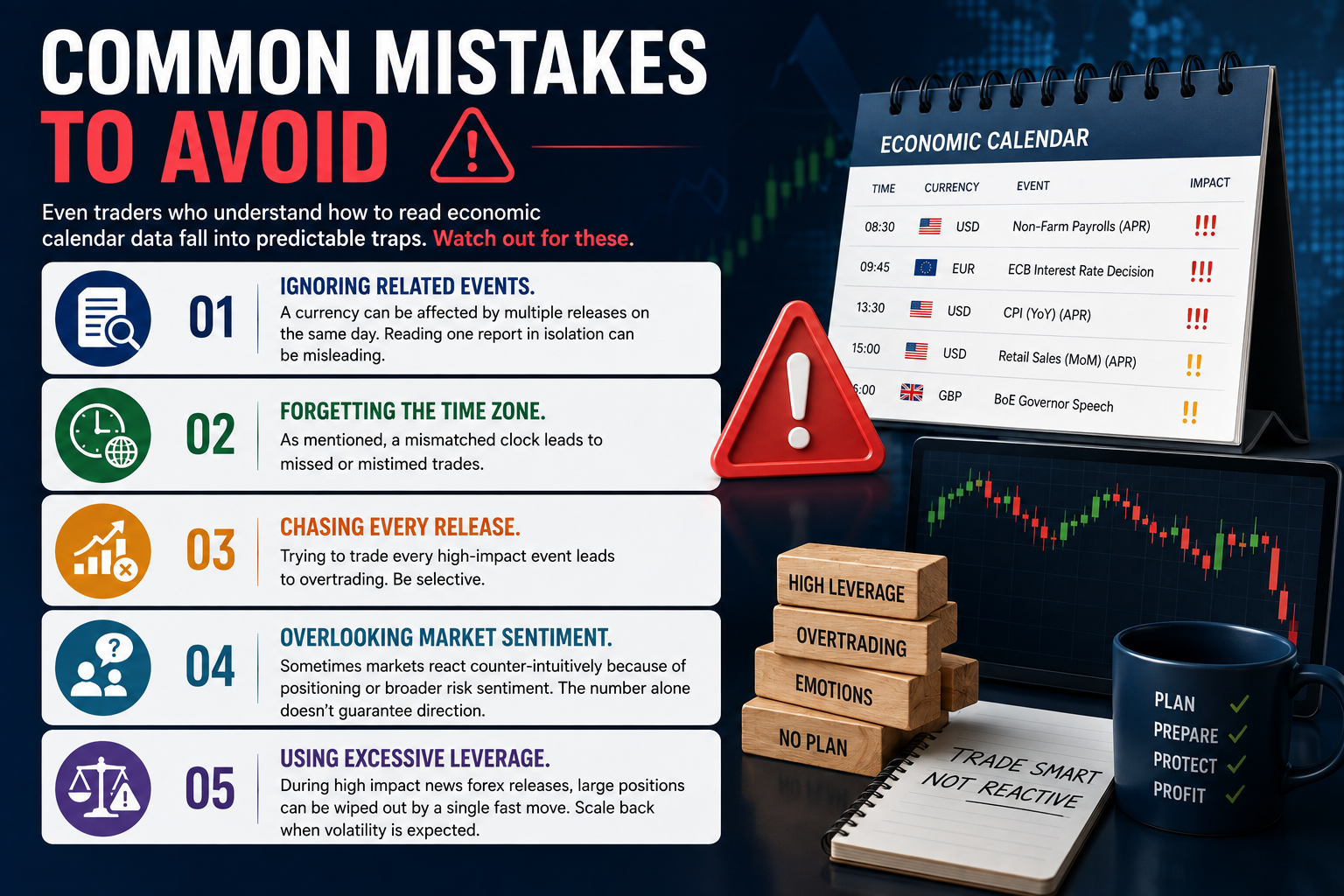
Even traders who understand how to read economic calendar data fall into predictable traps. Watch out for these.
Ignoring related events. A currency can be affected by multiple releases on the same day. Reading one report in isolation can be misleading.
Forgetting the time zone. As mentioned, a mismatched clock leads to missed or mistimed trades.
Chasing every release. Trying to trade every high-impact event leads to overtrading. Be selective.
Overlooking market sentiment. Sometimes markets react counter-intuitively because of positioning or broader risk sentiment. The number alone doesn’t guarantee direction.
Using excessive leverage. During high impact news forex releases, large positions can be wiped out by a single fast move. Scale back when volatility is expected.
Putting It All Together
Mastering the economic calendar is less about memorizing every indicator and more about building a repeatable habit. Check it before each session, filter for the currencies and impact levels that matter to you, understand the forecast-versus-actual dynamic, and decide your approach to each event in advance.
Over time, learning how to read economic calendar information becomes second nature. You’ll start to anticipate volatility, understand why prices move the way they do, and make calmer, more informed decisions. Combined with sound risk management, the economic calendar forex traders rely on can transform reactive guessing into a structured, confident process.
The market will always have surprises, but with the calendar in hand, far fewer of them will catch you off guard.
Frequently Asked Questions
What is the best time to check the economic calendar? Ideally, review it at the start of your trading day and again before each session you plan to trade. Checking in the morning gives you a full overview of scheduled releases, while a pre-session glance confirms nothing has shifted and reminds you of key times ahead.
Which economic calendar is best for forex traders? Forex Factory and Investing.com are among the most popular free options, offering filters for currency, impact level, and time zone. DailyFX and Myfxbook are also widely used. The “best” one is simply whichever layout you find easiest to read consistently.
What does high impact news mean on the calendar? High impact news forex releases are events expected to cause significant market volatility, usually marked in red. Examples include interest rate decisions, employment reports like NFP, and inflation data. These deserve the most attention because they can move prices sharply and quickly.
Should beginners trade during news events? Beginners are often better off avoiding trading news events until they understand how volatility and spread widening work. Watching a few releases without trading is a great way to learn how prices react before risking capital.
Why didn’t the price move even though the data was strong? If the actual figure matched the forecast, the market likely priced it in already, producing little reaction. Markets respond to surprises relative to expectations, not to whether a number is objectively good or bad.
How do I know which currencies an event affects? The currency column on the calendar tags each event. Filter for the currencies in the pairs you trade so you only see relevant releases. Remember that a single pair like EUR/USD is affected by events tagged for both EUR and USD.
Does the economic calendar work for other markets too? Yes. While this guide focuses on the economic calendar forex application, the same releases influence stocks, bonds, commodities, and indices. Interest rate and inflation data in particular ripple across nearly every asset class.