Quick answer
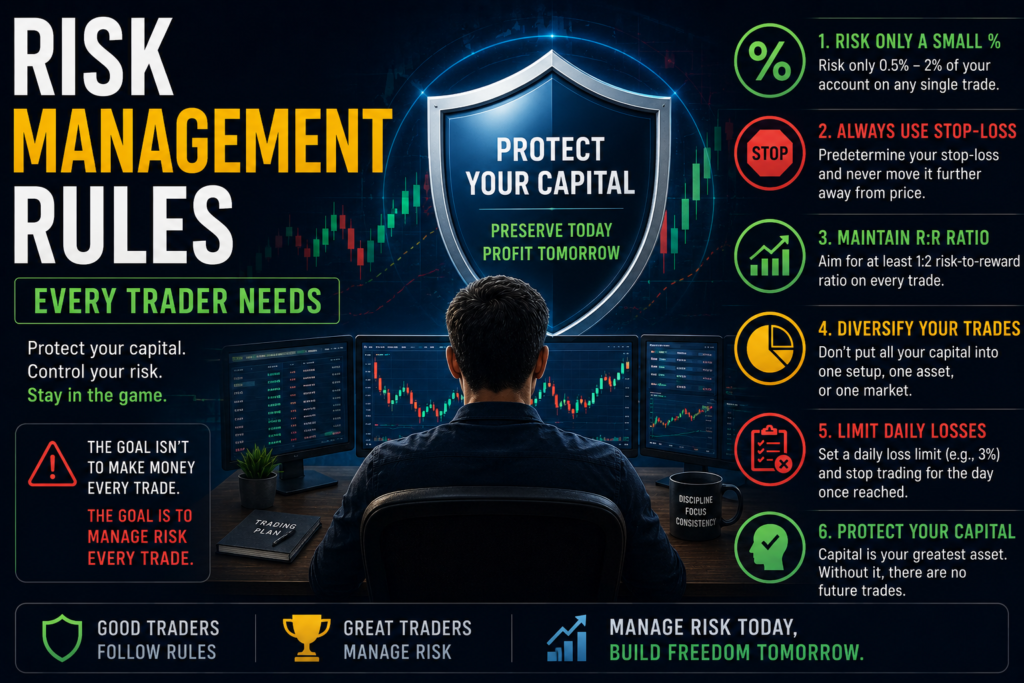
Forex risk management is the set of rules that protect your capital so you can trade another day. The core rules: risk only a small fixed percentage per trade (often 1-2%), always use a stop-loss, size positions to that risk, aim for a favourable risk-reward ratio, and respect leverage.
Introduction
Ask any experienced trader what matters most, and few will name a strategy or indicator. They will say forex risk management. The reason is simple: you can be right about the market and still go broke if a single trade is too large. Risk management is what keeps you in the game long enough for your edge to play out.
This guide lays out the risk management rules every trader needs, with the math to back them up. Master these and you shift the odds of survival dramatically in your favour. Everything here is educational, not financial advice, and every figure has been calculated and checked.
What Is Forex Risk Management?
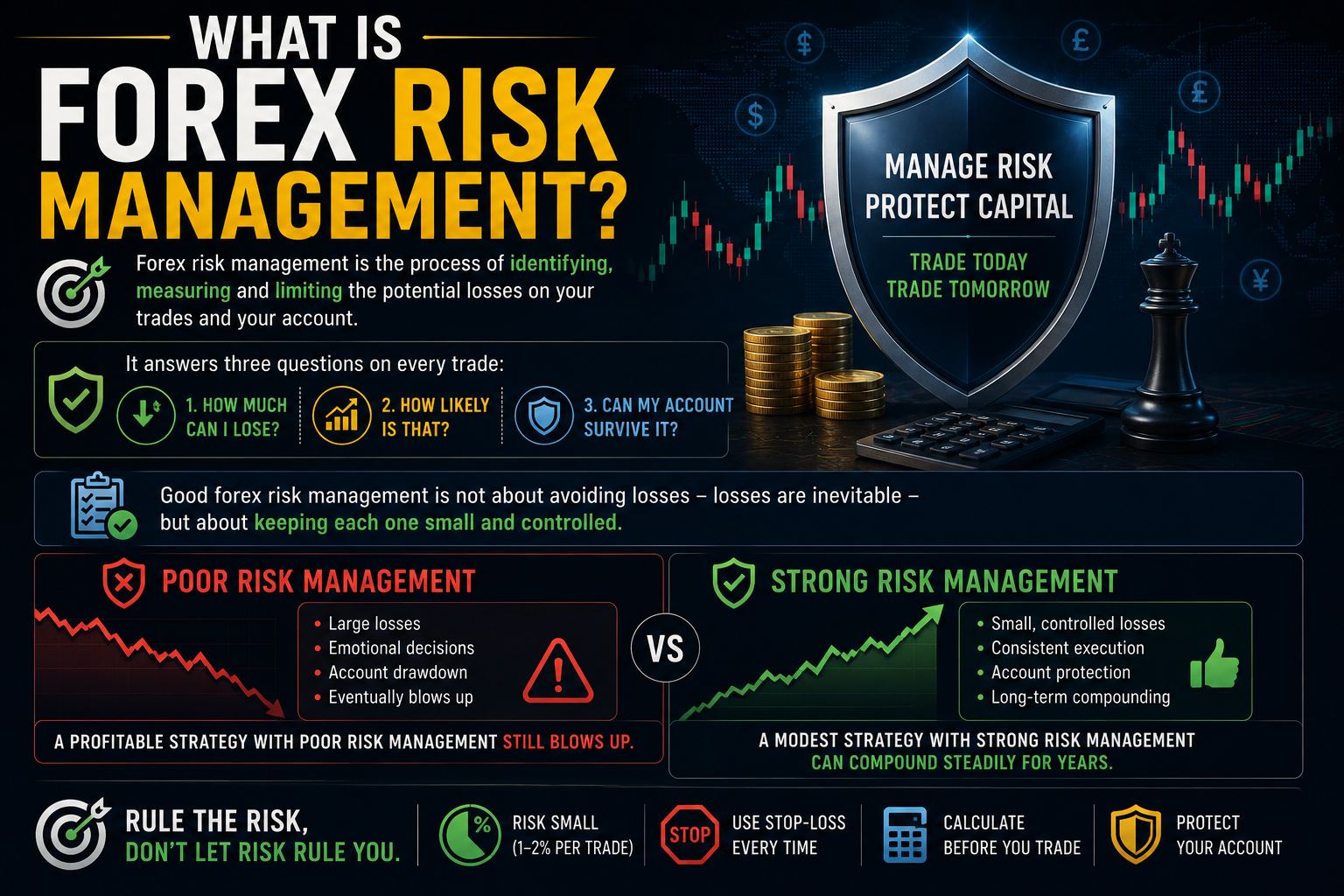
Forex risk management is the process of identifying, measuring and limiting the potential losses on your trades and your account. It answers three questions on every trade: how much can I lose, how likely is that, and can my account survive it? Good forex risk management is not about avoiding losses – losses are inevitable – but about keeping each one small and controlled.
Think of it as the defence to your strategy’s offence. A profitable strategy with poor risk management still blows up; a modest strategy with strong forex risk management can compound steadily for years.
Why Risk Management Matters More Than Anything
Regulated brokers routinely disclose that a majority of retail traders lose money, and poor risk control is a leading reason. The core problem is asymmetry: losses compound against you. As the table below shows, the bigger the loss, the disproportionately larger the gain needed just to recover.
| Drawdown | Gain needed to recover |
|---|---|
| -10% | +11.1% |
| -20% | +25.0% |
| -25% | +33.3% |
| -50% | +100.0% |
A trader who never lets a loss get large never faces the right-hand column. That is the whole game of forex risk management – protect the downside, and the upside takes care of itself.
The 10 Risk Management Rules Every Trader Needs
Rule 1: Risk a small fixed percentage per trade
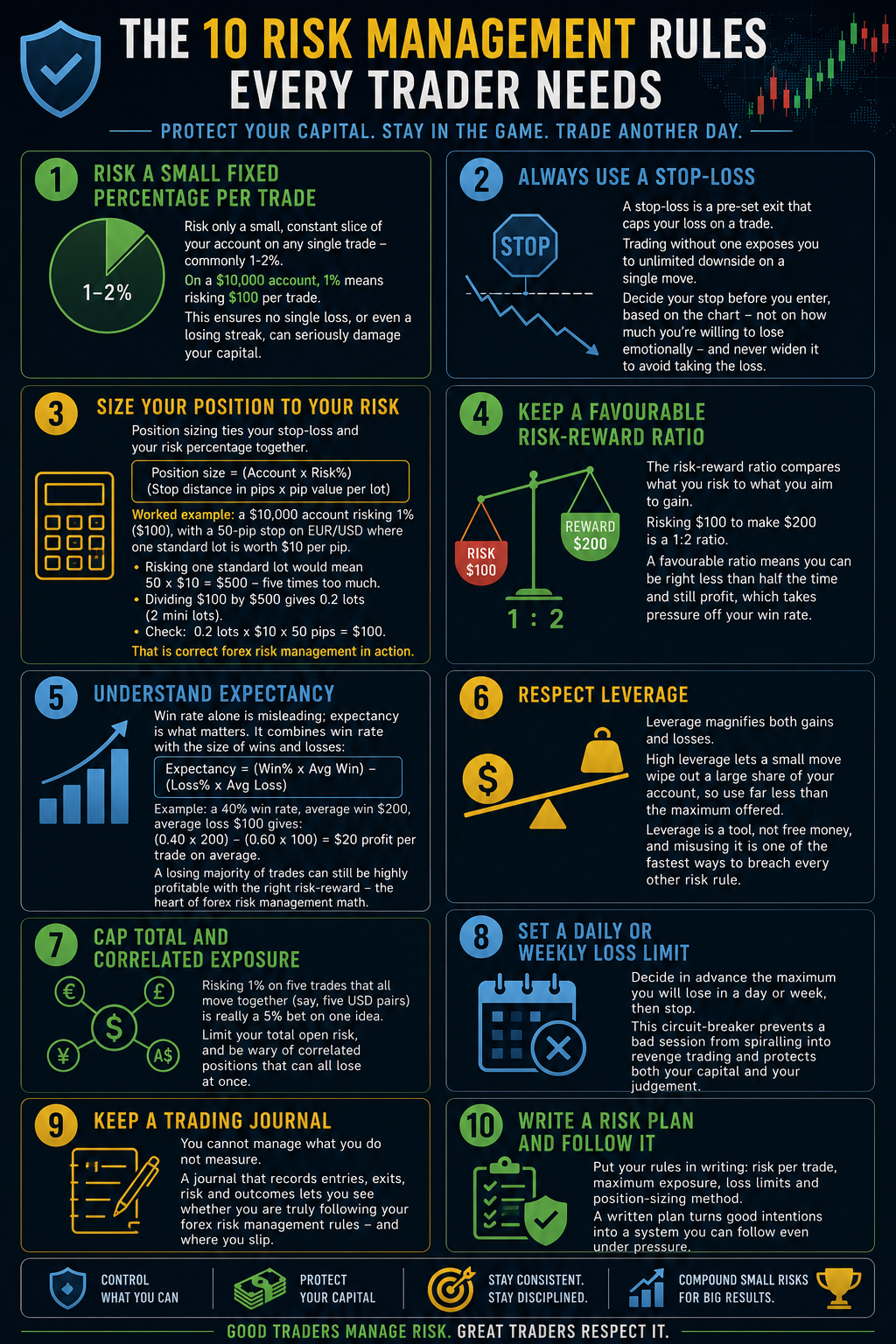
The most important rule in forex risk management is to risk only a small, constant slice of your account on any single trade – commonly 1-2%. On a $10,000 account, 1% means risking $100 per trade. This ensures no single loss, or even a losing streak, can seriously damage your capital.
Rule 2: Always use a stop-loss
A stop-loss is a pre-set exit that caps your loss on a trade. Trading without one exposes you to unlimited downside on a single move. Decide your stop before you enter, based on the chart – not on how much you’re willing to lose emotionally – and never widen it to avoid taking the loss.
Rule 3: Size your position to your risk
Position sizing ties your stop-loss and your risk percentage together. The formula is:
Position size = (Account x Risk%) / (Stop distance in pips x pip value per lot)
Worked example: a $10,000 account risking 1% ($100), with a 50-pip stop on EUR/USD where one standard lot is worth $10 per pip. Risking one standard lot would mean 50 x $10 = $500 – five times too much. Dividing $100 by $500 gives 0.2 lots (2 mini lots). Check: 0.2 lots x $10 x 50 pips = $100. That is correct forex risk management in action.
Rule 4: Keep a favourable risk-reward ratio
The risk-reward ratio compares what you risk to what you aim to gain. Risking $100 to make $200 is a 1:2 ratio. A favourable ratio means you can be right less than half the time and still profit, which takes pressure off your win rate.
Rule 5: Understand expectancy
Win rate alone is misleading; expectancy is what matters. It combines win rate with the size of wins and losses:
Expectancy = (Win% x Avg Win) – (Loss% x Avg Loss)
Example: a 40% win rate, average win $200, average loss $100 gives (0.40 x 200) – (0.60 x 100) = $20 profit per trade on average. A losing majority of trades can still be highly profitable with the right risk-reward – the heart of forex risk management math.
Rule 6: Respect leverage
Leverage magnifies both gains and losses. High leverage lets a small move wipe out a large share of your account, so use far less than the maximum offered. Leverage is a tool, not free money, and misusing it is one of the fastest ways to breach every other risk rule.
Rule 7: Cap total and correlated exposure
Risking 1% on five trades that all move together (say, five USD pairs) is really a 5% bet on one idea. Limit your total open risk, and be wary of correlated positions that can all lose at once.
Rule 8: Set a daily or weekly loss limit
Decide in advance the maximum you will lose in a day or week, then stop. This circuit-breaker prevents a bad session from spiralling into revenge trading and protects both your capital and your judgement.
Rule 9: Keep a trading journal
You cannot manage what you do not measure. A journal that records entries, exits, risk and outcomes lets you see whether you are truly following your forex risk management rules – and where you slip.
Rule 10: Write a risk plan and follow it
Put your rules in writing: risk per trade, maximum exposure, loss limits and position-sizing method. A written plan turns good intentions into a system you can follow even under pressure.
Quick-Reference: The Rules at a Glance
| Rule | The essential guideline |
|---|---|
| Risk per trade | Keep it small and fixed (often 1-2%) |
| Stop-loss | Always set one before entering |
| Position sizing | Size to your risk and stop distance |
| Risk-reward | Aim for at least 1:1.5 to 1:2 or better |
| Leverage | Use well below the maximum offered |
| Total exposure | Cap open risk; watch correlation |
| Loss limit | Stop after a set daily/weekly loss |
| Review | Journal and audit every trade |
Common Mistakes
- Risking too much per trade – the single most common account-killer.
- Trading without a stop-loss, or widening it to avoid a loss.
- Over-leveraging and mistaking leverage for extra capital.
- Ignoring correlation and effectively making one big bet.
- Chasing a high win rate instead of positive expectancy.
Myths vs Facts
| Myth | Fact |
|---|---|
| A high win rate means you’ll be profitable. | Expectancy – win rate plus win/loss size – is what determines profit. |
| Risk management limits your profits. | It preserves capital so profits can compound over time. |
| Stop-losses just get hit and lose money. | They cap losses; the alternative is unlimited downside. |
| More leverage means more profit. | It equally magnifies losses and shortens survival. |
Risk disclaimer
This article is for educational purposes only and is not investment advice. Forex trading carries a high risk of loss, and most retail traders lose money. Examples and figures are illustrative and simplified. Consider your risk tolerance and consult a licensed financial adviser before trading.
Expert Analysis
If there is a single reason skilled traders survive while talented ones blow up, it is that survivors treat forex risk management as the primary job and profit as a by-product. Their first question on any trade is not ‘how much can I make?’ but ‘how much can I lose, and can I take that loss ten times in a row without damage?’ That inversion changes everything: it caps position size, forces a stop-loss, and makes leverage a servant rather than a master.
The deepest point is mathematical. Because a 50% loss requires a 100% gain to recover, and a 90% loss requires a 900% gain, the cost of a large drawdown is brutally non-linear. Strong forex risk management simply refuses to visit that part of the curve. By keeping every loss small and every position sized to a fixed fraction of capital, a trader ensures that no single mistake – or run of them – can end the game. Consistency and survival, not any one big win, are what compound a trading account over time.
Key Takeaways
- Forex risk management protects your capital so your edge has time to work.
- Risk a small fixed percentage per trade and always use a stop-loss.
- Size positions to your risk; a 1% risk on a 50-pip stop may be just 0.2 lots on a $10,000 account.
- Expectancy beats win rate – a favourable risk-reward can profit with under 50% wins.
- Respect leverage, cap total exposure, set loss limits and write your rules down.
Frequently Asked Questions (FAQ)
Q: What is forex risk management?
A: It is the process of identifying and limiting potential losses on your trades and account, so no single loss can seriously damage your capital.
Q: How much should I risk per trade?
A: A common guideline is 1-2% of your account per trade, keeping any single loss small enough to absorb a losing streak.
Q: How do I calculate position size in forex?
A: Divide your risk amount (account x risk%) by the stop distance in pips times the pip value per lot to get the position size.
Q: What is a good risk-reward ratio?
A: Many traders aim for at least 1:1.5 to 1:2, meaning they target a reward one and a half to two times the amount risked.
Q: Why is a stop-loss important?
A: A stop-loss caps your loss on a trade. Without one, a single adverse move can cause an unlimited, account-threatening loss.
Q: What is expectancy in trading?
A: Expectancy = (Win% x Avg Win) – (Loss% x Avg Loss). It shows your average profit per trade and can be positive even with a sub-50% win rate.
Q: How does leverage affect risk?
A: Leverage magnifies both gains and losses. High leverage can let a small move wipe out a large part of your account.
Q: Why do most forex traders lose money?
A: Poor risk management is a leading cause – risking too much, no stop-loss, over-leverage and letting losses grow too large.
Q: What is the 1% rule in trading?
A: Risking no more than 1% of your account on any single trade, so a series of losses cannot cause serious damage.
Q: How much does a big loss hurt?
A: Losses compound: a 50% drawdown needs a 100% gain to recover, which is why keeping losses small is essential.
Q: Does risk management reduce profits?
A: No – it preserves capital so profits can compound. Blowing up an account ends all future profit.
Q: What is correlated risk?
A: When multiple open trades move together, their combined risk is larger than it appears – effectively one big bet.
Q: Should I use a daily loss limit?
A: Yes. A preset daily or weekly loss limit stops a bad run from spiralling and protects your judgement.
Q: Is win rate the most important metric?
A: No. Expectancy, which combines win rate with the size of wins and losses, matters far more.
Q: How do I start improving my risk management?
A: Write a risk plan with fixed risk per trade, a stop-loss rule, position-sizing method and loss limits – then follow it.