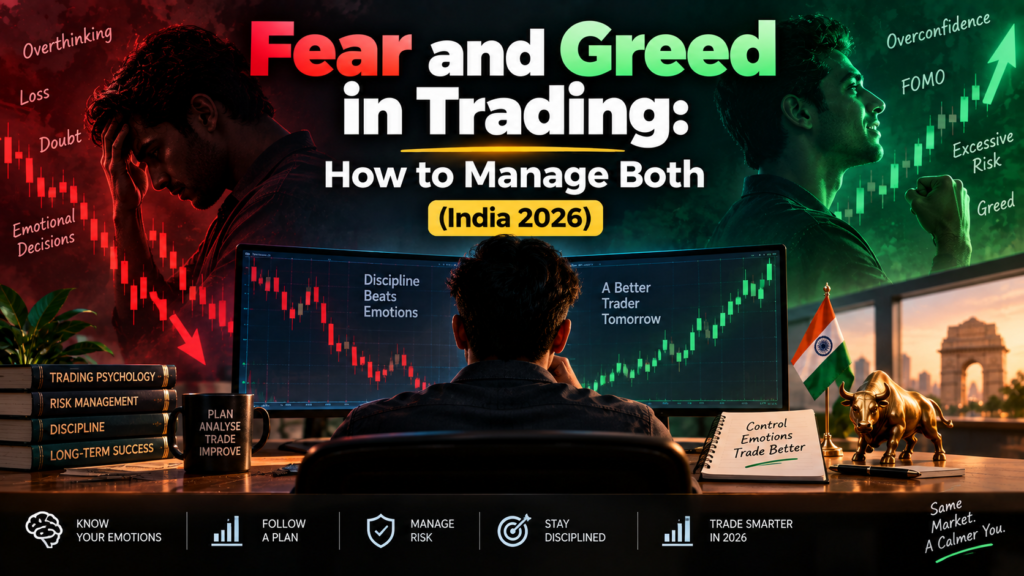
Quick answer: Fear and greed trading are the two emotions behind most trading mistakes. Fear makes you exit winners too early, avoid good setups or panic-sell in a fall. Greed makes you overtrade, use too much leverage, chase rallies and hold positions too long. You manage both not with willpower but with rules set before the trade: fixed risk per trade, pre-planned stops and targets, and a written plan you review.
Every trader feels both emotions. Professionals don’t feel them less; they build systems so the emotions have less room to act. This guide explains where fear and greed come from, how to spot them in your own trades and in the market, and a step-by-step framework to keep them in check.
What are fear and greed in trading?
Definition: In trading, fear is the urge to avoid loss or pain, and greed is the urge to capture more gain than your plan allows. Both push you to act on feelings rather than on your rules.
How fear shows up
- Closing a winning trade early to “lock in” a small profit.
- Freezing and missing a valid setup after a recent loss.
- Panic-selling during a sharp fall, often near the bottom.
- Moving a stop-loss further away because you can’t accept being wrong.
How greed shows up
- Increasing position size or leverage after a winning streak.
- Chasing a stock or index that has already rallied (FOMO, the fear of missing out).
- Removing a profit target hoping for “just a bit more.”
- Revenge trading: taking bigger bets to win back a loss quickly.
FOMO and revenge trading mix both emotions: fear of missing out or of staying down, and greed for a fast recovery.
The psychology behind it
| Bias | What it means | How it hurts traders |
|---|---|---|
| Loss aversion | Losses feel roughly twice as painful as equal gains feel good (Kahneman and Tversky’s prospect theory) | You hold losers to avoid “making the loss real” |
| Disposition effect | Tendency to sell winners too early and keep losers too long | Small wins and large losses, the reverse of what works |
| Overconfidence | Overrating your own skill, especially after wins | Bigger size, more trades, less checking |
| Herd behaviour | Copying what everyone else is doing | Buying tops and selling bottoms with the crowd |
| Recency bias | Giving too much weight to the last few trades or days | Assuming a trend or a losing streak will continue forever |
Warren Buffett’s well-known advice captures the contrarian idea: be fearful when others are greedy, and greedy when others are fearful. For a beginner, the more practical lesson is simpler: notice which emotion is driving you before you click buy or sell.
How to spot fear and greed
In yourself: a warning-signs checklist
| You notice… | Likely driver | What to do instead |
|---|---|---|
| You want to double your size after three wins | Greed / overconfidence | Keep risk per trade fixed |
| You entered because “everyone on Telegram is buying” | Greed / herd behaviour (FOMO) | Only take setups written in your plan |
| You moved your stop-loss to avoid being stopped out | Fear of a realised loss | Accept the stop; it was your plan |
| You want to win back today’s loss before close | Revenge trading | Stop for the day after a set daily loss |
| You closed a winner at +0.5R when the target was +2R | Fear of giving back profit | Use a trailing stop instead of an early exit |
| You skip valid setups after a losing streak | Fear | Trade smaller, not zero, and follow the checklist |
(R = the amount you risk on a trade. A +2R trade makes twice what you risked.)
In the market: sentiment gauges
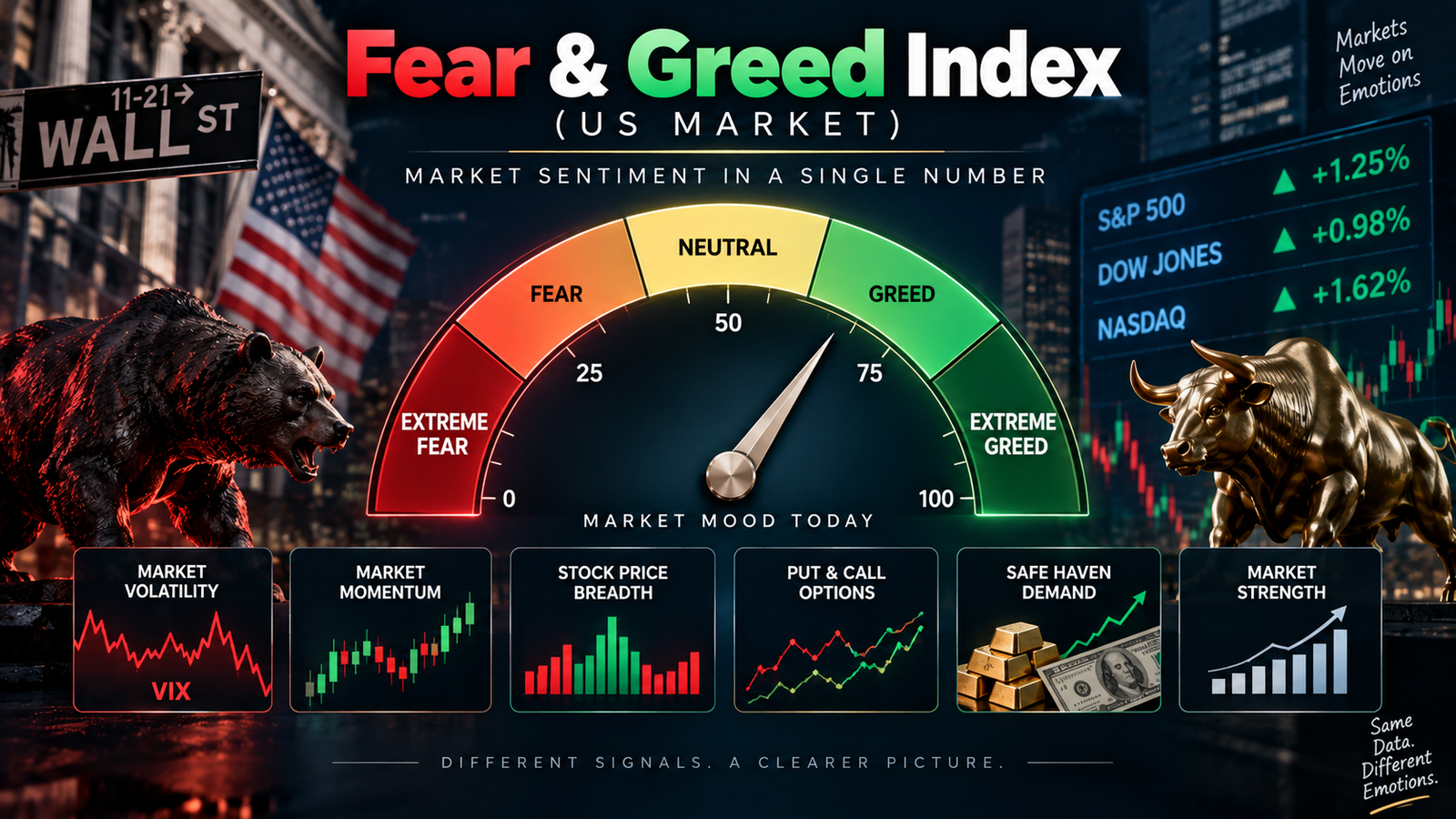
CNN Fear & Greed Index (US market): a 0–100 score where 0 is extreme fear and 100 is extreme greed. It averages seven equally weighted indicators: market momentum, stock price strength, stock price breadth, put/call options, market volatility, safe-haven demand and junk-bond demand. It fell to 12 in September 2008 and to 2 in March 2020. It measures US sentiment, which often spills over into Indian markets.
India VIX (Indian market): NSE‘s volatility index, often called India’s “fear gauge.” It rises when traders expect bigger Nifty swings. It usually moves opposite to Nifty: during the March 2020 Covid crash it reached 71.56 on 23 March, the day Nifty fell about 13%. Its all-time high of about 92.5 came in November 2008.
| Gauge | Covers | Reads fear when | Reads greed / calm when |
|---|---|---|---|
| CNN Fear & Greed Index | US stocks | Near 0–25 | Near 75–100 |
| India VIX | Nifty 50 options | Spiking sharply | Low and falling |
How beginners should use them: as context, not as buy or sell signals. Extreme readings tell you emotions are running high, which is exactly when to follow your rules most strictly. Markets can stay fearful or greedy for longer than a beginner’s capital can last.
Real-world examples
Fear: the March 2020 Covid crash in India
On 23 March 2020, after the nationwide lockdown was announced, the Sensex fell 3,935 points and Nifty 1,135 points, both about 13%, in one of the worst single-day falls on record. Nifty fell about 23% over March 2020 as a whole. Many investors sold near the bottom. By January 2021, Nifty had set a new all-time high near 14,750, so those who sold in panic missed the recovery.
Fear again: March 2026
In March 2026, geopolitical tension and an oil-price spike pushed India VIX into its high-volatility zone; it read 24.64 on 25 March. Foreign portfolio investors sold about $9.6 billion of Indian equities between 28 February and 20 March, net sellers every trading day. Readings like these are when fear-driven exits are most tempting.
Greed: India’s F&O boom
SEBI’s studies show the cost of greed-driven overtrading:
| SEBI study | Period | Individual traders who lost money |
|---|---|---|
| July 2025 | FY25 | Over 91% (net loss ₹1,05,603 crore) |
| September 2024 | FY22–FY24 | 93% (average loss about ₹2 lakh each) |
| January 2023 | FY22 | 89% |
The most telling behavioural finding: more than 75% of loss-making traders kept trading F&O even after consecutive losing years. SEBI’s FY23 study of intraday traders also found that loss-makers made more trades on average than profit-makers.
Greed in crypto
Bitcoin peaked near $69,000 in November 2021 amid widespread FOMO, then fell roughly 75% over the following year. Traders who bought the hype with leverage were hit hardest.
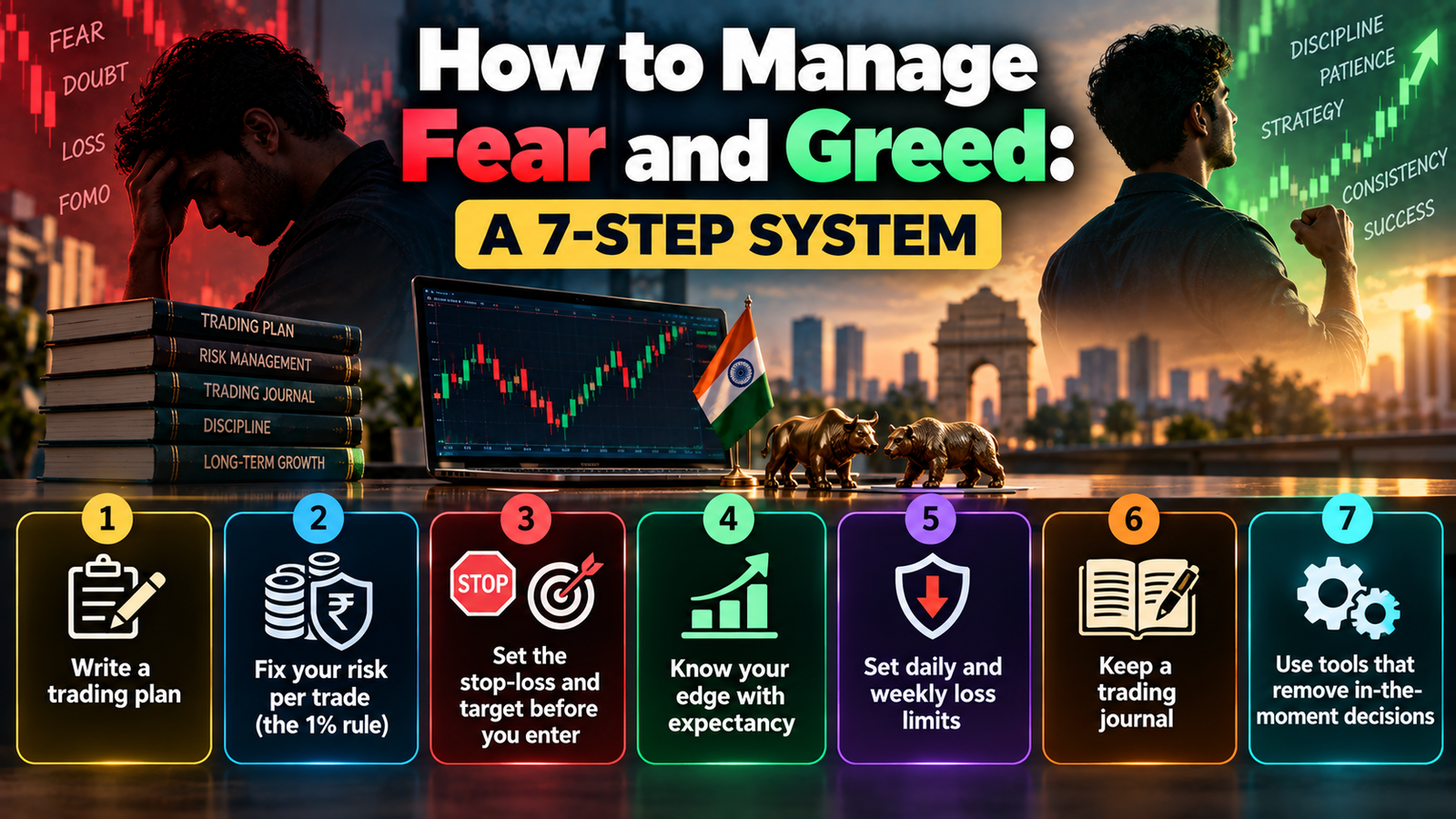
How to manage fear and greed: a 7-step system
The goal is to make decisions before emotions arrive. Every step below is decided when you are calm, then followed mechanically.
Step 1: Write a trading plan
List what you trade, which setups you take, when you enter, where you exit, and how much you risk. If a trade isn’t in the plan, you don’t take it. This alone blocks most FOMO trades.
Step 2: Fix your risk per trade (the 1% rule)
Risk a small, fixed share of capital on each trade, commonly 1–2% for beginners.
Position size = (capital × risk %) ÷ risk per unit
Stock example (illustrative): capital ₹5,00,000; risk 1% = ₹5,000. You buy a stock at ₹1,200 with a stop at ₹1,170, so risk per share = ₹30.
- Shares = ₹5,000 ÷ ₹30 = 166 shares
- Position value = 166 × ₹1,200 = ₹1,99,200
Nifty futures example (illustrative): a 50-point stop × 65 lot size = ₹3,250 risk per lot. ₹5,000 ÷ ₹3,250 = 1.5, so you trade 1 lot, never 2. Fixed risk takes the “how big should I go?” decision away from greed.
Step 3: Set the stop-loss and target before you enter
Decide both in advance and use a risk/reward of at least 1:2.
| Risk/reward | Win rate needed to break even (before costs) |
|---|---|
| 1:1 | 50% |
| 1:2 | 33.3% |
| 1:3 | 25% |
Break-even win rate = 1 ÷ (1 + reward/risk). With 1:2, you can be wrong on two trades out of three and still not lose money before costs. That takes pressure off every single trade, which reduces fear.
Step 4: Know your edge with expectancy
Expectancy = (win rate × average win) − (loss rate × average loss)
Example: 40% wins at +2R, 60% losses at −1R. Expectancy = 0.4 × 2 − 0.6 × 1 = +0.2R per trade. At ₹5,000 risk, that is about ₹1,000 per trade on average over many trades, before costs. Thinking in averages over 50–100 trades stops any single loss from feeling like a disaster.
Step 5: Set daily and weekly loss limits
For example, stop trading for the day after losing 2% (₹10,000 on ₹5 lakh) and for the week after 5%. This is the most direct cure for revenge trading.
Why it matters: losses are harder to recover than they look.
| Drawdown | Gain needed to get back to start |
|---|---|
| 10% | 11.1% |
| 25% | 33.3% |
| 50% | 100% |
Step 6: Keep a trading journal
For each trade record: setup, entry, stop, target, size, result, and the emotion you felt (calm, anxious, excited, frustrated). After 30–50 trades, patterns appear, such as “my worst trades happen after two wins in a row.”
Step 7: Use tools that remove in-the-moment decisions
- Place stop-loss and target orders with the entry, or use a bracket or GTT order where your broker offers one.
- Use a trailing stop to let winners run without fear of giving back all profit.
- Turn off P&L display while a trade is open if watching it makes you exit early.
- Avoid trading in the minutes around major events such as RBI policy, US Fed decisions or budget announcements, unless your plan covers it.
Pre-trade checklist
- Is this setup in my written plan?
- Are my stop and target set, with reward at least twice the risk?
- Is my size within 1–2% of capital?
- Am I under my daily loss limit?
- Am I calm, not chasing, not trying to win back a loss?
Expert analysis
Fact: across three SEBI studies covering FY22 to FY25, roughly 9 in 10 individual F&O traders lost money, and more than three-quarters of loss-makers kept trading.
Analysis: that persistence is a behavioural pattern, not an information gap. Traders know the odds but keep trading to recover losses. That is greed and loss aversion working together, and it is exactly what fixed risk and loss limits are designed to stop.
Analysis: fear and greed are not always wrong. Fear that makes you cut a position when your thesis breaks is healthy. Greed that keeps you in a strong trend with a trailing stop can be profitable. The problem is acting on either emotion outside your plan.
Analysis: sentiment extremes are useful context but poor timing tools. India VIX spiked in March 2020 and again in March 2026; what followed was very different in speed and size. A beginner should use such readings to tighten discipline, not to predict turns.
Opinion: for most beginners, the single most effective change is smaller position size. When the rupee amount at risk is small, fear and greed both lose most of their grip.
Common mistakes
- Relying on willpower instead of written rules.
- Increasing size after a winning streak.
- Averaging down a losing trade that has no plan behind it.
- Trading right after a big loss to “get it back.”
- Treating a fear-and-greed reading as a buy or sell signal.
- Following tips from social media groups without checking them against your plan.
Myths vs facts
| Myth | Fact |
|---|---|
| Professional traders feel no fear or greed | They feel both; they limit the damage with rules and size |
| Being fearless makes you a better trader | Healthy fear keeps you using stop-losses |
| Greed is always bad | Letting winners run with a trailing stop is planned, rule-based greed |
| Extreme fear always means buy | Markets can keep falling for weeks after fear peaks |
| More trades mean more profit | SEBI found loss-makers traded more often than profit-makers |
| You can control emotions by will alone | Pre-set rules and automation work better than willpower |
Key takeaways
- Fear makes you exit early, freeze or panic-sell; greed makes you overtrade, oversize and chase.
- Loss aversion, overconfidence and herd behaviour are the biases behind both.
- India VIX and the CNN Fear & Greed Index show market mood; use them as context, not signals.
- Risk a fixed 1–2% of capital per trade and set stops and targets before entry.
- A 1:2 risk/reward needs only a 33.3% win rate to break even before costs.
- Daily and weekly loss limits are the best defence against revenge trading.
- A journal that records emotions shows your personal patterns within 30–50 trades.
FAQs
1. What is fear and greed in trading?
Fear is the urge to avoid loss, and greed is the urge to grab more gain than your plan allows. Both lead traders to act on emotion instead of rules.
2. How do you control fear in trading?
Trade smaller, set your stop-loss before entry, and use a risk/reward of at least 1:2. When each trade risks only 1–2% of capital, losses feel manageable.
3. How do you control greed in trading?
Fix your risk per trade, set profit targets or trailing stops in advance, and cap the number of trades per day. Never raise size just because you are on a winning streak.
4. What is the Fear and Greed Index?
It is CNN’s 0–100 gauge of US stock market sentiment, built from seven equally weighted indicators. Low readings show fear; high readings show greed.
5. Is there a fear and greed index for India?
There is no official one, but India VIX, NSE’s volatility index, is widely used as India’s fear gauge. It rises when traders expect larger Nifty swings.
6. Should I buy when the Fear and Greed Index shows extreme fear?
Not on that signal alone. Markets can keep falling after fear peaks. Use it as context and follow your own plan and risk rules.
7. What is FOMO in trading?
FOMO, or fear of missing out, is the urge to jump into a move because others are profiting. It often leads to buying after most of the move has happened.
8. What is revenge trading?
It is taking bigger or unplanned trades to quickly win back a loss. A daily loss limit is the most effective way to stop it.
9. Why do traders sell winners too early and hold losers too long?
This is the disposition effect, driven by loss aversion. Locking in a gain feels good, while closing a loss makes it feel real.
10. What is loss aversion?
It is the finding, from Kahneman and Tversky’s prospect theory, that losses feel roughly twice as painful as equal gains feel good.
11. How much should a beginner risk per trade?
A common guideline is 1–2% of trading capital. On ₹5 lakh, 1% is ₹5,000 of risk per trade.
12. Does a trading journal really help?
Yes. Recording the emotion behind each trade reveals patterns, such as oversizing after wins, that you can then write rules against.
13. Why do most F&O traders in India lose money?
SEBI studies show about 9 in 10 individual F&O traders lose money. Overtrading, high leverage, transaction costs and emotional decisions all contribute.
14. Can fear ever be useful in trading?
Yes. Healthy fear keeps you using stop-losses and sensible position sizes. It becomes harmful only when it overrides your plan.
15. Is greed always bad in trading?
No. Letting a winning trade run with a trailing stop is planned greed. Unplanned greed, such as oversizing or chasing, is what causes damage.
16. How long does it take to control trading emotions?
There is no fixed time. Most traders see clear patterns after journaling 30–50 trades, and improvement comes from consistently following rules rather than from time alone.