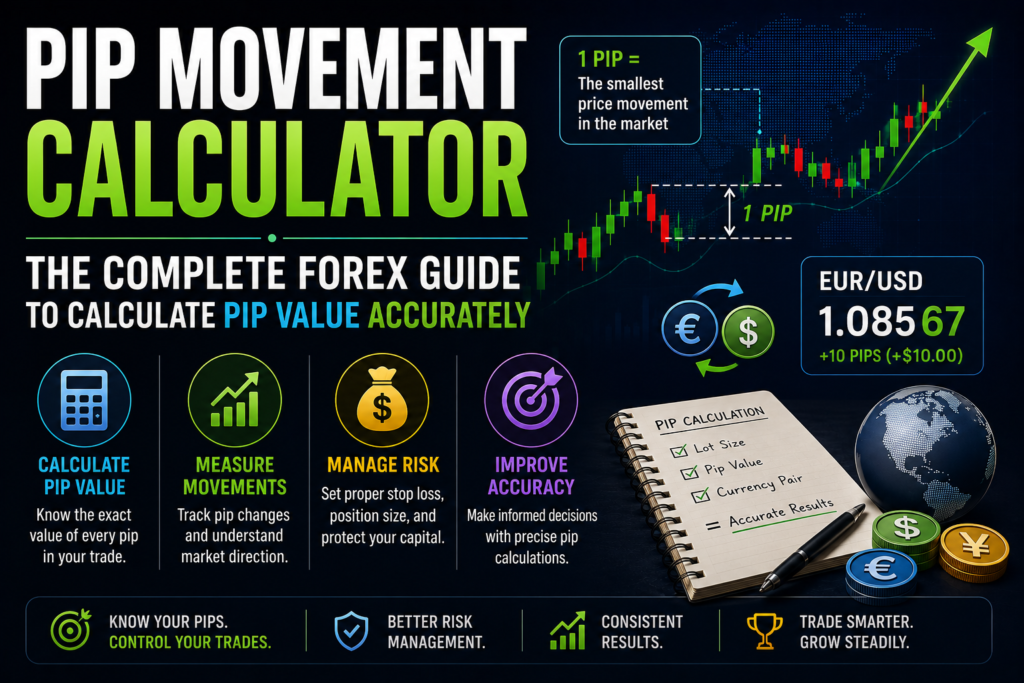

Every trader eventually runs into the same starting question: how to calculate pips accurately enough to trust the number. It’s one of the first skills worth mastering, because nearly everything downstream of it — position sizing, stop-loss placement, profit projections — depends on getting this single calculation right, whether you’re trading currency pairs or commodities like gold.
This guide walks through the fundamentals from scratch, the formula behind pip value, how the math shifts between forex and commodities, and the mistakes that most commonly trip up beginners.
First Things First: What Is a Pip?
A pip — short for “percentage in point” — is the standard unit forex traders use to measure price movement in a currency pair. For most pairs, this sits at the fourth decimal place: 0.0001. Pairs involving the Japanese yen use a different convention, placing a pip at the second decimal instead: 0.01.
This standardization exists so traders have a consistent way to describe and compare price movement, regardless of which specific pair they’re looking at or which broker they’re using. Without it, “the market moved” would carry no comparable meaning between something like EUR/USD and USD/JPY.
Getting Comfortable With Pip Size
Pip size is simply the numerical value of one pip — 0.0001 for most currency pairs, 0.01 for JPY pairs. Some brokers quote to an additional decimal place, introducing what’s called a pipette: one-tenth of a full pip, at 0.00001 for most pairs.
Pip value itself isn’t a single fixed number — it shifts depending on three things working together: the specific currency pair, your trade size (lot size), and the current exchange rate. Understanding how these three interact is really the entire foundation of learning how to calculate pips correctly.
The Formula Behind Pip Value
The standard formula for pip value is:
Pip Value = (Pip Size ÷ Exchange Rate) × Position Size
A couple of things worth knowing about how this plays out in practice:
- For pairs where USD is directly involved (like EUR/USD), pip value tends to stay relatively constant — commonly around $10 per pip on a standard lot.
- For cross-currency pairs, or accounts not denominated in USD, pip value fluctuates with the exchange rate and needs converting into your actual account currency before it means anything financially useful.
Turning Pip Value Into Actual Profit or Loss
Once pip value is known, calculating profit or loss on a trade is a short step further:
Profit or Loss = Number of Pips × Pip Value
Where pip value itself can also be expressed as:
Pip Value = Lot Size × Contract Size × Pip Size
For nearly all currency pairs, pip size is 0.0001; JPY pairs use 0.01 instead, and commodities follow their own separate conventions entirely (more on that shortly).
Worked example: Buying 1 standard lot (100,000 units) of EUR/USD, with the price moving 50 pips in your favor, and a pip value of $10:
50 pips × $10 = $500 profit
A Smaller-Scale Example
The same logic applies regardless of position size — only the resulting figures scale down. Suppose you enter a trade at 1.3000 with a position size of 0.1 lot (10,000 units), and the price moves to 1.3050. If one pip on this position size equals $1:
50 pips × $1 = $50 profit
Running through both a standard-lot and a smaller-lot example side by side makes the scaling relationship concrete — identical pip movement, dramatically different dollar outcomes, purely as a function of position size.
What Actually Influences a Pip Profit Calculation
A handful of variables shape the final result, and it’s worth understanding each individually:
Trade size (lot size). Larger lots mean larger pip values, and therefore larger swings in profit or loss for the same price movement.
Currency pair and account currency. Pip value is quoted in the pair’s quote currency, and if that differs from your account currency, a conversion step is needed to reflect true profit or loss.
Leverage. While leverage changes your margin requirements — how much capital is needed to open a position — pip profit itself is calculated against the full position size, not the leveraged capital outlay.
Price movement. The raw difference between entry and exit price, expressed in pips, is what ultimately drives the calculation from start to finish.
Where Forex and Commodities Diverge

Learning how to calculate pips in forex is a natural starting point, but the moment you branch into commodities like gold or silver, some of the underlying assumptions need adjusting.
Forex Specifics
- A pip in forex is typically the smallest standardized price movement — 0.0001 for most pairs, 0.01 for JPY pairs, due to differing decimal conventions.
- Pairs are quoted as base/quote currency, so pip value calculations depend on both the specific pair and your account currency. Trading EUR/USD, for instance, involves a different calculation path than USD/JPY, purely because of decimal placement and relative currency value.
- Cross pairs — those not involving USD at all — require an additional conversion step to translate pip value back into your account currency accurately.
- For finer pricing precision, brokers use pipettes, representing one-tenth of a standard pip.
Commodities Specifics
- Commodities like gold (XAU/USD) and silver define pip value differently — often $0.01 for gold — but lot sizes and trading units vary considerably (a standard gold lot, for instance, is commonly 100 ounces).
- Because commodities are typically priced in USD per ounce or barrel, calculating pip values here follows a somewhat different logic than standard currency pairs, though the underlying goal — translating price movement into real monetary impact — stays the same.
- Each commodity carries its own standard lot size convention, which directly shapes how pip size and pip value get calculated for that specific instrument.
Key Differences at a Glance
| Aspect | Forex | Commodities |
|---|---|---|
| Pip definition | Generally 0.0001, 0.01 for JPY | Typically $0.01 or the smallest tick |
| Lot size | Standard lot = 100,000 units | Varies — e.g., gold = 100 ounces |
| Price quote | Base/quote currency pair | Dollar price per unit (ounce, barrel) |
| Pip value impact | Depends on pair and account currency | Depends on contract size and price quoting |
Understanding these distinctions matters because applying a forex-style assumption directly to a commodity trade — or vice versa — produces a pip value calculation that looks plausible but doesn’t actually reflect the instrument’s real conventions.
Where Traders Typically Turn for Pip Calculations
Rather than working the formula out by hand every time, most traders lean on dedicated calculators — usually offered free by brokers or independent trading education platforms. These generally fall into a few broad categories: tools focused purely on straightforward pip value lookup for a given pair and lot size; broader calculator suites that bundle pip value alongside margin, spread, and commission figures for a fuller pre-trade picture; and tools specifically built to convert pip movement directly into your account’s base currency, which is particularly useful for traders working across multiple currency pairs or non-USD accounts.
Whichever type you use, the underlying value comes from the same place: consistent, accurate figures that remove the guesswork from position sizing and risk management, regardless of whether you’re calculating by hand or letting a tool handle it.
Common Mistakes Worth Avoiding
Applying the wrong pip size to JPY pairs. Using 0.0001 instead of 0.01 (or vice versa) throws the resulting pip count off by a full order of magnitude — one of the most frequent errors among traders still building fluency in how to calculate pips accurately.
Forgetting account currency conversion. A pip value calculated in the pair’s quote currency doesn’t automatically reflect your actual account currency if the two differ.
Confusing leverage with pip value. Leverage affects margin requirements and overall exposure, but it doesn’t change the underlying pip value calculation itself — the two are related but distinct concepts.
Applying forex conventions directly to commodities. Gold, silver, and other commodities follow their own lot size and pip conventions — treating them identically to a currency pair produces an inaccurate figure.
Overlooking pipettes. Reading a fifth-decimal movement as a full pip inflates the resulting calculation by a factor of ten.
How Pip Targets Vary by Trading Style
Once you’ve got the calculation itself down, it helps to know what a realistic pip target actually looks like depending on how you trade. Scalpers typically aim for short, quick movements — often just 5 to 10 pips per trade — executing frequently rather than chasing a single large move. Swing traders, by contrast, work on a longer horizon, often targeting 50 to 100 pips or more per position, holding through more of the market’s natural back-and-forth in pursuit of a bigger overall move.
Frequently Asked Questions
What is a pip in forex trading? The smallest standardized price movement a currency pair can make under normal conditions — typically the fourth decimal place for most pairs.
How is pip value calculated? It depends on the currency pair, lot size, and account currency. For USD-involved pairs, one pip is commonly worth around $10 on a standard lot, though this varies by lot size and pair.
How do I calculate profit or loss from pip movement? Multiply pip value by the number of pips the price moved in your favor or against you, accounting for your lot size — this gives you the actual monetary gain or loss on the trade.
How many pips are typical for different trading styles? Scalpers generally target short, quick moves of around 5–10 pips, while swing traders often aim for 50–100 pips or more per position.
What is a pipette? A pipette is one-tenth of a standard pip, offering more precise pricing — particularly useful for tight spreads and small, incremental price movements.
Final Thoughts
Knowing how to calculate pips properly is genuinely foundational for both forex and commodities traders aiming for consistent, long-term results. It removes a significant amount of guesswork from trading — letting you predict potential profit or loss with real accuracy, manage risk deliberately, and build strategies grounded in numbers rather than rough estimates.
Whether you’re working the formula out manually or relying on a dedicated calculator, the underlying goal stays the same: turning raw price movement into a monetary figure you can genuinely trust, trade after trade.
This article is for educational purposes only and does not constitute financial advice. Trading forex and commodities involves substantial risk — always do your own research or consult a professional advisor before making trading decisions.