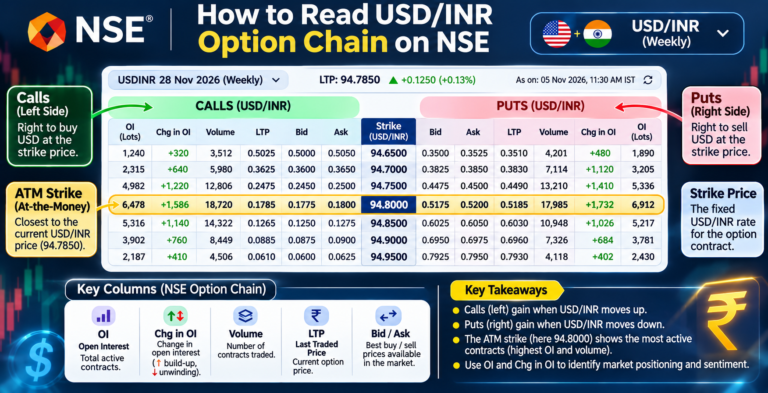

Introduction to Open Currency Trading Account India
Currency trading has become far more accessible in India. Discount brokers let you open an account online in a day or two, and the NSE and BSE offer futures and options on major currency pairs. At the same time, social media is full of offshore “forex apps” that promise huge leverage and fast profits, many of which are illegal for Indian residents.
If you want to open a currency trading account in India that is fully legal, the process is straightforward once you know the steps. This guide walks you through everything:
- What a currency trading account is and what you can trade
- How to choose a SEBI-registered broker
- Documents and income proof required
- The step-by-step account opening process
- Costs, margins and placing your first trade
- Mistakes and scams to avoid
What Is a Currency Trading Account?
A currency trading account in India is a trading account with a SEBI-registered stockbroker that has the currency derivatives segment enabled. It allows you to trade exchange-listed currency futures and options on NSE and BSE.
Currency derivatives are cash-settled in rupees, so no foreign currency changes hands. You trade price movements in pairs such as USD/INR rather than buying and holding actual dollars.
Pairs you can trade
| Type | Pairs | Lot size |
|---|---|---|
| INR pairs | USD/INR, EUR/INR, GBP/INR, JPY/INR | $1,000, €1,000, £1,000, ¥1,00,000 |
| Cross-currency pairs | EUR/USD, GBP/USD, USD/JPY | €1,000, £1,000, $1,000 |
Is Currency Trading Legal in India?
Yes, but only through the right channel. Under FEMA and RBI rules, resident Indians can trade currency derivatives only on recognised Indian exchanges through SEBI-registered brokers.
Trading leveraged forex or CFDs on offshore platforms, or sending money abroad for such trading, is not permitted. The RBI maintains an Alert List of unauthorised forex trading platforms and websites. Before you open a currency trading account in India, make sure the broker is SEBI-registered and the trades go through NSE or BSE.

Who Can Open a Currency Trading Account?
- Resident Indian individuals aged 18 or above
- Hindu Undivided Families (HUFs), companies, partnership firms and LLPs, with additional documents
- Minors cannot trade derivatives
- Non-resident Indians face separate rules and restrictions on currency derivatives, so they should check with their broker and a FEMA adviser
Step 1 to Open Currency Trading Account India: Choose a SEBI-Registered Broker
The first decision when you open a currency trading account in India is the broker. Compare these factors:
| Factor | What to check |
|---|---|
| Registration | SEBI registration number and NSE/BSE membership for the currency segment |
| Currency segment support | Whether currency futures and options, including cross-currency pairs, are offered |
| Brokerage | Flat fee per order or percentage of turnover |
| Platform | Charting, order types, mobile app, stability during volatile periods |
| Margin tools | Margin calculator and clear display of required margins |
| Account charges | Account opening fee, annual maintenance charges (AMC) |
| Support | Responsiveness of customer service |
You can verify a broker’s registration on the SEBI website using its registration number. Discount brokers usually charge low flat fees, while full-service brokers may offer research and advice at higher costs.
Step 2: Documents to Open Currency Trading Account India
To open a currency trading account in India, brokers need standard KYC documents:
- PAN card: Mandatory for all securities trading.
- Aadhaar: Used for identity and address verification and e-signing.
- Bank account details: A cancelled cheque or bank statement showing your name, account number and IFSC.
- Photograph and signature: Usually captured during the online process.
- Mobile number and email: Linked to your Aadhaar and used for OTPs.
Income proof for the derivatives segment
Because currency futures and options are derivatives, brokers require proof of income or net worth before activating the segment. Accepted documents usually include one of:
- Latest income tax return acknowledgement
- Recent salary slip
- Bank statement for the last six months
- Net worth certificate from a chartered accountant
- Demat holding statement above a broker-specified value
Requirements vary slightly by broker, so check the list before you start.
Step 3: Apply Online to Open Currency Trading Account India
Most brokers now offer a fully digital process to open a currency trading account in India that you can finish in under an hour:
- Visit the broker’s website or app and start the account opening process.
- Enter your mobile number and email and verify with OTPs.
- Enter PAN details and date of birth; the broker verifies them.
- Complete Aadhaar -based KYC through DigiLocker or OTP.
- Link your bank account.
- Select the segments you want, making sure to tick currency derivatives (sometimes listed as “CDS” or “Currency”).
- Upload income proof for derivatives activation.
- Add nominee details or choose to opt out.
- Complete in-person verification, usually a short video or selfie step.
- E-sign the application using Aadhaar OTP.
Many brokers open a demat account alongside the trading account. Currency derivatives are cash-settled and do not need a demat account themselves, but most brokers open both together, which is useful if you also trade shares.
Step 4: Account Verification and Activation
After submission, the broker verifies your documents and registers you with the exchanges. This typically takes one to three working days. You will receive login credentials by email or SMS.
If the currency segment was not activated at the start, you can usually enable it later from the broker’s profile or segment settings, by uploading income proof.
Once you open a currency trading account in India and it is active, some brokers may also ask you to confirm that you understand the risks of derivatives trading or complete a short questionnaire about your experience.
Step 5: Fund Your Account
Transfer money from your linked bank account using UPI, net banking or NEFT/IMPS. Funds must come from a bank account registered in your name with the broker; third-party transfers are not accepted.
Funding is the last step after you open a currency trading account in India. Currency derivatives require margin, a percentage of the contract value blocked by the exchange. Margins for USD/INR are relatively small because each lot is $1,000 and the pair moves slowly. Use your broker’s margin calculator to check current figures before trading.
Costs to Open Currency Trading Account India
| Cost | Typical position |
|---|---|
| Account opening fee | Free or a small one-time fee at many brokers |
| Annual maintenance charge | Varies; often charged on the demat account |
| Brokerage | Flat fee per executed order at discount brokers, or a percentage at full-service brokers |
| Exchange transaction charges | Charged on turnover by the exchange |
| SEBI fees and stamp duty | Small charges on each trade |
| GST | On brokerage and exchange charges |
| STT | Not applicable on currency derivatives |
Compare the total cost per trade, not just brokerage, especially if you plan to trade frequently.
Step 6: Place Your First Trade After You Open Currency Trading Account India
- Log in to the trading platform and search for the contract, for example USDINR with the current month’s expiry.
- Check the lot size, current price, bid-ask spread and margin required.
- Decide your entry, stop-loss and target in advance.
- Calculate position size: each 1 paise move in USD/INR is worth ₹10 per lot.
- Place a limit order to control your entry price.
- Add a stop-loss order immediately after entry.
- Record the trade in a trading journal.
Example: If you buy 5 lots of USD/INR futures and the price rises by 8 paise, your profit is 8 × ₹10 × 5 = ₹400 before costs. A move of 8 paise against you would cost the same amount. This example is illustrative.
NSE rupee currency derivatives trade from 9:00am to 5:00pm IST on weekdays. Check current timings for cross-currency contracts with your broker.
Already Have a Trading Account? Activate the Currency Segment
Many investors already have a trading and demat account for shares. You may not need a new account at all. Instead of going through full KYC again, you can usually add the currency derivatives segment to your existing account:
- Log in to your broker’s website or app and open the profile or segments section.
- Select currency derivatives (sometimes shown as CDS).
- Upload fresh income proof if the broker asks for it.
- E-sign the segment activation request.
- Wait for confirmation, usually within one to two working days.
If your current broker does not offer currency trading, or charges high fees for it, it may be worth choosing a second broker and going through the full process to open a currency trading account in India with them. Having accounts with two brokers is allowed, though it adds to paperwork and annual charges.

Regulatory Points to Know
- Position limits: Exchanges set position limits per client and per contract.
- Underlying exposure rules: RBI rules allow users to take exchange-traded currency derivative positions up to a set limit without having to establish an underlying exposure. The RBI reduced this limit from $100 million to $5 million with effect from 10 October 2026. This is well above typical retail positions, but your broker may ask you for declarations.
- Risk disclosure: Brokers must provide a risk disclosure document for derivatives. Read it before you open a currency trading account in India.
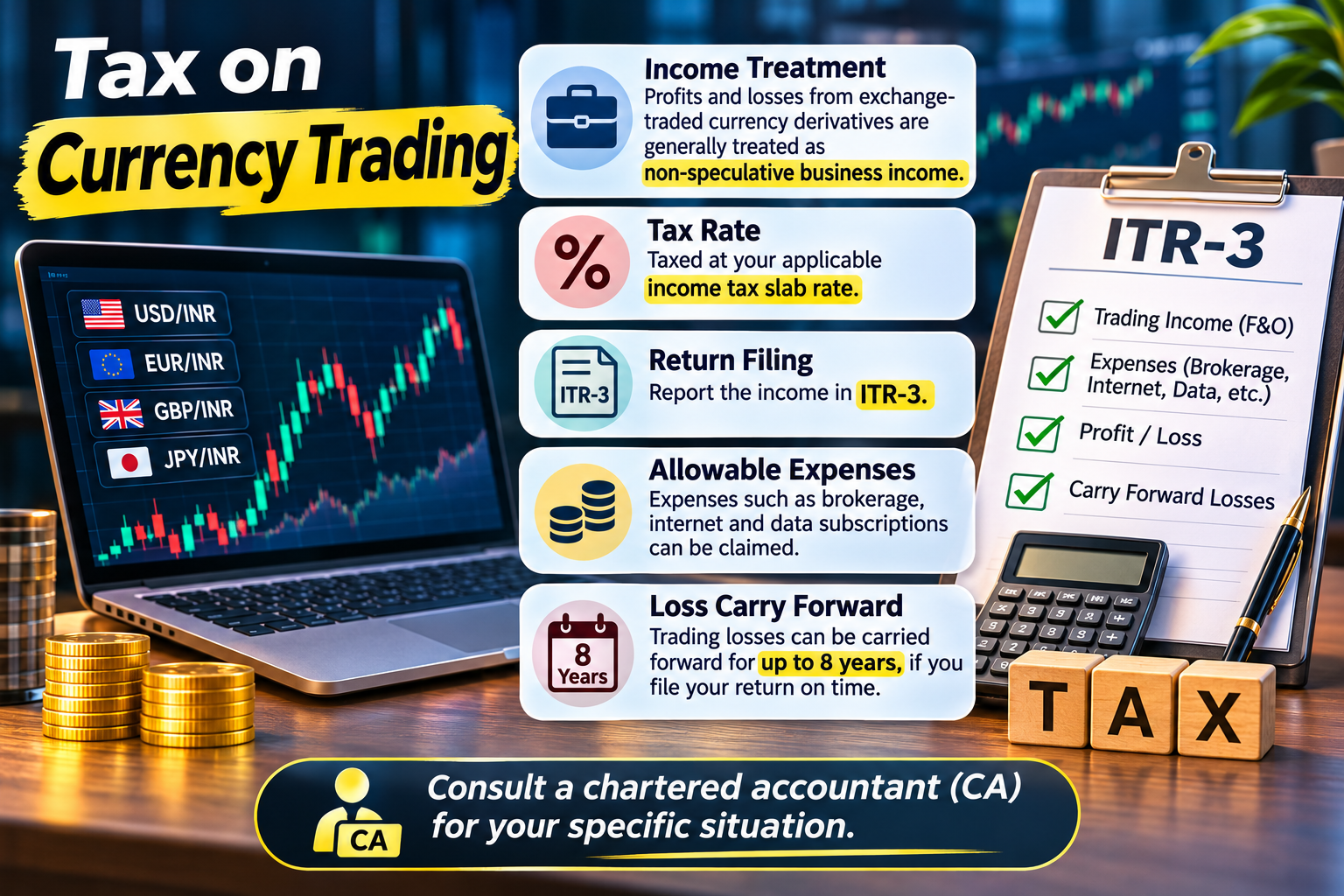
Tax on Currency Trading
Profits and losses from exchange-traded currency derivatives are generally treated as non-speculative business income. They are taxed at your slab rate and reported in ITR-3. Trading expenses such as brokerage, internet and data subscriptions can be claimed, and losses can be carried forward for up to 8 years if you file on time. Consult a chartered accountant for your situation.
Scams and Mistakes to Avoid When You Open Currency Trading Account India
- Offshore forex apps: Platforms offering 1:500 leverage on EUR/USD or gold are not legal for Indian residents, and funds can be frozen or lost.
- Social media “account managers”: Never hand over login details or let anyone trade on your behalf.
- Guaranteed return schemes: No legitimate broker guarantees profits.
- Paying via UPI to individuals: Always fund your account only through the broker’s official payment channels.
- Skipping the risk disclosure: Understand margin calls and how quickly losses can grow.
- Over-leveraging: Small margins make it easy to trade too many lots.
- Not checking registration: Verify the broker on SEBI’s website before you open a currency trading account in India.
Checklist Before You Open Currency Trading Account India
- Is the broker SEBI-registered with NSE/BSE currency segment membership?
- Do I have PAN, Aadhaar and a linked bank account?
- Do I have acceptable income proof for derivatives activation?
- Have I compared brokerage and total costs?
- Have I read the risk disclosure document?
- Have I planned position sizing and stop-losses?
- Do I understand the tax treatment?
FAQs
How long does it take to open a currency trading account in India?
Online applications usually take under an hour, and activation typically takes one to three working days.
Can I open a currency trading account in India without income proof?
You can usually open the trading account itself, but the currency derivatives segment is activated only after you submit acceptable income or net worth proof.
Do I need a demat account for currency trading?
Currency derivatives are cash-settled and do not require a demat account, but most brokers open trading and demat accounts together.
What documents are required?
PAN, Aadhaar, bank details, photograph, signature and income proof for the derivatives segment.
Can I trade EUR/USD from India?
Yes, through cross-currency futures and options on NSE and BSE. Trading EUR/USD on offshore leveraged platforms is not permitted.
How much money do I need to start?
Margins for a single USD/INR lot are small, but you should keep enough capital to absorb losses and follow sensible risk limits, such as risking no more than 1% per trade.
Conclusion
The process to open a currency trading account in India is simple: choose a SEBI-registered broker, complete online KYC, submit income proof to activate the currency derivatives segment, fund your account and start with small positions. The bigger challenge is staying on the legal path and avoiding offshore apps that promise easy profits.
Take time to compare brokers, read the risk disclosure, learn how lot sizes and margins work, and practise risk management from your very first trade.