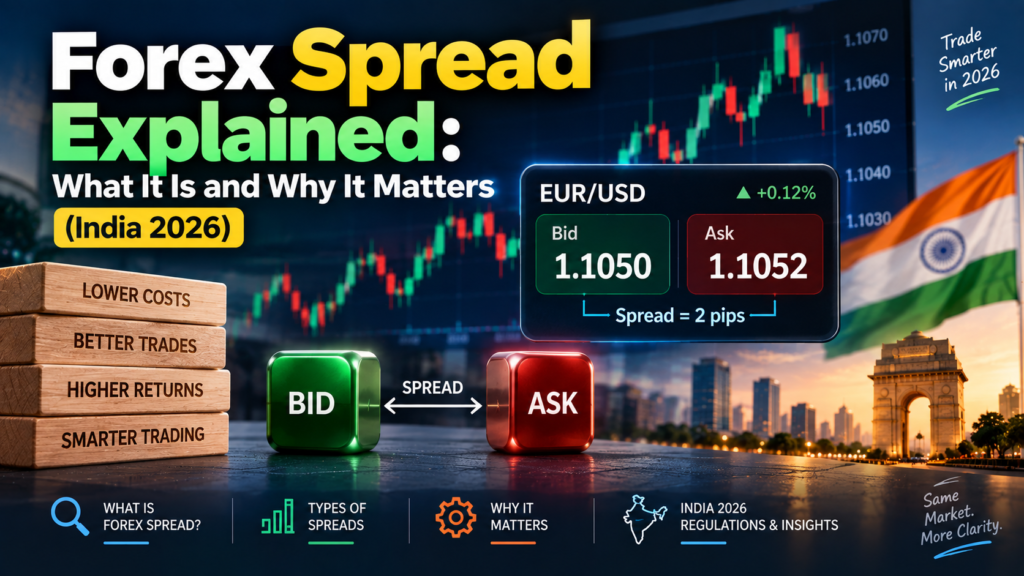
Quick answer: A forex spread is the gap between the price you can buy a currency at (the ask) and the price you can sell it at (the bid). It is the cost of entering a trade. Every trade starts slightly in loss by the size of the spread, and price must move past it before you break even.
Beginners often focus on brokerage and ignore the spread because it never shows up as a separate line on the contract note. But you pay it on every entry and exit, and for frequent traders it adds up quickly.
This guide explains what a spread is, how to calculate it in rupees, why it widens, and where Indian traders and travellers meet it in real life.
What is a spread in forex?
Definition: The spread is the difference between the ask (offer) price and the bid price of a currency pair. Spread = Ask − Bid.
- Bid = the highest price a buyer is willing to pay right now. You sell at the bid.
- Ask = the lowest price a seller will accept right now. You buy at the ask.
- The ask is always higher than the bid. The gap is what market makers, banks and brokers earn for providing a ready price.
Worked example: EUR/USD (illustrative)
| Quote | Price |
|---|---|
| Bid | 1.0850 |
| Ask | 1.0852 |
| Spread | 0.0002 = 2 pips |
If you buy at 1.0852 and immediately sell, you get 1.0850. You lose 2 pips without the market moving at all.
Worked example: USD/INR futures (illustrative)
| Quote | Price |
|---|---|
| Bid | ₹94.0000 |
| Ask | ₹94.0025 |
| Spread | ₹0.0025 = 1 tick (0.25 paise) |
In Indian exchange-traded currency futures, the spread is counted in ticks or paise rather than pips.
A spread you already know
The board at an airport exchange counter shows two rates, “We buy” and “We sell.” The difference between them is a spread, just a much wider one than on an exchange.
How to calculate the cost of a spread
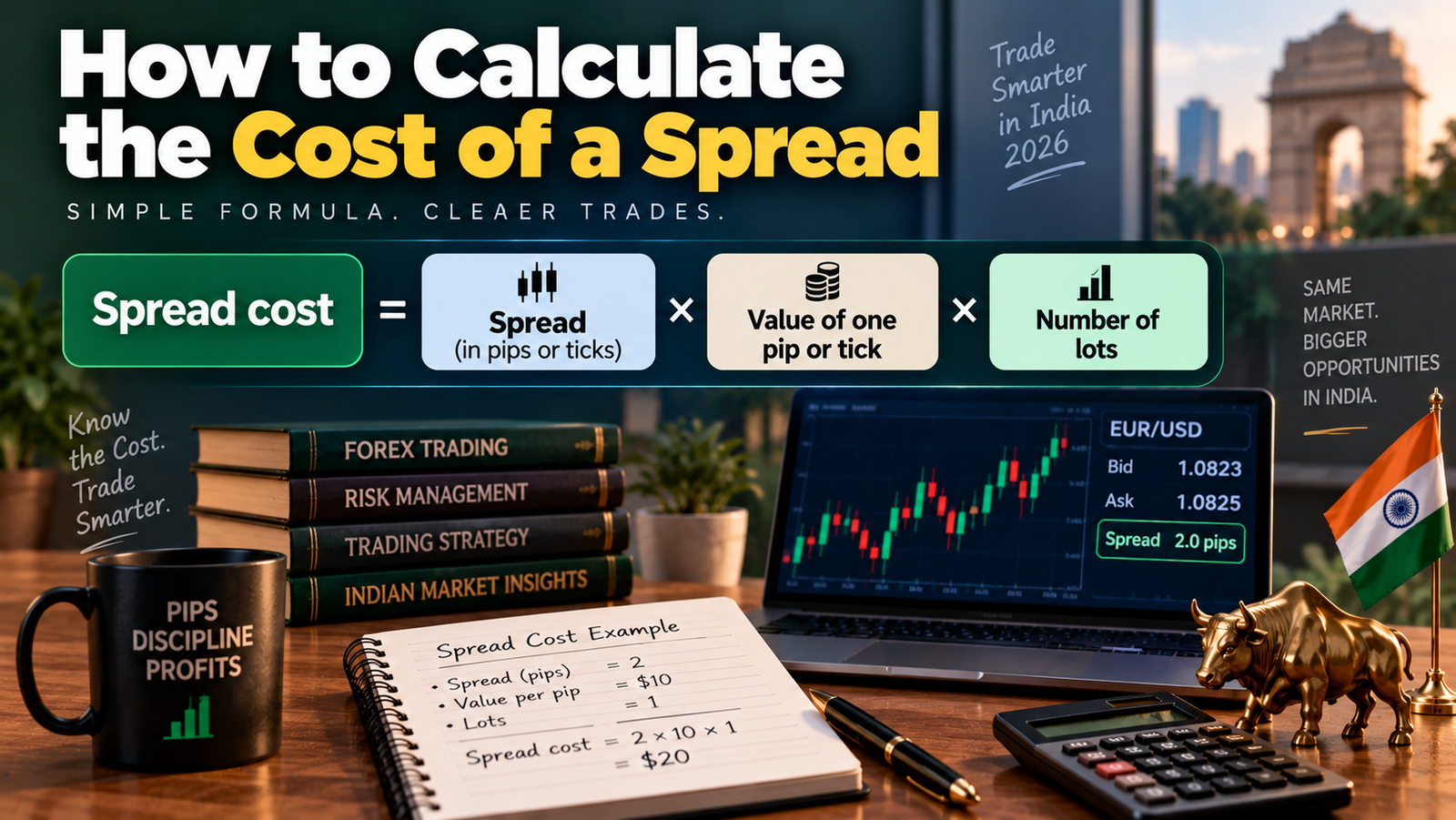
Spread cost = spread (in pips or ticks) × value of one pip or tick × number of lots.
You pay one full spread per round trip: you buy at the ask and later sell at the bid (or the reverse for a short trade).
Global forex example (illustrative)
EUR/USD spread = 2 pips. On one standard lot (100,000 units), 1 pip = $10.
- Spread cost = 2 × $10 = $20 per round trip
- On a mini lot (10,000 units): 2 × $1 = $2
- On a micro lot (1,000 units): 2 × $0.10 = $0.20
Indian exchange example: USD/INR futures (illustrative)
One USD/INR lot is $1,000 and one tick is ₹0.0025, so one tick = ₹2.50 per lot.
- With a 1-tick spread: 1 × ₹2.50 = ₹2.50 per lot
- 10 lots: ₹25 per round trip
- If the spread widens to 4 ticks in a quiet contract: 4 × ₹2.50 × 10 = ₹100
Spread as a percentage
Spread % = (Ask − Bid) ÷ Ask × 100. This lets you compare very different products.
| Product (illustrative quotes) | Bid | Ask | Spread % |
|---|---|---|---|
| USD/INR futures (1 tick) | 94.0000 | 94.0025 | about 0.003% |
| EUR/USD (2 pips) | 1.0850 | 1.0852 | about 0.018% |
| Cash counter (₹92.00 / ₹96.00) | 92.00 | 96.00 | about 4.2% |
Break-even move
Your trade must move at least one full spread in your favour before you make money, plus enough to cover brokerage and taxes. A scalper aiming for 5 pips with a 2-pip spread gives up 40% of the target to the spread.
Types of spreads and why they widen
Fixed, variable and raw spreads
| Spread type | How it works | Good for | Watch out for |
|---|---|---|---|
| Fixed | Broker quotes the same spread in most conditions | Predictable costs | Usually wider than average; may be suspended or requotes in fast markets |
| Variable (floating) | Moves with live market supply and demand | Tighter in calm, liquid hours | Can jump sharply around news or at night |
| Raw + commission | Near-interbank spread plus a separate commission per lot | Comparing true costs | Add both parts before comparing with a “zero commission” offer |
| Exchange order book | Set by the best bid and offer on an exchange such as NSE | Transparent; you can see market depth | Thin contracts can show gaps of several ticks |
What makes spreads widen
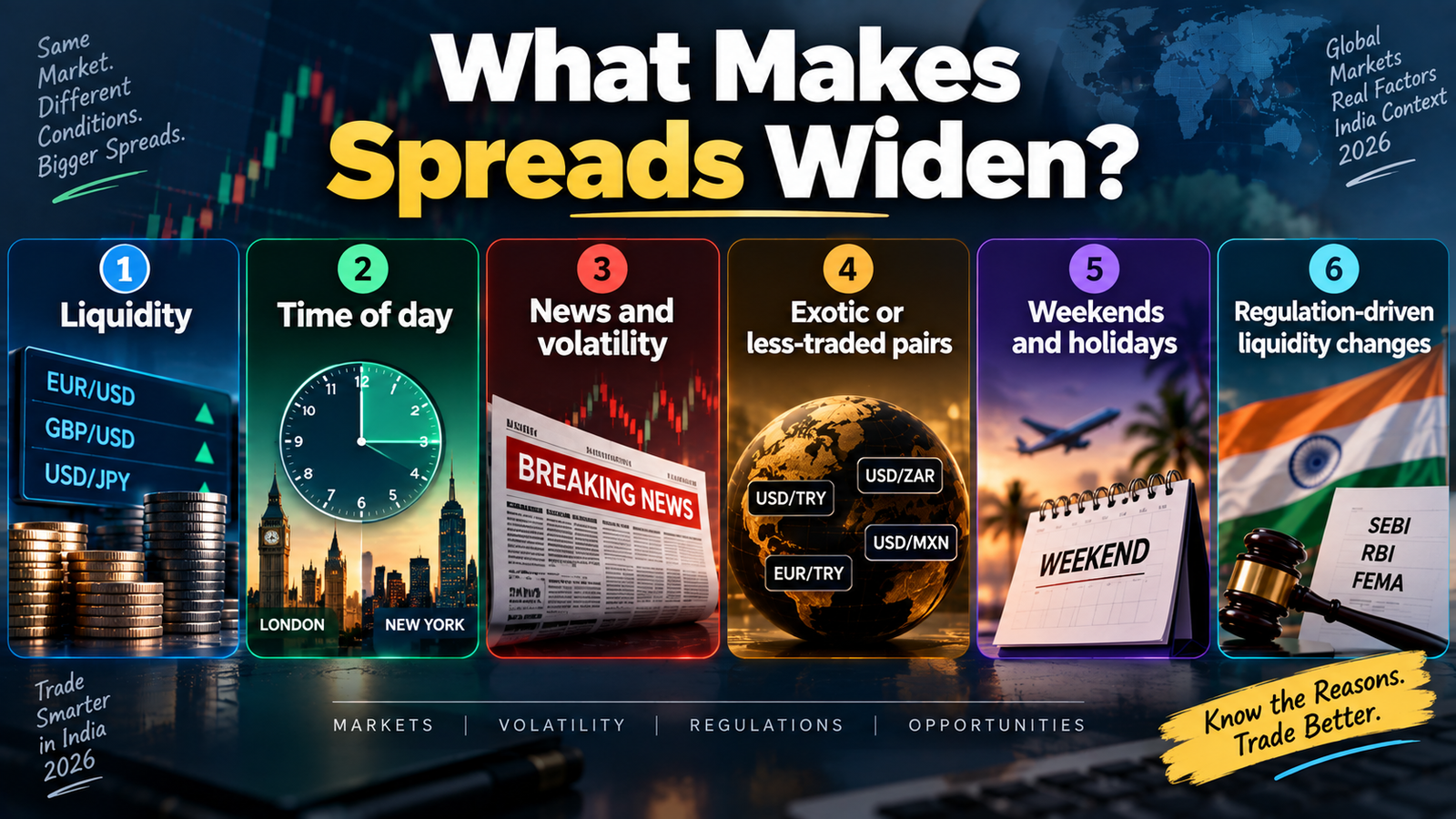
- Liquidity. Heavily traded pairs have the tightest spreads. The global FX market averaged about $9.6 trillion a day in April 2025, per the BIS Triennial Survey, but most of that is concentrated in major pairs such as EUR/USD.
- Time of day. Spreads are usually tightest when London and New York overlap, roughly 5:30 pm to 9:30 pm IST (about an hour later in the northern winter). They are often widest around the daily rollover, in the early hours of the morning in India.
- News and volatility. Before and after events such as US jobs data, Fed decisions or RBI policy announcements, dealers widen quotes to protect themselves.
- Exotic or less-traded pairs. Pairs involving smaller currencies can carry spreads many times wider than the majors.
- Weekends and holidays. Thin trading near the weekly open and on bank holidays often means wider spreads and price gaps.
- Regulation-driven liquidity changes. When fewer participants trade a contract, the order book thins and spreads widen. The India section below shows a real example.
Spreads in India: where you actually pay them
Most Indians meet forex spreads not on a trading screen but when sending money abroad, receiving a foreign payment, or loading a forex card. The spread there is far wider than on an exchange.
Bank remittance and forex-card rates
Banks publish a daily rate sheet with separate buying and selling rates. The gap between them is the bank’s spread, built into the rate rather than shown as a fee.
| Rate on a bank sheet | When it applies to you |
|---|---|
| TT buying rate | You receive money from abroad (freelance income, NRI transfer) |
| TT selling rate | You send money abroad (fees, family support, investments) |
| Card rate | You load or cash out a forex card |
| Currency notes rate | You buy or sell cash; usually the widest spread |
In one published USD sheet from September 2026, the gap between a private bank’s TT buying and selling rates was ₹3.00 per dollar, about 3.2%. Another bank’s sheet the same month showed a gap of just ₹0.66, about 0.7%. Spreads differ sharply between banks, so it pays to compare the rate, not just the fee.
Worked example (illustrative): You send $10,000 abroad. Mid-market rate = ₹94.50; your bank’s TT selling rate = ₹95.90.
- Cost at mid-market: 10,000 × 94.50 = ₹9,45,000
- Cost at the bank’s rate: 10,000 × 95.90 = ₹9,59,000
- Spread cost: ₹14,000, before remittance fees and GST
Exchange-traded currency derivatives (NSE, BSE)
On NSE, INR pairs trade with a tick of ₹0.0025 and a lot of $1,000, so the tightest possible spread is ₹2.50 per lot. Spreads here are visible in the order book, which makes them the most transparent in India.
Important rule change: since May 3, 2024, RBI requires participants in rupee-linked exchange-traded currency derivatives to have a genuine underlying currency exposure. Positions up to $100 million need no documents, but the exposure must exist. This effectively shut out purely speculative retail trading in these contracts.
Effect on spreads: retail activity had been a large share of volume. NSE’s average daily currency derivatives turnover fell 87% in April 2024, from ₹1.56 lakh crore in March to ₹20,646 crore. Fewer participants means thinner order books and wider spreads, especially in less-traded contracts and far-month expiries. Regulators were reported to be reviewing these rules in November 2025; check RBI and SEBI for the current position before trading.
Learn more about Pips vs Points vs Ticks
Offshore forex apps
Many apps advertise “zero spread” forex trading to Indians. Trading on overseas online forex platforms is illegal for Indian residents under FEMA, and the RBI maintains an Alert List of unauthorised platforms. A tight advertised spread does not make a platform legal or safe.
Why the spread matters
1. It is a cost on every single trade
Spread cost scales with how often you trade.
| Trader (illustrative) | Round trips | Spread per round trip | Spread cost per day | Per month (20 days) |
|---|---|---|---|---|
| Scalper, 10 lots USD/INR futures | 20 a day | 1 tick = ₹25 | ₹500 | ₹10,000 |
| Day trader, 10 lots USD/INR futures | 4 a day | 1 tick = ₹25 | ₹100 | ₹2,000 |
| Swing trader, 10 lots USD/INR futures | 4 a month | 1 tick = ₹25 | — | ₹100 |
The same spread costs the scalper 100 times what it costs the swing trader.
2. It decides which strategies can work
Short-term strategies aim for small moves, so the spread eats a bigger share of each target. A 5-pip target with a 2-pip spread gives up 40%; a 50-pip target with the same spread gives up 4%.
3. It can trigger your stop-loss
A long position closes at the bid. If the spread suddenly widens, the bid can touch your stop even though the chart (often drawn from bid or mid prices) never seemed to reach it. Placing stops a little beyond obvious levels, and avoiding tight stops around big news, reduces this.
4. It signals market health
A widening spread is an early sign of thin liquidity or stress. Tight spreads usually mean an active, competitive market.
Expert analysis
Fact: the spread is paid on every round trip and is rarely shown as a separate charge, whether on a trading platform or a bank remittance.
Analysis: for Indian retail users, the biggest spreads are not in trading but in everyday conversions. A 2–3% bank or card spread on a $10,000 transfer costs more than years of exchange-traded spreads on a small position.
Analysis: India’s 2024 exposure rule shows how regulation affects spreads. When retail volume left NSE currency futures, order books thinned; reports in June 2025 said some rupee futures activity shifted to the Singapore Exchange.
Opinion: beginners should judge any currency product by its total cost — spread plus commission plus fees plus taxes — and compare that number, not the advertised “zero brokerage” or “zero spread.”
Common mistakes
- Ignoring the spread because it isn’t on the contract note.
- Comparing a “zero commission” account with a raw-spread account without adding the commission back.
- Trading or setting tight stops in the minutes around major data releases.
- Using market orders in thin contracts, where the next price can be several ticks away.
- Converting money at airport counters, where spreads are among the widest.
Myths vs facts
| Myth | Fact |
|---|---|
| Zero-spread accounts are free | Costs usually move into commissions or wider prices elsewhere |
| The spread is the same all day | It changes with liquidity, time and news |
| Spread only matters to traders | Remittances, forex cards and cash exchange all include one |
| A tight spread means a platform is safe | Legality and regulation matter more; check the RBI Alert List |
| Fixed spreads are always better | They are predictable but often wider on average |
Key takeaways
- Spread = Ask − Bid; it is the built-in cost of every trade or conversion.
- Spread cost = spread × value per pip or tick × lots, paid once per round trip.
- Spreads widen with low liquidity, off-hours, news and weekends.
- On NSE, the minimum USD/INR spread is one tick: ₹0.0025, or ₹2.50 per $1,000 lot.
- Bank and forex-card spreads commonly run into whole percentage points, so compare rates.
- Rupee-linked exchange-traded currency derivatives require a genuine underlying exposure under RBI rules.
- Offshore forex apps are illegal for Indian residents under FEMA, whatever spread they advertise.
FAQs
1. What is a spread in forex?
It is the difference between the ask price (where you buy) and the bid price (where you sell) of a currency pair. It is the built-in cost of a trade.
2. How do you calculate the forex spread?
Subtract the bid from the ask. If EUR/USD is 1.0850 bid and 1.0852 ask, the spread is 0.0002, or 2 pips.
3. How do you calculate the cost of a spread?
Multiply the spread in pips or ticks by the value of one pip or tick and by the number of lots. A 2-pip spread on one standard EUR/USD lot costs $20.
4. What is a good spread in forex?
There is no single number. Major pairs in liquid hours have the tightest spreads; exotic pairs and off-hours are wider. Compare total cost, including commission.
5. Why do forex spreads widen?
Spreads widen when liquidity falls or risk rises: around major news, outside the main trading sessions, near the weekly open and on holidays.
6. When are forex spreads lowest for Indian traders?
Usually during the London–New York overlap, roughly 5:30 pm to 9:30 pm IST, about an hour later in the northern-hemisphere winter.
7. What is the difference between fixed and variable spreads?
A fixed spread stays the same in most conditions. A variable spread moves with the market and is often tighter in calm periods but wider during news.
8. Is a zero-spread account really free?
Rarely. The cost usually shifts to a commission per lot or to other fees. Add all charges before comparing.
9. Is the spread a hidden fee?
It is built into the buy and sell prices rather than charged separately, so it often goes unnoticed. It is still a real cost on every round trip.
10. What is the spread on USD/INR futures in India?
The minimum is one tick, ₹0.0025, which equals ₹2.50 per $1,000 lot. The actual spread depends on how active the contract is.
11. What is the spread when I send money abroad from India?
It is the gap between the bank’s TT selling rate and the mid-market rate. Published bank sheets in 2026 show gaps ranging from under 1% to over 3%.
12. Can the spread trigger my stop-loss?
Yes. A long position closes at the bid, so a sudden widening can hit your stop even if the chart didn’t seem to reach it.
13. Can Indian residents trade currency derivatives on NSE?
Under RBI rules effective May 3, 2024, rupee-linked exchange-traded currency derivatives are allowed only with a genuine underlying currency exposure. Check the latest RBI and SEBI rules before trading.
14. Is forex trading on offshore apps legal in India?
No. Trading on overseas online forex platforms is illegal for Indian residents under FEMA. The RBI publishes an Alert List of unauthorised platforms.
15. Does spread matter for long-term traders?
Less than for scalpers, because it is paid once per round trip and spread over a larger target. It still adds up for large or frequent conversions.
16. What is the difference between spread and slippage?
The spread is the known gap between bid and ask. Slippage is the difference between the price you expected and the price you actually got when the order filled.