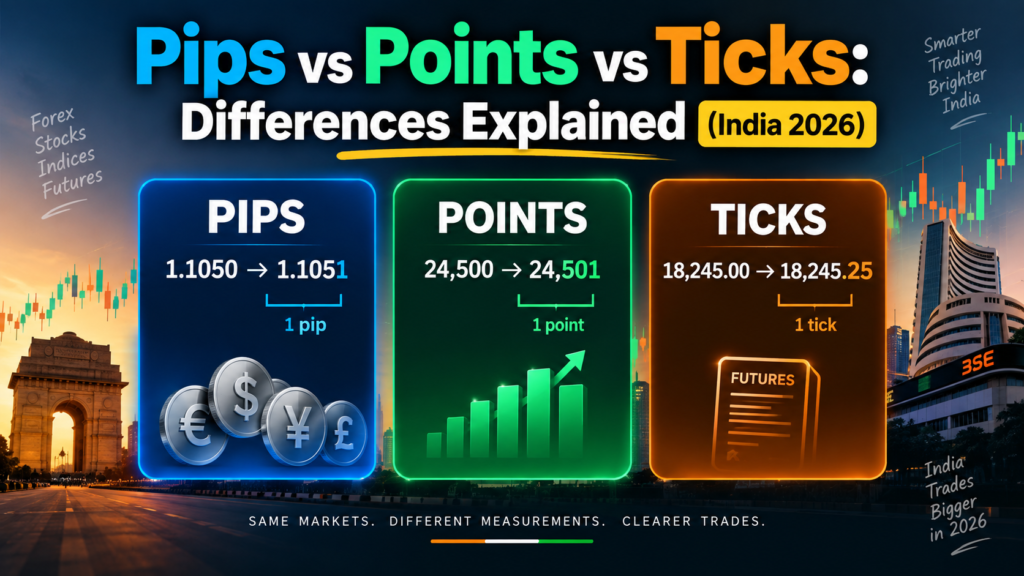
Quick answer: A pip is the standard unit of price change in forex, usually the 4th decimal (0.0001). A point is a whole-number move in price, such as Nifty going from 25,000 to 25,001. A tick is the smallest price step an exchange allows; in Nifty futures that is currently 0.10, so one point equals ten ticks.
If you have watched one video say “we caught 40 pips” and another say “Nifty moved 150 points,” you have seen two measuring systems. Add “the stock moved 3 ticks” and it gets confusing.
All three describe the same idea at different scales: how far price moved. None tells you how much money you made or lost until you combine it with your position size. That second step is where most beginners go wrong.
What is a pip?
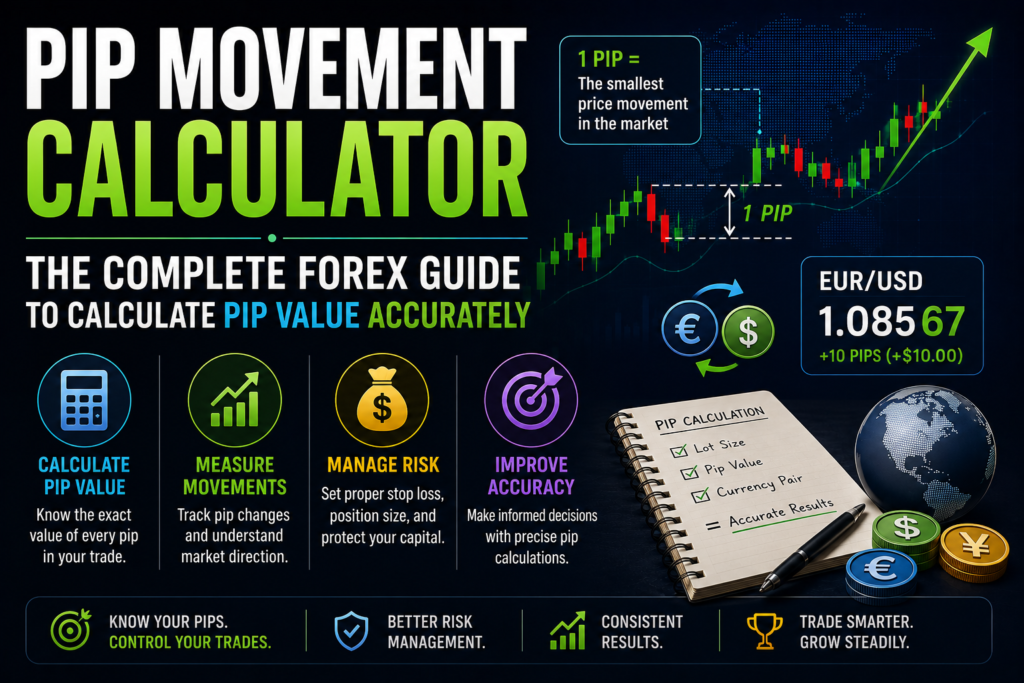
Definition: A pip (“percentage in point”) is the conventional smallest quoted move in a currency pair: 0.0001 for most pairs and 0.01 for yen pairs.
- EUR/USD moving from 1.0850 to 1.0851 = 1 pip.
- USD/JPY moving from 150.20 to 150.21 = 1 pip.
- Many platforms show a 5th decimal (3rd for yen). That extra digit is a pipette, one-tenth of a pip.
What is a pip worth?
Pip value = pip size × position size (in base-currency units), converted into your account currency if needed.
| Lot (global OTC convention) | Units | Value of 1 pip on EUR/USD |
|---|---|---|
| Standard | 100,000 | $10 |
| Mini | 10,000 | $1 |
| Micro | 1,000 | $0.10 |
Worked example (illustrative): EUR/USD rises from 1.0850 to 1.0875. That is 0.0025, or 25 pips. On one standard lot: 25 × $10 = $250.
The India twist: pips vs paise
Indian residents trade currencies legally through exchange-traded currency derivatives on recognised Indian exchanges. On NSE, INR pairs (USD, EUR, GBP and JPY against the rupee) have a tick of 0.25 paise (₹0.0025), and one USD/INR lot is $1,000. For permitted cross pairs, NSE’s tick is 0.0001 for EUR/USD and GBP/USD and 0.01 for USD/JPY, so tick and pip are the same there.

USD/INR worked example (illustrative):
- Tick value per lot = ₹0.0025 × 1,000 = ₹2.50
- USD/INR futures rise from 88.0000 to 88.0500 = ₹0.05 = 20 ticks
- P&L per lot = 20 × ₹2.50 = ₹50, before brokerage and taxes
Indian currency traders usually say “5 paise,” not “500 pips.” Using forex-style pip language for USD/INR is a common source of confusion.
What is a point?
Definition: A point is a move of one whole unit in the quoted price. In Indian markets it usually means ₹1 in a stock, or one index level in Nifty, Bank Nifty or Sensex.
Points in index trading
Points become money through the lot size. NSE cut the Nifty 50 lot from 75 to 65 and Bank Nifty from 35 to 30, from the 6 January 2026 weekly expiry and the 27 January 2026 monthly expiry.
Value of 1 point per lot = lot size × ₹1.
| Contract | Lot size (2026) | Value of 1 point per lot |
|---|---|---|
| Nifty 50 F&O | 65 | ₹65 |
| Nifty Financial Services | 60 | ₹60 |
| Bank Nifty F&O | 30 | ₹30 |
Worked example (illustrative): You buy 1 lot of Nifty futures at 25,000 and sell at 25,040. That is 40 points, so P&L = 40 × 65 = ₹2,600 per lot before costs. Lot sizes are revised periodically, so check NSE’s current contract file before trading.
Points in stocks and global indices
For a share, “up 12 points” means ₹12 per share. In US index futures, a point has a fixed dollar multiplier: one point in the CME E-mini S&P 500 is worth $50, and its tick is 0.25 point ($12.50). That is why US traders often talk in ticks and Indian traders in points.
What is a tick?
Definition: A tick (tick size) is the minimum price increment an exchange allows for a contract. You cannot place an order between two ticks.
Ticks are set by the exchange, so they are the most precise of the three units. With a ₹0.05 tick, price can go from ₹100.00 to ₹100.05, but ₹100.03 is not allowed.
NSE tick sizes for cash market and stock futures (verified September 2026)
| Stock price band | Tick size |
|---|---|
| Below ₹250 | ₹0.01 |
| ₹250–₹1,000 | ₹0.05 |
| ₹1,000–₹5,000 | ₹0.10 |
| ₹5,000–₹10,000 | ₹0.50 |
| ₹10,000–₹20,000 | ₹1.00 |
| Above ₹20,000 | ₹5.00 |
NSE reviews these bands monthly, using the closing price on the last trading day of each month.
Index futures: the tick depends on index level — 0.05 up to 15,000, 0.10 between 15,000 and 30,000, and 0.20 above 30,000 (effective April 15, 2025).
Options: index options use a 0.05 tick. Stock options use 0.01 when the underlying is below ₹250 and 0.05 at ₹250 and above.
How many ticks are in a point?
Ticks per point = 1 ÷ tick size.
| Instrument | Tick | Ticks per point | Tick value per lot |
|---|---|---|---|
| Nifty futures (index 15k–30k) | 0.10 | 10 | ₹6.50 |
| Nifty options | 0.05 | 20 | ₹3.25 |
| Stock priced ₹1,000–₹5,000 | ₹0.10 | 10 | ₹0.10 per share |
| MCX Gold (1 kg) | ₹1 per 10 g | 1 | ₹100 |
| USD/INR futures | ₹0.0025 | 400 | ₹2.50 |
MCX commodity ticks
The flagship MCX Gold contract covers 1 kg of 995-fineness gold, is quoted per 10 grams, and has a ₹1 tick per 10 grams.
P&L per tick = (lot size ÷ quotation unit) × tick size.
- Gold: (1,000 g ÷ 10 g) × ₹1 = ₹100 per tick
- Gold Mini (100 g): (100 ÷ 10) × ₹1 = ₹10 per tick
Worked example (illustrative): Gold futures rise ₹150 per 10 g, which is 150 ticks. One lot of Gold gains 150 × ₹100 = ₹15,000; one lot of Gold Mini gains ₹1,500.
Pips vs points vs ticks: side by side
| Pip | Point | Tick | |
|---|---|---|---|
| What it measures | Conventional smallest forex move | One whole unit of price | Exchange-set minimum increment |
| Who defines it | Market convention | Market convention | The exchange (under SEBI rules in India) |
| Typical size | 0.0001 (0.01 for JPY pairs) | 1.00 | Varies: ₹0.01 to ₹5; 0.05–0.20 for index futures |
| Main markets | Forex, cross-currency futures | Indices, stocks, commodities | Every exchange-traded contract |
| Indian example | EUR/USD on NSE (tick = 1 pip) | Nifty up 100 points | Nifty futures tick = 0.10 |
| Money value | Depends on lot size | Depends on lot size | Depends on lot size |
| Can it be split? | Yes, into pipettes | Yes, into ticks | No, it is the smallest step |
How to convert any move into rupees
- Find the tick size on the exchange contract specification page.
- Find the lot size (or number of units or shares).
- Tick value = tick size × lot size, adjusted for the quotation unit (e.g., gold per 10 g).
- Ticks moved = price move ÷ tick size.
- P&L = ticks × tick value × number of lots.
- Subtract brokerage, STT/CTT, exchange charges, GST and stamp duty.
Using the units for risk/reward: risking 20 Nifty points (₹1,300 per lot) to target 40 points (₹2,600 per lot) gives a risk/reward of 1:2. Planning in points keeps the math consistent; converting to rupees shows whether the risk fits your capital.
Timeline of tick and lot changes
| Date | Change |
|---|---|
| January 2026 | Nifty lot 75 → 65; Bank Nifty 35 → 30 |
| November 2025 | Stock options on underlyings below ₹250 move to a ₹0.01 tick |
| 15 April 2025 | Higher tick bands for costlier stocks; index futures get 0.10 / 0.20 ticks |
| 8 July 2024 | ₹0.01 tick extended to futures on stocks below ₹250 |
| 10 June 2024 | NSE cash stocks below ₹250 move from ₹0.05 to ₹0.01 tick |
Is forex trading in pips legal in India?
Most pip-based content online is aimed at offshore spot forex and CFD platforms. For Indian residents, trading on overseas online forex platforms is illegal and punishable under FEMA.
The RBI keeps an Alert List of entities not authorised to deal in forex under FEMA or to run a forex electronic trading platform. After its November 2025 update it had 95 names, and the RBI says an entity missing from the list should not be assumed authorised. Check RBI’s website for the latest version.

Practical takeaway: for currency exposure, use INR pairs or permitted cross-currency contracts through a SEBI-registered broker on NSE or BSE, where prices move in exchange-defined ticks.
Expert analysis
Advantages and disadvantages of each unit
| Unit | Advantages | Disadvantages |
|---|---|---|
| Pip | Universal across forex; easy to compare pairs | Not exchange-defined; pipettes cause decimal confusion; meaningless for Nifty |
| Point | Intuitive; how news reports index moves | Hides tick precision; rupee value changes when lot sizes are revised |
| Tick | Exact and exchange-defined; ideal for orders and stop-losses | Changes with price bands and index levels; varies by contract |
Risk level by instrument (beginner view)
| Instrument | Tick value per lot | Leverage risk | Beginner suitability |
|---|---|---|---|
| Cash-market shares | ₹0.01–₹5 per share | Low (no leverage by default) | Highest |
| USD/INR futures | ₹2.50 | Moderate | Moderate |
| Nifty futures | ₹6.50 | High | Low |
| MCX Gold Mini | ₹10 | High | Low |
| MCX Gold (1 kg) | ₹100 | Very high | Very low |
Fact: ticks are the only one of the three units an exchange formally defines. Pips and points are conventions.
Analysis: India’s recent tick policy moved two ways at once. Finer ₹0.01 ticks for low-priced stocks narrow the minimum possible spread. Coarser ticks for expensive stocks and index futures concentrate orders at fewer price levels. For a beginner, the effect is simple: every stop-loss or limit order must sit on a valid tick.
Analysis: lot-size changes quietly alter what a point is worth. A 50-point Nifty stop-loss cost ₹3,750 per lot at a lot size of 75; at 65 it costs ₹3,250.
Context on risk (fact): SEBI’s FY25 study found over 91% of individual traders lost money in equity derivatives, with net losses of ₹1,05,603 crore after transaction costs, up from ₹74,812 crore in FY24. Knowing these units won’t make you profitable, but it lets you measure risk before you take it.
Opinion: beginners should plan in ticks and rupees, not pips or points. Ticks match what the order book accepts; rupees match what your account feels.
Common mistakes
- Calling a USD/INR move “pips” and misjudging its value (the tick is 0.0025, not 0.0001).
- Assuming 1 Nifty point = ₹1; it is ₹65 per lot in 2026.
- Using outdated lot sizes (75 or 50) from old videos.
- Placing a limit order at a price that isn’t a valid tick, so it gets rejected.
- Applying a “100-pip target” from a US forex course to Indian exchange contracts.
Myths vs facts
| Myth | Fact |
|---|---|
| A pip is always 0.0001 | For yen pairs it is 0.01 |
| A point and a pip are the same | A point is a whole unit; a pip is a small forex decimal |
| Tick size is fixed forever | NSE reviews stock tick bands monthly |
| A basis point is a pip | A basis point is 0.01%, used for rates and yields |
| Offshore forex apps are fine if they accept UPI | Payment access isn’t authorisation; check the RBI Alert List |
Key takeaways
- Pip = forex convention, usually 0.0001 (0.01 for JPY pairs).
- Point = one whole unit of price (₹1 in stocks; one index level in Nifty).
- Tick = the exchange’s smallest allowed step, the only formally defined unit.
- Nifty futures: 0.10 tick, 10 ticks per point, ₹6.50 per tick and ₹65 per point per lot.
- MCX Gold: ₹1 tick per 10 g, ₹100 per tick per 1 kg lot.
- USD/INR futures: ₹0.0025 tick, ₹2.50 per tick per lot.
- Money value = ticks × tick value × lots, then subtract costs.
- Offshore pip-based forex trading is illegal for Indian residents under FEMA.
FAQs
1. What is the difference between pips, points and ticks?
A pip is the standard small move in forex (0.0001). A point is a whole-unit move, such as Nifty from 25,000 to 25,001. A tick is the smallest price step an exchange allows.
2. How much is 1 point in Nifty futures?
With the 2026 lot size of 65, one Nifty point equals ₹65 per lot, before costs.
3. What is the tick size of Nifty futures in 2026?
It is 0.10 when the index is between 15,000 and 30,000, and 0.20 above 30,000. One tick is worth ₹6.50 per lot in the 0.10 band.
4. What is the tick size of Nifty options?
Index options on NSE move in ticks of 0.05, worth ₹3.25 per Nifty lot of 65.
5. How many ticks are in one point?
Divide 1 by the tick size. A 0.10 tick gives 10 ticks per point; a 0.05 tick gives 20.
6. What is a pip in forex?
It is the fourth decimal place in most currency pairs (0.0001) and the second decimal in yen pairs (0.01).
7. What is a pipette?
A pipette is one-tenth of a pip, shown as the fifth decimal (or third for yen pairs) on many platforms.
8. How do you calculate pip value?
Multiply the pip size by the number of currency units traded. One standard lot of EUR/USD gives $10 per pip.
9. What is the tick size for USD/INR futures?
₹0.0025 (0.25 paise). With a $1,000 lot, each tick is worth ₹2.50.
10. What is one tick worth in MCX Gold?
MCX Gold has a ₹1 tick per 10 grams. On the 1 kg contract that is ₹100 per tick; on Gold Mini it is ₹10.
11. What is the tick size for NSE stocks?
It depends on price: ₹0.01 below ₹250, ₹0.05 up to ₹1,000, ₹0.10 up to ₹5,000, and higher for costlier shares.
12. Is a point the same as a pip?
No. A point is a full unit of price, while a pip is a small decimal step used in forex.
13. Why do US traders talk in ticks while Indians talk in points?
US futures such as the E-mini S&P 500 have a fixed dollar value per tick ($12.50), so ticks are convenient. Indian index moves are usually reported in points.
14. Is it legal to trade forex in pips in India?
Indian residents may trade permitted currency pairs on recognised Indian exchanges. Trading on overseas online forex platforms is illegal under FEMA.
15. Does tick size affect trading costs?
Yes. A smaller tick allows narrower bid-ask spreads, which can lower the cost of entering and exiting trades.
16. What is a basis point, and is it related?
A basis point is 0.01%, used for interest rates and bond yields. It is a percentage measure, not a price unit like a pip.