Quick answer
Trading psychology is the study of how emotions and mental biases affect trading decisions. For beginners, mastering trading psychology forex-style means learning to manage fear and greed, avoid biases like loss aversion and overconfidence, and follow a plan with discipline – because mindset, not strategy alone, determines long-term results.
Introduction
New traders spend months hunting for the perfect strategy, indicator or signal. Yet most who fail do not fail because of a bad strategy – they fail because of how they behave under pressure. That is why trading psychology forex education is arguably the most important skill a beginner can build, and the one most often ignored.
This guide introduces trading psychology for beginners from the ground up: the emotions that drive decisions, the biases that distort them, and the habits that build a calm, disciplined mind. Master these, and your strategy finally gets a chance to work. It is educational content, not financial advice.
What Is Trading Psychology?
Trading psychology is the study of the emotional and mental factors that influence how traders make decisions. It covers the feelings behind your trades – fear, greed, hope, regret – and the thinking errors that quietly steer you off course. In the context of forex, trading psychology forex principles explain why two people with the same strategy can get completely different results: the difference is discipline and emotional control, not the method.
Put simply, your strategy tells you what to do; your psychology decides whether you actually do it. A great plan followed poorly loses money, while a modest plan followed with discipline can thrive.
Why Trading Psychology Matters More Than Strategy
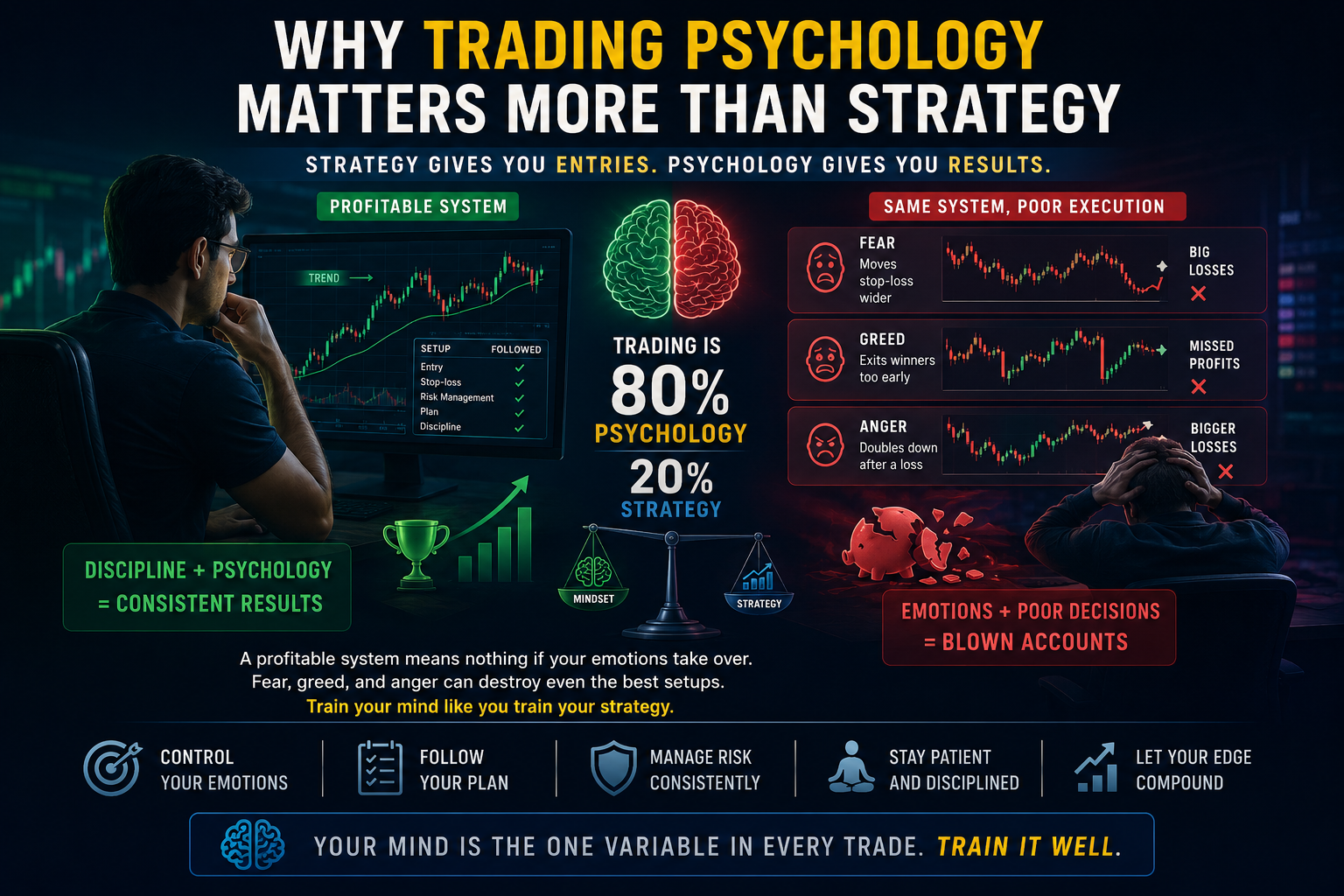
Experienced traders often say trading is 80% psychology and 20% strategy. Whatever the exact split, the point holds: execution is where money is made or lost. Consider a trader with a genuinely profitable system who moves their stop-loss out of fear, exits winners too early out of greed, and doubles down after a loss out of anger. The edge in the system is real, but their psychology destroys it before it can compound.
This is why strong trading psychology forex habits are non-negotiable. Your mind is the one variable present in every single trade – so it deserves as much training as any chart pattern.
The Two Core Emotions: Fear and Greed
Almost every trading mistake traces back to two emotions. Learning to notice them in real time is the foundation of trading psychology.
Fear
Fear makes traders exit winners too soon, hesitate on valid setups, or refuse to take a trade after a loss. It protects you from imagined danger but robs you of real opportunity when it is not managed.
Greed
Greed makes traders hold winners too long, risk too much on one idea, or add to positions chasing more profit. It turns a good trade into a bad one by ignoring the plan. Balancing fear and greed is the daily work of trading psychology.
Cognitive Biases That Sabotage Traders
Beyond raw emotion, the brain uses mental shortcuts that misfire in markets. Recognising these biases is a core part of trading psychology forex mastery.
| Bias | What it does to your trading |
|---|---|
| Loss aversion | Losses hurt about twice as much as gains, pushing you to hold losers too long. |
| Overconfidence | A few wins convince you that you can’t lose, so you over-risk. |
| Confirmation bias | You seek only information that agrees with your open trade. |
| Recency bias | You over-weight your last few trades and abandon a sound plan. |
| Anchoring | You fixate on a price (like your entry) instead of current reality. |
| Gambler’s fallacy | You believe a win is ‘due’ after a losing streak. |
Emotional Traps Beginners Fall Into
Certain patterns are so common among new traders that they have names. Each is a failure of trading psychology, not strategy:
- FOMO – jumping into a move late for fear of missing out, usually near the worst price.
- Revenge trading – impulsively trying to win back a loss with a bigger, unplanned trade.
- Overtrading – taking too many trades out of boredom or the need to feel active.
- Analysis paralysis – so much fear of being wrong that you never pull the trigger on valid setups.
- Moving the goalposts – shifting stops and targets mid-trade to avoid admitting a mistake.
How to Build a Strong Trading Mindset
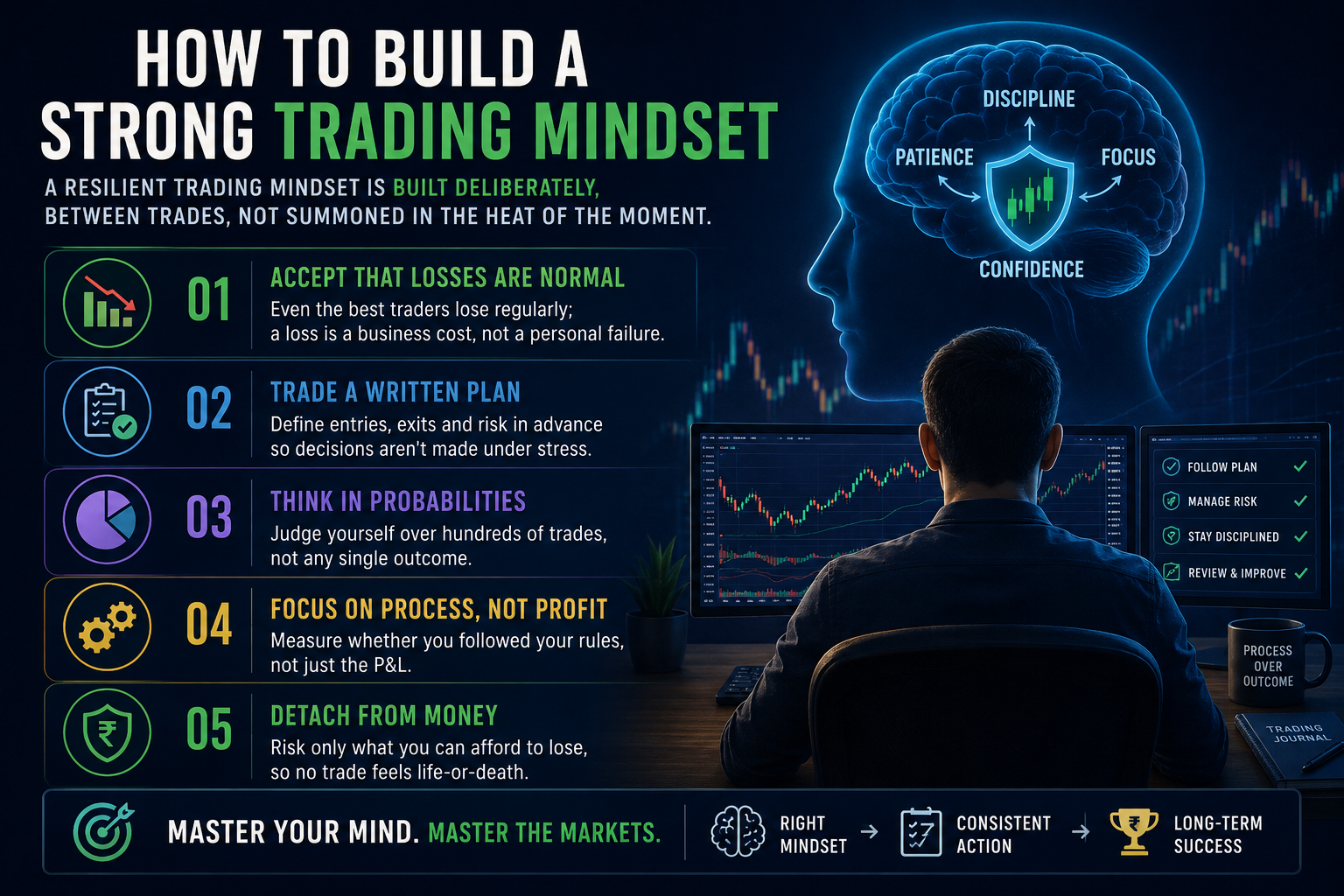
A resilient trading mindset is built deliberately, between trades, not summoned in the heat of the moment. Here is a practical framework:
- Accept that losses are normal – even the best traders lose regularly; a loss is a business cost, not a personal failure.
- Trade a written plan – define entries, exits and risk in advance so decisions aren’t made under stress.
- Think in probabilities – judge yourself over hundreds of trades, not any single outcome.
- Focus on process, not profit – measure whether you followed your rules, not just the P&L.
- Detach from money – risk only what you can afford to lose, so no trade feels life-or-death.
Emotional-Control Techniques That Work
Managing emotions is a skill you can practise. These techniques strengthen the core of trading psychology forex discipline:
- Keep a trading journal – record the emotion behind each trade to expose your patterns.
- Use a pre-trade checklist – a valid setup must tick every box before you enter.
- Take scheduled breaks – step away after a loss or a big win to reset your state.
- Breathe and slow down – a few deep breaths calm the stress response before you act.
- Set daily limits – stop for the day after a fixed number of losses or a loss cap.
The Role of Risk Management and a Trading Plan
Good trading psychology and good risk management are inseparable. When you risk only a small, fixed percentage per trade – many traders use 1-2% – no single loss can trigger panic, so the emotions that fuel revenge trading and overtrading lose their power. Risk rules are, in effect, psychology made mechanical: they make the disciplined choice the automatic one.
A written trading plan does the same job for decisions. By deciding your entries, exits and risk in a calm moment, you remove the need to decide under stress – which is exactly when trading psychology tends to break down.
An Illustrative Example
Two beginners take the same signal. The first, with weak trading psychology, risks 10% on a hunch, panics when price dips, moves the stop, and ends up with a large loss. The second risks a planned 1%, lets the trade play out to its predefined stop or target, and accepts the result calmly. Over one trade the difference looks small; over a year, the disciplined trader is still in the game while the other has likely blown the account. Same market, same signal – different psychology. (Illustrative scenario.)
Myths vs Facts
| Fact |
|---|
| You can’t delete emotions; the skill is managing them, not suppressing them. |
| Execution and discipline decide outcomes as much as the strategy itself. |
| Healthy trading confidence includes accepting uncertainty and losses. |
| Even professionals actively manage their mindset every session. |
A note on wellbeing
If trading is causing you persistent stress, sleeplessness, or the urge to chase losses at any cost, please step back and consider speaking with a mental-health professional or a problem-gambling helpline in your region. Protecting your wellbeing always comes before any trade.
Learn more about Trading Psychology: Beating Overtrading, FOMO & Revenge Trading
Expert Analysis
The most useful reframe for a beginner is to stop treating trading psychology as a soft, optional topic and start treating it as the operating system on which every strategy runs. A strategy is just a set of instructions; psychology determines whether those instructions are followed cleanly or corrupted by fear, greed and bias. This is why two traders with an identical system produce opposite results – and why the fix is rarely a new indicator.
In practice, the traders who master trading psychology forex challenges do it structurally, not heroically. They do not rely on feeling calm; they build systems – fixed risk, written plans, daily loss limits, journaling – that make the disciplined action the default even on a bad day. Willpower is unreliable under stress, so the goal is to need as little of it as possible. Mindset, in the end, is engineered more than it is willed.
Key Takeaways
- Trading psychology is how emotions and biases shape trading decisions – often more than strategy does.
- Fear and greed drive most beginner mistakes; the skill is managing, not deleting, them.
- Biases like loss aversion, overconfidence and confirmation bias quietly sabotage traders.
- Build a mindset with a written plan, probabilistic thinking and a focus on process over profit.
- Fixed risk and a trading plan turn good trading psychology into automatic behaviour.
Frequently Asked Questions (FAQ)
Q: What is trading psychology?
A: Trading psychology is the study of how emotions and mental biases influence trading decisions, and how managing them improves consistency.
Q: Why is trading psychology important in forex?
A: Because execution – following your plan under pressure – decides results. Even a profitable strategy fails if emotions override it.
Q: What are the main emotions in trading?
A: Fear and greed are the two core emotions, along with hope, regret and frustration, all of which can distort decisions.
Q: How do I control my emotions while trading?
A: Trade a written plan, risk a small fixed amount, keep a journal, use a pre-trade checklist, take breaks and set daily loss limits.
Q: Is trading really 80% psychology?
A: The exact figure varies, but the principle is widely accepted: mindset and discipline matter at least as much as the strategy.
Q: What is loss aversion in trading?
A: The tendency to feel losses about twice as strongly as equivalent gains, which pushes traders to hold losers and cut winners too early.
Q: How do I stop revenge trading?
A: Pause after losses, set a daily loss limit, trade only valid setups and keep risk fixed so no single loss triggers an impulsive reaction.
Q: What is FOMO in trading?
A: Fear of missing out – entering a move late because you’re afraid of missing profit, usually at a poor price.
Q: How can beginners build a trading mindset?
A: Accept losses as normal, think in probabilities, focus on process over profit, and detach from the money by risking only what you can lose.
Q: Does a trading journal help psychology?
A: Yes. Recording the emotion behind each trade reveals patterns you can then correct, strengthening discipline over time.
Q: Can you trade without emotions?
A: No – emotions are part of being human. The goal is to manage and channel them, not eliminate them.
Q: How does risk management affect psychology?
A: Small, fixed risk keeps any single loss from triggering panic, which removes the fuel for revenge trading and overtrading.
Q: What is overtrading?
A: Taking too many trades – often out of boredom or a need to feel active – rather than waiting for valid setups.
Q: How long does it take to master trading psychology?
A: It is an ongoing practice rather than a destination; even professionals actively manage their mindset every session.
Q: Is trading psychology different from investing psychology?
A: The core emotions and biases overlap, but trading’s faster pace and frequent decisions make emotional control even more critical.