
Introduction
Every currency futures and options contract on NSE has a fixed life. On a set day it stops trading, and every open position is settled in cash at an official rate. If you trade USD/INR or any other currency pair on the exchange, knowing the currency futures expiry date NSE uses is basic risk management. Missing it can leave you with a position settled at a price you did not choose, or a rollover done in a hurry at a poor rate.
This guide explains how the currency futures expiry date NSE assigns to monthly and weekly contracts is worked out. It also covers the 12:30pm cut-off on expiry day, how the final settlement price is set from the RBI reference rate, mark-to-market and final settlement timelines, holiday adjustments, cross-currency contracts, rollover and how the profits are taxed.
What Are Currency Derivatives on NSE?
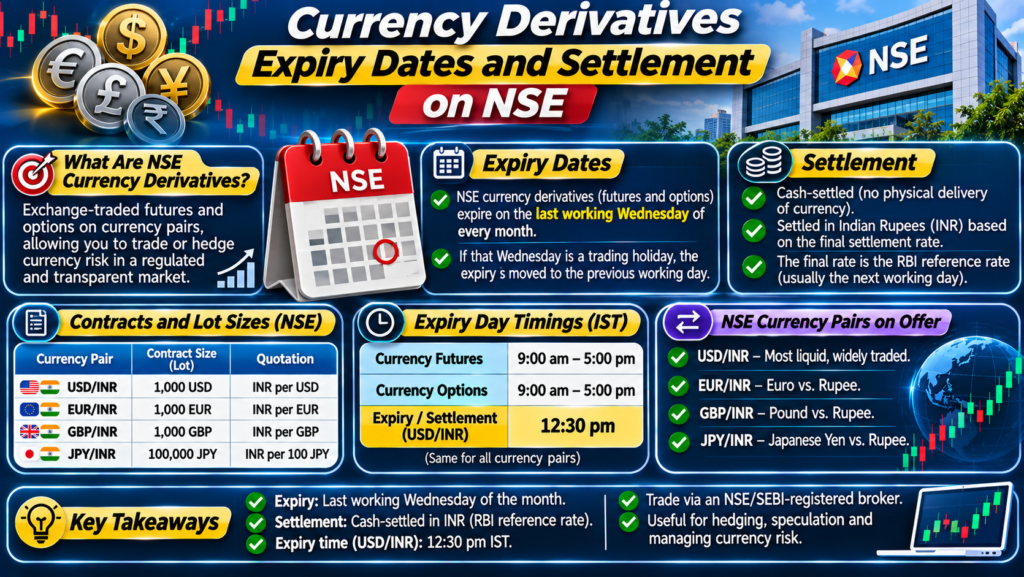
Currency derivatives are exchange-traded futures and options on currency pairs. Indian residents can trade them on NSE and BSE through SEBI-registered brokers. This is the legal route, because the Foreign Exchange Management Act (FEMA) does not allow residents to trade leveraged forex on offshore platforms.
NSE offers contracts on seven pairs:
- Rupee pairs: USD/INR, EUR/INR, GBP/INR and JPY/INR.
- Cross-currency pairs: EUR/USD, GBP/USD and USD/JPY.
The lot size is $1,000 for USD/INR, €1,000 for EUR/INR, £1,000 for GBP/INR and ¥1,00,000 for JPY/INR. For the crosses it is €1,000 for EUR/USD, £1,000 for GBP/USD and $1,000 for USD/JPY. All contracts are cash-settled in Indian rupees. No foreign currency is delivered.
How the Currency Futures Expiry Date NSE Uses Is Set (Monthly Contracts)
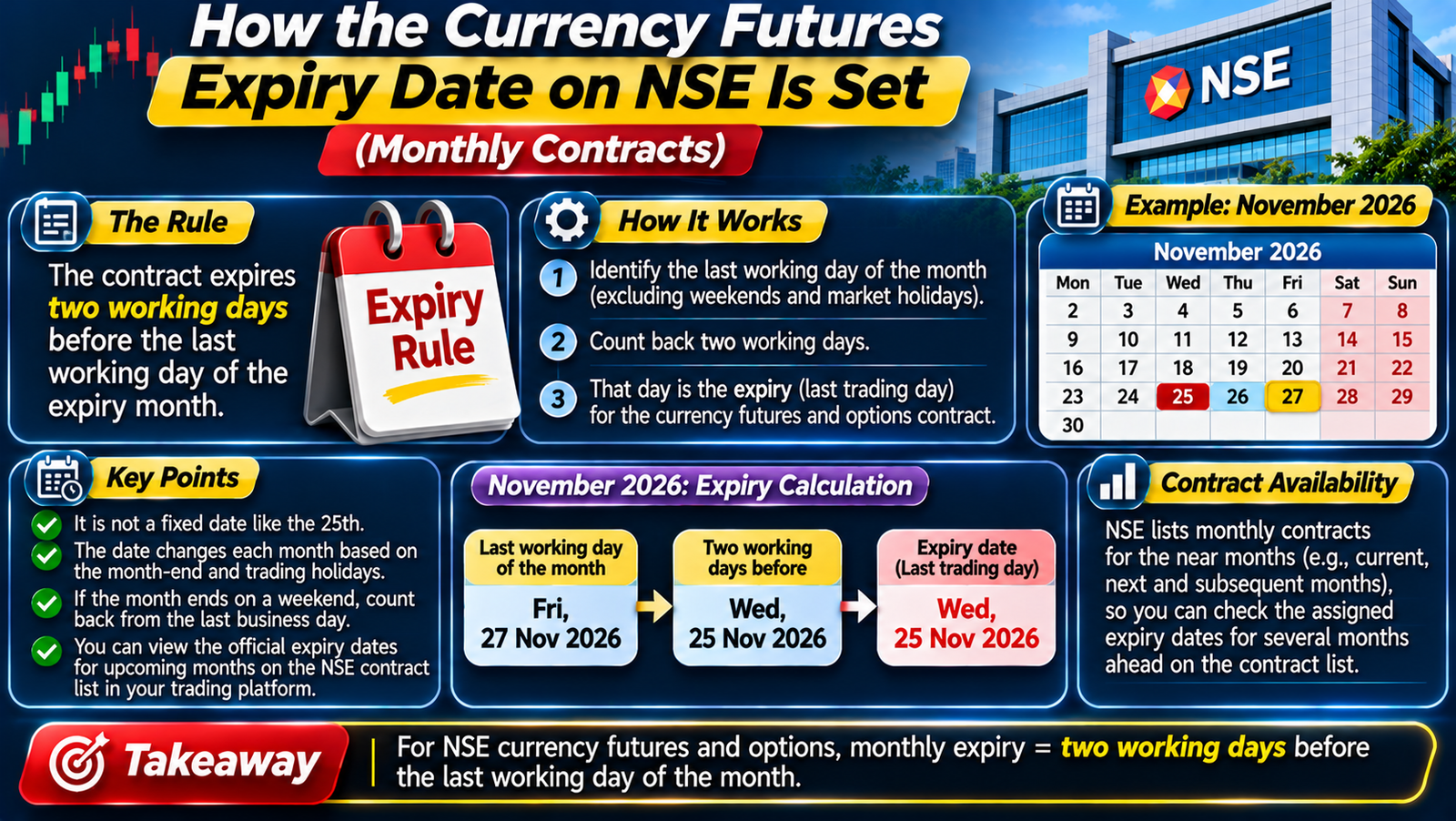
Monthly currency futures and options follow one simple rule. The contract expires two working days before the last working day of the expiry month. That day is the last trading day.
So the currency futures expiry date NSE assigns is not a fixed calendar date like the 25th. It moves each month depending on where the month ends and which days are holidays. If the month ends on a weekend, count back from the last business day, not from the last calendar day.
The exchange lists monthly contracts for the near months and some further months ahead, so you can see the currency futures expiry date NSE has set for several months on the contract list in your trading platform.
Trading stops at 12:30pm on expiry day
Rupee pairs normally trade from 9:00am to 5:00pm IST. On the last trading day, the expiring contract stops trading at 12:30pm IST. This is because the RBI publishes its reference rate around midday, and that rate is used for final settlement. Contracts for later months continue to trade as usual until 5:00pm.
Many new traders assume they can exit an expiring position in the afternoon. They cannot. Plan any exit or rollover for the morning of the currency futures expiry date NSE has set, or earlier.
Weekly Currency Futures and Options Expiry
NSE also offers weekly contracts on USD/INR. Weekly options were introduced around December 2018, and weekly USD/INR futures were launched on 11 October 2021, with serial weekly contracts listed ahead.
The weekly rule is different from the monthly one:
- Weekly contracts expire on Friday of the expiry week.
- Trading in the expiring weekly contract stops at 12:30pm IST, as with monthly contracts.
- If Friday is a trading holiday, the contract usually expires on the previous working day.
Weekly contracts suit traders who want to hedge or take a view around one data release or event. But they also bring frequent expiry days, so you must track each currency futures expiry date NSE lists on the weekly series as well as the monthly one.
Currency Futures Expiry Date NSE: Monthly vs Weekly Comparison
| Feature | Monthly contracts | Weekly contracts |
|---|---|---|
| Pairs | All seven pairs | Mainly USD/INR |
| Expiry day | Two working days before the last working day of the month | Friday of the expiry week |
| Trading cut-off on expiry day | 12:30pm IST | 12:30pm IST |
| Holiday on expiry day | Moves to the previous working day | Moves to the previous working day |
| Final settlement price | RBI reference rate on the last trading day | RBI reference rate on the last trading day |
| Settlement | Cash in INR | Cash in INR |
What Happens After the Currency Futures Expiry Date NSE Sets: Settlement
Settlement on NSE happens in two stages: daily mark-to-market and final settlement.
Daily mark-to-market (MTM)
Every open futures position is marked to the day’s settlement price at the end of each trading day. If the price moved in your favour, the profit is credited; if it moved against you, the loss is debited. MTM is settled in cash on a T+1 basis, meaning the next working day. This is why you need enough margin in your account each day, not just on expiry.
Final settlement
On the currency futures expiry date NSE has set, all open positions in the expiring contract are closed at the final settlement price. The final profit or loss is then paid in rupees. Final settlement is completed on a T+2 basis, two working days after the last trading day. Under the monthly rule, that usually lands on the last working day of the month.
The final settlement price
- USD/INR, EUR/INR, GBP/INR and JPY/INR: the RBI reference rate published on the last trading day.
- EUR/USD, GBP/USD and USD/JPY: a cross rate derived from the RBI reference rates on the last trading day, as set out in NSE’s contract specifications.
Because the RBI reference rate is calculated from market rates around midday, the final settlement price can differ slightly from the last traded price of the futures contract. Traders who hold to expiry accept that small gap.
How options settle
Currency options on NSE are European style, so they can only be exercised at expiry. On the expiry day, in-the-money options are exercised automatically and settled in cash against the same RBI reference rate. Out-of-the-money options expire worthless. The premium is paid and received in rupees.
Holidays and the Currency Futures Expiry Date NSE Calendar
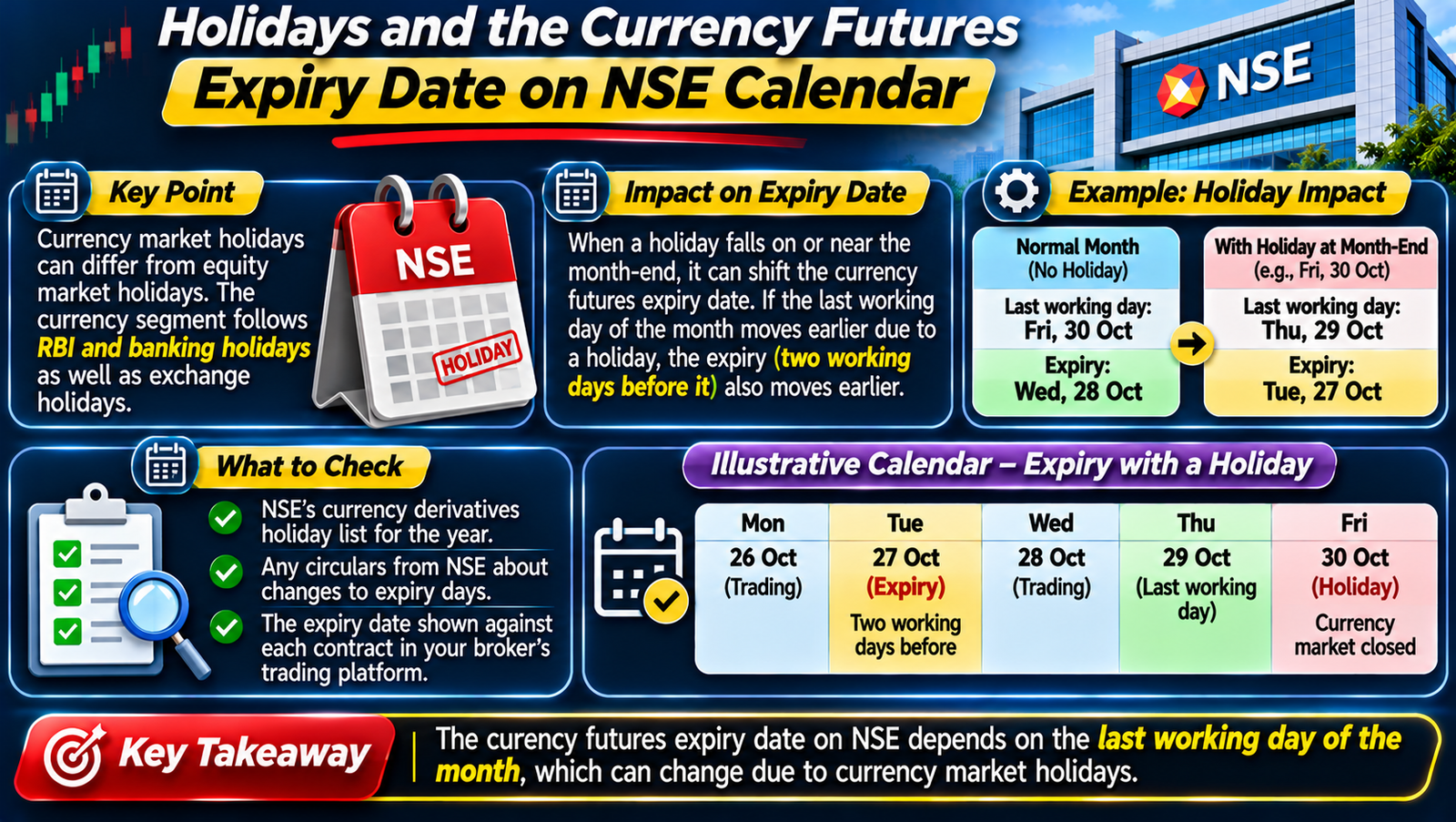
Currency market holidays can differ from equity market holidays. The currency segment follows RBI and banking holidays as well as exchange holidays, so a day when shares trade may still be closed for currency trading, and the reverse.
When a holiday falls on or near the end of the month, it can shift the currency futures expiry date NSE uses. For example, if the last working day itself moves earlier because of a holiday, the expiry, which is two working days before it, moves earlier too. Always check:
- NSE’s currency derivatives holiday list for the year.
- Any circular NSE issues about changes to expiry days.
- The expiry date shown against each contract in your broker’s platform.
 Worked Example: Finding the Expiry and Settling a Trade
This example is illustrative. The prices are hypothetical, and the dates assume no extra holidays, so confirm them on NSE’s calendar.
Step 1: find the expiry. In November 2026, the last day of the month, 30 November, is a Monday and a working day. Two working days before it are Friday 27 November (one) and Thursday 26 November (two). So the November monthly contract would expire on Thursday 26 November 2026, with trading in it ending at 12:30pm.
For December 2026, 31 December is a Thursday. Counting back two working days gives Wednesday 30 December (one) and Tuesday 29 December (two). The December contract would expire on Tuesday 29 December 2026.
Step 2: settle the trade. A trader buys 10 lots of the November USD/INR future at 88.50 and holds it to expiry. Assume the RBI reference rate on 26 November is 88.80.
- Move: 88.80 − 88.50 = 0.30 rupees, or 30 paise.
- Value per paise per lot: ₹10 (because 1 lot = $1,000).
- Profit: 30 paise × ₹10 × 10 lots = ₹3,000, before brokerage, exchange charges, GST and stamp duty.
Part of this profit would already have been received through daily MTM. Final settlement pays only the difference between the last daily settlement price and the final settlement price.
Rolling Over Before the Currency Futures Expiry Date NSE Sets
If you want to keep a position beyond the currency futures expiry date NSE has set, you need to roll it over. That means closing the expiring contract and opening the same position in the next month’s contract.
- Roll early. Liquidity often moves to the next month in the days before expiry. Rolling a day or two early avoids the rush before the 12:30pm cut-off.
- Watch the spread between months. The next-month contract usually trades at a premium to the near month for USD/INR, reflecting the interest rate difference between India and the US. You pay or receive this difference when you roll.
- Use a calendar spread order if your broker offers one, so both legs are filled together.
- Check the margin. You will need margin for the new contract before the old one settles.
Position Limits and Regulatory Points
Position limits also matter as the currency futures expiry date NSE has set approaches. Exchanges set position limits for clients, brokers and banks in currency derivatives, and these apply until each contract expires. The RBI also controls who can trade without showing an underlying currency exposure. From 10 October 2026, the RBI reduced the limit for taking positions without an underlying exposure from $100 million to $5 million. For most retail traders this is far above their trading size, but larger traders and businesses should check how it applies to them with their broker.
Brokers may also raise margins or restrict new positions in the expiring contract close to expiry.
How Currency Derivatives Profits Are Taxed
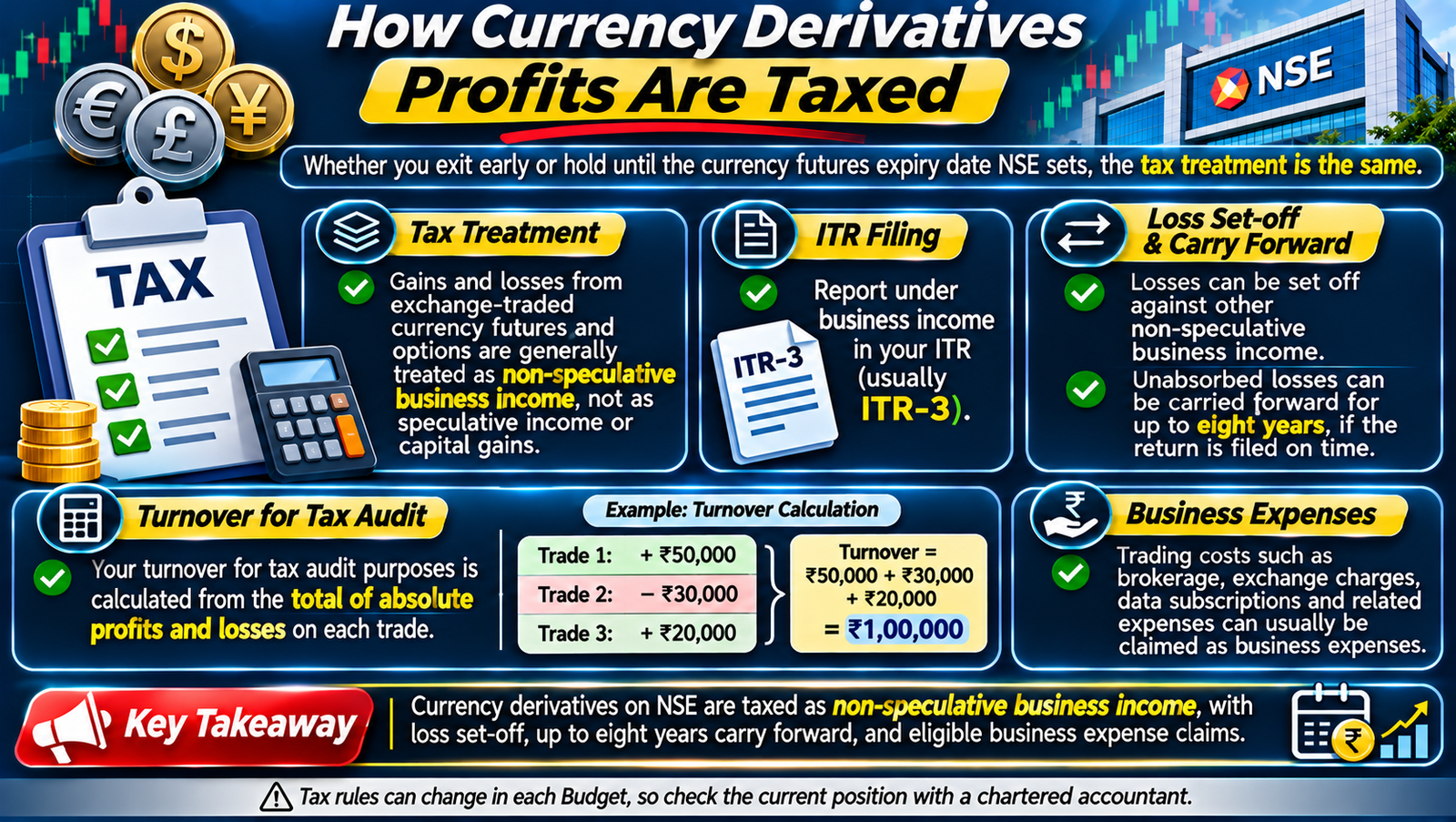
Whether you exit early or hold until the currency futures expiry date NSE sets, the tax treatment is the same. Gains and losses from exchange-traded currency futures and options are generally treated as non-speculative business income, not as speculative income or capital gains. This means:
- You report them under business income in your ITR (usually ITR-3).
- Losses can be set off against other non-speculative business income and carried forward for up to eight years if the return is filed on time.
- Your turnover for tax audit purposes is calculated from the total of absolute profits and losses on each trade.
- Trading costs such as brokerage and data subscriptions can usually be claimed as business expenses.
Tax rules can change in each Budget, so check the current position with a chartered accountant.
Common Mistakes Around the Currency Futures Expiry Date NSE Sets
- Assuming expiry is the last day of the month. It is two working days before the last working day.
- Planning to exit in the afternoon. The expiring contract stops at 12:30pm.
- Forgetting weekly contracts expire every Friday. A weekly position can expire much sooner than you think.
- Ignoring the holiday calendar. A banking holiday can bring the currency futures expiry date NSE uses forward.
- Rolling at the last minute. Spreads can widen as liquidity thins before the cut-off.
- Not keeping enough margin. Daily MTM losses must be paid even if you plan to hold to expiry.
Expiry Day Checklist
- Note every currency futures expiry date NSE lists for the contracts you hold, monthly and weekly.
- Check NSE’s holiday list for the month.
- Decide in advance whether you will exit, roll or hold to settlement.
- Complete exits or rollovers before 12:30pm on expiry day.
- Make sure you have margin for new positions and MTM.
- Check the final settlement price and your contract note after settlement.
FAQs
What is the currency futures expiry date NSE uses for monthly contracts?
Monthly contracts expire two working days before the last working day of the expiry month, with trading stopping at 12:30pm IST on that day.
When do weekly USD/INR contracts expire?
Weekly contracts expire on Friday of the expiry week, also at 12:30pm. If Friday is a holiday, expiry generally moves to the previous working day.
What price are currency futures settled at on expiry?
Rupee pairs settle at the RBI reference rate on the last trading day. Cross-currency pairs settle at a cross rate derived from RBI reference rates, as per NSE’s specifications.
When is the money credited after expiry?
Daily MTM is settled T+1. Final settlement is completed T+2, two working days after the last trading day.
Do I get US dollars if I hold USD/INR futures to expiry?
No. All NSE currency derivatives are cash-settled in Indian rupees. Only the profit or loss is paid.
Where can I check the exact currency futures expiry date NSE has set?
Check NSE’s currency derivatives contract specifications and holiday calendar, and the expiry date shown against each contract in your broker’s platform.
Conclusion
The rules are simple once you know them. Monthly contracts expire two working days before the last working day of the month, weekly USD/INR contracts expire on Fridays, and expiring contracts stop trading at 12:30pm. Positions then settle in rupees at the RBI reference rate, with MTM paid T+1 and final settlement T+2.
Put each currency futures expiry date NSE publishes into your trading calendar, check the holiday list every month and plan your exits and rollovers early. That small habit protects you from forced settlements, rushed rollovers and avoidable losses.