

Introduction
Price charts show what the market has done. Positioning data shows who is behind those moves and how crowded a trade has become. One of the most widely used sources of positioning information is the Commitment of Traders (COT) report, published every week by the US Commodity Futures Trading Commission (CFTC).
For currency traders, the COT report forex data reveals how large speculators, institutional investors and hedgers are positioned in currency futures. It can show when a trade is extremely crowded, when sentiment is shifting and whether big players are confirming or contradicting the trend.
This guide explains what the COT report is, the main report types, the trader categories, how to read currency positions, how to build a simple COT index, worked examples and the limits of using COT report forex analysis.
What Is the COT Report?
The COT report is a weekly breakdown of open interest in US futures markets, showing how different groups of traders are positioned. It covers commodities, interest rates, stock indices and currencies.
- Publisher: the US Commodity Futures Trading Commission (CFTC).
- Data date: positions as of the close of business on Tuesday.
- Release: usually Friday at 3:30pm US Eastern Time.
- Markets covered for forex: CME currency futures such as the euro, Japanese yen, British pound, Swiss franc, Canadian dollar, Australian dollar, New Zealand dollar and Mexican peso, plus US Dollar Index futures.
Because the spot forex market is decentralized and has no single source of positioning data, the COT report forex traders use is one of the few transparent, regular windows into how big participants are positioned.

COT Release Time in Indian Time
| Period | US release time | IST |
|---|---|---|
| US standard time (winter) | Friday 3:30pm ET | Saturday 2:00am |
| US daylight saving time (summer) | Friday 3:30pm ET | Saturday 1:00am |
For Indian traders, the report is available over the weekend, which makes it useful for weekly planning before markets open on Monday. Release dates can shift around US public holidays.
Types of COT Reports
The CFTC publishes several versions, and choosing the right one is the first decision in COT report forex analysis:
| Report | Trader categories | Use for forex |
|---|---|---|
| Legacy report | Commercial, non-commercial, non-reportable | The traditional view; “non-commercials” are often treated as large speculators |
| Traders in Financial Futures (TFF) | Dealer/intermediary, asset manager/institutional, leveraged funds, other reportables, non-reportable | The more detailed report for currency, interest rate and equity index futures |
| Disaggregated report | Producers, swap dealers, managed money and others | Mainly for commodities, not currencies |
Many COT report forex traders still use the legacy report because it has a long history, while others prefer the TFF report because it separates hedge funds from institutional investors.
Understanding the Trader Categories
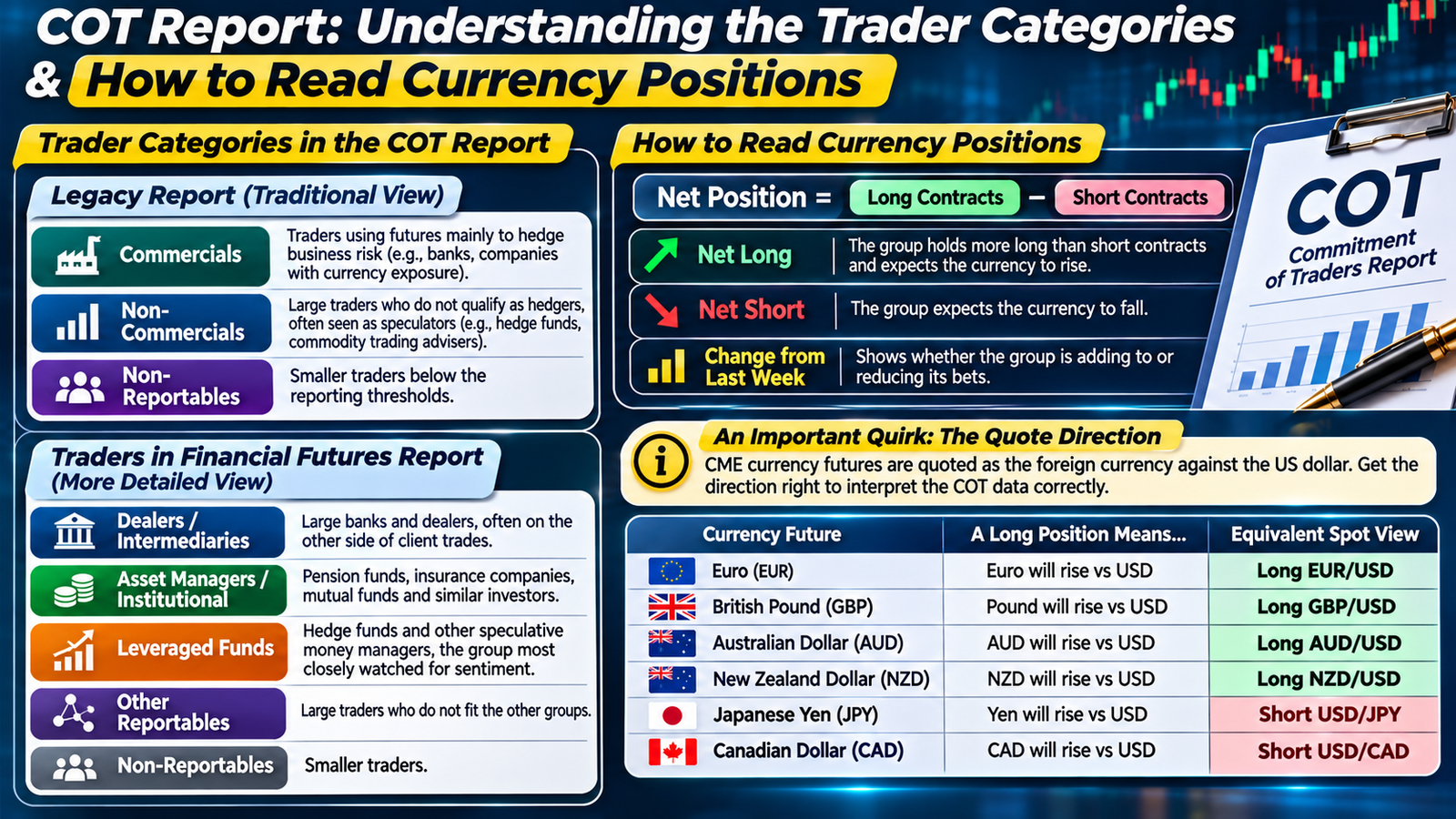
Legacy report
- Commercials: traders using futures mainly to hedge business risk, such as banks and companies with currency exposure.
- Non-commercials: large traders who do not qualify as hedgers, often seen as speculators such as hedge funds and commodity trading advisers.
- Non-reportable: smaller traders below the reporting thresholds.
Traders in Financial Futures report
- Dealers/intermediaries: large banks and dealers, often on the other side of client trades.
- Asset managers/institutional: pension funds, insurance companies, mutual funds and similar investors.
- Leveraged funds: hedge funds and other speculative money managers, the group most closely watched for sentiment.
- Other reportable: large traders who do not fit the other groups.
- Non-reportable: smaller traders.
How to Read Currency Positions
The key figure in COT report forex analysis is net positioning:
Net position = long contracts − short contracts
- Net long: the group holds more long than short contracts and expects the currency to rise.
- Net short: the group expects the currency to fall.
- Change from last week: shows whether the group is adding to or reducing its bets.
An important quirk: the quote direction
CME currency futures are quoted as the foreign currency against the US dollar. A long position in Japanese yen futures is a bet that the yen will rise, which is equivalent to being short USD/JPY. Similarly, long Canadian dollar futures equal short USD/CAD. For euro, pound, Australian dollar and New Zealand dollar futures, a long position matches being long EUR/USD, GBP/USD, AUD/USD and NZD/USD.
Getting this direction right is one of the most important steps in reading the COT report forex data correctly.
Contract sizes
| CME futures contract | Contract size |
|---|---|
| Euro | €125,000 |
| Japanese yen | ¥12,500,000 |
| British pound | £62,500 |
| Swiss franc | CHF 125,000 |
| Canadian dollar | CAD 100,000 |
| Australian dollar | AUD 100,000 |
Converting net contracts into dollar values helps compare positioning across currencies.
Building a Simple COT Index
Raw net positions can be hard to compare over time. Many traders use a COT index to see where current positioning sits relative to its recent range:
COT index = (current net position − lowest net position in the period) ÷ (highest − lowest) × 100
- A reading near 100 means positioning is at the most bullish level of the look back period.
- A reading near 0 means it is at the most bearish level.
- Common look back periods range from 26 weeks to three years.
COT Report Forex Worked Example: A Crowded Yen Short
This example is illustrative and uses hypothetical figures.
- Leveraged funds hold a net short of 120,000 Japanese yen futures contracts.
- Over the past three years, their net position has ranged from −125,000 to +40,000.
- COT index = (−120,000 − (−125,000)) ÷ (40,000 − (−125,000)) × 100 = 5,000 ÷ 165,000 × 100 ≈ 3.
A reading of about 3 means speculators are near their most bearish on the yen in three years, which is equivalent to being heavily long USD/JPY. This does not mean the trend must reverse, but it warns that the trade is crowded. If a catalyst appears, such as a hawkish Bank of Japan surprise, short-covering could drive a sharp yen rally, as happened in some past episodes when crowded yen shorts unwound quickly.
COT Report Forex Worked Example: Trend Confirmation
This example is illustrative and uses hypothetical figures.
- EUR/USD has been rising for six weeks.
- Leveraged funds have moved from a small net short to a moderate net long in euro futures, and their position is still growing.
- The COT index is around 60, well below extreme levels.
Here positioning confirms the trend without being crowded. A trader might treat this as support for staying with the uptrend, while still using technical levels and stop-losses.
How Traders Use COT Report Forex Data
- Spot extremes: very high or very low COT index readings can warn of crowded trades and the risk of sharp reversals.
- Confirm trends: rising positioning in the direction of the trend suggests big players support the move.
- Track shifts: a turn in positioning after a long build-up can signal changing sentiment.
- Compare groups: leveraged funds and asset managers sometimes take opposite views; asset managers often move more slowly and steadily.
- Plan the week: review the weekend report to set your bias and key levels before Monday.
Limitations of the COT Report
COT report forex signals have real weaknesses that every trader should know:
- Time lag: data is as of Tuesday and released on Friday, so positions may have changed by the time you read it.
- Futures only: it covers US-listed futures, not the much larger over-the-counter spot and forward market.
- Not a timing tool: crowded positions can stay crowded for weeks or months before reversing.
- Category blurring: traders can be classified in ways that do not perfectly match their motives.
- Limited rupee coverage: the COT report is not a meaningful source of positioning data for the Indian rupee.
Because of these limits, COT report forex analysis works best as a background sentiment tool, combined with price action, fundamentals and risk management.
COT Report Forex Analysis for Indian Traders
Indian traders can use COT data to understand positioning in the major currencies that also trade on Indian exchanges as cross-currency contracts, such as EUR/USD, GBP/USD and USD/JPY. Positioning in US Dollar Index futures can also help gauge broad dollar sentiment, which matters for USD/INR.
For rupee positioning itself, traders usually look at other sources, such as open interest data from NSE and BSE, foreign portfolio investment flows and RBI reserves data.
Indian residents can trade currency views through exchange-traded currency derivatives on NSE and BSE via SEBI-registered brokers. Contracts include USD/INR, EUR/INR, GBP/INR and JPY/INR, along with EUR/USD, GBP/USD and USD/JPY. One USD/INR lot is $1,000, so a one-paisa move is worth ₹10 per lot. Leveraged forex through offshore brokers is not permitted for Indian residents under FEMA.
Step-by-Step: Reading the COT Report Each Week
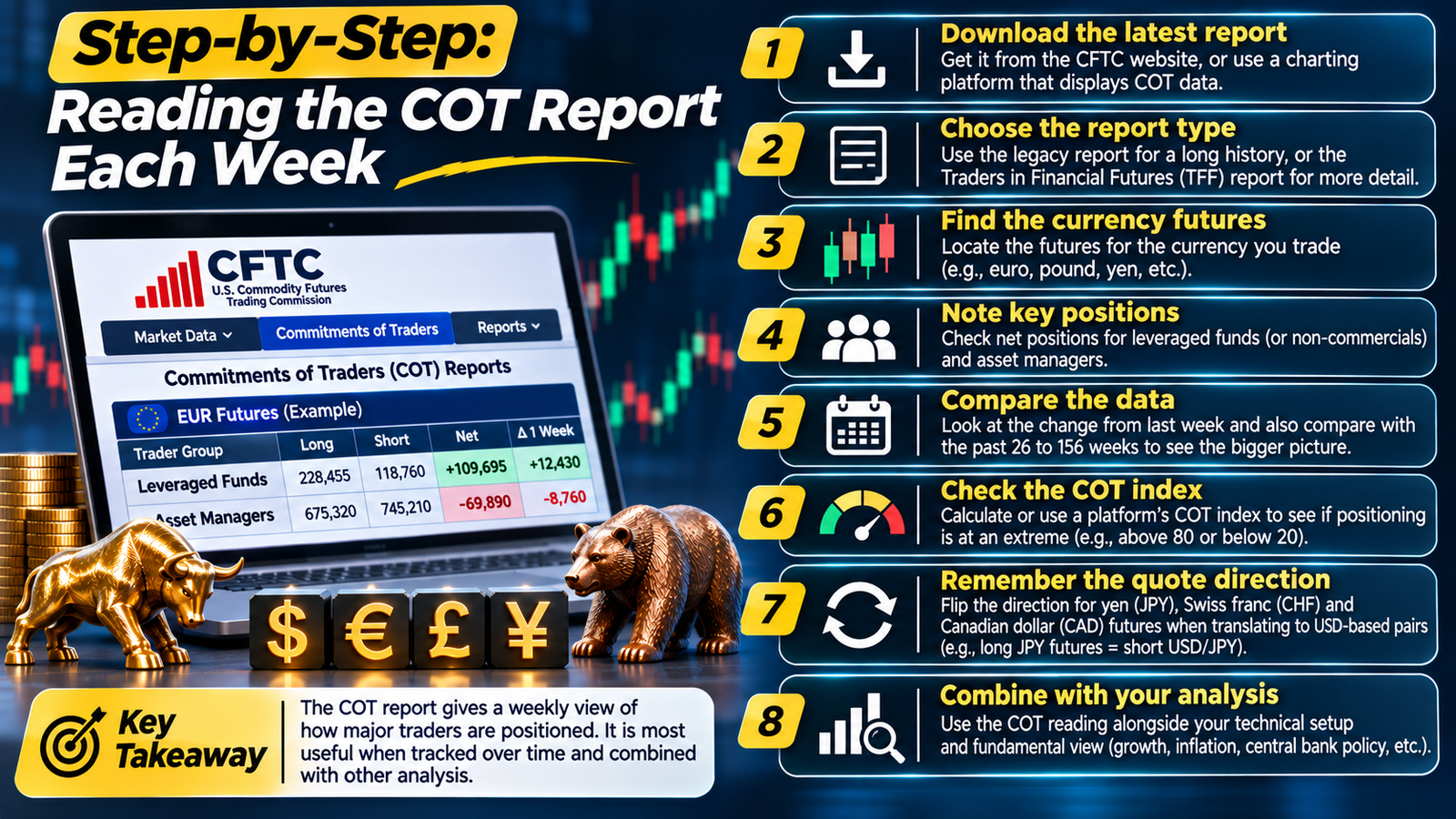
- Download the latest report from the CFTC website, or use a charting platform that displays COT data.
- Choose the report type: legacy for long history, TFF for more detail.
- Find the currency futures you trade.
- Note net positions for leveraged funds (or non-commercials) and asset managers.
- Compare with last week and with the past 26 to 156 weeks.
- Calculate or check the COT index.
- Remember to flip direction for yen, Swiss franc and Canadian dollar futures when translating to USD-based pairs.
- Combine the reading with your technical and fundamental view.
 COT Report Forex Positioning vs Other Sentiment Tools
| Tool | What it shows | Strength | Weakness |
|---|---|---|---|
| COT report | Futures positioning of large traders | Official, consistent, long history | Weekly and delayed |
| Broker sentiment data | Share of a broker’s retail clients long or short | Frequent updates | Covers only one broker’s clients |
| Options risk reversals | Relative demand for calls versus puts | Real-time, forward-looking | Needs options knowledge to interpret |
| Open interest on exchanges | Total outstanding contracts | Daily data, including NSE and BSE | Does not show who holds the positions |
Combining COT report forex data with one or two of these tools gives a fuller picture of market sentiment than any single source.
Common Mistakes
These are the errors COT report forex traders make most often:
- Reading the direction wrongly: long yen futures means short USD/JPY.
- Treating extremes as instant reversal signals: crowded trades can keep running.
- Ignoring the time lag: markets can move a lot between Tuesday and Friday.
- Looking only at one group: compare speculators, institutions and hedgers.
- Trading on COT alone: it is context, not an entry signal.
Quick Reference
| Term | Meaning |
|---|---|
| COT report | Weekly CFTC report on futures positioning |
| Net position | Long contracts minus short contracts |
| Leveraged funds | Hedge funds and speculative money managers |
| Asset managers | Pension funds, insurers, mutual funds |
| Non-commercials | Large speculators in the legacy report |
| COT index | Current net position relative to its range, from 0 to 100 |
FAQs
What is the COT report in forex?
A weekly CFTC report showing how different groups of traders are positioned in currency futures. COT report forex analysis uses it to gauge sentiment and crowded trades.
Is COT report forex analysis useful for day traders?
Less so. Because the data is weekly and delayed, it suits swing and position traders better. Day traders may use it only as background context.
When is the COT report released?
Usually on Friday at 3:30pm US Eastern Time, covering positions as of the previous Tuesday. In India, that is early on Saturday morning.
Which trader group matters most?
Many traders focus on leveraged funds or non-commercials, as they represent speculative positioning.
What does a COT index near 100 mean?
Positioning is at the most bullish level of the chosen look back period, which can signal a crowded long trade.
Does the COT report cover the Indian rupee?
Not meaningfully. Rupee traders rely on NSE and BSE open interest, FPI flows and RBI data instead.
Can the COT report predict reversals?
It can warn that a trade is crowded, but it cannot time reversals. Use it with price action and risk management.
Conclusion
The Commitment of Traders report offers a rare, regular look at how major participants are positioned in currency futures. By tracking net positions, changes and extremes, traders can see whether a trend is supported or becoming crowded.
Use COT report forex insights as weekly context rather than a trading signal. Remember the time lag and the quote direction, combine positioning with price action and fundamentals, and always manage risk carefully.