

Introduction
Consumers drive a large share of economic activity in most developed economies. In the United States, personal consumption makes up roughly two-thirds of GDP. So when shoppers spend more or less, markets pay attention, and one of the fastest ways to see what shoppers are doing is the monthly retail sales report.
For currency traders, retail sales data can shift expectations for growth, inflation and interest rates within seconds. Understanding retail sales forex reactions helps you read the report quickly, judge whether a surprise matters and avoid getting caught on the wrong side of a sharp move.
This guide explains what retail sales data measures, the key components, the main releases around the world, release times in Indian time, how currencies react, worked examples and practical ways to trade the data.
What Is Retail Sales Data?
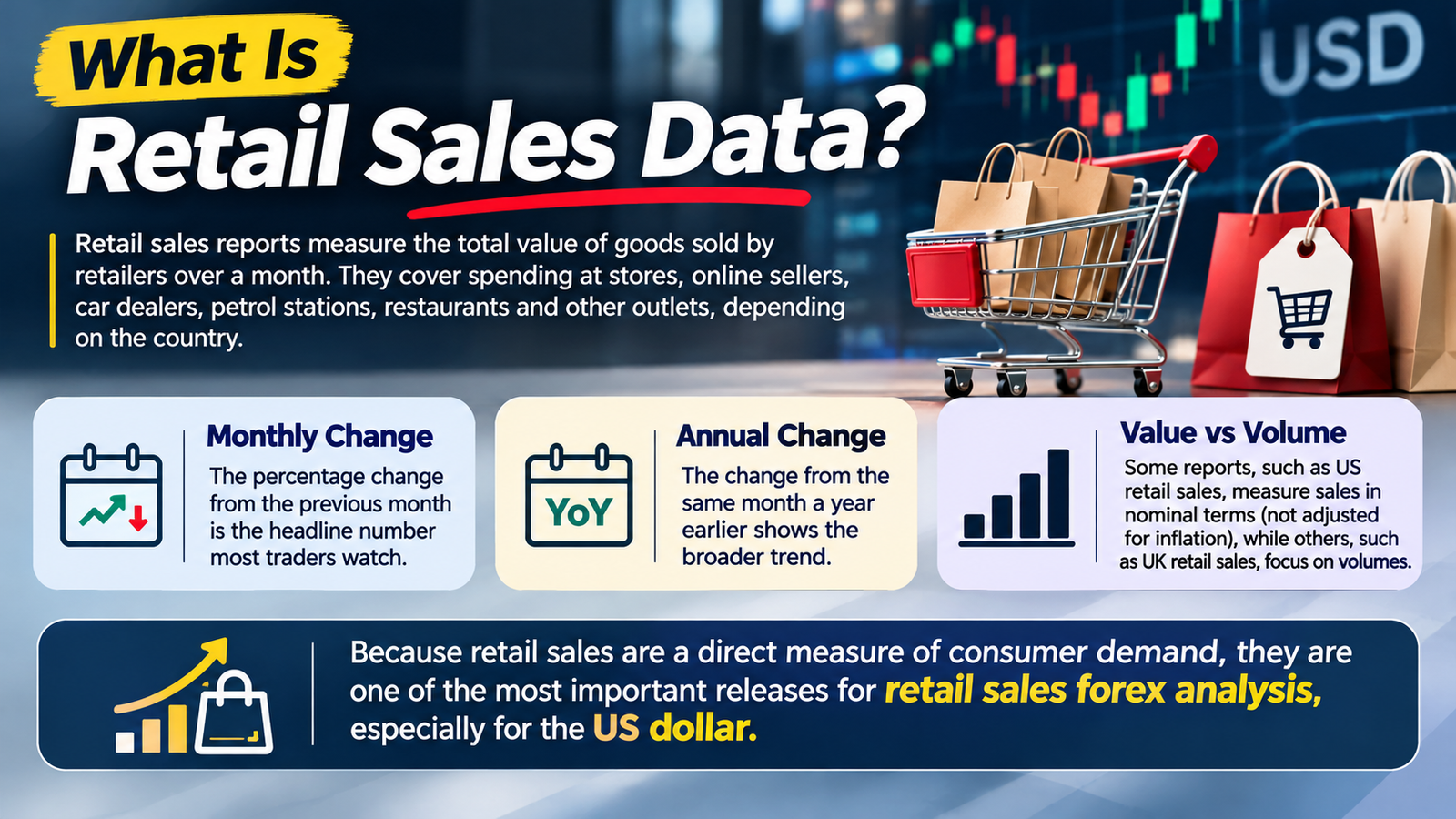
Before looking at retail sales forex reactions, it helps to know what the report actually measures. Retail sales reports measure the total value of goods sold by retailers over a month. They cover spending at stores, online sellers, car dealers, petrol stations, restaurants and other outlets, depending on the country.
- Monthly change: the percentage change from the previous month is the headline number most traders watch.
- Annual change: the change from the same month a year earlier shows the broader trend.
- Value vs volume: some reports, such as US retail sales, measure sales in nominal terms (not adjusted for inflation), while others, such as UK retail sales, focus on volumes.
Because retail sales are a direct measure of consumer demand, they are one of the most important releases for retail sales forex analysis, especially for the US dollar.
US Retail Sales: The Key Components
The US Census Bureau publishes the Advance Monthly Retail Trade Report, usually around the middle of the month, covering the previous month. Key figures include:
| Measure | What it includes | Why it matters |
|---|---|---|
| Headline retail sales | All retail and food services sales | The main headline number |
| Ex-autos | Excludes motor vehicles and parts | Removes volatile car sales |
| Ex-autos and gas | Excludes cars and petrol stations | Removes swings caused by fuel prices |
| Control group | Excludes autos, gas stations, building materials and food services | Feeds directly into GDP estimates of consumer spending; often the most watched by professionals |
Experienced retail sales forex traders often focus on the control group, because it gives the cleanest read on underlying consumer demand and its contribution to GDP.
Revisions
The previous month’s figures are often revised. A strong headline can lose its impact if the prior month is revised sharply lower, and a weak headline can be offset by an upward revision. Always check revisions alongside the new number.
Retail Sales Releases Around the World
The US report gets the most attention, but retail sales forex traders follow several releases:
| Country or region | Publisher | Typical timing | Currency |
|---|---|---|---|
| United States | Census Bureau | Around mid-month, 8:30am ET | USD |
| United Kingdom | Office for National Statistics (ONS) | Usually in the second half of the month, 7:00am UK time | GBP |
| Eurozone | Eurostat | Early in the month, covering two months earlier | EUR |
| Canada | Statistics Canada | Around the third week of the month | CAD |
| Australia | Australian Bureau of Statistics | Around the end of the month | AUD |
| China | National Bureau of Statistics | Mid-month, with industrial production and other activity data | CNY, AUD |
The US release usually has the biggest global impact, but UK and Australian retail sales can move their currencies sharply too. Eurozone retail sales tend to have a smaller effect, because national data and PMIs often arrive earlier.
India does not have a headline monthly retail sales release with the same market impact. Indian traders follow consumption trends through other indicators, such as GST collections, auto sales and industry surveys.
Retail Sales Release Times in Indian Time
| Release | Local time | IST (winter) | IST (summer) |
|---|---|---|---|
| US retail sales | 8:30am ET | 7:00pm | 6:00pm |
| UK retail sales | 7:00am UK time | 12:30pm | 11:30am |
| Canada retail sales | 8:30am ET | 7:00pm | 6:00pm |
Times are approximate and change with daylight saving in the US and UK. Always confirm with an economic calendar.
For Indian traders, UK retail sales arrive during Indian market hours, while US and Canadian figures land in the evening, after rupee pairs close but while cross-currency contracts may still be trading.
How Retail Sales Data Moves Currencies
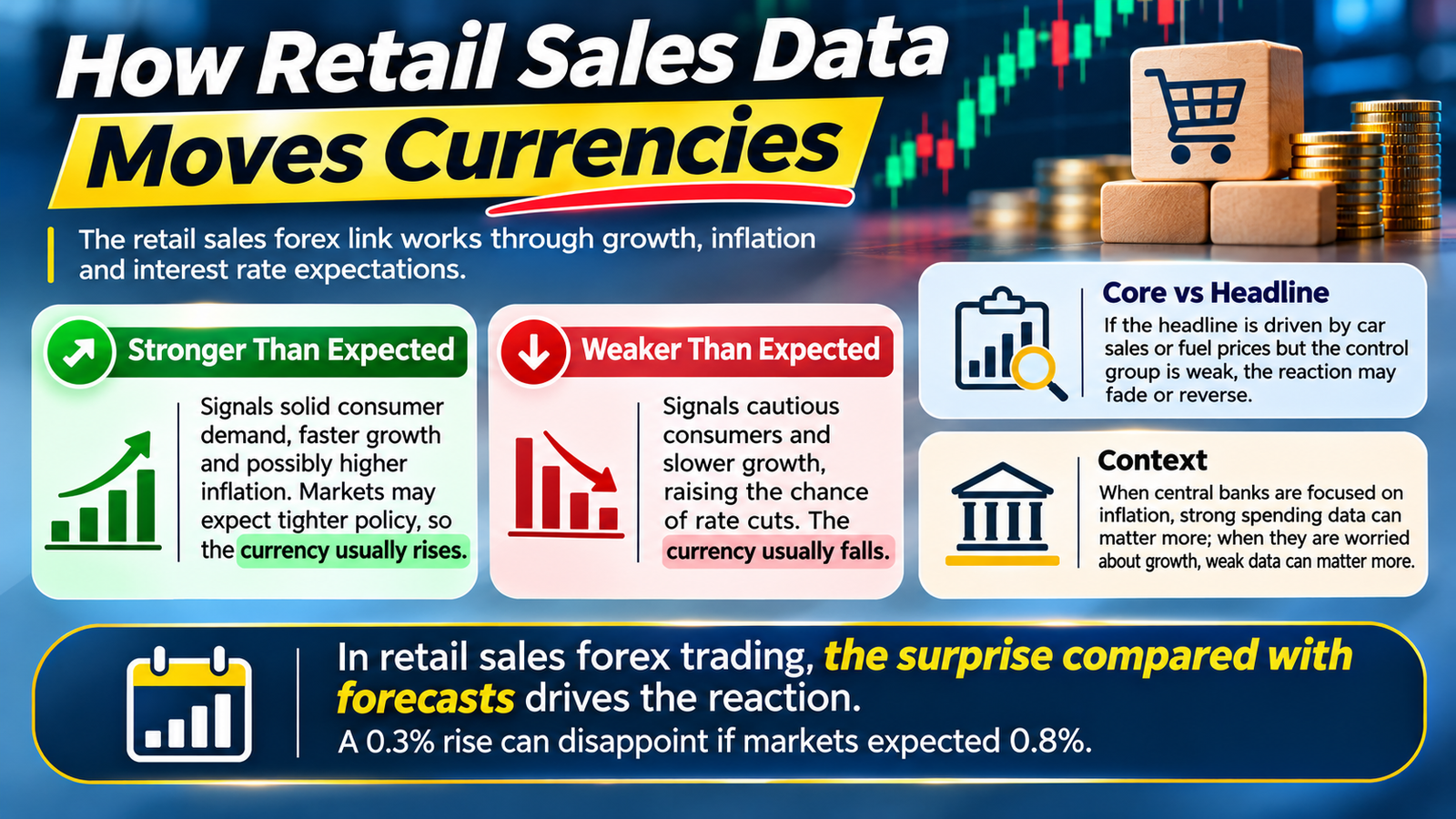
The retail sales forex link works through growth, inflation and interest rate expectations.
- Stronger than expected: signals solid consumer demand, faster growth and possibly higher inflation. Markets may expect tighter policy, so the currency usually rises.
- Weaker than expected: signals cautious consumers and slower growth, raising the chance of rate cuts. The currency usually falls.
- Core vs headline: if the headline is driven by car sales or fuel prices but the control group is weak, the reaction may fade or reverse.
- Context: when central banks are focused on inflation, strong spending data can matter more; when they are worried about growth, weak data can matter more.
In retail sales forex trading, as with all economic data, the surprise compared with forecasts drives the reaction. A 0.3% rise can disappoint if markets expected 0.8%.
Retail Sales Forex Worked Example: US Data
This example is illustrative and uses hypothetical figures.
- Forecast headline retail sales: +0.4% month on month.
- Actual headline: +0.9%.
- Control group: +0.8% vs forecast +0.3%.
- Previous month revised up from 0.2% to 0.4%.
- US two-year yields jump, and the dollar strengthens.
- EUR/USD falls from 1.1650 to 1.1595, a 55-pip move; USD/JPY rises.
Here the headline, control group and revision all point the same way, so the move is more likely to last. A retail sales forex trader would treat this as a clean, strong signal.
Retail Sales Forex Worked Example: A Mixed Report
This example is illustrative and uses hypothetical figures.
- Headline retail sales: +1.0% vs forecast +0.5%, driven by a jump in car sales.
- Control group: −0.1% vs forecast +0.3%.
- The dollar spikes higher on the headline, then reverses within 30 minutes as traders digest the weak control group.
This is a common pattern: the first reaction follows the headline, then the market focuses on the details. Waiting a few minutes before acting can help avoid being caught in the reversal.
What Retail Sales Mean for the Rupee
Indian traders cannot ignore retail sales forex moves in the dollar, because they spill over into the rupee:
- Strong US retail sales can lift the dollar and US yields, which may add pressure on emerging market currencies, including the rupee.
- Weak US data can weaken the dollar and support the rupee.
- The reaction in USD/INR usually appears the next morning, because the US release comes after Indian rupee pairs close.
- The RBI often smooths sharp moves, so USD/INR reactions are typically smaller than in major pairs.
How to Trade Retail Sales Data
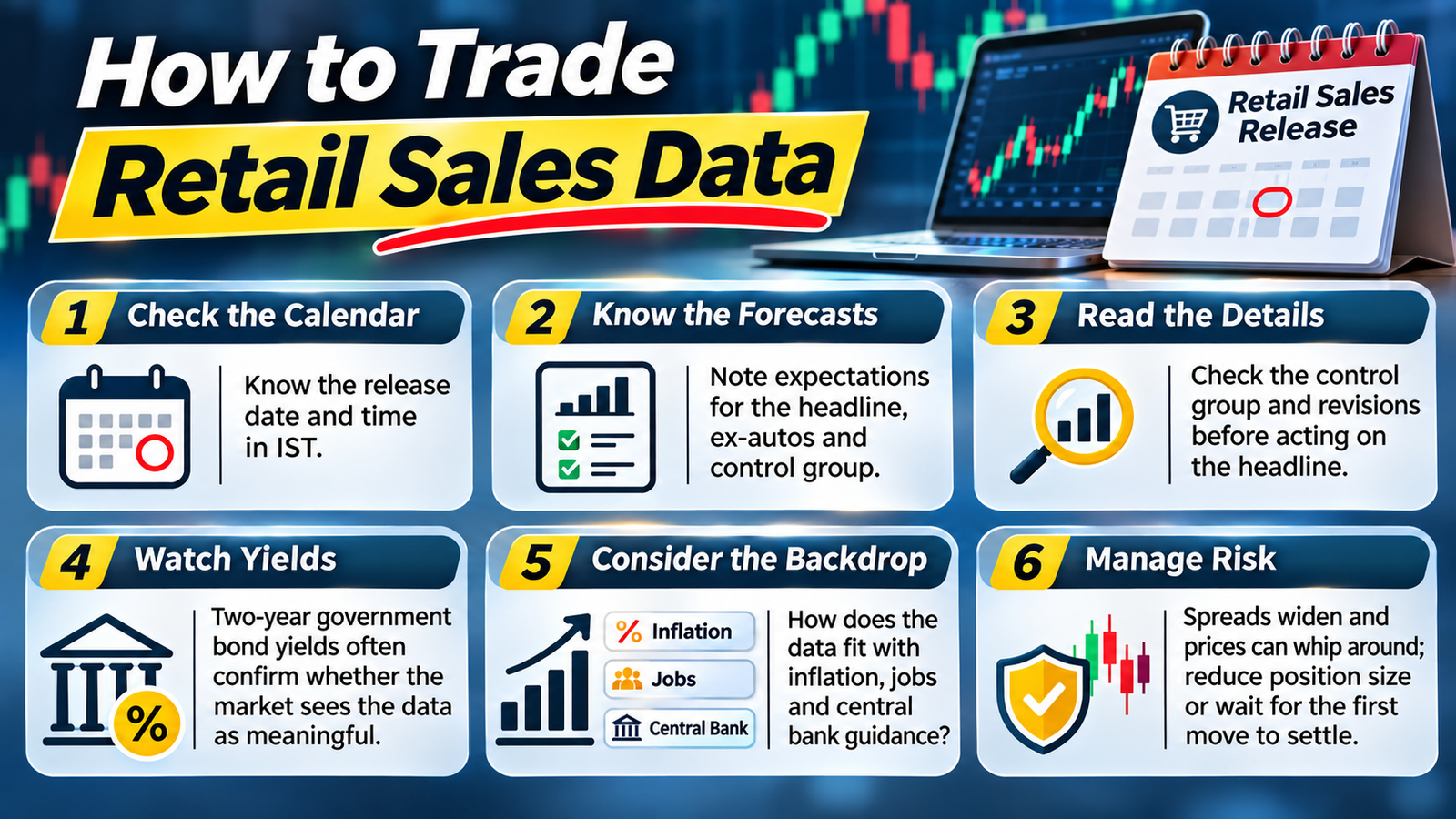
- Check the calendar: know the release date and time in IST.
- Know the forecasts: note expectations for the headline, ex-autos and control group.
- Read the details: check the control group and revisions before acting on the headline.
- Watch yields: two-year government bond yields often confirm whether the market sees the data as meaningful.
- Consider the backdrop: how does the data fit with inflation, jobs and central bank guidance?
- Manage risk: spreads widen and prices can whip around; reduce position size or wait for the first move to settle.
 Retail Sales Forex Strategy Ideas
- Wait-and-confirm: let the first spike pass, then trade in the direction supported by the details and bond yields.
- Trend context: use a run of strong or weak retail sales to support a broader view on a currency.
- Divergence: when consumer data diverges between two economies, the pair between them may trend over time.
- Avoid pre-release bets: large positions just before the release carry gap and slippage risk.
Any retail sales forex strategy should be backtested and traded with strict risk limits.
Retail Sales Forex Checklist
- What are the forecasts for the headline, ex-autos and control group?
- Did the headline and control group surprise in the same direction?
- Was the previous month revised up or down?
- Did two-year yields confirm the move?
- Does the result change expectations for the next central bank meeting?
- Is my position size small enough to handle a sudden spike?
Working through this list in the first few minutes after a release helps separate meaningful surprises from noise.
Retail Sales vs Other Consumer Indicators
| Indicator | What it shows | Timing |
|---|---|---|
| Retail sales | Actual goods spending | Monthly, about two weeks after month end |
| Consumer confidence surveys | How households feel about the economy | Monthly, often earlier |
| Personal spending (US) | Goods and services spending, in both nominal and inflation-adjusted terms | Monthly, later in the month |
| Card spending data | High-frequency spending trends | Weekly or daily, from private providers |
Combining these gives retail sales forex traders a fuller picture of consumer health than any single release.
Limitations of Retail Sales Data
- Nominal values: US retail sales are not adjusted for inflation, so higher prices can make spending look stronger than it is.
- Volatility: monthly data can swing because of weather, holidays, fuel prices and car sales.
- Revisions: early figures can change significantly.
- Limited coverage: retail sales focus on goods; services spending, a large part of consumption, is only partly captured.
- Market focus: when inflation or jobs data dominate, retail sales may have less impact.
Trading Currencies from India
Indian residents can trade the effects of retail sales data through exchange-traded currency derivatives on NSE and BSE via SEBI-registered brokers. Contracts include USD/INR, EUR/INR, GBP/INR and JPY/INR, along with EUR/USD, GBP/USD and USD/JPY. One USD/INR lot is $1,000, so a one-paisa move is worth ₹10 per lot. Leveraged forex through offshore brokers is not permitted for Indian residents under FEMA.
Common Mistakes
These are the errors retail sales forex traders make most often:
- Trading the headline alone: the control group and revisions often matter more.
- Ignoring inflation: nominal sales growth can be driven by higher prices.
- Overreacting to one month: look for trends over several months.
- Forgetting time zones: check IST times, especially around daylight saving changes.
- Oversized positions: news spikes can trigger stops and slippage.
Quick Reference
| Term | Meaning |
|---|---|
| Headline retail sales | Total retail and food services sales, monthly change |
| Ex-autos | Sales excluding vehicles and parts |
| Control group | Core measure feeding into GDP consumption estimates |
| Revision | Change to the previous month’s figure |
| Beat or miss | Actual result above or below forecasts |
FAQs
Why does retail sales data matter in forex?
It shows consumer demand, which shapes growth, inflation and interest rate expectations. In retail sales forex trading, strong data usually supports a currency and weak data weighs on it.
What is the retail sales control group?
A core US measure that excludes autos, gas stations, building materials and food services. It feeds directly into GDP estimates of consumer spending.
When is US retail sales data released in India?
At 8:30am US Eastern Time: 7:00pm IST in winter and 6:00pm IST during US daylight saving time.
Which retail sales report moves currencies the most?
US retail sales usually has the biggest global impact, followed by UK and Australian data for their currencies.
Is retail sales data adjusted for inflation?
US retail sales are reported in nominal terms. UK retail sales focus on volumes, which adjust for prices.
Does retail sales data affect USD/INR?
Indirectly. Strong US data can lift the dollar and weigh on the rupee; weak data can support the rupee. The move usually shows up the next morning.
Conclusion
Retail sales data offers a timely view of consumer spending, one of the biggest drivers of economic growth. For currency traders, the key is to compare results with forecasts, look past the headline to the control group and revisions, and consider the wider policy backdrop.
Use retail sales forex signals as part of a broader framework that includes inflation, jobs data and central bank guidance. Manage risk carefully around release times, and remember that the trend over several months tells you more than any single report.