
Introduction
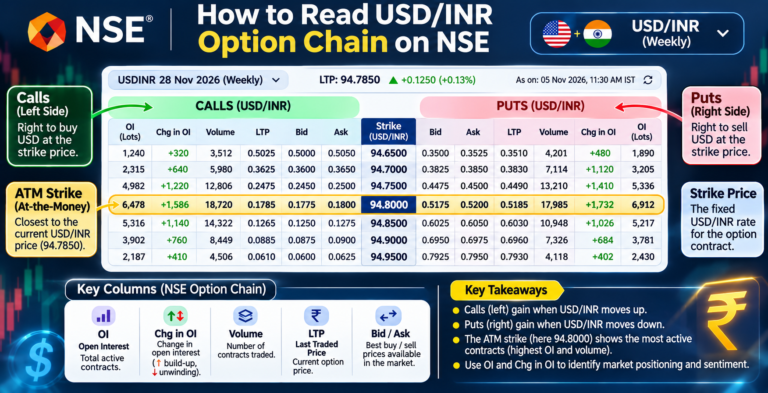
Ask an Indian trader which currency pair to trade and you will often hear “EUR/USD” or “gold”. But for Indian residents, the right answer starts with a different question: which pairs are you legally allowed to trade, and when are they actually active in Indian time?
This guide looks at the best currency pairs to trade in India from both angles. We cover the pairs available on recognised Indian exchanges, how each one behaves, when it moves most in IST and how to match a pair to your schedule and trading style.
You will learn:
- Which currency pairs Indian residents can legally trade
- The characteristics of each pair
- Global forex sessions converted to IST
- The best pairs for different times of day
- How to choose a pair that suits you
The Legal Framework Behind the Best Currency Pairs to Trade in India
Under FEMA and RBI rules, resident Indians can trade currency derivatives only on recognised Indian exchanges, such as NSE and BSE, through SEBI-registered brokers. Leveraged forex or CFD trading on offshore platforms, including many apps advertised on social media, is not permitted. The RBI maintains an Alert List of unauthorised forex trading platforms.
That narrows the list of pairs you can trade to:
| Type | Pairs | Lot size |
|---|---|---|
| INR pairs | USD/INR, EUR/INR, GBP/INR, JPY/INR | $1,000, €1,000, £1,000, ¥1,00,000 |
| Cross-currency pairs | EUR/USD, GBP/USD, USD/JPY | €1,000, £1,000, $1,000 |
So when we talk about the best currency pairs to trade in India, we mean these seven exchange-traded pairs. Everything below focuses on them.
Forex Sessions in Indian Time
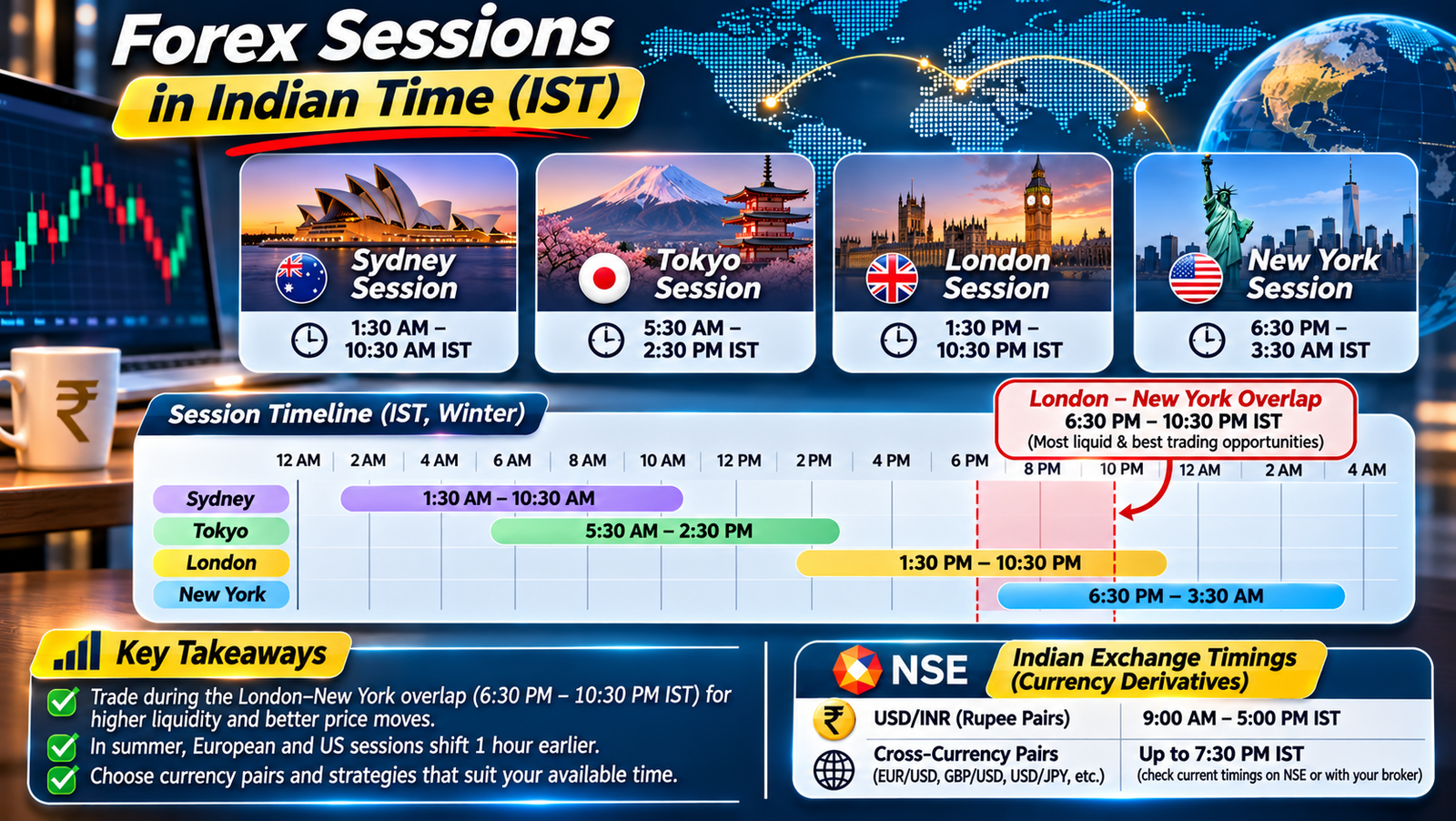
Currency markets are most active when major financial centres are open. Converted to IST, the main global sessions in winter look like this:
| Session | Approximate time (IST, winter) |
|---|---|
| Sydney | 1:30am – 10:30am |
| Tokyo | 5:30am – 2:30pm |
| London | 1:30pm – 10:30pm |
| New York | 6:30pm – 3:30am |
The most liquid period is the London–New York overlap, roughly 6:30pm to 10:30pm IST in winter. In summer, all European and US times shift one hour earlier.
Indian exchange timings matter too. NSE rupee currency derivatives trade from 9:00am to 5:00pm IST on weekdays. Cross-currency derivatives were launched with longer hours, up to 7:30pm IST, but check the current timings on NSE or with your broker, as sources differ.
The Best Currency Pairs to Trade in India
1. USD/INR
USD/INR is the most traded currency contract in India by a wide margin, and for most traders it is the natural starting point.
- Liquidity: Highest of all Indian currency contracts, with tight spreads.
- Volatility: Low. The RBI often smooths sharp moves, so daily ranges are usually narrow.
- Drivers: RBI policy and intervention, US dollar strength, crude oil prices, foreign portfolio flows and India’s trade balance.
- Best time in IST: The NSE open (9:00am to 11:00am), RBI policy announcements (usually 10:00am) and the afternoon when London opens (around 1:30pm in winter).
- Tick value: ₹2.50 per 0.25 paise tick, or ₹10 per paise per lot.
For beginners, USD/INR is often among the best currency pairs to trade in India because of its liquidity and steady behaviour.
2. EUR/INR
- Liquidity: Lower than USD/INR, but reasonable in the near-month contract.
- Volatility: Moderate. It moves with both EUR/USD and USD/INR.
- Drivers: European Central Bank policy, euro area data and the dollar–rupee rate.
- Best time in IST: From the European open, around 1:30pm in winter, to the 5:00pm NSE close.
3. GBP/INR
- Liquidity: Moderate.
- Volatility: Higher than USD/INR and EUR/INR, because the pound is a volatile currency.
- Drivers: Bank of England decisions, UK inflation and jobs data, and the dollar–rupee rate.
- Best time in IST: From the London open, around 1:30pm in winter, to the NSE close.
4. JPY/INR
- Liquidity: The lowest of the four INR pairs.
- Volatility: Can spike when the yen moves sharply, often around Bank of Japan decisions or global risk-off events.
- Drivers: Bank of Japan policy, Japanese interest rates and global risk sentiment.
- Best time in IST: The morning, when the Tokyo session overlaps with the NSE session.
- Quotation: Priced in rupees per 100 yen.
5. EUR/USD (cross-currency futures)
- Liquidity: The most traded pair in the world globally, but liquidity on Indian exchanges is much lower than for USD/INR.
- Volatility: Moderate, with smooth trends.
- Drivers: The interest rate gap between the US Federal Reserve and the ECB, US and euro area data.
- Best time in IST: From the London open in the afternoon into the evening, within the exchange’s trading hours.
- Tick value: $0.10 per 0.0001 tick per lot, converted to rupees at the RBI reference rate.
6. GBP/USD (cross-currency futures)
- Volatility: Higher than EUR/USD, with larger daily ranges.
- Drivers: Bank of England and Fed policy, UK and US data.
- Best time in IST: The London session, from about 1:30pm in winter.
7. USD/JPY (cross-currency futures)
- Volatility: Moderate, with occasional sharp moves around Bank of Japan decisions and possible intervention.
- Drivers: The interest rate gap between the US and Japan, and global risk sentiment.
- Best time in IST: The morning Tokyo session and again when US data is released in the evening.
Comparison: Best Currency Pairs to Trade in India at a Glance
| Pair | Liquidity on NSE | Volatility | Most active time (IST, winter) | Suits |
|---|---|---|---|---|
| USD/INR | Very high | Low | 9:00am–11:00am, RBI events | Beginners, range traders |
| EUR/INR | Moderate | Moderate | 1:30pm–5:00pm | Afternoon traders |
| GBP/INR | Moderate | Higher | 1:30pm–5:00pm | Traders seeking bigger moves |
| JPY/INR | Low | Moderate, can spike | Morning | Experienced traders |
| EUR/USD | Low on NSE | Moderate | Afternoon to evening | Trend and swing traders |
| GBP/USD | Low on NSE | Higher | Afternoon to evening | Experienced traders |
| USD/JPY | Low on NSE | Moderate | Morning and evening | Macro and swing traders |
 Best Currency Pairs to Trade in India by Time of Day
Morning (9:00am – 1:00pm)
The Asian session is active and the NSE has just opened. USD/INR sees its heaviest volume, and JPY/INR and USD/JPY react to Japanese news. Among the best currency pairs to trade in India in the morning, USD/INR leads for liquidity.
Afternoon (1:00pm – 5:00pm)
Europe opens around 1:30pm IST in winter. EUR/INR, GBP/INR, EUR/USD and GBP/USD become more active. This is often the most productive window for Indian currency traders, because both NSE and European markets are open. For many part-time traders, these afternoon hours are when the best currency pairs to trade in India offer the best mix of liquidity and movement.
Evening (5:00pm onwards)
Rupee pairs stop trading at 5:00pm. Cross-currency pairs may still trade, depending on current exchange hours, during the start of the London–New York overlap. Major US releases usually arrive around 7:00pm IST in winter, which may be after exchange hours, so their effect often shows up at the next open. Evening traders should therefore weigh the best currency pairs to trade in India differently from those who trade during the day.
How to Choose the Best Currency Pairs to Trade in India for You
There is no single list of the best currency pairs to trade in India that fits everyone. The right choice depends on five personal factors.
1. Your schedule
If you work 9-to-6, intraday trading of rupee pairs is difficult. Swing trading with pending orders, or focusing on pairs that are active in the late afternoon, may suit you better.
2. Your capital
Lot sizes are small, but margins and the value of each move differ. USD/INR moves slowly, so you may need more lots to make a meaningful profit. GBP pairs move more, so each lot carries more risk.
3. Your risk tolerance
Prefer calm, predictable markets? USD/INR fits. Comfortable with bigger swings? GBP/INR or GBP/USD may suit you.
4. Your trading style
- Range traders: USD/INR often moves in ranges because of RBI smoothing.
- Trend traders: EUR/USD and GBP/USD often trend over weeks.
- News traders: USD/INR around RBI policy; GBP pairs around Bank of England decisions.
5. Liquidity
Always check volumes and bid-ask spreads. Thin markets mean wider spreads and slippage, especially in JPY/INR and cross-currency contracts.

Worked Example: Choosing a Pair for an Afternoon Trader
Consider a trader who works from home and is free from 1:00pm to 5:00pm IST.
- USD/INR is liquid but often quiet in the afternoon.
- EUR/INR and GBP/INR become more active once Europe opens around 1:30pm.
- The trader picks GBP/INR for its larger moves and EUR/INR as a backup.
- If GBP/INR moves 20 paise in their favour on one lot, the gain is about ₹200 before costs (₹10 per paise per lot).
- They risk no more than 1% of capital per trade and avoid holding through Bank of England decisions unless planned.
For this trader, GBP/INR and EUR/INR are the best currency pairs to trade in India because they match both the schedule and the desired volatility.
This example is illustrative and uses hypothetical figures.
Correlations Between Indian Currency Pairs
Several of these pairs move together, which matters when you build a watchlist from the best currency pairs to trade in India.
- The four rupee pairs: USD/INR, EUR/INR, GBP/INR and JPY/INR share the rupee leg, so a broad rupee move affects all of them at once.
- EUR/INR and GBP/INR: The euro and pound often move in the same direction against the dollar, so these two pairs are usually positively correlated.
- EUR/INR and EUR/USD: EUR/INR is roughly EUR/USD multiplied by USD/INR, so a big EUR/USD move shows up in EUR/INR too.
- USD/JPY and JPY/INR: A stronger yen pushes USD/JPY down and JPY/INR up, so these often move in opposite directions.
Holding long positions in both EUR/INR and GBP/INR, for example, is closer to one large trade than two separate ones. When you shortlist the best currency pairs to trade in India, pick pairs that give you different exposures, or reduce size when you hold correlated positions.
Common Mistakes When Picking the Best Currency Pairs to Trade in India
- Using illegal offshore platforms: These expose you to FEMA violations, frozen funds and fraud risk.
- Trading illiquid contracts: Wide spreads quickly erase profits.
- Ignoring timing: Trading a pair when its main markets are closed often means flat, choppy price action.
- Trading too many pairs: Focus on one or two and learn their behaviour.
- Overlooking correlations: EUR/INR and GBP/INR often move together, so trading both doubles your exposure.
- Ignoring news: RBI, Fed, ECB, Bank of England and Bank of Japan decisions can move pairs sharply.
 Tax on Currency Trading in India
Whichever of the best currency pairs to trade in India you choose, the tax treatment is the same. Profits from exchange-traded currency derivatives are generally treated as non-speculative business income, taxed at your slab rate and reported in ITR-3. Trading expenses can be claimed, and losses can be carried forward for up to 8 years if you file on time. There is no STT on currency derivatives, though exchange charges, stamp duty and GST apply. Consult a chartered accountant for your situation.
FAQs
What are the best currency pairs to trade in India?
For most traders, USD/INR is the best starting point because of its liquidity. EUR/INR and GBP/INR suit afternoon traders, while EUR/USD, GBP/USD and USD/JPY cross-currency futures offer exposure to global pairs.
Do the best currency pairs to trade in India change over time?
Yes. Liquidity, volatility and exchange timings shift with market conditions and regulation, so review your choice of pairs every few months.
Can I trade EUR/USD legally in India?
Yes, through cross-currency futures and options on NSE and BSE. Trading it on offshore leveraged platforms is not permitted.
What is the best time to trade forex in India?
For rupee pairs, the NSE morning and the afternoon when Europe opens. Globally, the London–New York overlap, about 6:30pm to 10:30pm IST in winter, is the busiest.
Which currency pair is best for beginners in India?
USD/INR, because it is the most liquid and usually the least volatile.
Is gold (XAU/USD) a currency pair I can trade in India?
Not as a forex pair on Indian currency exchanges. Gold can be traded through commodity derivatives on MCX or through gold ETFs.
Conclusion
The best currency pairs to trade in India are the ones that are legal, liquid and active when you are available. USD/INR is the clear starting point for most traders, EUR/INR and GBP/INR suit afternoon schedules, and the cross-currency pairs EUR/USD, GBP/USD and USD/JPY offer global exposure through Indian exchanges.
Choose one or two pairs, learn how they behave across the IST trading day, size positions carefully and always trade through SEBI-registered brokers on recognised exchanges.