
Introduction
For an Indian business that sells abroad or buys from overseas suppliers, a move of a rupee or two in USD/INR can wipe out a quarter’s margin. An exporter quoting a price in dollars today may receive fewer rupees when the payment arrives in 60 days if the rupee strengthens. An importer may pay more if the rupee weakens.
Hedging reduces that uncertainty. Done well, it lets a business price confidently, protect margins and focus on its core work rather than guessing currency moves. This guide covers practical currency hedging for exporters India businesses can apply, and the same approach for importers, using exchange-traded contracts on NSE alongside bank products.
It explains how to measure exposure, choose between futures, options and forwards, set a hedge ratio, use natural hedges, follow RBI rules and build a simple hedging policy.
Understanding Your Currency Exposure
The first step in currency hedging for exporters India businesses take is identifying what they are actually exposed to.
| Business type | Exposure | Risk | Typical hedge |
|---|---|---|---|
| Exporter (receives dollars) | Long USD | Rupee strengthens (USD/INR falls) | Sell USD/INR futures, buy puts or book sell forwards |
| Importer (pays dollars) | Short USD | Rupee weakens (USD/INR rises) | Buy USD/INR futures, buy calls or book buy forwards |
| Business with both | Net position | Depends on the net amount | Hedge only the net exposure |
Types of exposure
- Transaction exposure: confirmed invoices or orders with known amounts and dates. This is the main focus of hedging.
- Anticipated exposure: expected sales or purchases not yet confirmed.
- Economic exposure: the longer-term effect of exchange rates on competitiveness and pricing.
Good currency hedging for exporters India practitioners recommend starts with a simple exposure register: amount, currency, due date, customer or supplier, and status (confirmed or expected).
Hedging Tools Available in India
Several tools are available for currency hedging for exporters India and importers can use:
| Tool | Where | How it works | Pros | Cons |
|---|---|---|---|---|
| Bank forward contract | Authorised dealer banks | Locks a rate for a future date, with actual delivery of currency | Matches exact amounts and dates; delivery of funds | Needs bank limits and documentation; pricing less transparent |
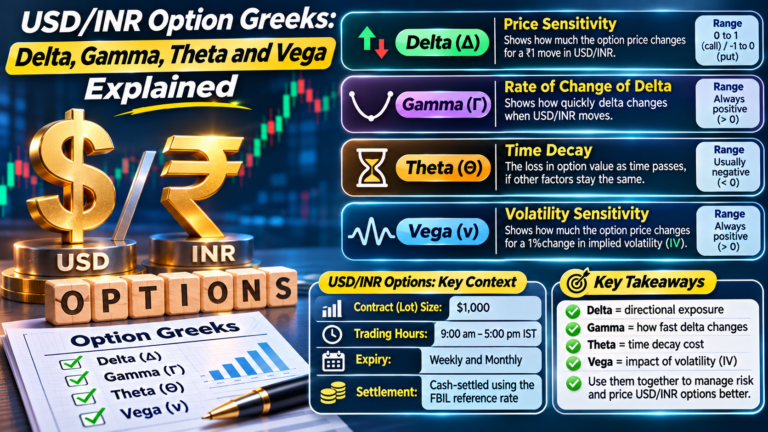
| Currency futures | NSE, BSE | Exchange-traded contracts on USD/INR and other pairs, cash-settled | Transparent pricing, small lots ($1,000), no credit line needed | Daily margin; fixed expiry dates; basis risk |
| Currency options | NSE, BSE and banks | Right but not obligation to buy or sell at a strike | Protection with upside; known maximum cost | Premium cost; time decay |
| EEFC account | Banks | Exporters hold foreign currency earnings in a foreign currency account | Can be used to pay imports in the same currency | Does not lock a rupee rate |
Many businesses combine bank forwards for exact-date payments with NSE futures and options for flexibility and transparent pricing.
Why Use NSE for Hedging?
- Small lot sizes: one USD/INR lot is $1,000, which suits MSMEs with modest invoice sizes.
- Transparent prices: everyone sees the same quotes on the exchange.
- No bank credit limit needed: you post margin with your broker instead.
- Low costs: no STT; brokerage, exchange charges, stamp duty and GST apply.
- Clearing guarantee: trades are cleared through the exchange’s clearing corporation.
- Settlement: contracts are cash-settled in rupees against the FBIL reference rate.
For many smaller businesses, exchange-traded contracts make currency hedging for exporters India-wide far more accessible than in the past.

RBI Rules You Must Follow
- Exchange-traded rupee currency derivatives are meant mainly for hedging genuine foreign currency exposures, and brokers ask clients to sign a declaration confirming this.
- Users could take positions up to a set limit without documentary proof of exposure. On 10 October 2026, the RBI announced that this limit for exchange-traded INR currency derivatives would be cut from US 100 million to US5 million equivalent across exchanges.
- Bank forwards and OTC options require evidence of underlying exposure according to RBI directions and your bank’s documentation.
- Hedge amounts should not exceed your genuine exposure.
Keep invoices, purchase orders and contracts on file to support your hedges.
Worked Example 1: Exporter Hedging with NSE Futures
This example is illustrative and uses hypothetical prices. Charges are ignored for simplicity.
A textile exporter ships goods and will receive $50,000 in about one month. Spot USD/INR is 88.50; the near-month futures contract trades at 88.62.
- The exporter sells 50 lots of USD/INR futures at 88.62.
- Scenario A: rupee strengthens to 87.80 at expiry. Futures gain 82 paise × ₹10 × 50 = ₹41,000. The $50,000 receipt converts to ₹43,90,000, and with the futures gain the effective total is ₹44,31,000, or about 88.62 per dollar.
- Scenario B: rupee weakens to 89.40. Futures lose 78 paise × ₹10 × 50 = ₹39,000. The receipt converts to ₹44,70,000; net ₹44,31,000, again about 88.62.
Either way, the exporter locks in close to 88.62. Small differences arise if the payment date and conversion rate differ from the futures expiry and FBIL settlement rate, known as basis risk.
Worked Example 2: Importer Hedging with Options
This example is illustrative and uses hypothetical premiums.
An electronics importer must pay $30,000 next month. Spot is 88.50. The importer wants protection against a weaker rupee but would like to benefit if the rupee strengthens.
- The importer buys 30 lots of an 88.75 USD/INR call at a premium of ₹0.30, costing ₹9,000.
- If USD/INR rises to 89.60: calls are worth 85 paise × ₹10 × 30 = ₹25,500, a net gain of ₹16,500, which offsets most of the higher rupee cost of the payment.
- If USD/INR falls to 87.90: calls expire worthless, and the importer loses ₹9,000 of premium, but buys dollars about ₹18,000 cheaper than at the starting spot rate.
The importer effectively caps the dollar cost near 88.75 plus the premium, while keeping the benefit of a stronger rupee.
Choosing a Hedge Ratio
Few businesses hedge 100% of every exposure. A hedge ratio balances certainty with flexibility.
| Exposure type | Common approach |
|---|---|
| Confirmed invoices due within 3 months | Hedge a high share, such as 75% to 100% |
| Expected orders 3 to 6 months out | Hedge a moderate share, such as 25% to 50% |
| Uncertain or long-dated exposure | Hedge little, or use options rather than futures |
A layered hedging approach, adding cover gradually as orders become more certain, avoids putting the whole hedge on at a single rate. This is one of the most practical ideas in currency hedging for exporters India businesses can adopt.
Natural Hedging
Before using derivatives, look for natural hedges that reduce exposure at no cost.
- Matching flows: businesses that both export and import in the same currency can offset receipts against payments.
- EEFC accounts: exporters can keep foreign currency earnings in an Exchange Earners’ Foreign Currency account and use them for permitted payments, such as imports.
- Foreign currency borrowing: exporters with steady dollar earnings may borrow in dollars, subject to RBI rules, so loan repayments match receipts.
- Rupee invoicing: since 2022, the RBI has allowed invoicing and settlement of international trade in rupees through special vostro accounts, which shifts currency risk to the counterparty where buyers agree.
- Pricing clauses: contracts can include exchange rate adjustment clauses for large moves.
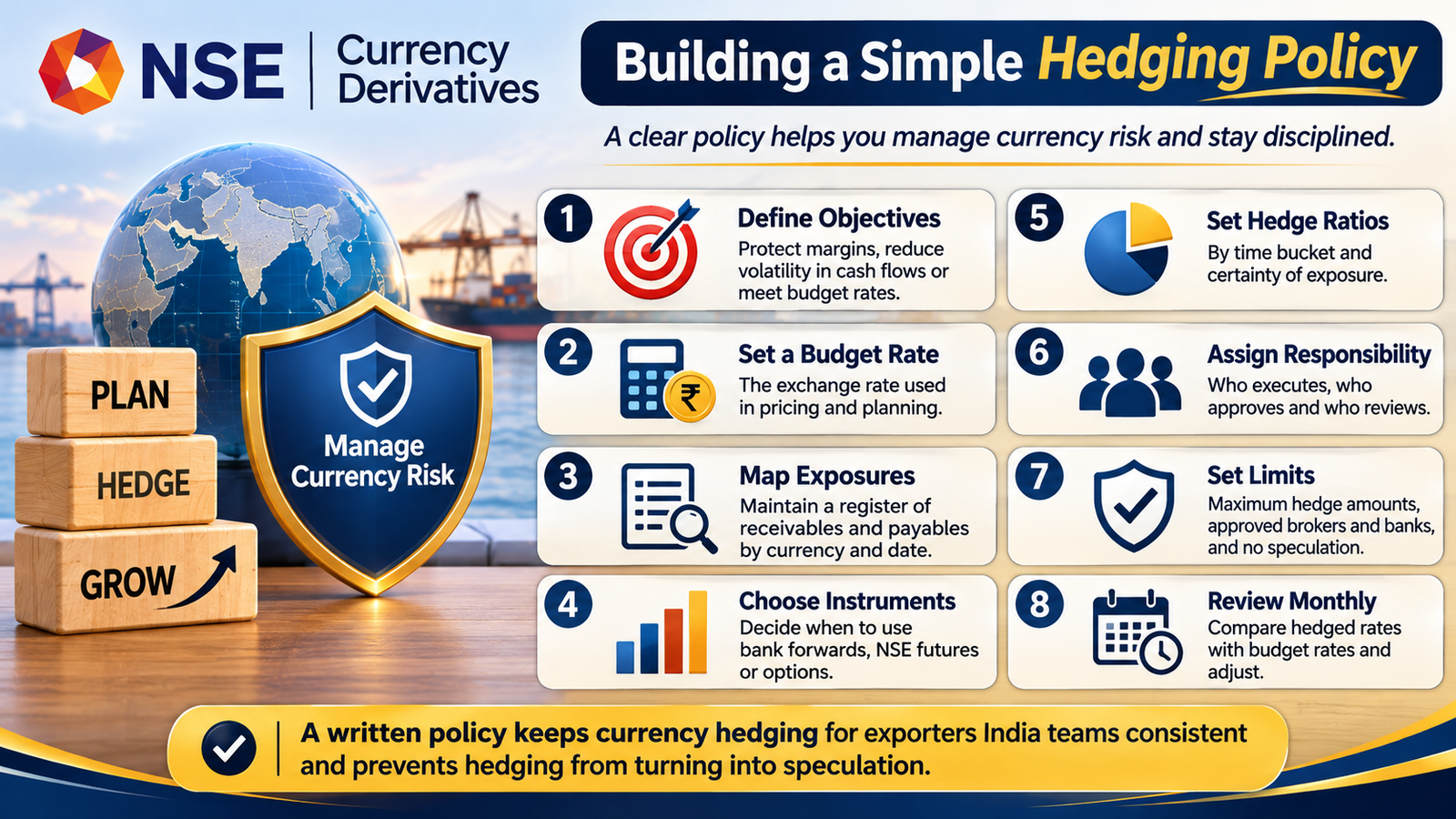
Building a Simple Hedging Policy
- Define objectives: protect margins, reduce volatility in cash flows or meet budget rates.
- Set a budget rate: the exchange rate used in pricing and planning.
- Map exposures: maintain a register of receivables and payables by currency and date.
- Choose instruments: decide when to use bank forwards, NSE futures or options.
- Set hedge ratios: by time bucket and certainty of exposure.
- Assign responsibility: who executes, who approves and who reviews.
- Set limits: maximum hedge amounts, approved brokers and banks, and no speculation.
- Review monthly: compare hedged rates with budget rates and adjust.
A written policy keeps currency hedging for exporters India teams consistent and prevents hedging from turning into speculation.
Practical Steps to Start Hedging on NSE
- Open a trading account in the business’s name with a SEBI-registered broker offering currency derivatives.
- Activate the currency segment and sign the RBI declaration.
- Arrange margin funds and understand daily mark-to-market settlement.
- Match futures expiry dates as closely as possible to payment dates, and plan to roll positions if needed.
- Keep records linking each hedge to the underlying invoice.
- Discuss accounting treatment with your chartered accountant, including whether hedge accounting under Ind AS applies.
Costs of Hedging
- Futures: brokerage, exchange charges, SEBI fees, stamp duty and GST, plus the forward premium built into futures prices.
- Options: premium plus charges; premiums rise when volatility is high.
- Bank forwards: the bank’s margin is built into the forward rate.
- Opportunity cost: a hedge gives up gains if the rupee moves in your favour, unless you use options.
For exporters, the forward premium on USD/INR has historically worked in their favour, because selling dollars forward usually locks in a rate above spot. For importers, it usually adds a cost.
Currency Hedging for Exporters India: MSME Checklist
Smaller exporters often lack a treasury team, so a short checklist helps keep currency hedging for exporters India-based MSMEs practise simple and consistent:
- Do I know every foreign currency receivable and payable for the next three to six months?
- Have I set a budget rate for pricing and planning?
- Which exposures are confirmed, and which are only expected?
- Have I used natural hedges, such as an EEFC account or matching flows, first?
- Am I using futures for confirmed receipts and options for uncertain ones?
- Do I have enough margin funds for daily settlement on futures?
- Is every hedge linked to a genuine invoice or order, in line with RBI rules?
- Do I review hedges against budget rates every month?
Spending an hour a month on this checklist is usually enough for a small business to stay protected.
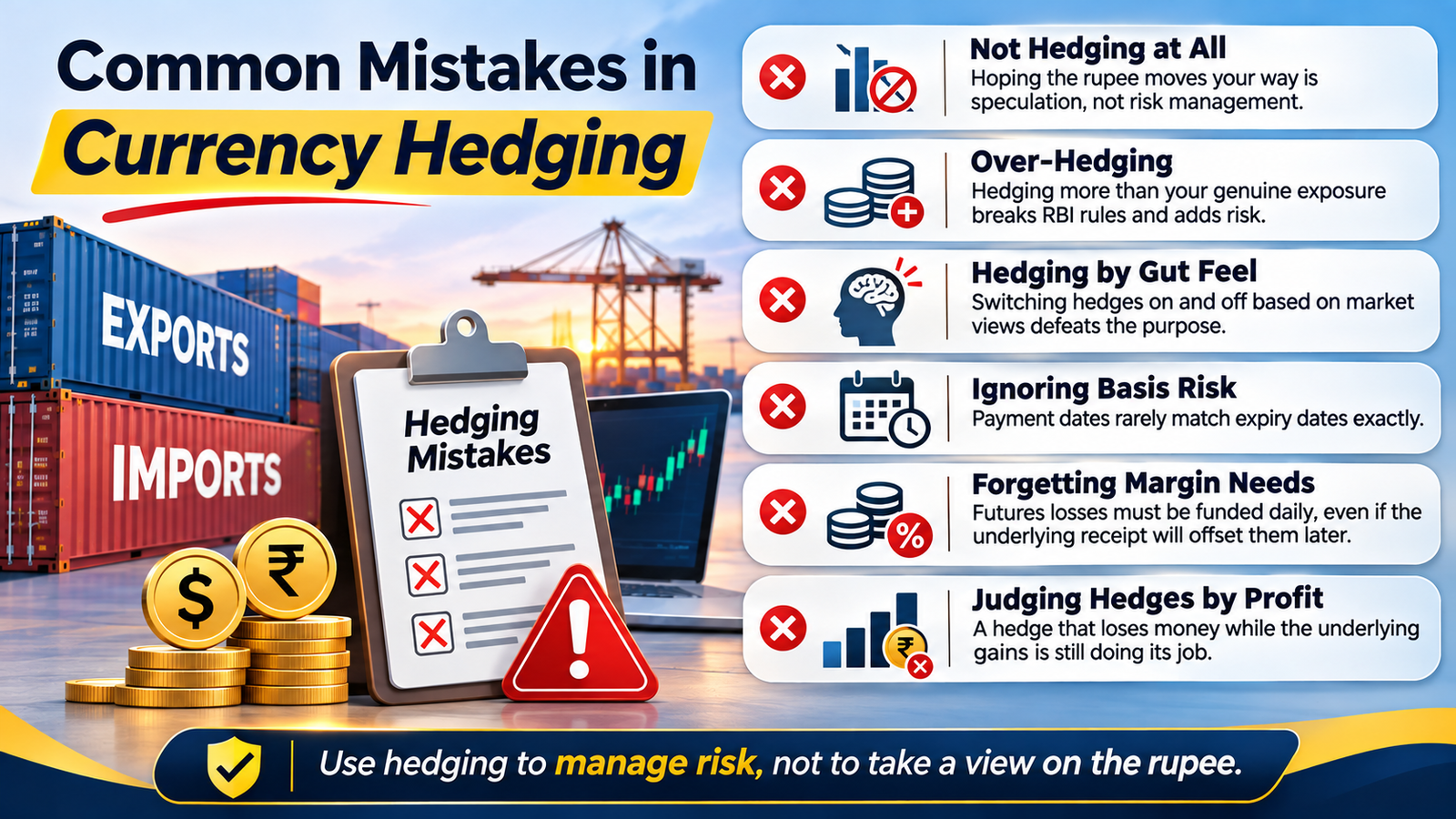
Common Mistakes
- Not hedging at all: hoping the rupee moves your way is speculation, not risk management.
- Over-hedging: hedging more than your genuine exposure breaks RBI rules and adds risk.
- Hedging by gut feel: switching hedges on and off based on market views defeats the purpose.
- Ignoring basis risk: payment dates rarely match expiry dates exactly.
- Forgetting margin needs: futures losses must be funded daily, even if the underlying receipt will offset them later.
- Judging hedges by profit: a hedge that loses money while the underlying gains is still doing its job.
 FAQs
What is currency hedging for exporters India?
It is the use of instruments such as NSE currency futures, options and bank forwards to lock in or protect the rupee value of foreign currency receipts.
Is currency hedging for exporters India only for large companies?
No. Small lot sizes on NSE and simple bank forwards make hedging practical for MSMEs and even individual service exporters.
Should exporters use futures or options?
Futures lock in a rate and suit confirmed receipts. Buying puts sets a floor while keeping upside and suits uncertain receipts. Many exporters use both.
Can MSMEs hedge on NSE?
Yes. The $1,000 lot size makes exchange-traded hedging practical for small exporters and importers.
Do I need proof of exposure?
Brokers ask for a declaration. Under the RBI’s October 2026 announcement, positions above US$5 million equivalent across exchanges require documentary evidence of exposure.
What is an EEFC account?
An Exchange Earners’ Foreign Currency account lets exporters hold foreign currency earnings and use them for permitted payments, reducing conversion needs.
How much should I hedge?
Many businesses hedge most confirmed near-term exposures and a smaller share of uncertain or long-dated ones, often in layers.
Conclusion
Currency risk is a business risk, not a trading opportunity. Effective currency hedging for exporters India and importers alike starts with a clear view of exposure, a budget rate and a written policy. NSE futures and options offer transparent, accessible tools, especially for smaller businesses, while bank forwards suit exact-date payments.
Use natural hedges first, hedge confirmed exposures in layers, keep records for RBI compliance and judge success by margin stability rather than hedge profits. With a disciplined approach, exchange rate moves become a manageable cost rather than a threat to your business.