
Introduction
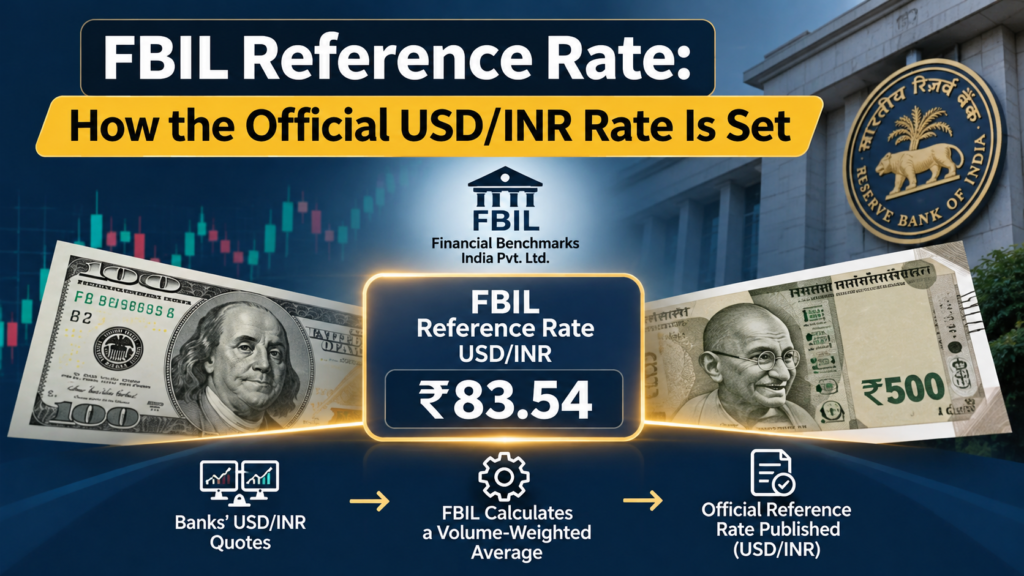
Every business day, one number becomes India’s official benchmark for the dollar-rupee exchange rate. It settles currency futures and options on NSE and BSE, fixes offshore rupee non-deliverable forwards, and appears in thousands of business contracts. That number is the FBIL reference rate.
Many traders still call it the “RBI reference rate”, because the Reserve Bank of India published it until 2018. Today it is set by Financial Benchmarks India Pvt Ltd (FBIL), an independent benchmark administrator, using a published methodology based on actual market trades.
This guide focuses on how the FBIL reference rate is set: who FBIL is, the calculation process, the data it uses, how cross-currency rates are derived, how the benchmark is governed and where it is used across India’s currency markets.
Who Is FBIL?
Financial Benchmarks India Pvt Ltd (FBIL) was set up in 2014 as an independent administrator for Indian financial benchmarks. It is jointly owned by three industry bodies:
- FIMMDA (Fixed Income Money Market and Derivatives Association of India)
- FEDAI (Foreign Exchange Dealers’ Association of India)
- IBA (Indian Banks’ Association)
FBIL first administered money market and fixed income benchmarks, such as the overnight MIBOR. On 10 July 2018 it took over the computation and publication of the rupee reference rates from the RBI. The first FBIL reference rate for USD/INR was 68.7942.
Why an Independent Benchmark Administrator?
After global scandals over the manipulation of benchmarks such as LIBOR, regulators worldwide pushed for financial benchmarks to be run independently, with clear methods and strong oversight. The International Organization of Securities Commissions (IOSCO) published principles for financial benchmarks in 2013, covering governance, quality, methodology and accountability.
In India, moving the reference rate from the RBI to FBIL separated the central bank, which also intervenes in the currency market, from the body that calculates the official benchmark. The RBI regulates benchmark administrators under its Financial Benchmark Administrators Directions, so the benchmark is produced under a formal regulatory framework.

How the FBIL Reference Rate Is Calculated
Under the RBI’s earlier method, the reference rate was based on bid and offer quotes collected from a panel of banks during a short window around midday. FBIL’s approach uses actual transactions. In outline, according to FBIL’s published methodology:
| Step | What happens |
|---|---|
| Calculation window | Spot USD/INR trades between 11:30am and 12:30pm Mumbai time on each business day |
| Data sources | Actual spot USD/INR transactions on electronic trading platforms, with data from sources such as Refinitiv and CCIL; if one source lacks usable data, the other is used |
| Computation | The transaction data is processed under FBIL’s published rules to produce a single representative rate |
| Publication | Around 1:00pm Mumbai time on FBIL’s website |
| Cross rates | EUR/INR, GBP/INR and JPY/INR are derived from USD/INR and international cross rates |
Using a full hour of real trades makes the benchmark harder to manipulate than a single quote at a single moment. FBIL can update its methodology, so always check the current methodology document for the latest details.
Publication time change
From 6 January 2025, FBIL moved the publication of the USD/INR reference rate from around 1:30pm to around 1:00pm Mumbai time. Overseas exchanges that use the rate, such as the Hong Kong exchange, notified their participants of the change.
How Cross-Currency Reference Rates Are Derived
The USD/INR benchmark is the anchor. Rates for other major currencies against the rupee are calculated by combining it with international cross rates.
This example is illustrative and uses hypothetical rates.
- FBIL USD/INR reference rate: 88.6500
- EUR/USD at the relevant time: 1.1650
- Derived EUR/INR = 88.65 × 1.1650 ≈ 103.28
- USD/JPY at the relevant time: 152.40
- Derived JPY/INR (per 100 yen) = 88.65 ÷ 152.40 × 100 ≈ 58.17
This approach keeps all the rupee reference rates consistent with each other and with the global currency market.
Days When the Rate Is Not Published
The FBIL reference rate is published only on Mumbai business days. It is not published on Saturdays, Sundays or Mumbai bank and market holidays. Exchange-traded contracts do not expire on those days, and private contracts usually specify which rate to use instead, often the previous business day’s rate.
Where the FBIL Reference Rate Is Used
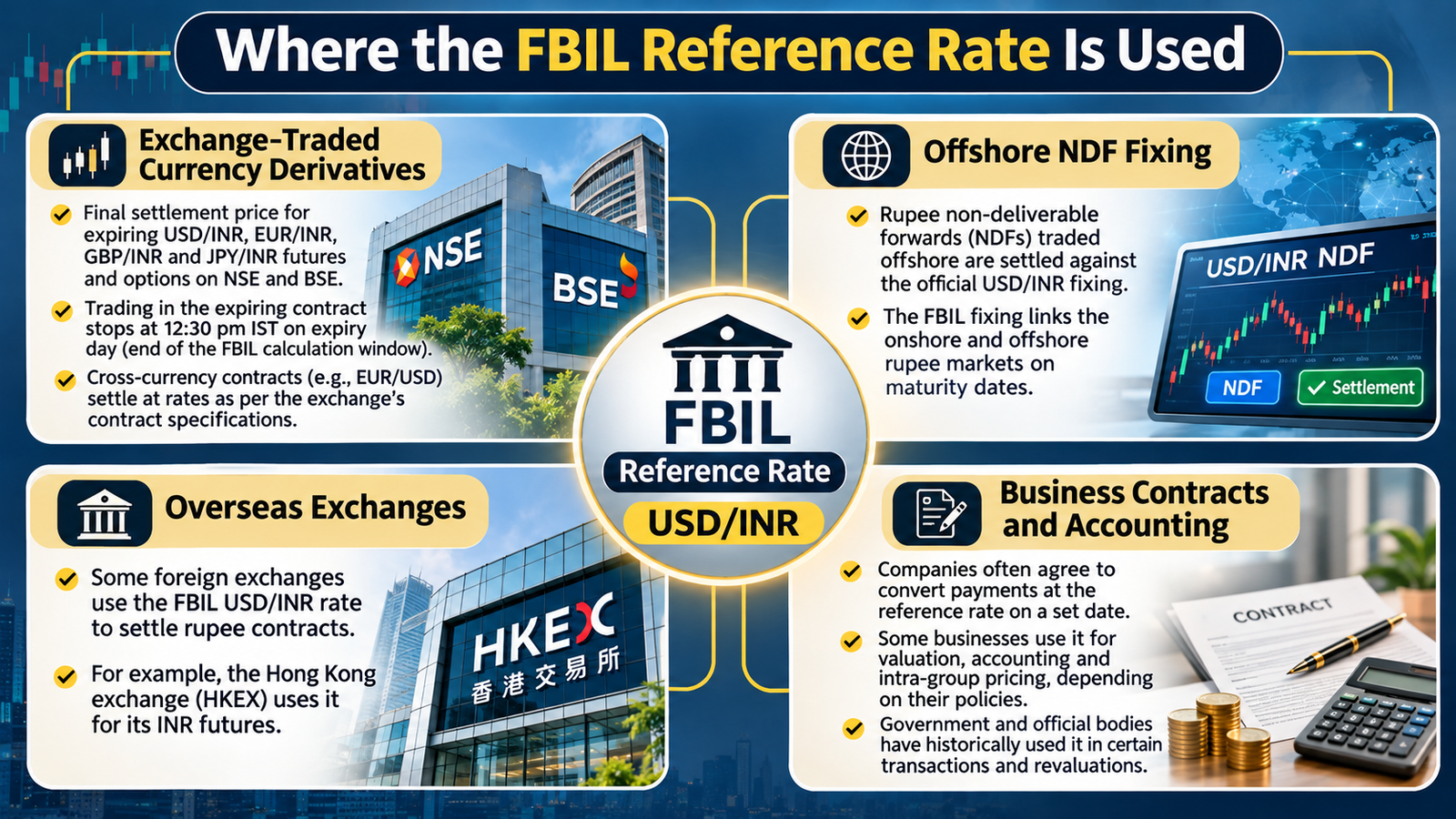
Exchange-traded currency derivatives
On NSE and BSE, the FBIL reference rate is the final settlement price for expiring USD/INR, EUR/INR, GBP/INR and JPY/INR futures and options. This is why trading in the expiring contract stops at 12:30pm IST on expiry day, when the calculation window ends. Cross-currency contracts such as EUR/USD settle at rates derived as set out in the exchange’s contract specifications.
Offshore NDF fixing
Rupee non-deliverable forwards traded offshore are settled against the official USD/INR fixing. The official FBIL fixing therefore links the onshore and offshore rupee markets on maturity dates.
Overseas exchanges
Some foreign exchanges use the FBIL USD/INR rate to settle rupee contracts. For example, the Hong Kong exchange (HKEX) uses it for its INR futures.
Business contracts and accounting
- Companies often agree to convert payments at the reference rate on a set date.
- Some businesses use it for valuation, accounting and intra-group pricing, depending on their policies.
- Government and official bodies have historically used it in certain transactions and revaluations.
FBIL Reference Rate vs Other “Official” Rates
| Rate | Who sets it | Typical use |
|---|---|---|
| FBIL reference rate | FBIL, every business day | Settlement of exchange-traded currency derivatives, NDF fixing, contracts and valuation |
| Customs exchange rate | CBIC, notified periodically | Calculating customs duty on imports and exports |
| SBI TT buying rate | State Bank of India | Converting foreign income for certain income tax purposes |
| Bank card or remittance rate | Each bank | The actual rate you get when buying or selling currency |
The FBIL reference rate is a benchmark, not a dealing price. If you buy or sell dollars, your bank will quote its own rate, including a margin.
Worked Example: Settling a Futures Position
This example is illustrative. Rates are hypothetical, and brokerage, taxes and charges are ignored.
A trader is short 3 lots of the expiring USD/INR futures contract, sold earlier at 88.80, and holds to final settlement.
- Last traded futures price at 12:30pm: 88.62
- FBIL reference rate published around 1:00pm: 88.65
- Final settlement price: 88.65
- Gain: 88.80 − 88.65 = 15 paise
- Value: 15 paise × ₹10 per paise per lot × 3 lots = ₹450
Much of this would already have been credited through daily mark-to-market, with the final settlement covering the last day’s difference. Note that the trader settled at 88.65, not the last traded price of 88.62.
What Happens During the Calculation Window
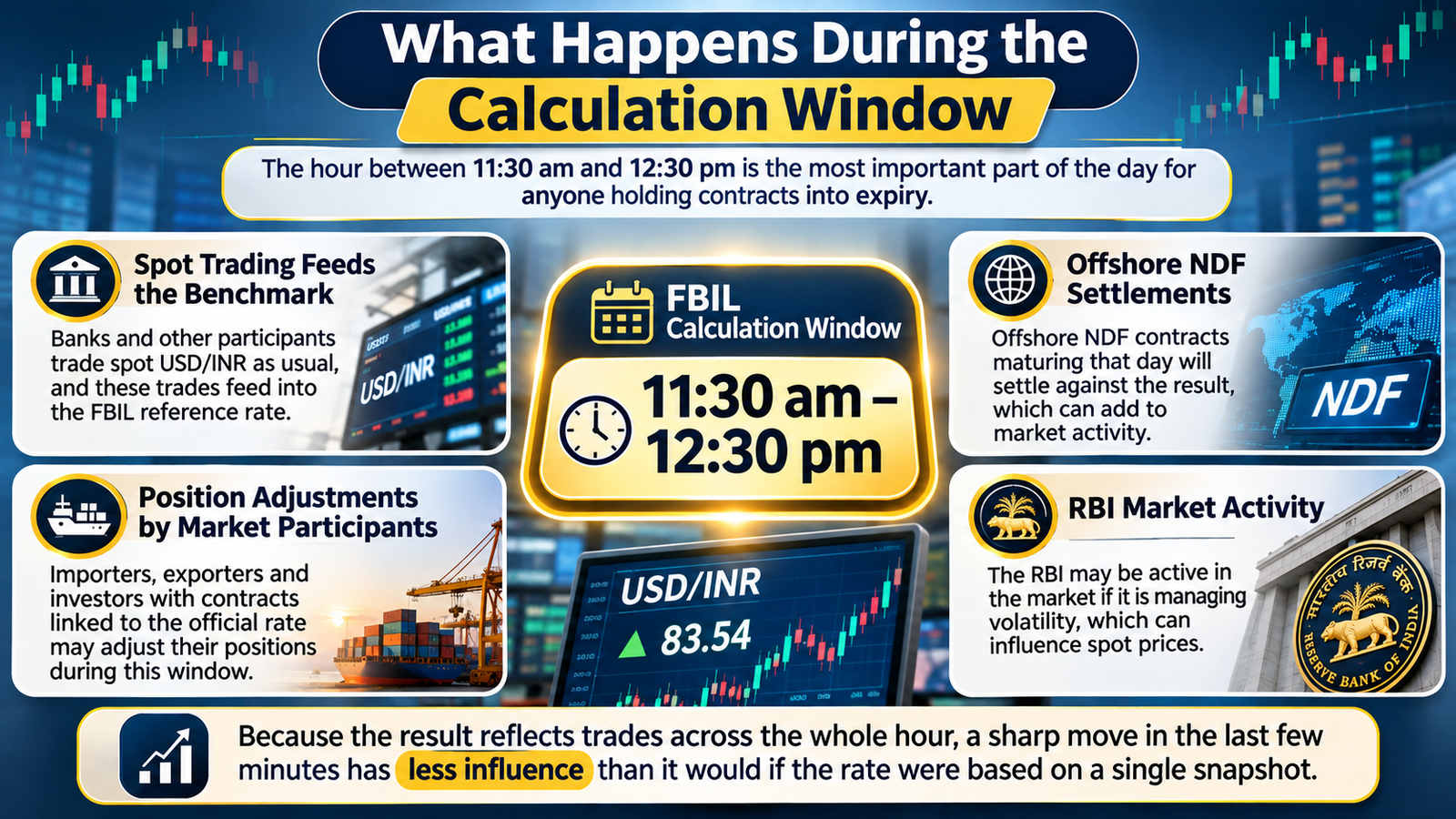
The hour between 11:30am and 12:30pm is the most important part of the day for anyone holding contracts into expiry. During this window:
- Banks and other participants trade spot USD/INR as usual, and these trades feed into the benchmark.
- Importers, exporters and investors with contracts linked to the official rate may adjust their positions.
- Offshore NDF contracts maturing that day will settle against the result, which can add to activity.
- The RBI may be active in the market if it is managing volatility, which can influence spot prices.
Because the result reflects trades across the whole hour, a sharp move in the last few minutes has less influence than it would if the rate were based on a single snapshot.
Expiry Day Checklist
- Which of my currency contracts expire today?
- Have I decided whether to exit, roll or hold to final settlement?
- Will I complete any exit before trading in the expiring contract stops at 12:30pm?
- Am I watching spot USD/INR during the 11:30am to 12:30pm window?
- Have I checked the published figure around 1:00pm?
- Does the final settlement in my contract note match the published rate?
Safeguards and Governance
- Published methodology: FBIL publishes how the rate is calculated, so users can understand and check it.
- Transaction-based data: using real trades rather than opinions reduces the scope for manipulation.
- Fallback rules: if one data source has no usable data, another is used.
- Regulatory oversight: FBIL operates under the RBI’s framework for benchmark administrators.
- Review and consultation: methodology changes, such as the 2025 publication time change, are announced in advance.
Why the FBIL Reference Rate Matters for Traders
- Know your settlement price: any position held to expiry settles at the benchmark, not the last trade.
- Watch the window: spot USD/INR moves between 11:30am and 12:30pm decide expiry outcomes.
- Plan exits: decide before 12:30pm on expiry day whether to exit, roll or hold.
- Track NDF maturities: large offshore NDF fixings can add to activity during the window.
- Verify: check the published FBIL figure against your contract note.
Trading Currency Derivatives from India
Indian residents can trade currency futures and options on NSE and BSE through SEBI-registered brokers. Contracts include USD/INR, EUR/INR, GBP/INR and JPY/INR, along with EUR/USD, GBP/USD and USD/JPY. One USD/INR lot is $1,000, so a one-paisa move is worth ₹10 per lot. Leveraged forex through offshore brokers is not permitted for Indian residents under FEMA.
Common Misunderstandings
- “The RBI sets the rate.” Since July 2018, FBIL has calculated and published it.
- “It is published at 1:30pm.” Since 6 January 2025, publication has been around 1:00pm.
- “It is the same as my bank’s rate.” Banks add their own margin.
- “Customs and tax use the same rate.” Customs uses CBIC-notified rates, and some tax conversions use SBI’s TT buying rate.
- “Futures settle at the last traded price.” They settle at the FBIL reference rate.
FAQs
What is the FBIL reference rate?
It is India’s official daily benchmark for the USD/INR spot rate, published by Financial Benchmarks India Pvt Ltd. FBIL also publishes rates for EUR, GBP and JPY against the rupee.
How is the FBIL reference rate calculated?
It is based on actual spot USD/INR trades on electronic platforms between 11:30am and 12:30pm Mumbai time, according to FBIL’s published methodology.
What time is the FBIL reference rate published?
Around 1:00pm Mumbai time on business days, since 6 January 2025.
Who owns FBIL?
It is jointly owned by FIMMDA, FEDAI and the Indian Banks’ Association.
Is the FBIL reference rate the same as the RBI reference rate?
Yes, in practice. The RBI published the rate until July 2018; FBIL has published it since, and many people still use the old name.
Where can I find the rate?
On FBIL’s website, which also keeps an archive of past rates.
Conclusion
The FBIL reference rate is the backbone of India’s currency benchmarks. Calculated from actual spot trades in a one-hour window and published around 1:00pm, it settles exchange-traded currency derivatives, fixes offshore NDFs and anchors countless business contracts. Independent administration and RBI oversight help make it a trusted, neutral number.
For traders, understanding how the rate is set turns expiry day into a planned event rather than a surprise. Watch the calculation window, decide early whether to hold to settlement and always confirm the published figure.