
Introduction
Millions of Indian freelancers, consultants, developers, designers and remote workers now earn in US dollars. A client in the US pays $2,000 for a project, and the rupee value of that payment depends on the USD/INR rate on the day it is converted. If the rupee strengthens before you convert, you receive less. If it weakens, you receive more.
For many freelancers, these swings are noise. But when dollar income pays your rent, EMIs and taxes, a move of a rupee or two can make monthly budgeting harder. Learning how to hedge USD income freelancer India professionals earn, or at least manage the currency risk sensibly, brings more predictability to your finances.
This guide explains how rupee moves affect your income, simple non-trading approaches, an EEFC account, pricing strategies, how exchange-traded futures and options can help, RBI rules, and basic tax and GST points.
How Rupee Moves Affect Your Income
This example is illustrative and uses hypothetical rates.
| Monthly income | USD/INR rate | Rupee value |
|---|---|---|
| $3,000 | 86.50 | ₹2,59,500 |
| $3,000 | 88.50 | ₹2,65,500 |
| $3,000 | 90.50 | ₹2,71,500 |
A ₹2 swing in USD/INR changes the rupee value of $3,000 by ₹6,000 a month, or ₹72,000 a year. Over the long run, the rupee has tended to weaken against the dollar, which has generally helped dollar earners. But there are also periods when the rupee strengthens, and the timing of conversions matters.
Step 1: Know Your Exposure
- How much do you earn in dollars each month?
- How regular is it? Retainer clients are predictable; one-off projects are not.
- When do you receive payment? Note invoice and payment dates.
- What are your rupee expenses? Rent, EMIs, school fees and taxes set the minimum you need each month.
- Do you have dollar expenses? Software subscriptions or travel paid in dollars offset part of your exposure.
Your net dollar exposure is what you earn in dollars minus what you spend in dollars.
Step 2: Simple Ways to Reduce Currency Risk Without Trading
The simplest way to hedge USD income freelancer India professionals earn does not involve derivatives at all. Start with these habits:
Convert regularly
Converting a fixed share of income on a regular schedule, such as every payment or every fortnight, averages out the exchange rate over time. It avoids the stress of trying to pick the best day.
Keep a rupee buffer
Keep three to six months of rupee expenses in your savings. With a buffer, you are not forced to convert dollars at a bad rate to meet bills.
Price in dollars, but review rates
Pricing in dollars is common for international clients. Review your rates annually; if the rupee has strengthened significantly, a modest dollar rate increase can protect your rupee income.
Choose platforms carefully
Payment platforms and banks charge conversion margins and fees, which can cost more than small exchange rate moves. Compare total costs, including the exchange rate offered against the market rate, and keep the foreign inward remittance documents (such as FIRA or FIRC) that your bank or platform provides.
Step 3: Consider an EEFC Account
An Exchange Earners’ Foreign Currency (EEFC) account lets eligible residents who earn foreign exchange, including professionals exporting services, hold part or all of their foreign currency earnings in that currency with an Indian bank.
- You can keep dollars and convert to rupees when you choose.
- You can use the dollars for permitted payments, such as foreign subscriptions or travel.
- EEFC balances generally do not earn interest, so holding dollars for long periods has an opportunity cost.
- An EEFC account gives flexibility on timing, but it does not lock in a rate.
Check eligibility, documentation and charges with your bank.
Step 4: Hedge USD Income Freelancer India-Style with Exchange-Traded Contracts
For freelancers with larger, regular dollar income, exchange-traded currency derivatives on NSE and BSE offer a way to lock in rates. One USD/INR futures lot is $1,000, which suits freelancers receiving a few thousand dollars a month.
Using futures
If you expect to receive dollars next month and want to lock in today’s forward rate, you can sell USD/INR futures equal to the expected amount. If the rupee strengthens, the futures gain offsets the lower conversion value. If the rupee weakens, the futures lose, but your dollars convert to more rupees.
Using options
If you want protection against a stronger rupee but still want to benefit if it weakens, you can buy USD/INR put options. Your maximum cost is the premium paid.
Worked Example: Hedging a Monthly Retainer with Futures
This example is illustrative and uses hypothetical prices. Charges are ignored for simplicity.
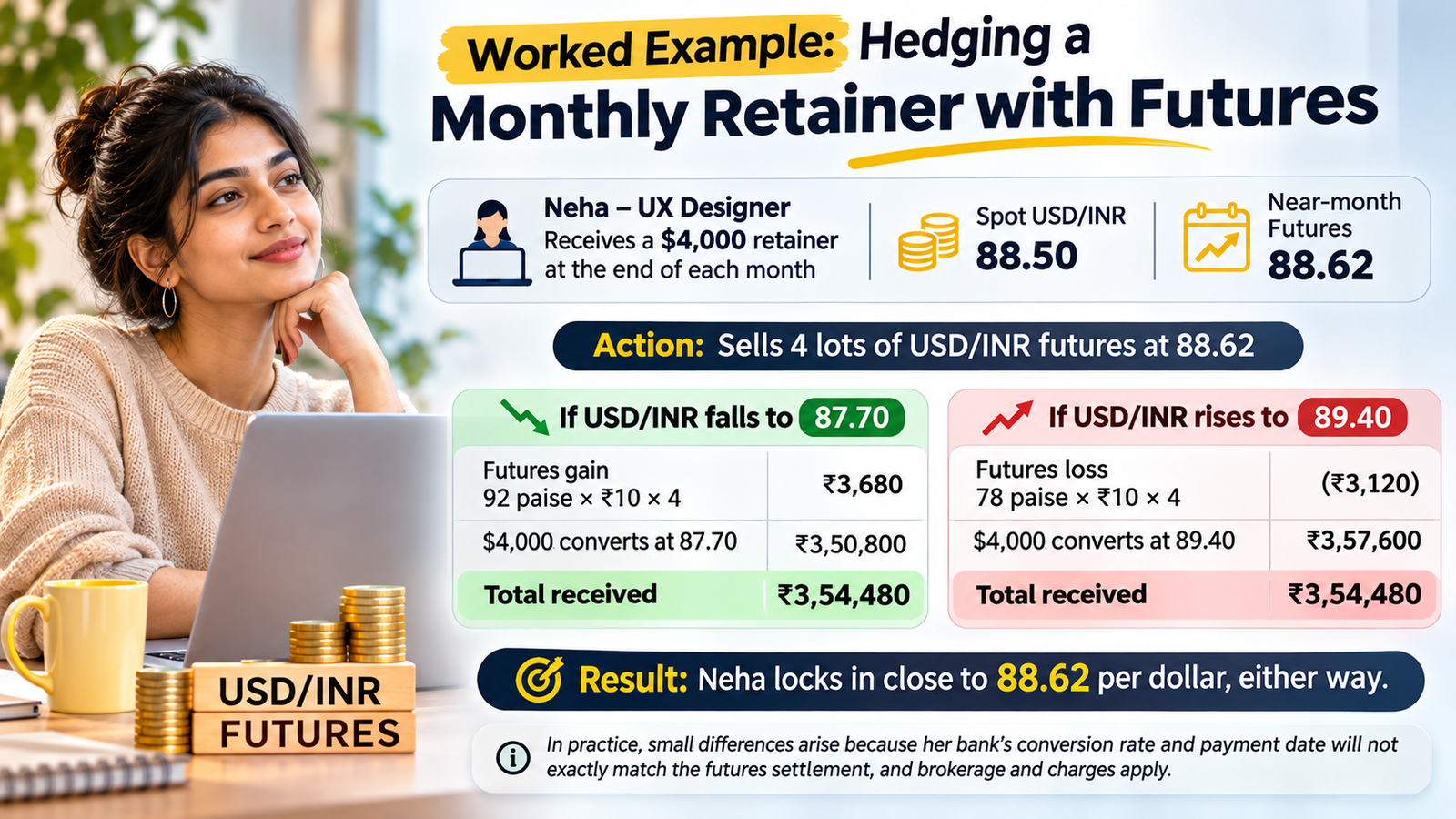
Neha, a UX designer, receives a $4,000 retainer at the end of each month. Spot USD/INR is 88.50, and the near-month futures contract trades at 88.62. She sells 4 lots of USD/INR futures at 88.62.
- If USD/INR falls to 87.70 at expiry: her futures gain 92 paise × ₹10 × 4 = ₹3,680. Her $4,000 converts to ₹3,50,800. Total: ₹3,54,480, about 88.62 per dollar.
- If USD/INR rises to 89.40: her futures lose 78 paise × ₹10 × 4 = ₹3,120. Her $4,000 converts to ₹3,57,600. Total: ₹3,54,480, again about 88.62.
Either way, Neha locks in close to 88.62. In practice, small differences arise because her bank’s conversion rate and payment date will not exactly match the futures settlement, and brokerage and charges apply.
Worked Example: Protecting with a Put Option
This example is illustrative and uses hypothetical premiums.
Rahul, a developer, expects $3,000 next month but is unsure of the exact date. He buys 3 lots of an 88.25 USD/INR put at a premium of ₹0.25, costing ₹750.
- If USD/INR falls to 87.50: the puts are worth 75 paise × ₹10 × 3 = ₹2,250, a net gain of ₹1,500, which offsets much of the lower conversion value.
- If USD/INR rises to 89.50: the puts expire worthless, Rahul loses ₹750, but his dollars convert at the higher rate.
Hedge USD Income Freelancer India: Is It Worth It for You?
| Situation | Suggested approach |
|---|---|
| Small or irregular dollar income | Convert regularly, keep a rupee buffer, compare platform costs |
| Steady retainer income of a few thousand dollars a month | Consider partial hedging with futures or options for one to three months ahead |
| Large, predictable income or big one-off contracts | Consider a structured hedge for confirmed amounts, with advice |
| Uncertain payment timing | Prefer options over futures, or simply convert as payments arrive |
Many freelancers hedge only part of their expected income, for example half of next month’s retainer, to balance protection with flexibility. Before you hedge USD income freelancer India-wide practice suggests starting small and keeping records.
Building a Simple Annual Plan
A once-a-year plan keeps currency decisions calm and consistent:
- January: estimate dollar income for the year and set a “budget rate” for planning your rupee expenses.
- Each month: convert a fixed share of receipts and keep the rest in an EEFC account or convert as needed.
- Each quarter: review whether your dollar rates still cover rupee costs, and decide whether to hedge the next one to three months of retainer income.
- Year end: compare your average conversion rate with your budget rate and adjust pricing for the next year.
This approach lets you hedge USD income freelancer India-wide in a measured way, without reacting to every move in the rupee.

RBI Rules for Freelancers Using Currency Derivatives
- Exchange-traded rupee currency derivatives are meant mainly for hedging genuine foreign currency exposures, such as freelance export income. Brokers ask clients to sign a declaration.
- In October 2026, the RBI announced a cut in the limit for positions without documented underlying exposure from US100milliontoUS5 million equivalent across exchanges. Most freelancers are far below this limit, but positions should still reflect genuine income.
- Keep invoices, contracts and payment records to support your hedges.
- Leveraged forex through offshore brokers and apps is not permitted for Indian residents under FEMA. Do not use offshore platforms to “hedge” your income.
Tax and GST Basics
Whatever method you use to hedge USD income freelancer India tax and GST rules still apply to the underlying income:
- Income tax: freelance income received in dollars is taxable in India, converted into rupees under the applicable rules. Professionals may be eligible for presumptive taxation schemes, subject to conditions. The Income-tax Act, 2025 applies from 1 April 2026, so section numbers differ from older guides.
- Hedging gains and losses: profits and losses on exchange-traded currency derivatives are generally treated as non-speculative business income. Discuss with a chartered accountant how to report them alongside your freelance income.
- GST: services provided to clients abroad can qualify as export of services. Freelancers registered for GST commonly file a Letter of Undertaking (LUT) to export without paying IGST, subject to conditions such as receiving payment in convertible foreign exchange.
- Records: keep FIRA or FIRC documents, invoices and bank statements for tax and GST purposes.
Hedge USD Income Freelancer India Checklist
- Do I know my monthly dollar income and rupee expenses?
- Do I have a rupee emergency buffer?
- Am I comparing conversion costs across banks and platforms?
- Would an EEFC account give me useful timing flexibility?
- Is my income large and regular enough to justify futures or options?
- Have I signed the RBI declaration and kept records of my exposure?
- Have I spoken to a chartered accountant about tax and GST?

Common Mistakes
- Trying to time the market: waiting for the “perfect” rate often leads to worse outcomes.
- Ignoring conversion fees: platform margins can cost more than currency moves.
- Over-hedging: hedging more than your expected income turns protection into speculation.
- Using offshore forex apps: illegal for residents and risky for your money.
- Forgetting margin needs: futures require margin and daily settlement of losses.
- Neglecting records: missing FIRA, FIRC or invoices can cause tax and GST problems.
FAQs
How can I hedge USD income freelancer India-style?
Start with simple steps: convert regularly, keep a rupee buffer and compare conversion costs. If your income is large and regular, you can sell USD/INR futures or buy put options on NSE or BSE through a SEBI-registered broker.
What is the cheapest way to hedge USD income freelancer India professionals can use?
Regular conversion and a rupee buffer cost nothing extra. Futures and options add brokerage and other charges, so they make sense mainly for larger, regular income.
Can freelancers open an EEFC account?
Eligible residents earning foreign exchange, including professionals exporting services, can generally open one. Check with your bank.
Is hedging worth it for small amounts?
Often not. For small or irregular income, regular conversion and a rupee buffer may be enough.
Do I need to sign anything to trade currency derivatives?
Yes. Brokers ask for an RBI declaration that you are hedging a genuine exposure.
Can I use offshore forex apps to hedge?
No. Leveraged forex through offshore platforms is not permitted for Indian residents under FEMA.
Do I pay GST on foreign client income?
Services to foreign clients may qualify as zero-rated exports, often under an LUT, subject to conditions. Consult a chartered accountant.
Conclusion
Earning in dollars is an advantage, but rupee swings can make monthly income unpredictable. Most freelancers can manage this with simple habits: converting regularly, keeping a rupee buffer, reviewing rates and comparing conversion costs. Those with larger, regular income can go further and hedge USD income freelancer India-style through exchange-traded futures and options, within RBI rules.
Whatever you choose, keep it simple, keep records and treat hedging as protection, not a way to profit from currency moves.