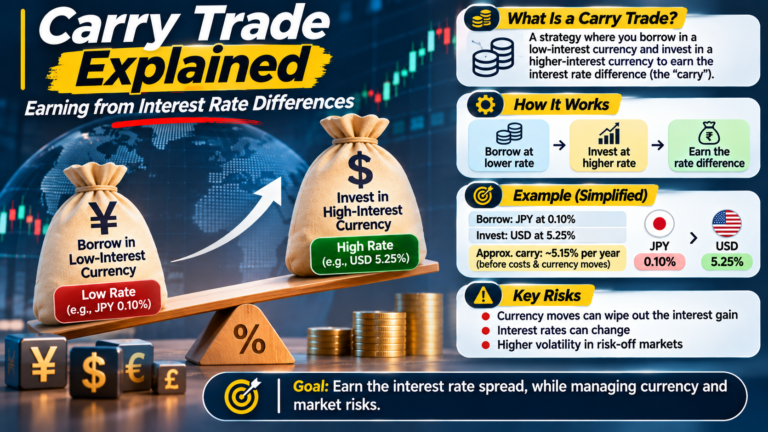

Introduction of Best Broker for Currency Trading India
Your broker is the gateway to every currency trade you make. Picking the best broker for currency trading in India can save you money, time and stress. It affects how much you pay in charges, how quickly orders are filled, which pairs you can trade and how safe your money is. Yet many traders choose a broker based on an advertisement or a friend’s recommendation without checking the basics.
In India, choosing a currency broker also has a legal dimension. Only certain brokers and certain markets are permitted, and offshore forex apps that promise high leverage are not legal for Indian residents.
This guide explains how to find the best broker for currency trading in India for your needs. We cover:
- The legal requirements every broker must meet
- Costs, including hidden charges
- Platforms, tools and order types
- Margins, support and account features
- Red flags and a step-by-step comparison method
First Rule: The Broker Must Be SEBI-Registered
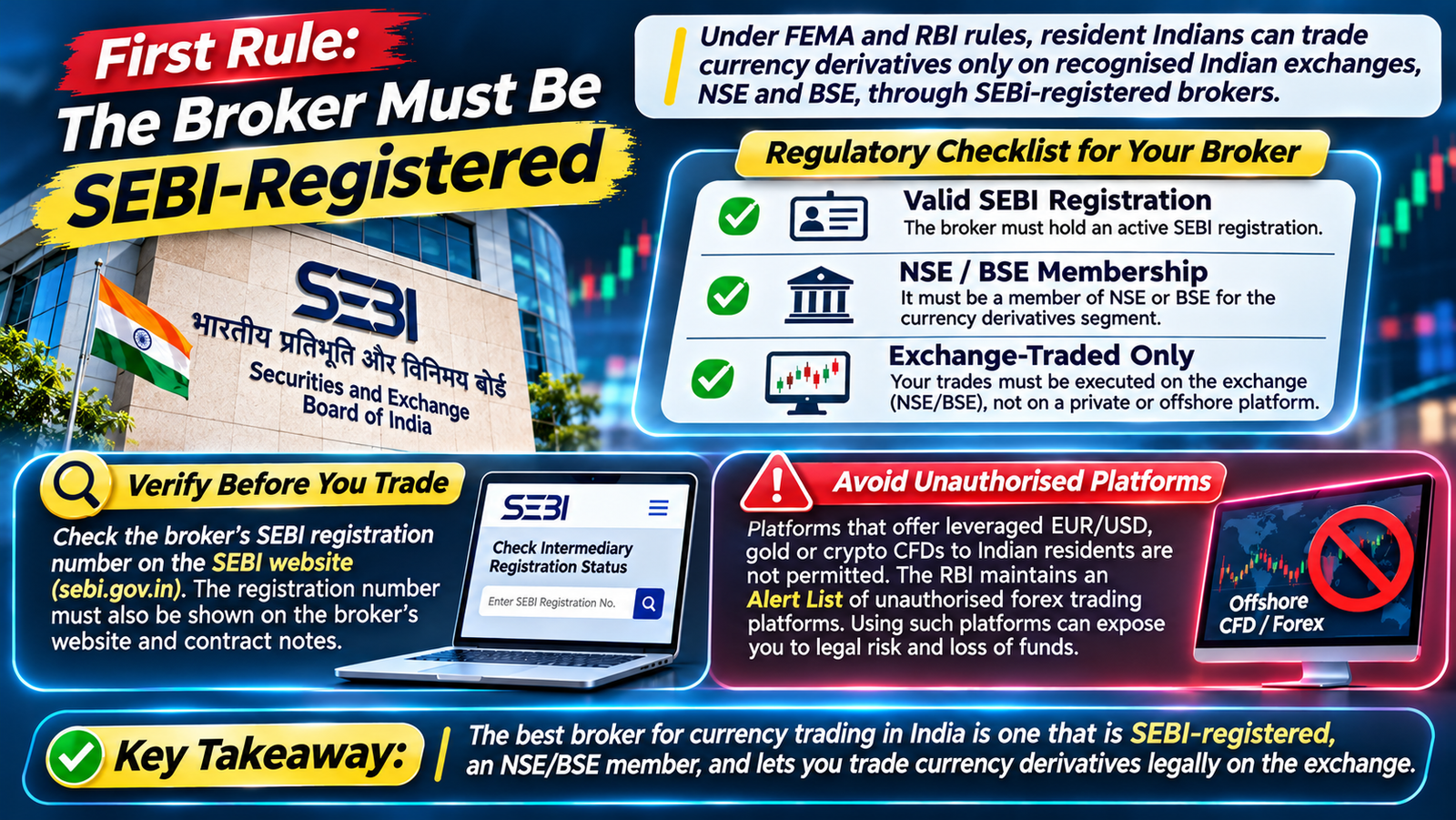
Under FEMA and RBI rules, resident Indians can trade currency derivatives only on recognised Indian exchanges, NSE and BSE, through SEBI-registered brokers. That means the starting point for the best broker for currency trading in India is always regulation:
- The broker must hold a valid SEBI registration.
- It must be a member of NSE or BSE for the currency derivatives segment.
- Trades must be executed on the exchange, not on a private platform.
You can verify a broker’s registration on the SEBI website using its registration number, which brokers must display on their websites and contract notes.
Platforms that offer leveraged EUR/USD, gold or crypto CFDs to Indian residents, often promoted through social media, are not permitted. The RBI maintains an Alert List of unauthorised forex trading platforms. No matter how attractive their offers look, they cannot be the best broker for currency trading in India, because using them can expose you to legal risk and loss of funds.
What You Can Trade Through an Indian Broker
| Type | Pairs | Lot size |
|---|---|---|
| INR pairs | USD/INR, EUR/INR, GBP/INR, JPY/INR | $1,000, €1,000, £1,000, ¥1,00,000 |
| Cross-currency pairs | EUR/USD, GBP/USD, USD/JPY | €1,000, £1,000, $1,000 |
Both futures and options are available on these pairs, although liquidity is concentrated in USD/INR. Not every broker supports every contract equally well, so check before you sign up.
Key Factors When Choosing the Best Broker for Currency Trading India
1. Currency segment support
- Does the broker offer currency futures and options on NSE and BSE?
- Are cross-currency pairs (EUR/USD, GBP/USD, USD/JPY) available?
- Can you trade both near-month and later contracts?
2. Brokerage model
| Model | How it works | Suits |
|---|---|---|
| Discount broker | Low flat fee per executed order | Active, self-directed traders |
| Full-service broker | Percentage-based or higher fees, with research and advisory support | Traders who want guidance and relationship managers |
For frequent currency traders, small differences in per-order fees add up quickly.
3. Total trading costs
Brokerage is only one part of the cost. Every currency trade also carries:
- Exchange transaction charges
- SEBI turnover fees
- Stamp duty
- GST on brokerage and exchange charges
There is no STT on currency derivatives. Some brokers also charge for call-and-trade orders, account maintenance, payment gateway use or auto square-off. Ask for a complete charges list.
4. Account opening and maintenance fees
Many brokers offer free or low-cost account opening, but annual maintenance charges, usually on the demat account, vary. Currency derivatives do not need a demat account, but most brokers open trading and demat accounts together.
5. Trading platform quality
- Stability during volatile periods such as RBI announcements
- Advanced charting with indicators and drawing tools
- Fast, reliable mobile app
- Order types: limit, stop-loss, stop-loss market, cover and bracket orders where offered
- Option chain and Greeks for currency options
- API access if you plan to automate trading
A platform that freezes during an RBI announcement can cost more than a year of brokerage savings, so reliability should weigh heavily when you pick the best broker for currency trading in India.
6. Margin information and tools
Currency margins are set by the exchange, but brokers differ in how clearly they show requirements. Look for a margin calculator, real-time margin display and clear communication on margin calls.
7. Research and education
Some brokers provide currency research, economic calendars and educational content. Beginners may value this; experienced traders may prefer low costs over research.
8. Customer support
Check how easy it is to reach support by phone, chat or email, especially during market hours. Quick help matters when an order or margin issue arises.
9. Fund transfer and withdrawal
Look for instant fund transfer via UPI or net banking and quick withdrawals to your registered bank account.
10. Reputation and complaint history
Check the broker’s track record, user reviews and complaint data published by the exchanges. A long, clean record is a good sign.
Best Broker for Currency Trading India: Comparison Table
| Criterion | What a good broker offers | Warning sign |
|---|---|---|
| Regulation | Valid SEBI registration and NSE/BSE membership | No registration number displayed |
| Currency segment | INR and cross-currency futures and options | Limited or no cross pairs |
| Costs | Clear, published charges | Vague or hidden fees |
| Platform | Stable, fast, good charts and order types | Frequent outages |
| Margins | Clear calculator and real-time display | Unclear margin calls |
| Support | Reachable during market hours | Slow or unresponsive |
| Funds | Fast deposits and withdrawals | Delays or unusual payment methods |
Worked Example: Comparing Costs for an Active Trader
Suppose a trader places 200 executed currency orders a month. Two hypothetical brokers charge:
- Broker A (discount): ₹20 per executed order.
- Broker B (full-service): ₹50 per executed order.
Brokerage per month:
- Broker A: 200 × ₹20 = ₹4,000
- Broker B: 200 × ₹50 = ₹10,000
Before GST and exchange charges, the difference is ₹6,000 a month, or ₹72,000 a year. For an active trader, that can be a large share of profits. A trader who places only 10 orders a month, however, may happily pay more for research and support.
This example is illustrative and uses hypothetical fees, not those of any real broker.
Discount vs Full-Service: Which Is Better?
Neither is universally the best broker for currency trading in India. It depends on your style:
- Choose a discount broker if you trade frequently, make your own decisions and want low costs.
- Choose a full-service broker if you want research, advice and a dedicated contact, and trade less often.
In practice, the best broker for currency trading in India for one trader can be the wrong choice for another. Many traders use a discount broker for active trading and keep a full-service relationship for investments or advice.

Red Flags When Searching for the Best Broker for Currency Trading India
- Very high leverage offers: Indian exchange-traded currency margins are set by the exchange; “1:500 leverage” signals an offshore platform.
- Trading in gold, oil or crypto CFDs from a “forex app”: These are not Indian exchange-traded currency derivatives.
- Requests to pay into personal UPI IDs or individual accounts: Legitimate brokers accept funds only from your registered bank account to the broker’s official account.
- Guaranteed returns or “account management” offers: No legitimate broker guarantees profits.
- No SEBI registration number on the website or contract notes.
- Pressure to deposit quickly or recruit friends.
If a platform shows any of these signs, it is not the best broker for currency trading in India, however good its marketing looks.
Step-by-Step: How to Choose the Best Broker for Currency Trading India
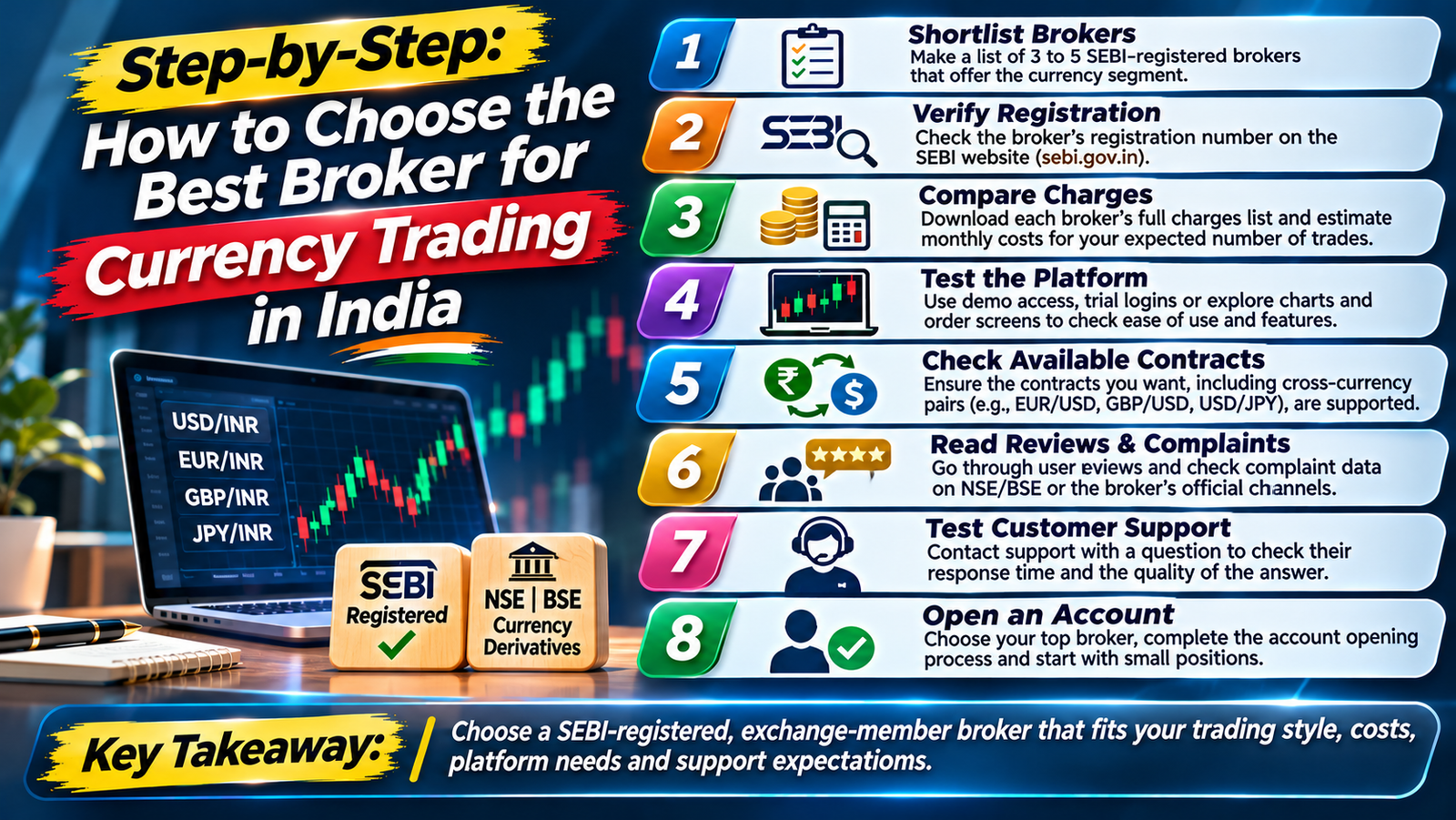
- Shortlist three to five SEBI-registered brokers that offer the currency segment.
- Verify registration on the SEBI website.
- Download each broker’s full charges list and estimate monthly costs for your expected number of trades.
- Test the platform using demo access, trial logins or by viewing charts and order screens.
- Check that the contracts you want, including cross-currency pairs, are supported.
- Read user reviews and check complaint data on exchange websites.
- Contact customer support with a question to test response time.
- Open an account with your top choice and start with small positions.
 Questions to Ask Before You Commit
Before opening an account, put a few direct questions to each shortlisted broker. Their answers, and how quickly they reply, tell you a lot about whether they could be the best broker for currency trading in India for you.
- What is the complete list of charges for currency futures and options, including GST and any platform fees?
- Are cross-currency futures and options available on both web and mobile platforms?
- How are margin shortfalls communicated, and when are positions squared off?
- What are the timings and charges for auto square-off on expiry day?
- How long do withdrawals take to reach my bank account?
- Do you provide a trade-wise tax P&L report for the currency segment?
- Is there an API or algo trading facility, and what does it cost?
Write down the answers and compare them side by side. A broker that gives vague replies before you are a customer is unlikely to become more helpful afterwards. The best broker for currency trading in India for an active trader may differ from the right choice for an occasional hedger, so focus on the answers that matter to your own style.
Opening an Account With the Best Broker for Currency Trading India
Once you have picked the best broker for currency trading in India for your needs, account opening is usually online and takes one to three working days. You will need PAN, Aadhaar, bank details, a photograph and signature, and income proof to activate the derivatives segment. If you already have a trading account, you can usually activate the currency segment from your profile settings.
Tax and Record-Keeping
Profits from exchange-traded currency derivatives are generally treated as non-speculative business income, taxed at your slab rate and reported in ITR-3. A good broker provides clear contract notes, a tax P&L report and ledger statements, all of which make filing much easier. Check the quality of these reports when choosing the best broker for currency trading in India, because poor records make tax filing and turnover calculation much harder.
Best Broker for Currency Trading India Checklist
- Is the broker SEBI-registered with NSE/BSE currency segment membership?
- Does it offer the INR and cross-currency contracts I want?
- What are my total estimated monthly costs?
- Is the platform stable, with the charts and order types I need?
- Are margins displayed clearly?
- Is customer support responsive?
- Are deposits and withdrawals quick and through official channels?
- Does the broker provide good tax and P&L reports?
FAQs
How do I find the best broker for currency trading in India?
Start with SEBI-registered brokers that offer the NSE and BSE currency segment, then compare total costs, platform quality, contract availability, margins and support.
Can I use international forex brokers from India?
Indian residents are not permitted to trade leveraged forex or CFDs through offshore platforms. Currency trading should be done on NSE or BSE through SEBI-registered brokers.
Is a discount broker good for currency trading?
Yes, for active, self-directed traders who want low costs. Full-service brokers may suit traders who want research and advice.
Do all brokers offer cross-currency pairs?
Not all brokers support them equally. Check whether EUR/USD, GBP/USD and USD/JPY futures and options are available before opening an account.
How do I check if a broker is registered?
Use the broker’s SEBI registration number on the SEBI website’s intermediary search.
Conclusion
The best broker for currency trading in India is not necessarily the one with the biggest advertising budget. It is the one that is properly regulated, supports the contracts you want, charges transparently, offers a stable platform and responds when you need help.
Start by confirming SEBI registration, compare total costs for your trading frequency, test the platform and avoid any app that offers offshore-style leverage. With the right broker, you can focus on what matters most: trading with a clear plan and disciplined risk management.