
Introduction
More Indian traders now hold accounts outside India. Some invest in US stocks through overseas brokers under the Liberalised Remittance Scheme (LRS). Others receive prop firm payouts into foreign payment accounts or hold balances with international platforms. Each of these can create a reporting obligation in your income tax return.
That obligation sits in Schedule FA, the section of the ITR where resident taxpayers disclose foreign assets and accounts. Getting your Schedule FA foreign account reporting wrong, or skipping it altogether, can attract a penalty of ₹10 lakh under the Black Money Act, even if the account is small and the income has already been taxed.
This guide explains:
- What Schedule FA is and who must file it
- The calendar-year reporting period
- Which tables apply to foreign trading and brokerage accounts
- What values to report and how to convert them into rupees
- Penalties, common mistakes and a filing checklist
What Is Schedule FA?
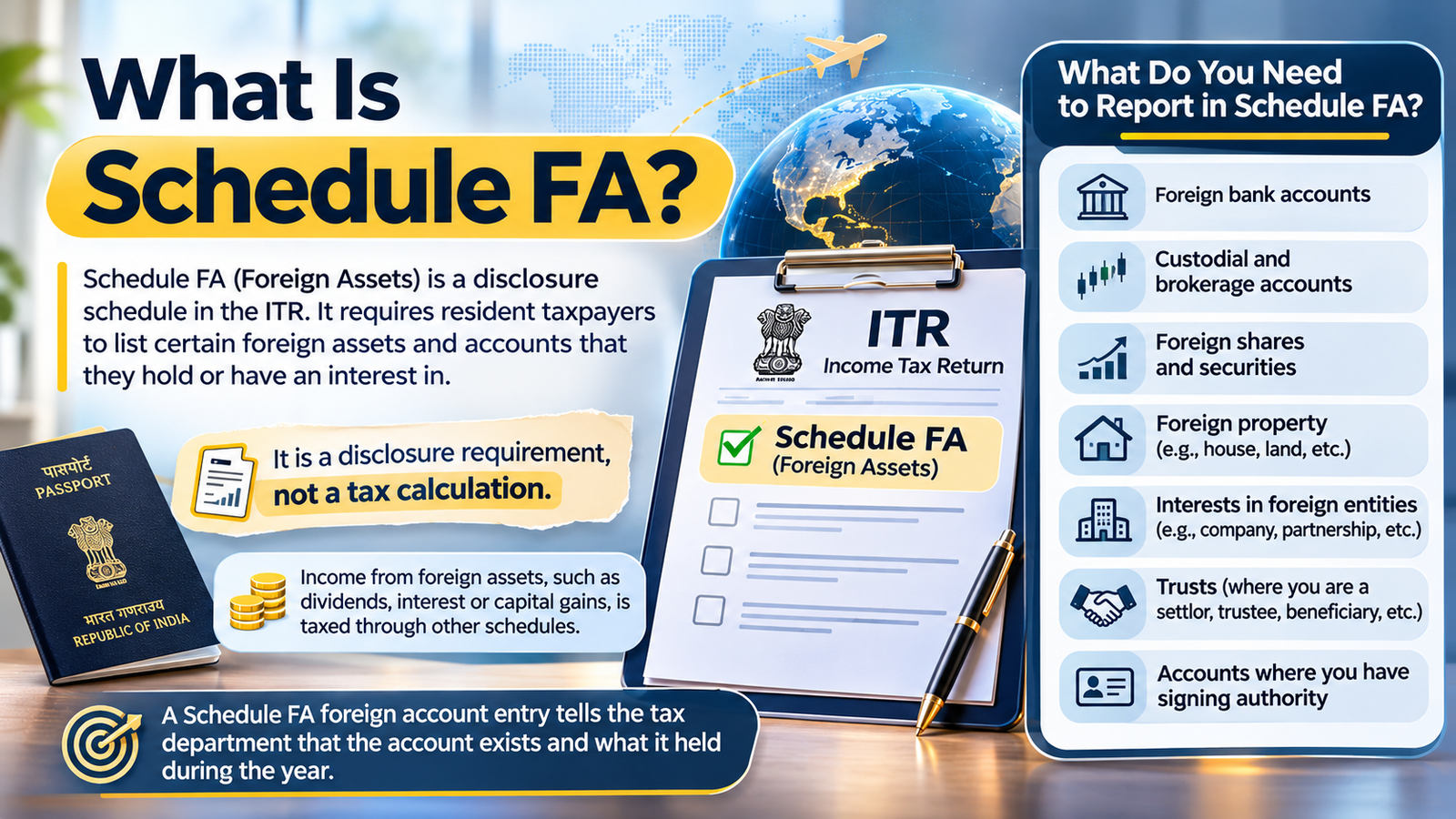
Schedule FA (Foreign Assets) is a disclosure schedule in the ITR. It requires resident taxpayers to list foreign bank accounts, custodial and brokerage accounts, foreign shares and securities, foreign property, interests in foreign entities, trusts and accounts where they have signing authority.
Schedule FA is a disclosure requirement, not a tax calculation. Income from foreign assets, such as dividends, interest or capital gains, is taxed through other schedules. A Schedule FA foreign account entry tells the tax department that the account exists and what it held during the year.
Who Must Report a Schedule FA Foreign Account?
- Resident and ordinarily resident (ROR) individuals and HUFs must report foreign assets and accounts held at any time during the relevant period.
- Non-residents (NRIs) and resident but not ordinarily resident (RNOR) taxpayers are generally not required to fill Schedule FA.
- Beneficial owners and beneficiaries must report, as must people with signing authority over a foreign account, even if they do not own the money.
The requirement applies regardless of the size of the account and regardless of whether the account earned any income. A dormant foreign trading account with a small balance is still a Schedule FA foreign account if you are an ROR.
Schedule FA Foreign Account Reporting Period: Calendar Year, Not Financial Year
This is one of the most common sources of error. Schedule FA uses the calendar year ending 31 December within the financial year, not the April–March financial year.
| Return | Financial year | Schedule FA reporting period |
|---|---|---|
| AY 2026-27 | 1 April 2025 – 31 March 2026 | 1 January 2025 – 31 December 2025 |
An account opened in February 2025 or closed in November 2025 must still be reported, because it was held at some point during the calendar year.
Which ITR Form Includes Schedule FA?
Schedule FA is available in ITR-2 and ITR-3. ITR-1 and ITR-4 do not include it, so if you have any foreign asset to disclose, you cannot use those simpler forms. Traders with F&O or other business income usually file ITR-3; investors with only salary and capital gains usually file ITR-2.
Schedule FA Foreign Account Tables at a Glance
| Table | What it covers |
|---|---|
| A1 | Foreign depository accounts (bank accounts) |
| A2 | Foreign custodial accounts (for example, brokerage accounts holding securities) |
| A3 | Foreign equity and debt interests (shares, ETFs, bonds) |
| A4 | Foreign cash value insurance or annuity contracts |
| B | Financial interest in any foreign entity |
| C | Immovable property outside India |
| D | Other capital assets outside India |
| E | Accounts with signing authority |
| F | Trusts outside India |
| G | Other foreign-source income not covered elsewhere |
Reporting a Trading Account as a Schedule FA Foreign Account
Foreign brokerage account: Table A2
If you hold shares, ETFs or other securities through an overseas broker or custodian, the account itself is generally reported as a Schedule FA foreign account in Table A2 (custodial accounts). Details typically include:
- Country and name of the institution
- Address and ZIP code
- Account number
- Status (owner, beneficial owner or beneficiary)
- Account opening date
- Peak balance during the period
- Closing balance on 31 December
- Gross amount paid or credited to the account during the period, such as dividends, interest or sale proceeds
Underlying holdings: Table A3
Each security held in the account, such as an individual stock or ETF, is usually reported separately in Table A3, with its acquisition date, initial value, peak value, closing value, income and sale proceeds.
Reporting the brokerage account in A2 does not replace reporting the holdings in A3. Practitioners differ on some details, such as whether cash balances in a brokerage account belong in A1 or A2, so agree an approach with your chartered accountant and apply it consistently every year.
Foreign bank and payment accounts: Table A1
If you hold a foreign bank account, for example to receive prop firm payouts or overseas income, it is reported as a Schedule FA foreign account in Table A1 with peak and closing balances and gross interest credited. Overseas e-wallets or payment accounts that hold balances may also need to be disclosed; their classification can vary, so take professional advice.
Schedule FA Foreign Account Special Cases for Traders
Prop firm accounts
Funded accounts at most prop firms are simulated and do not represent assets you own, so they are generally not reported as a Schedule FA foreign account. However, payouts are real income. If payouts are received into a foreign bank or payment account, that account may be reportable, and the payout itself must be reported as income.
Offshore forex and CFD accounts
Leveraged forex and CFD trading on offshore platforms is not permitted for Indian residents under FEMA. Reporting such an account in Schedule FA does not make it legal, but failing to report a foreign asset creates a separate tax-law problem. Anyone who holds or has held such an account should seek advice from a chartered accountant or lawyer.
Crypto on foreign exchanges
Crypto held on overseas exchanges is a grey area for Schedule FA classification. Many advisers recommend disclosure, often under Table D, but practice varies. Gains are separately taxed at the flat 30% rate applicable to virtual digital assets.
Employee stock (RSUs and ESOPs)
Shares received from a foreign employer and held in a foreign brokerage account follow the same A2 and A3 pattern.
Converting Schedule FA Foreign Account Values Into Rupees
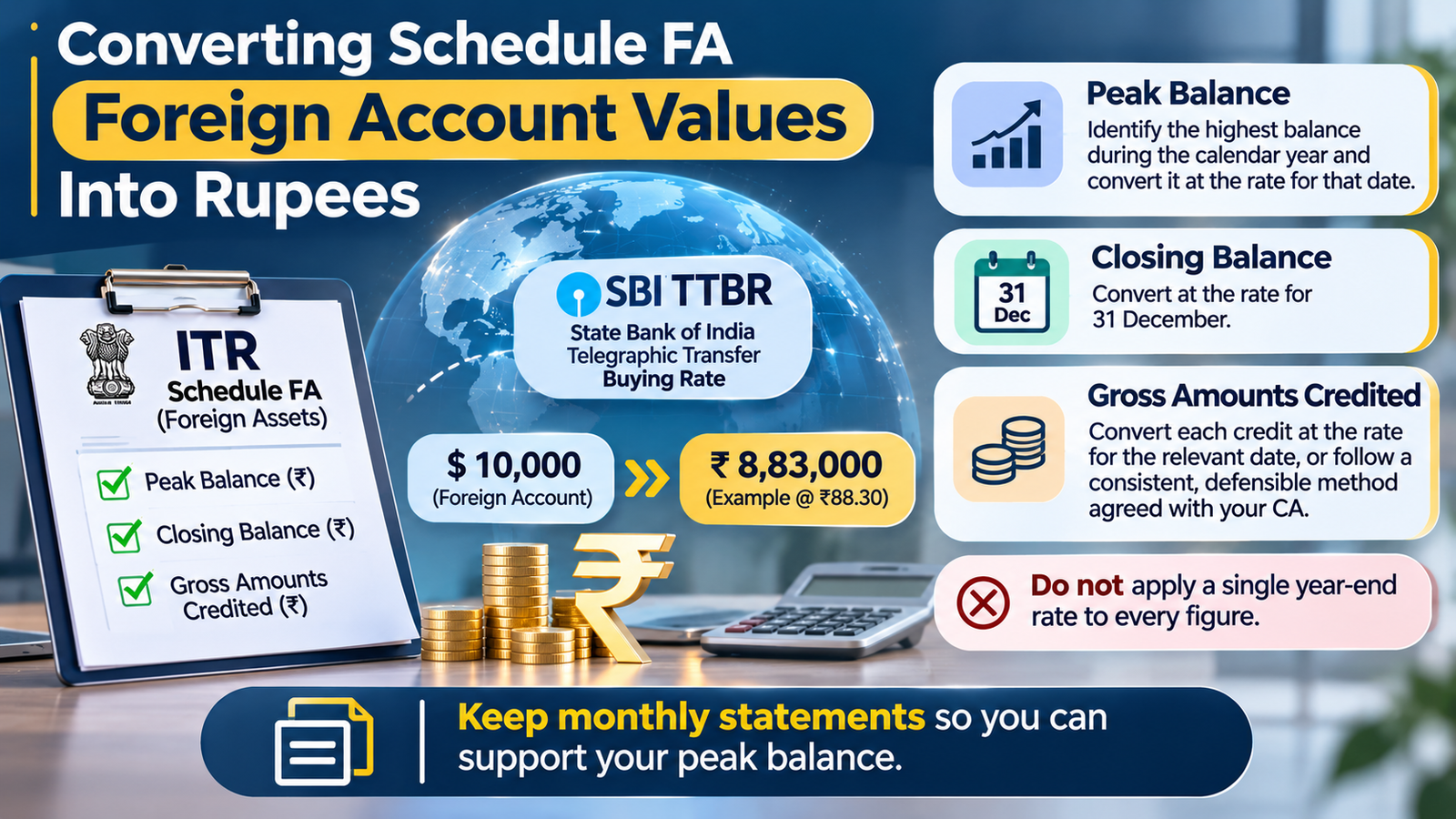
Schedule FA values must be reported in rupees. The commonly used rate is the State Bank of India telegraphic transfer buying rate (SBI TTBR) for the relevant date.
- Peak balance: Identify the highest balance during the calendar year and convert it at the rate for that date.
- Closing balance: Convert at the rate for 31 December.
- Gross amounts credited: Convert each credit at the rate for the relevant date, or follow a consistent, defensible method agreed with your CA.
A single year-end rate should not automatically be applied to every figure. Keep monthly statements so you can support your peak balance.
Worked Example of Schedule FA Foreign Account Reporting
Suppose a resident trader opened a US brokerage account in March 2025 and bought shares of one ETF.
| Item | USD | Illustrative rate | INR |
|---|---|---|---|
| Peak account value (August 2025) | $12,000 | ₹86 | ₹10,32,000 |
| Closing value (31 December 2025) | $11,000 | ₹88 | ₹9,68,000 |
| Dividends credited in the year | $150 | ₹87 | ₹13,050 |
The trader would typically report the brokerage account in Table A2 with these peak, closing and gross credit figures, and the ETF holding in Table A3 with its acquisition date, cost, peak and closing values and dividend income. The dividends are also reported as income in the relevant income schedules, with any US tax withheld claimed as foreign tax credit using Form 67 where eligible.
This example is illustrative. Exchange rates shown are hypothetical, not actual SBI TTBR rates.
Related Schedules: FSI, TR and Form 67
- Schedule FSI: Reports income from outside India, such as foreign dividends or capital gains.
- Schedule TR: Summarises relief claimed for taxes paid abroad.
- Form 67: Must be filed online before the ITR to claim foreign tax credit.
A complete Schedule FA foreign account disclosure usually goes hand in hand with these schedules when the account generates income.
Penalties for Not Reporting a Schedule FA Foreign Account
Under the Black Money (Undisclosed Foreign Income and Assets) and Imposition of Tax Act, 2015:
- Failure to disclose a foreign asset or account in Schedule FA can attract a penalty of ₹10 lakh.
- Undisclosed foreign income or assets on which tax has not been paid can be taxed at 30% of their value, with a further penalty that can be three times the tax.
- Serious cases can lead to prosecution.
Amendments made in 2024 provide that the ₹10 lakh non-disclosure penalty does not apply where the aggregate value of foreign assets, other than immovable property, does not exceed ₹20 lakh. This relief applies to the penalty only; the obligation to disclose each Schedule FA foreign account remains. Confirm how the threshold applies to your case with your CA.
Budget 2026 also announced a one-time foreign asset disclosure window for taxpayers who missed earlier reporting. Check whether it has been notified and is open before relying on it.
Common Schedule FA Foreign Account Mistakes
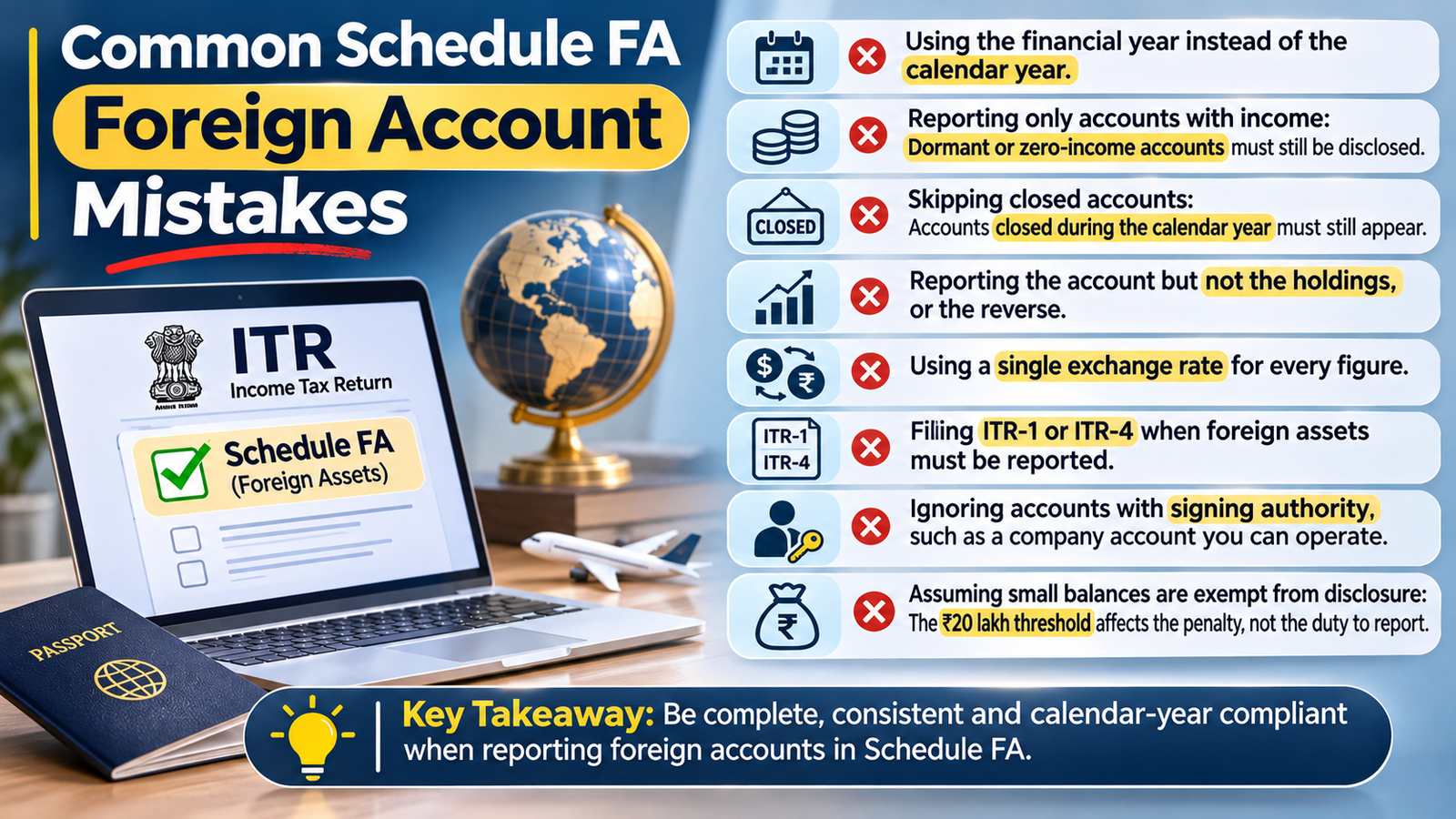
- Using the financial year instead of the calendar year.
- Reporting only accounts with income: Dormant or zero-income accounts must still be disclosed.
- Skipping closed accounts: Accounts closed during the calendar year must still appear.
- Reporting the account but not the holdings, or the reverse.
- Using a single exchange rate for every figure.
- Filing ITR-1 or ITR-4 when foreign assets must be reported.
- Ignoring accounts with signing authority, such as a company account you can operate.
- Assuming small balances are exempt from disclosure: The ₹20 lakh threshold affects the penalty, not the duty to report.
 Schedule FA Foreign Account Checklist
- Am I resident and ordinarily resident for the year?
- Did I hold any foreign bank, brokerage, payment or other account at any time between 1 January and 31 December?
- Have I listed each account in the correct table (A1, A2 or other)?
- Have I listed each underlying holding in Table A3 or the relevant table?
- Do I have statements to support peak and closing balances?
- Have I converted values using SBI TTBR for the correct dates?
- Have I reported the related income in Schedule FSI and filed Form 67 if claiming foreign tax credit?
- Am I using ITR-2 or ITR-3?
FAQs
What is a Schedule FA foreign account?
It is any foreign bank, custodial, brokerage or other account that a resident and ordinarily resident taxpayer must disclose in Schedule FA of the ITR.
Do I need to report a foreign account with no income?
Yes. Disclosure depends on holding the account, not on whether it earned income.
Which period does Schedule FA cover?
The calendar year ending 31 December within the financial year. For AY 2026-27, that is 1 January to 31 December 2025.
Where do I report a US brokerage account?
Generally in Table A2 as a custodial account, with the shares or ETFs it holds reported in Table A3.
Is there a penalty for small foreign accounts?
The ₹10 lakh penalty does not apply where the aggregate value of foreign assets, other than immovable property, is ₹20 lakh or less, but disclosure is still required.
Conclusion
Schedule FA foreign account reporting is a disclosure exercise, but the consequences of getting it wrong are serious. If you are a resident trader with foreign brokerage accounts, bank accounts or payout accounts, list every account held during the calendar year, report the holdings inside them, use correct peak and closing values converted at SBI TTBR and file the related income schedules.
Keep monthly statements, choose ITR-2 or ITR-3 and review your disclosures each year with a chartered accountant experienced in foreign assets. Complete, consistent reporting is the simplest protection against penalties.