
Introduction
Some currency pairs move a few dozen pips on a normal day. Others can swing 150 pips or more in a single session. For traders, those bigger moves mean bigger opportunities, and bigger risks.
Knowing which are the most volatile currency pairs helps you choose markets that match your strategy, set realistic stop-losses and size positions correctly. Trading a fast-moving pair with the same position size you use on a calm pair is one of the quickest ways to blow up an account.
This guide explains:
- What currency volatility is and how to measure it
- Which pairs tend to be the most volatile, and why
- Strategies that suit volatile markets
- Risk management rules for high volatility
- Which volatile pairs Indian traders can trade legally
What Is Currency Volatility?
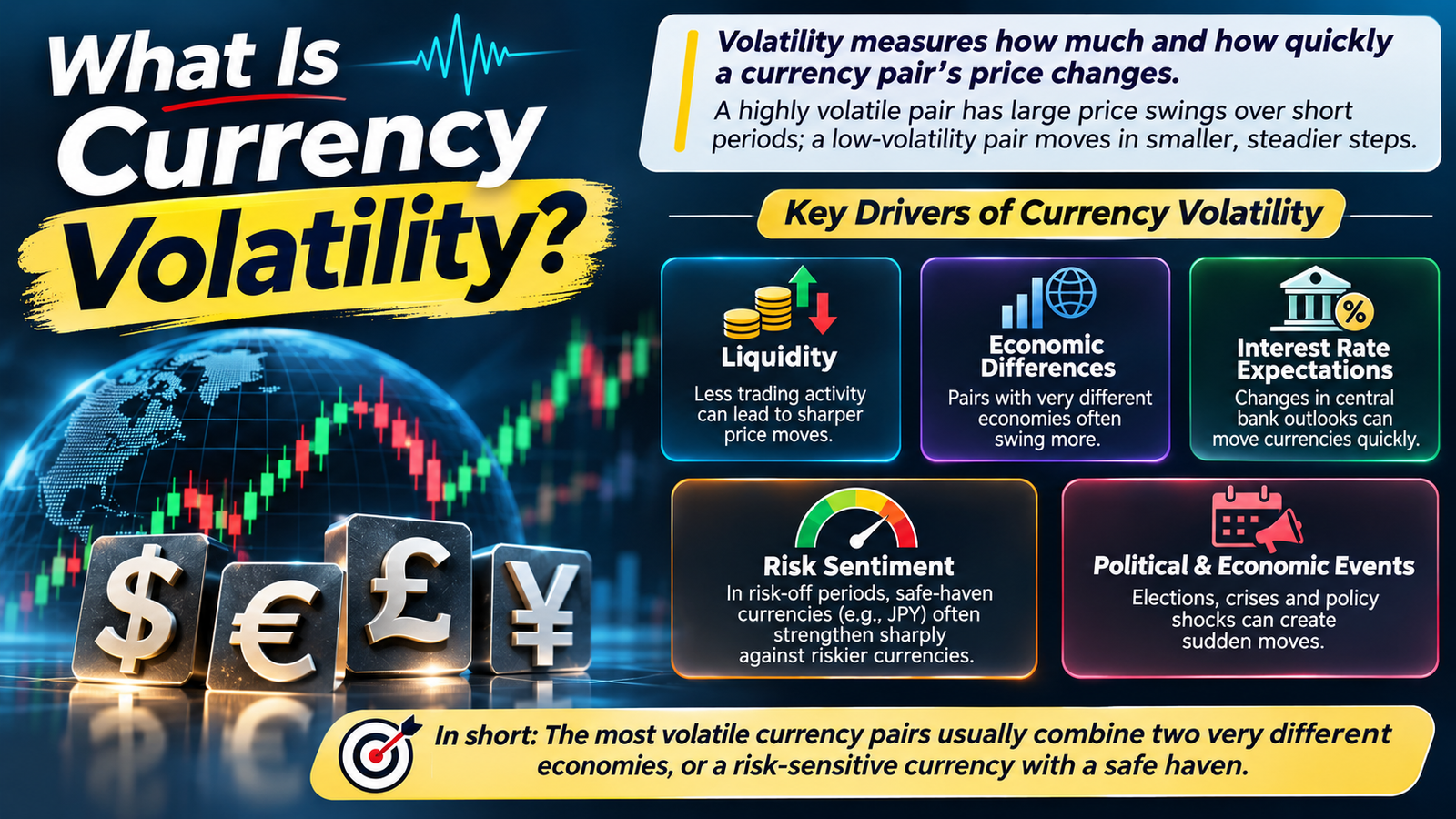
Volatility measures how much and how quickly a currency pair’s price changes. A highly volatile pair has large price swings over short periods; a low-volatility pair moves in smaller, steadier steps.
Volatility is driven by:
- Liquidity: Pairs with less trading activity move more sharply when large orders arrive.
- Economic differences: Pairs combining very different economies, such as a commodity exporter and a low-interest-rate economy, often swing more.
- Interest rate expectations: Changes in central bank outlooks move currencies quickly.
- Risk sentiment: In risk-off periods, safe-haven currencies such as the yen strengthen sharply against riskier currencies.
- Political and economic events: Elections, crises and policy shocks create sudden moves.
These drivers explain why the most volatile currency pairs usually combine two very different economies, or a risk-sensitive currency with a safe haven.
How to Measure Volatility in the Most Volatile Currency Pairs
Average True Range (ATR)
ATR is the most practical tool for measuring volatility. It shows the average range of price movement over a set number of periods, typically 14. A daily ATR of 120 pips means the pair has moved about 120 pips per day on average recently.
Average daily pip range
Many forex websites publish the average daily range for each pair over the past weeks or months. This is a quick way to compare pairs.
Percentage moves
Comparing percentage changes is more accurate across pairs with different price levels. For example, a 100-pip move on GBP/JPY (if priced around 190) is a smaller percentage than a 100-pip move on EUR/USD (if priced around 1.16), because of how pips are defined for yen pairs.
Bollinger Band width and historical volatility
Wider Bollinger Bands and higher historical volatility readings both indicate larger recent price swings.
The Most Volatile Currency Pairs
The list changes over time, but the following pairs have historically been among the most volatile currency pairs in the forex market.
1. GBP/JPY
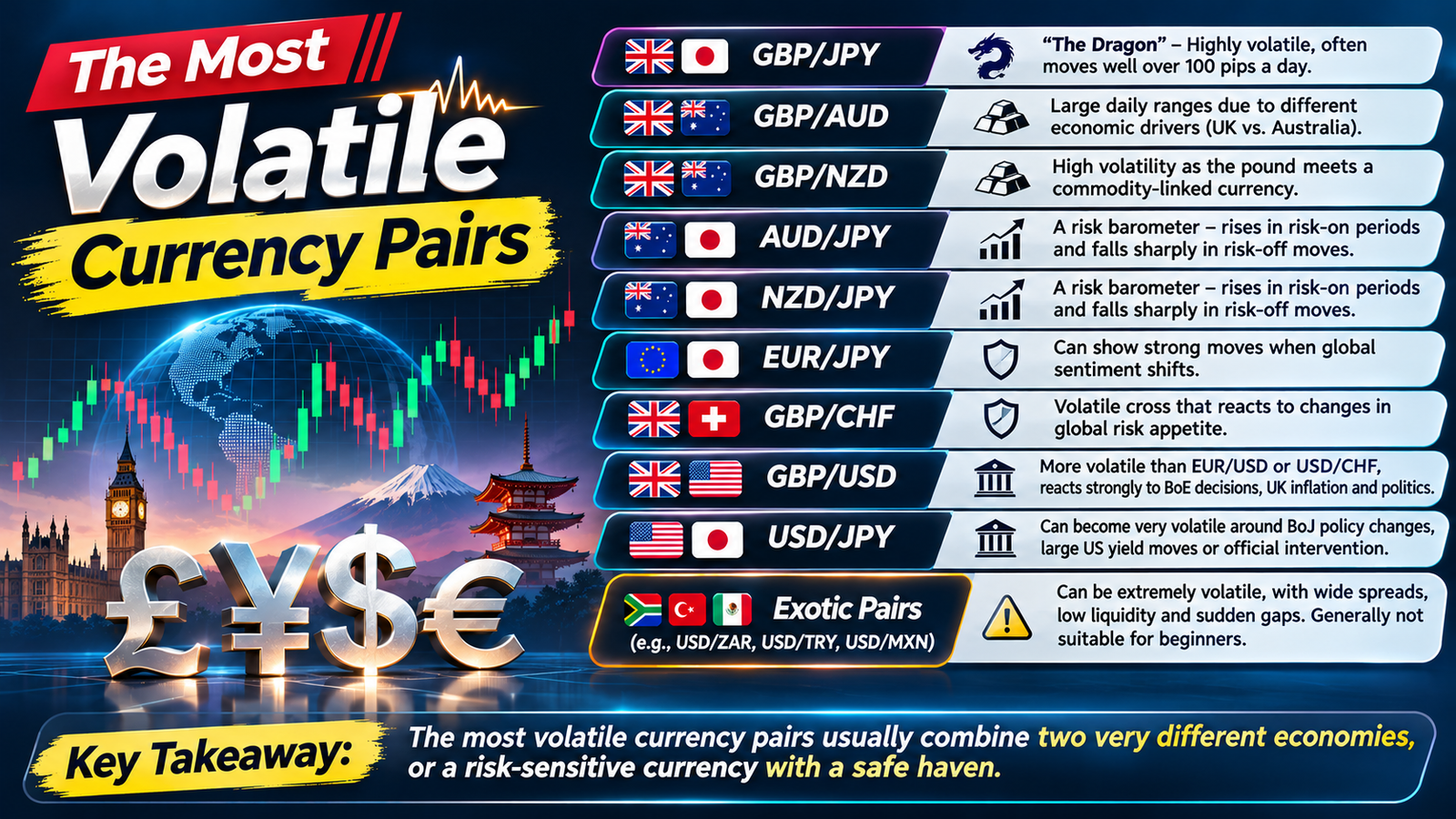
Often nicknamed “the Dragon” or “the Beast”, GBP/JPY combines the volatile British pound with the yen, a safe-haven currency. It frequently moves well over 100 pips a day and reacts strongly to both UK data and global risk sentiment.
2. GBP/AUD and GBP/NZD
These pairs combine the pound with commodity-linked currencies from Australia and New Zealand. Their daily ranges are often large because the two sides respond to very different economic drivers.
3. AUD/JPY and NZD/JPY
Known as risk barometers, these pairs rise when investors are optimistic and fall sharply in risk-off periods, when money flows into the yen.
4. EUR/JPY and GBP/CHF
Cross pairs involving safe-haven currencies such as the yen and Swiss franc can show strong moves when global sentiment shifts.
5. GBP/USD
Among the major pairs, GBP/USD is usually more volatile than EUR/USD or USD/CHF. It reacts strongly to Bank of England decisions, UK inflation and political news.
6. USD/JPY
Normally moderate, USD/JPY can become very volatile around Bank of Japan policy changes, large shifts in US yields or official intervention to support the yen.
7. Exotic pairs
Pairs such as USD/ZAR (South African rand), USD/TRY (Turkish lira) and USD/MXN (Mexican peso) can be extremely volatile, with wide spreads, low liquidity and sudden gaps. They are generally unsuitable for beginners.
Comparison: Most Volatile Currency Pairs at a Glance
| Pair | Type | Main drivers | Typical behaviour |
|---|---|---|---|
| GBP/JPY | Cross | UK data, risk sentiment, BoJ policy | Very large daily ranges |
| GBP/AUD, GBP/NZD | Cross | UK data, commodities, RBA and RBNZ | Large ranges, strong trends |
| AUD/JPY, NZD/JPY | Cross | Risk sentiment, commodity prices | Sharp falls in risk-off periods |
| GBP/USD | Major | BoE and Fed policy, UK politics | Most volatile of the main majors |
| USD/JPY | Major | US yields, BoJ policy, intervention | Bursts of high volatility |
| USD/ZAR, USD/TRY, USD/MXN | Exotic | Local politics, inflation, global risk | Extreme moves, wide spreads |
Use this as a starting point, then check current ATR readings, because the most volatile currency pairs in one year may be calmer the next.
Least Volatile Pairs for Comparison
At the other end of the scale, pairs such as EUR/USD, EUR/CHF and USD/CHF have often been among the calmer pairs, especially when their central banks have similar policies. USD/INR is also relatively low in volatility because the RBI often smooths sharp moves. Comparing these calmer pairs with the most volatile currency pairs shows how much your stop distances and position sizes need to change from one market to another.
Pros and Cons of Trading the Most Volatile Currency Pairs
Pros
- Bigger potential profits per trade
- More trading opportunities in a single session
- Clear trends can develop quickly
Cons
- Larger potential losses
- Wider spreads, especially on crosses and exotics
- More slippage around news
- Stops are hit more easily by sudden spikes
- Emotionally demanding for beginners
Strategies for Trading the Most Volatile Currency Pairs
1. Volatility breakout
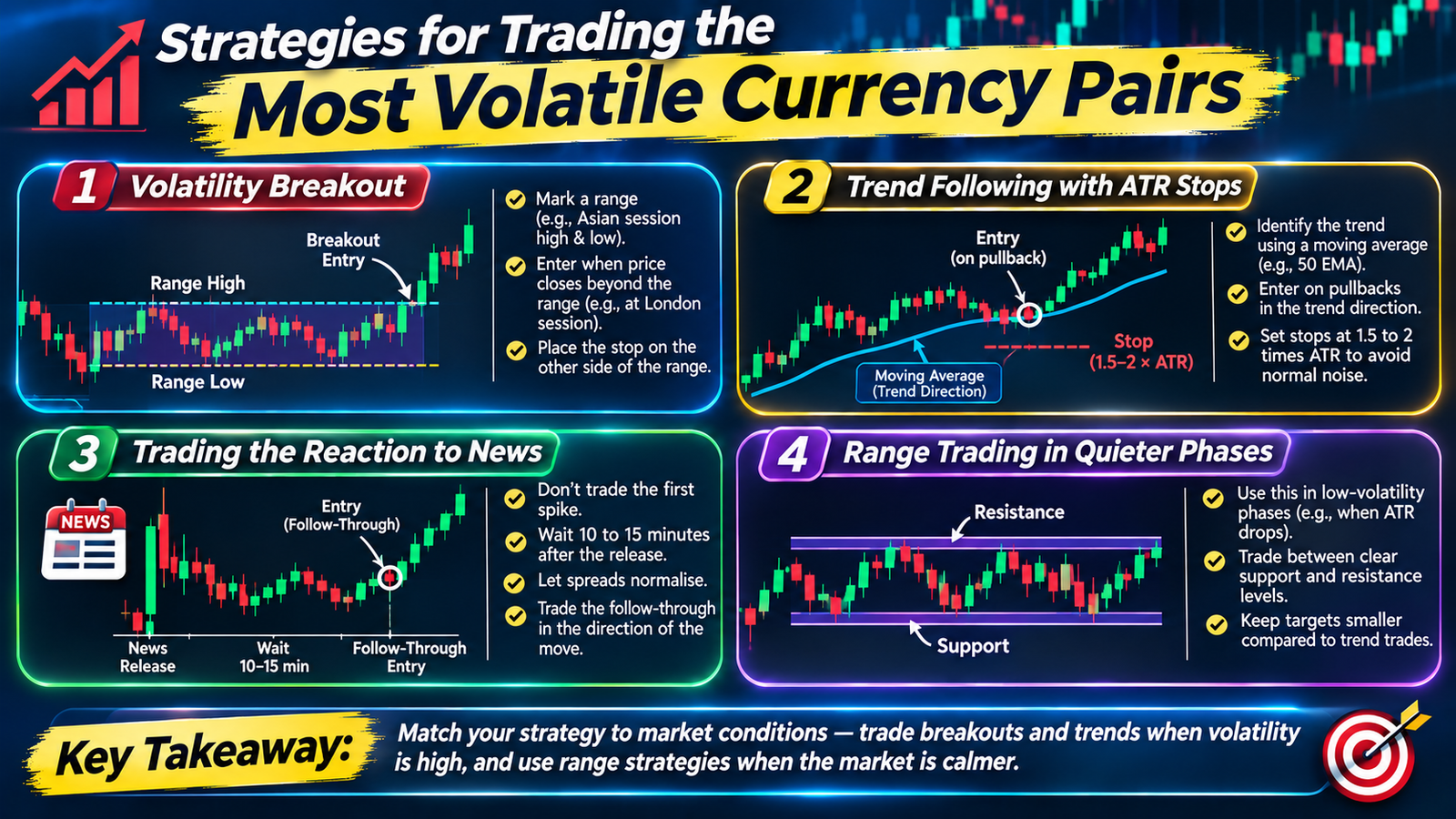
Volatile pairs often consolidate before large moves. Mark a range, such as the Asian session high and low on GBP/JPY, and trade a breakout when price closes beyond it during the London session. Place the stop on the other side of the range.
2. Trend following with ATR stops
Volatile pairs often trend strongly. Use a moving average to identify direction, enter on pullbacks and set stops at 1.5 to 2 times ATR to avoid being stopped out by normal noise.
3. Trading the reaction to news
Rather than trading the first spike, wait 10 to 15 minutes after a major release, let spreads normalise and trade the follow-through in the direction of the move.
4. Range trading in quieter phases
Even the most volatile currency pairs have quieter periods. When ATR drops and price moves sideways, range strategies at clear support and resistance can work, with smaller targets.
Risk Management for the Most Volatile Currency Pairs
Adjust position size to volatility
This is the single most important rule. If a pair’s ATR is twice that of another pair, your stop will usually be wider, so your position size should be smaller to keep the same rupee or dollar risk.
Position size = Account risk ÷ (Stop distance in pips × Pip value)
Other rules
- Risk no more than 0.5% to 1% of your account per trade.
- Use ATR-based stops rather than fixed small stops.
- Reduce size or stay out before major news.
- Avoid holding exotic pairs over weekends.
- Set a daily loss limit and stop trading when you hit it.
- Check spreads before entering, especially outside main sessions.
Worked Example: Sizing a Trade on a Volatile Pair
A trader with a 10,000accountrisks1%(100) per trade.
- EUR/USD: Daily ATR is 60 pips, and the trader uses a 30-pip stop. At about $10 per pip per standard lot, risk per lot is $300, so position size is about 0.33 lots.
- GBP/JPY: Daily ATR is 150 pips, and the trader uses a 75-pip stop. Pip value per standard lot is roughly $6.50 at a USD/JPY rate of around 154, so risk per lot is about $490 and position size is about 0.2 lots.
Both trades risk the same $100, but the GBP/JPY position is smaller to account for its wider stop. This is how professional traders handle the most volatile currency pairs.
This example is illustrative. Pip values change with exchange rates and account currency.
Best Times to Trade the Most Volatile Currency Pairs
Volatility is highest when major financial centres are open:
- London open: About 1:30pm IST in winter, when GBP and EUR pairs become active.
- London–New York overlap: About 6:30pm to 10:30pm IST in winter, the most liquid and often most volatile period.
- Tokyo session: JPY, AUD and NZD pairs are more active in the Indian morning.
- News releases: Central bank decisions and data such as US jobs and inflation figures cause the sharpest moves.
In summer, European and US session times shift one hour earlier in IST.
Most Volatile Currency Pairs for Indian Traders
Indian residents cannot legally trade most of the pairs above, such as GBP/JPY or USD/ZAR, through offshore leveraged platforms. Under FEMA and RBI rules, currency derivatives can be traded only on recognised Indian exchanges through SEBI-registered brokers.
That makes the legal list of the most volatile currency pairs for Indian residents much shorter. Among the pairs available on NSE and BSE, the most volatile tend to be:
- GBP/USD: A cross-currency futures contract on NSE, usually the most volatile of the legal cross pairs.
- GBP/INR: Typically more volatile than USD/INR and EUR/INR, because the pound itself moves more.
- USD/JPY: Can see sharp bursts around Bank of Japan decisions or intervention.
- JPY/INR: Lower liquidity, but can spike when the yen moves sharply.
USD/INR is the least volatile of the group. For INR pairs, each 1-paise move is worth ₹10 per lot, so even a 40-paise move in GBP/INR equals ₹400 per lot. Check liquidity and spreads, especially in cross-currency contracts.
Common Mistakes With the Most Volatile Currency Pairs
- Using the same lot size on every pair: This silently increases risk on volatile pairs.
- Stops that are too tight: Normal swings knock you out before the move develops.
- Chasing spikes: Entering after a big candle often means buying the top.
- Ignoring spreads: Wide spreads on crosses and exotics eat into profits.
- Trading exotics as a beginner: Thin liquidity and gaps can cause losses beyond your stop.
- Using illegal offshore platforms: Indian residents risk FEMA violations and frozen funds.
Most Volatile Currency Pairs Checklist
- What is the pair’s current ATR?
- Does my strategy suit high volatility?
- Is my stop based on ATR or structure rather than a fixed small number?
- Have I reduced position size to keep risk at 1% or less?
- Are spreads acceptable right now?
- Is major news due?
- Am I trading through a legal, regulated channel?
FAQs
What are the most volatile currency pairs?
GBP/JPY, GBP/AUD, GBP/NZD, AUD/JPY, NZD/JPY and exotic pairs such as USD/ZAR and USD/TRY have historically been among the most volatile. Among majors, GBP/USD is usually the most volatile.
How do I measure currency volatility?
Use the Average True Range (ATR), average daily pip range or historical volatility readings on your charting platform.
Are volatile pairs good for beginners?
Generally not. Beginners usually do better on calmer, liquid pairs until they master position sizing and risk control.
Which volatile pairs can Indian traders trade legally?
On NSE and BSE, GBP/USD, GBP/INR and USD/JPY are usually the most volatile options. Offshore trading of pairs like GBP/JPY is not permitted.
When are currency pairs most volatile?
During the London and New York sessions, especially their overlap, and around major economic releases and central bank decisions.
Conclusion
The most volatile currency pairs offer large moves and plenty of opportunities, but they demand respect. Pairs such as GBP/JPY, GBP/AUD and AUD/JPY can move far more in a day than EUR/USD, and exotic pairs can be even wilder.
The key to trading them is not bravery but preparation: measure volatility with ATR, size positions so every trade carries the same risk, use wider structure-based stops, trade at the right times and avoid chasing spikes. For Indian traders, focus on the volatile pairs available legally on NSE and BSE, such as GBP/USD and GBP/INR, and always trade through SEBI-registered brokers.