
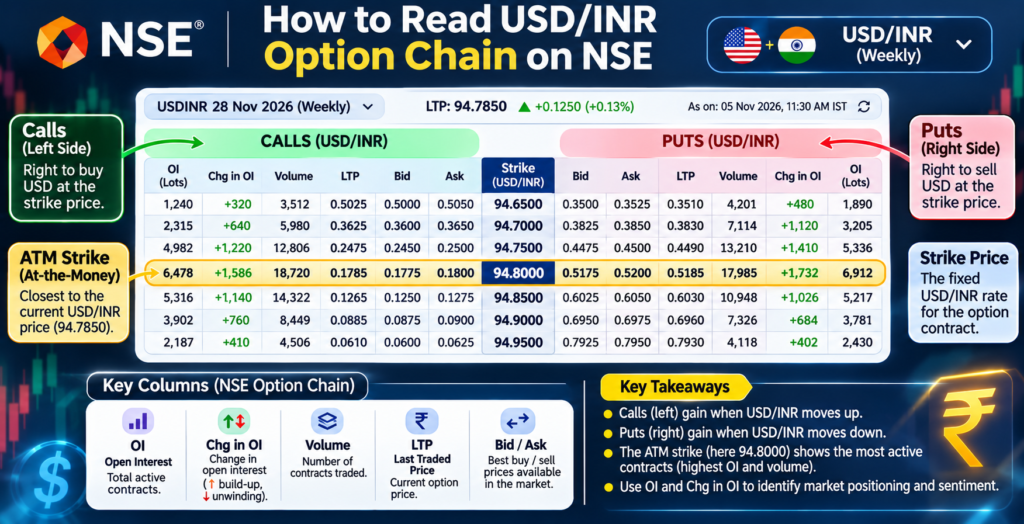
Key Takeaways to how to read usd inr option chain
- The USD/INR option chain lists every call and put strike for one expiry, with calls on the left, puts on the right and strikes in the middle.
- One NSE USD/INR option lot is US$1,000, and premium is quoted in rupees per dollar, so a premium of 0.2000 costs ₹200 per lot.
- Open interest (OI) and change in OI show where positions are building; volume shows where trading happened today.
- Implied volatility (IV) tells you whether options are cheap or expensive relative to expected rupee moves.
- Use the chain to map likely ranges and event risk, not to predict direction on its own.
Most Indian option-chain tutorials use Nifty, where premiums run into hundreds of rupees and strikes are 50 points apart. Rupee options look very different: premiums are quoted to four decimals, strikes sit 25 paise apart, and a quiet day can move the pair by only a few paise. This guide shows how to read the USD/INR option chain on NSE column by column. It is for retail traders and students who already know what a call and a put are. You will learn what each column means, how to work out the cost of a trade in rupees, how to read OI and PCR, and the mistakes that trip up new currency option traders.
How to read USD INR option chain on NSE?
To read the USD/INR option chain, pick an expiry, find the at-the-money strike nearest the current USD/INR futures price, then read calls on the left and puts on the right. Compare open interest, change in OI, volume, implied volatility and last traded price at each strike. Multiply premium by US$1,000 to get the rupee cost per lot.
What the chain actually is
An option chain is a table that shows every listed strike for one underlying and one expiry, with live data for the call and the put at each strike. On NSE, choose the currency segment, the USDINR symbol and an expiry date.
A strike price is the exchange rate at which the option can be exercised. A call gains value when USD/INR rises above its strike; a put gains value when USD/INR falls below its strike.
USD/INR options contract basics you need first
Before reading any number on the chain, know what one contract represents. According to the NSE currency derivatives contract specifications, USD/INR options have these features:
| Feature | USD/INR options on NSE |
|---|---|
| Contract size | 1 unit = US$1,000 |
| Premium quotation | In rupees (per US dollar) |
| Tick size | 0.25 paise (₹0.0025) |
| Style | Premium-style European calls and puts |
| Strikes available | At least 12 in-the-money, 12 out-of-the-money and 1 near-the-money (25 calls and 25 puts) |
| Contract cycle | 11 serial weekly, 3 serial monthly and 3 quarterly contracts |
| Underlying | The USD/INR exchange rate published by FBIL |
| Trading hours | 9:00 a.m. to 5:00 p.m. IST, Monday to Friday |
| Settlement | Cash-settled in rupees |
Two facts matter most. Every ₹0.01 (one paisa) of premium equals ₹10 per lot, because the lot is US$1,000. And European style means exercise happens only at expiry.
If paise-to-rupee conversion is still new to you, our guide on pip value in rupees walks through the arithmetic.
What does each column in the option chain mean?
The chain shows the same set of columns for calls and for puts. Here is what each one tells you.
Open interest (OI)
Open interest is the number of option contracts that are still open at a strike, meaning they have not been closed or exercised. High call OI at a strike above the market often marks a level where option writers expect USD/INR to stay below. High put OI below the market often marks a level writers expect to hold.
Change in OI
Change in OI shows how many contracts were added or removed today. A big rise in call OI at 95.00 on a day the rupee weakened tells you fresh positions are being built at that level. Falling OI means positions are being closed.
Volume
Volume is the number of contracts traded today. Read it together with change in OI, not on its own.
Implied volatility (IV)
Implied volatility is the volatility the market is pricing into an option’s premium. Higher IV means more expensive options. In USD/INR, IV often rises before RBI policy announcements, US jobs data or Fed meetings, then falls once the event passes.
LTP and net change
LTP is the last traded price of the option, quoted in rupees per dollar. Net change is the move from the previous close. A call LTP of 0.1850 means one lot costs 0.1850 × 1,000 = ₹185, before charges.
Bid, ask and quantities
Bid is the best price a buyer is offering; ask is the best price a seller wants. The gap between them is the bid-ask spread. In rupee options, far out-of-the-money strikes can show wide spreads or no quotes at all, which makes them costly to trade.
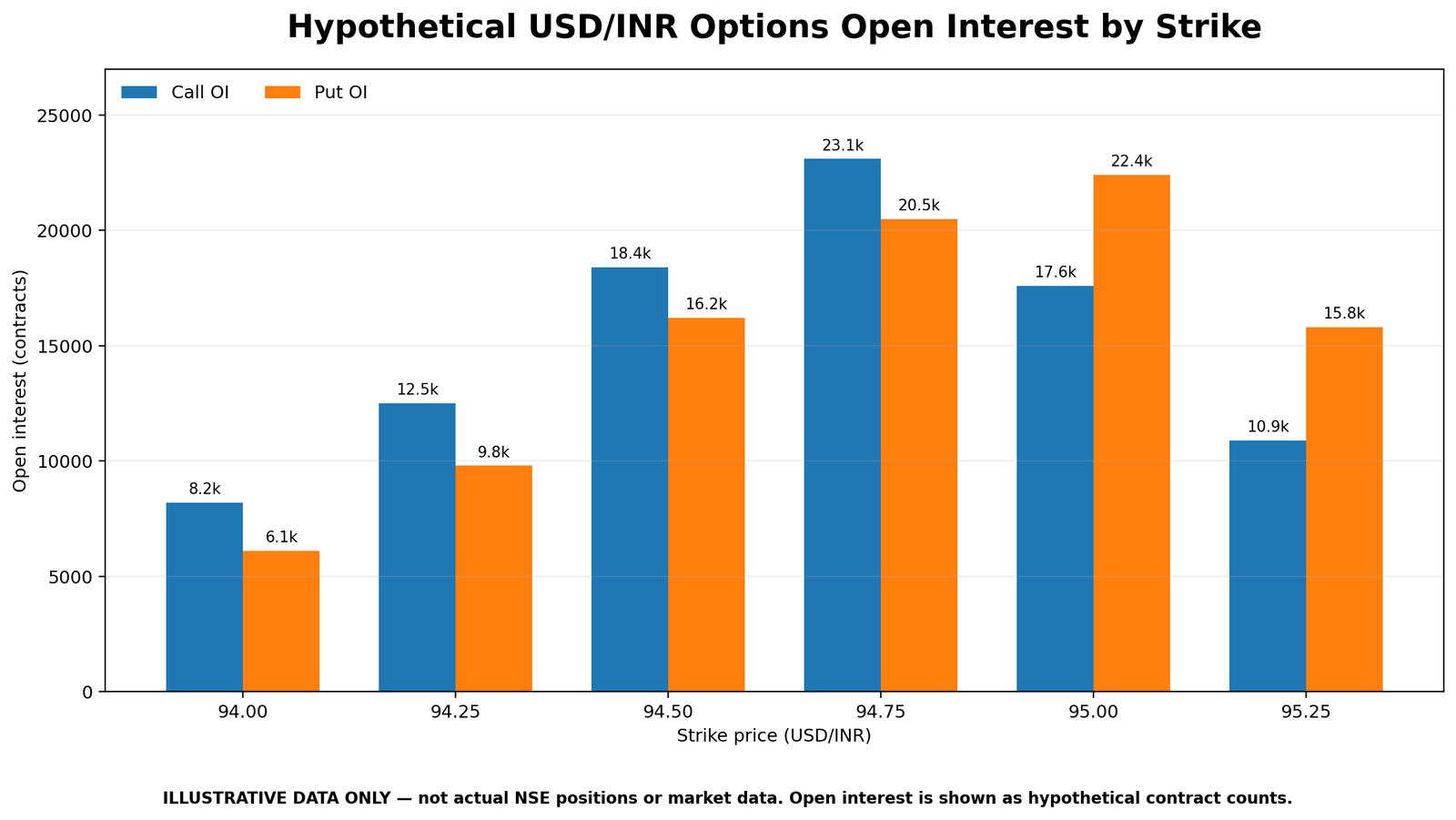
Worked example: reading a USD/INR chain in rupees
Example (hypothetical): USD/INR spot closed near 94.64 on 4 November 2026, according to a Reuters report carried by Business Recorder. Assume the near-month future trades at 94.80 and a trader looks at the following slice of the chain. All option figures below are hypothetical and for teaching only.
| Call OI (lots) | Call chg in OI | Call IV % | Call LTP | Strike | Put LTP | Put IV % | Put chg in OI | Put OI (lots) |
|---|---|---|---|---|---|---|---|---|
| 4,200 | +300 | 4.6 | 0.4650 | 94.50 | 0.1600 | 4.8 | +900 | 18,500 |
| 9,800 | +1,200 | 4.4 | 0.2750 | 94.75 | 0.2350 | 4.5 | +1,500 | 14,200 |
| 21,600 | +3,400 | 4.3 | 0.1450 | 95.00 | 0.3500 | 4.4 | -200 | 6,100 |
| 15,300 | +800 | 4.5 | 0.0700 | 95.25 | 0.5300 | 4.6 | -100 | 2,400 |
How to read it:
- At-the-money strike: 94.75 is closest to the 94.80 future, so it is the ATM row.
- Call side: The largest call OI and the biggest fresh addition sit at 95.00. Writers are betting USD/INR stays below 95.00 by expiry, so traders often treat 95.00 as near-term resistance.
- Put side: The largest put OI is at 94.50, with fresh additions. That level acts as perceived support.
- Cost in rupees: Buying one 95.00 call at 0.1450 costs 0.1450 × 1,000 = ₹145 per lot. Ten lots cost ₹1,450, and that is the maximum loss for a buyer, plus charges.
- Break-even: The 95.00 call breaks even at expiry at 95.00 + 0.1450 = 95.1450.
Now a trader with ₹1,00,000 capital who risks 1% per trade has ₹1,000 to lose. If she buys 95.00 calls and accepts losing the full premium, she can buy ₹1,000 ÷ ₹145 = 6.9, rounded down to 6 lots. Our max loss calculator helps set that cap before you place the order.
How to read put-call ratio (PCR) for rupee options
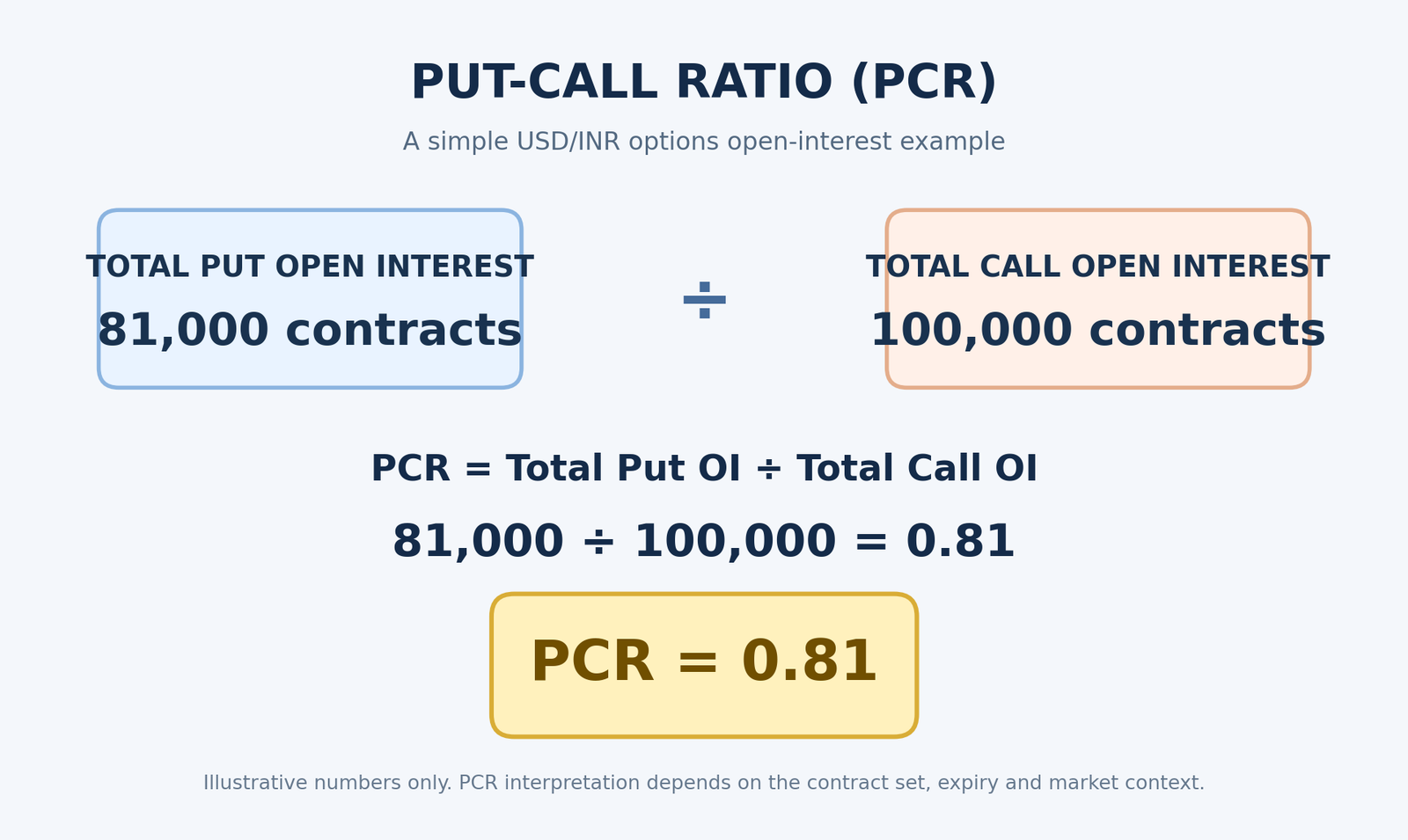
The put-call ratio is total put open interest divided by total call open interest for an expiry. In the slice above, put OI is 41,200 lots and call OI is 50,900 lots, so PCR = 41,200 ÷ 50,900 ≈ 0.81.
How traders often read it:
- PCR well above 1: More puts than calls are open. Some read this as writers expecting support below the market.
- PCR well below 1: More calls are open. Some read this as writers capping the upside.
- PCR near 1: Positioning is balanced.
Treat PCR as background, not a signal. Strike-wise PCR, comparing put and call OI at one strike, is often more useful than the headline number.
Step by step: using the chain before a USD/INR trade
- Pick the expiry. Weekly contracts react fastest to news; monthly contracts usually carry more OI.
- Find the ATM strike. Use the near-month futures price, not just spot, as your reference.
- Mark the highest call OI above and highest put OI below. These show where the bulk of writers are positioned.
- Check change in OI. Fresh additions matter more than old positions.
- Look at IV. Compare it with recent days. Rising IV before an RBI or Fed event means you pay more for options.
- Check the bid-ask spread. Stick to strikes with tight spreads and live quotes.
- Convert premium to rupees. Premium × 1,000 × lots = total cost.
- Size the trade. Decide your maximum loss in rupees first, then work back to lots.
- Know the margin if you sell. Option writers post margin like futures traders. Our forex margin calculator explains how margin and exposure relate.
Who is allowed to trade USD/INR options?
Indian residents may trade currency derivatives only through SEBI-registered brokers on recognised Indian exchanges such as NSE, BSE and MSE, in permitted pairs. Leveraged forex on overseas online platforms through LRS is not permitted, and RBI maintains an Alert List of unauthorised platforms.
RBI also treats exchange-traded rupee derivatives mainly as hedging tools. Since its 10 October 2026 measures, the limit for positions taken without establishing underlying exposure on recognised exchanges is US$5 million equivalent across all exchanges together. Confirm your eligibility with your broker. Our comparison of F&O vs forex trading in India explains the legal routes in more detail.
Common mistakes when reading the rupee option chain
Reading OI as a guaranteed level
High OI at 95.00 does not stop USD/INR from going through it. RBI action, a hawkish Fed or an oil shock can push the pair past it, and writers covering can speed up the move.
Ignoring that hedgers dominate
Exporters buying puts and importers buying calls are hedging real business exposure. Their OI does not reflect a short-term trading view, so do not read every big strike as “smart money”.
Chasing tiny premiums on illiquid strikes
A premium of 0.0300 looks cheap at ₹30 per lot, but far out-of-the-money options usually expire worthless, and strikes with no bid or a wide spread can leave you with no buyer when you want out.
Ignoring event days
IV and premiums jump before RBI policy, US CPI and payrolls. Our guide on how RBI announcements move traders covers what to expect around those dates.
FAQs
What is the lot size of USD/INR options on NSE?
One USD/INR option contract on NSE covers US$1,000. Premium is quoted in rupees per dollar, so a premium of 0.2500 means you pay 0.2500 × 1,000 = ₹250 per lot, plus brokerage and charges. A one-paisa change in premium changes the value of one lot by ₹10.
Where can I see the USD/INR option chain?
NSE publishes the currency option chain on its website under the Option Chain section; select the currency segment, the USDINR symbol and an expiry date. Most SEBI-registered brokers also show the chain inside their trading apps, often with extra tools such as strike-wise OI charts and Greeks.
What does high open interest at a strike mean in rupee options?
High open interest means many contracts are open at that strike. Large call OI above the market often marks a level option writers expect USD/INR to stay below, and large put OI below the market marks a level they expect to hold. It reflects positioning, not a guarantee, and hedger activity can distort it.
How do I calculate put call ratio for USD/INR options?
Add up the open interest of all puts for one expiry and divide it by the open interest of all calls for the same expiry. A PCR of 1.20 means 1.2 puts are open for every call. Many traders also compare put and call OI strike by strike, which gives a clearer picture than one headline ratio.
Are USD/INR options European or American style?
NSE lists USD/INR options as premium-style European options. They can be exercised only on expiry, not before. Most retail traders close or roll positions before expiry instead of holding to settlement. Settlement is in cash in Indian rupees, so no actual dollars change hands.
Why is implied volatility so low in USD/INR options?
USD/INR usually moves less than major pairs or equity indices, partly because RBI smooths sharp swings. Lower expected movement means lower implied volatility and smaller premiums. IV tends to rise before big events such as RBI policy or US data and when the rupee is under pressure.
Conclusion
Learning how to read the USD/INR option chain comes down to a few habits. Start at the at-the-money strike, read where call and put OI is largest, check whether fresh positions are being added, and compare IV with recent days. Then convert every premium into rupees per lot so you know your real cost and risk. The chain is a map of positioning, not a forecast, and hedgers shape much of it. Before you place a currency options trade, set your maximum loss with the max loss calculator and review our guide on how to trade USD/INR.