
Introduction
When Indian traders think of currency futures, they usually think of USD/INR. It is by far the most actively traded currency contract on Indian exchanges. But NSE and BSE also offer futures on three other major currencies against the rupee: the euro, the British pound and the Japanese yen.
These contracts let traders and businesses take a view on, or hedge against, movements in the rupee against Europe, the UK and Japan. EUR INR futures in particular are popular with exporters and importers who deal with European clients, and with traders who follow the euro.
This guide explains:
- How EUR/INR, GBP/INR and JPY/INR futures work
- Lot sizes, tick sizes and tick values
- How to calculate profit and loss
- What moves each currency pair
- Trading hours, expiry and settlement
- Strategies, risks and practical tips
What Are EUR INR Futures?
EUR INR futures are exchange-traded contracts based on the exchange rate between the euro and the Indian rupee. The price shows how many rupees are needed to buy one euro. If EUR/INR futures trade at ₹102.50, one euro is worth ₹102.50 in that contract.
- If you buy (go long): You profit if the euro strengthens against the rupee.
- If you sell (go short): You profit if the euro weakens against the rupee.
GBP/INR and JPY/INR futures work the same way, but with the pound and the yen as the base currency.
All of these contracts are cash-settled in rupees. No euros, pounds or yen change hands. They trade on recognised exchanges through SEBI-registered brokers, making them a legal route for Indian residents to trade these currencies.
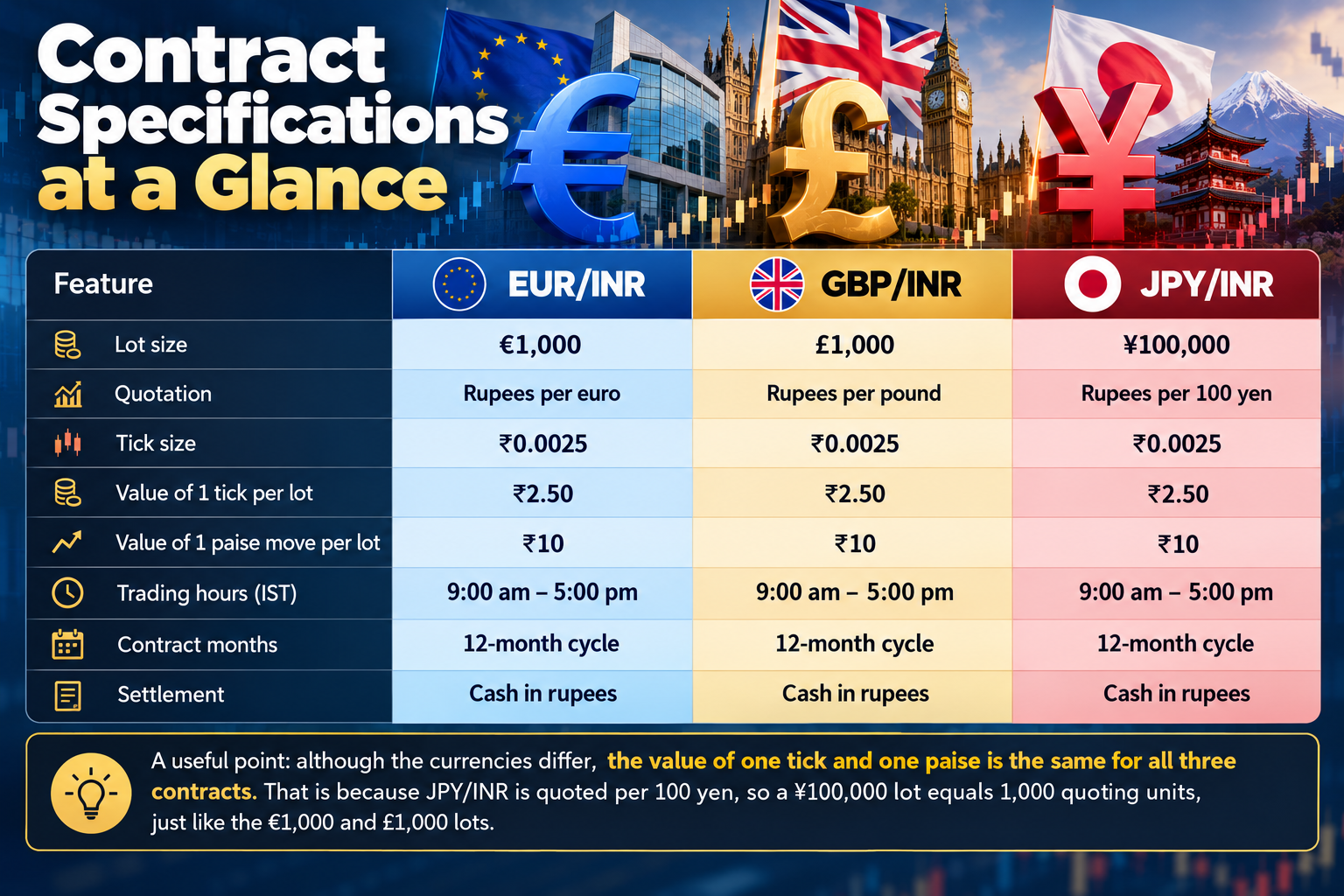
Contract Specifications at a Glance
| Feature | EUR/INR | GBP/INR | JPY/INR |
|---|---|---|---|
| Lot size | €1,000 | £1,000 | ¥100,000 |
| Quotation | Rupees per euro | Rupees per pound | Rupees per 100 yen |
| Tick size | ₹0.0025 | ₹0.0025 | ₹0.0025 |
| Value of 1 tick per lot | ₹2.50 | ₹2.50 | ₹2.50 |
| Value of 1 paise move per lot | ₹10 | ₹10 | ₹10 |
| Trading hours (IST) | 9:00 am – 5:00 pm | 9:00 am – 5:00 pm | 9:00 am – 5:00 pm |
| Contract months | 12-month cycle | 12-month cycle | 12-month cycle |
| Settlement | Cash in rupees | Cash in rupees | Cash in rupees |
A useful point: although the currencies differ, the value of one tick and one paise is the same for all three contracts. That is because JPY/INR is quoted per 100 yen, so a ¥100,000 lot equals 1,000 quoting units, just like the €1,000 and £1,000 lots.
How to Calculate Profit and Loss on EUR INR Futures
P&L = (Exit price − Entry price) × 1,000 × Number of lots
This formula works for EUR/INR, GBP/INR and JPY/INR, because each lot represents 1,000 quoting units.
Example 1: EUR/INR
You buy 4 lots of EUR INR futures at ₹102.2500 and sell at ₹102.6000.
- Price move: ₹0.35 (35 paise)
- P&L: 0.35 × 1,000 × 4 = ₹1,400, before costs
Example 2: GBP/INR
You sell 2 lots of GBP/INR futures at ₹117.8000 and buy back at ₹117.4000.
- Price move: ₹0.40 in your favour
- P&L: 0.40 × 1,000 × 2 = ₹800, before costs
Example 3: JPY/INR
You buy 5 lots of JPY/INR futures at ₹58.0000 (per 100 yen) and sell at ₹57.8500.
- Price move: −₹0.15
- P&L: −0.15 × 1,000 × 5 = −₹750, before costs
Prices in these examples are illustrative.
What Moves EUR INR Futures?
EUR/INR can be thought of as a combination of two exchange rates: EUR/USD and USD/INR. If the euro strengthens against the dollar, or the rupee weakens against the dollar, EUR/INR tends to rise.
Key drivers include:
- European Central Bank (ECB) policy: Interest rate decisions and guidance influence the euro.
- Eurozone data: Inflation, growth and business surveys in Germany, France and the wider eurozone.
- US dollar trends: Because EUR/INR is linked to EUR/USD, Federal Reserve policy and US data matter.
- RBI policy and intervention: The RBI manages volatility in the rupee, which affects all INR pairs.
- Trade flows: India’s trade with Europe and capital flows into Indian markets.
Because of this link, many traders watch EUR/USD charts when trading EUR INR futures. For example, if EUR/USD rises 0.5% while USD/INR is flat, EUR INR futures will usually rise by a similar percentage.
What Moves GBP/INR Futures?
- Bank of England policy: Rate decisions and guidance on inflation.
- UK economic data: Inflation, jobs, GDP and retail sales.
- UK politics and fiscal policy: Budgets and political events can move the pound sharply.
- GBP/USD and USD/INR: GBP/INR reflects both exchange rates.
The pound is often more volatile than the euro, so GBP/INR can move more in a day than EUR/INR.
What Moves JPY/INR Futures?
- Bank of Japan policy: Changes in interest rates or bond-buying strongly affect the yen.
- US-Japan yield differences: These drive USD/JPY, which feeds into JPY/INR.
- Safe-haven flows: The yen often strengthens during global market stress, which can push JPY/INR higher.
- Intervention by Japanese authorities: Japan has intervened in currency markets in recent years, causing sharp yen moves.
JPY/INR can behave differently from the other pairs, because the yen often rises when global risk appetite falls.
EUR INR Futures vs USD/INR Futures
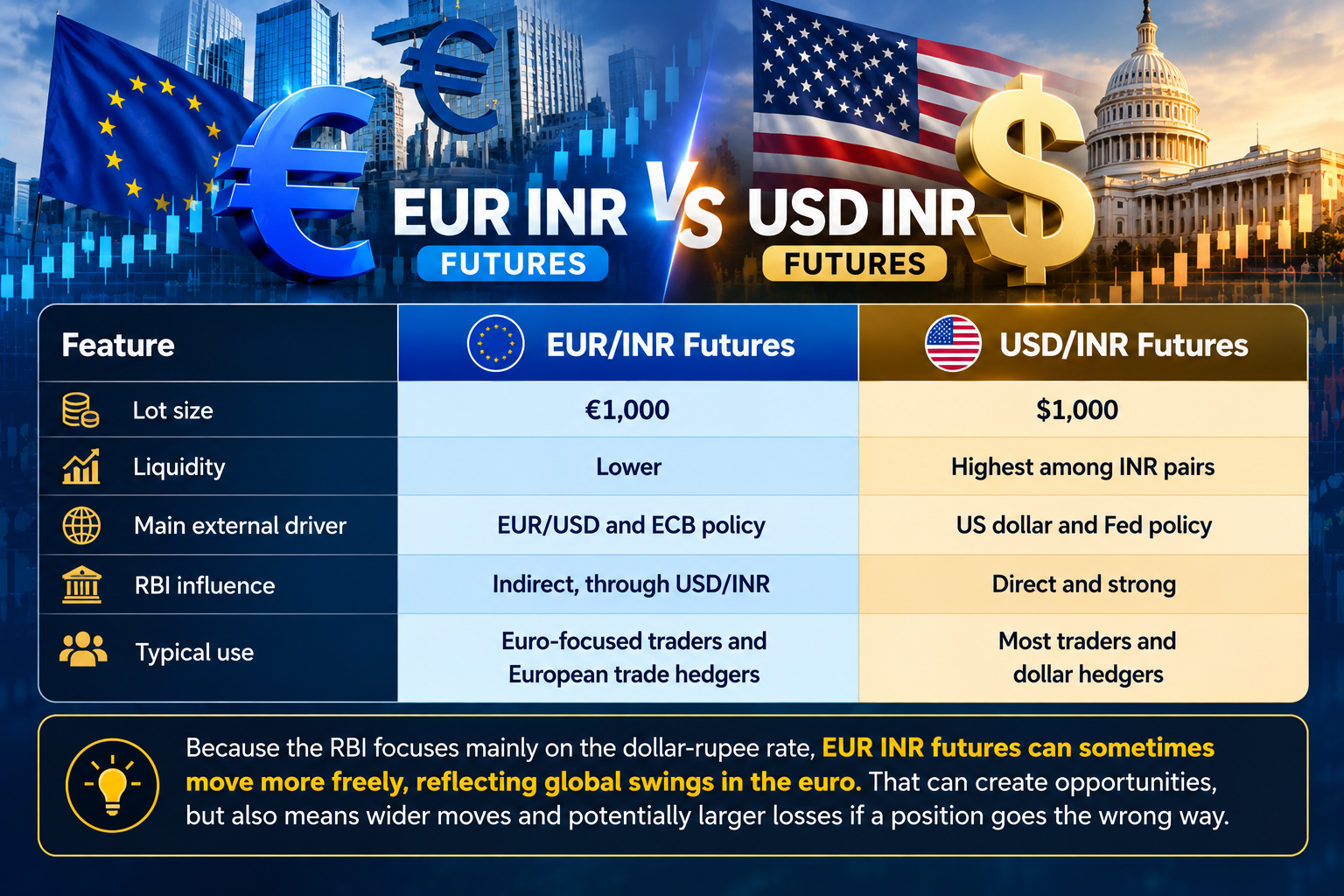
Many traders start with USD/INR and then consider other pairs. Here is how the euro contract compares:
| Feature | USD/INR futures | EUR/INR futures |
|---|---|---|
| Lot size | $1,000 | €1,000 |
| Liquidity | Highest among INR pairs | Lower |
| Main external driver | US dollar and Fed policy | EUR/USD and ECB policy |
| RBI influence | Direct and strong | Indirect, through USD/INR |
| Typical use | Most traders and dollar hedgers | Euro-focused traders and European trade hedgers |
Because the RBI focuses mainly on the dollar-rupee rate, EUR INR futures can sometimes move more freely, reflecting global swings in the euro. That can create opportunities, but also means wider moves and potentially larger losses if a position goes the wrong way.
Comparing the Three Pairs
| Feature | EUR/INR | GBP/INR | JPY/INR |
|---|---|---|---|
| Main external driver | EUR/USD and ECB | GBP/USD and Bank of England | USD/JPY and Bank of Japan |
| Typical volatility | Moderate | Often higher | Can spike in risk-off periods |
| Liquidity on NSE | Lower than USD/INR | Lower than USD/INR | Lower than USD/INR |
| Common users | Traders, European trade hedgers | Traders, UK trade hedgers | Traders, Japan trade hedgers |
Liquidity in these pairs is generally lower than in USD/INR, so spreads may be wider and large orders can move prices. Always check volumes and open interest before trading.
Trading Hours, Expiry and Settlement
Trading hours
INR currency futures, including EUR INR futures, trade from 9:00 am to 5:00 pm IST, Monday to Friday. The 5:00 pm close overlaps with the start of the European session, when euro and pound activity often picks up.
Expiry
- Monthly contracts are available on a 12-month cycle.
- The last trading day is two working days before the last business day of the expiry month.
- On expiry day, trading in the expiring contract stops at 12:30 pm IST.
Settlement
- Daily: Open positions are marked to market each day at the daily settlement price.
- Final: Expiring contracts are cash-settled in rupees at the relevant official reference rate. Check the exact final settlement basis for each pair in the contract specifications.
Margins and Costs
To trade EUR/INR, GBP/INR or JPY/INR futures, you post initial margin and exposure margin with your broker. Margins change with volatility, so check your broker’s margin calculator for current figures.
Costs include brokerage, exchange transaction charges, SEBI fees, stamp duty and GST. Securities Transaction Tax (STT) does not apply to currency derivatives.
Remember that margin is not your maximum loss. Because currency futures are leveraged, a move of just one or two rupees in the exchange rate can create a gain or loss many times larger than the margin blocked for a position. Always calculate the full notional value of your trade before entering.
Strategies for EUR INR Futures and Other INR Pairs
1. Trend trading
Use daily or 4-hour charts to identify the trend, for example with a 50-period moving average. Buy pullbacks in an uptrend or sell rallies in a downtrend, with stops beyond recent swing points.
2. Trading the European session
EUR INR futures often become more active in the afternoon, as European markets open around 1:30 pm IST in winter (12:30 pm in summer). Some traders focus on the last few hours of the Indian session.
3. Event-based trading
ECB, Bank of England and Bank of Japan decisions can move these pairs significantly. Some traders wait for the initial reaction to settle and then trade the direction of the move.
4. Using global charts
Because EUR/INR is linked to EUR/USD and USD/INR, watching EUR/USD can provide early clues. A strong move in EUR/USD often shows up in EUR INR futures.
5. Hedging
Exporters receiving euros can sell EUR INR futures to lock in a rupee value. Importers paying in euros can buy them to protect against a stronger euro. The same logic applies to pounds and yen.

Hedging Example
An Indian exporter expects to receive €50,000 from a German client in two months. They are worried the euro may weaken against the rupee.
- They sell 50 lots of EUR INR futures (50 × €1,000 = €50,000) at ₹102.50.
- Two months later, the euro has weakened, and the futures settle at ₹101.00.
- The futures position gains 1.50 × 1,000 × 50 = ₹75,000.
- This gain offsets the lower rupee value of the €50,000 received.
If the euro had strengthened instead, the futures would have lost money, but the exporter would receive more rupees from the payment. The hedge reduces uncertainty in either direction.
This example is simplified and illustrative.
Risk Management Tips
- Size by risk: Decide how much you will risk, then calculate lots using the ₹10-per-paise rule.
- Use stop-losses: Currency moves can accelerate around central bank decisions.
- Watch liquidity: Trade active contracts and avoid placing large market orders in thin conditions.
- Mind overnight risk: Big moves can happen in global markets after the Indian session closes.
- Track position limits: According to reports on RBI circulars from October 2026, positions in INR currency derivatives above USD 5 million equivalent, across all exchanges, require a demonstrated underlying exposure.
Common Mistakes
- Forgetting that JPY/INR is quoted per 100 yen
- Ignoring the link to EUR/USD, GBP/USD and USD/JPY
- Trading illiquid contract months
- Holding through the 12:30 pm expiry cut-off without a plan
- Using offshore CFD platforms instead of Indian exchanges, which can breach FEMA
Taxation
Profits and losses from currency futures on recognised Indian exchanges are generally treated as non-speculative business income. Traders usually report them in ITR-3. Losses can generally be carried forward for up to eight years if the return is filed on time. Check current rules with a chartered accountant.
FAQs
What is the lot size for EUR INR futures?
One lot is €1,000. GBP/INR is £1,000 and JPY/INR is ¥100,000.
How much is one paise move worth?
₹10 per lot for EUR/INR, GBP/INR and JPY/INR.
Why is JPY/INR quoted per 100 yen?
Because one yen is worth less than one rupee, quoting per 100 yen makes prices easier to read and keeps tick values consistent with other pairs.
What time do these contracts trade?
From 9:00 am to 5:00 pm IST on weekdays, with an early 12:30 pm close for the expiring contract on its last trading day.
Is STT charged?
No. STT does not apply to currency derivatives.
Are these contracts legal for Indian residents?
Yes, when traded on recognised exchanges such as NSE and BSE through SEBI-registered brokers.
Conclusion
EUR INR futures, along with GBP/INR and JPY/INR futures, give Indian traders and businesses a regulated way to trade or hedge the rupee against Europe, the UK and Japan. All three share the same simple structure: 1,000 quoting units per lot, a ₹0.0025 tick worth ₹2.50, and ₹10 per paise move.
Understand what drives each pair, watch the related global charts, respect liquidity and position limits, and manage risk carefully. Used well, these contracts can be valuable additions to a trader’s toolkit or a business’s hedging strategy.