
Introduction
Many Indian traders start with the stock market and later hear about forex, or the other way round. Both markets offer opportunities, but they work very differently. What you trade, when you can trade, how much leverage you can use, how you are taxed and even what is legal are not the same.
Understanding the forex vs stock market differences helps you choose the market that fits your goals, schedule and risk tolerance. It also helps you avoid one of the most common mistakes Indian traders make: trading forex through platforms that are not permitted under Indian law.
This guide compares the two markets across:
- What you are actually trading
- Regulation and legal access in India
- Trading hours
- Market size and liquidity
- Leverage, margin and costs
- Volatility and what drives prices
- Taxation
- Which market may suit you
Forex vs Stock Market: What Is Traded?
Stock market
In the stock market, you buy and sell shares of companies listed on exchanges such as the National Stock Exchange (NSE) and BSE. When you buy a share, you own a small part of that company. You can also trade equity derivatives, such as Nifty and Bank Nifty futures and options, and stock futures and options.
Forex market
In the forex market, you trade one currency against another, such as US dollars against Indian rupees (USD/INR) or euros against US dollars (EUR/USD). You are not buying an asset that pays dividends; you are speculating on, or hedging against, changes in exchange rates.
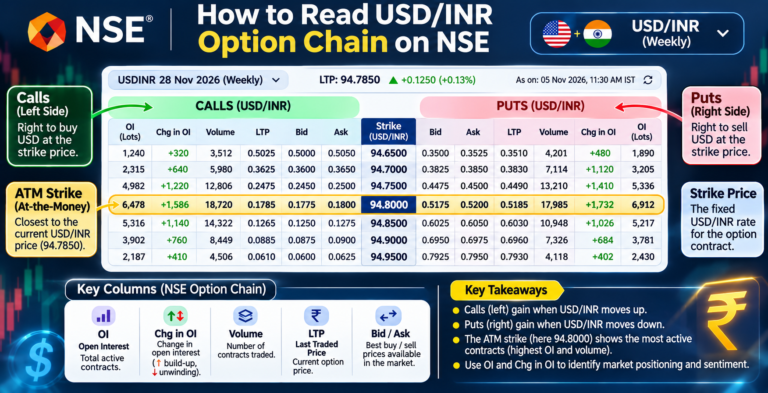
In India, retail forex trading happens mainly through exchange-traded currency futures and options on NSE and BSE.
Forex vs Stock Market: Regulation and Legal Access in India
This is the most important difference for Indian residents.
| Aspect | Stock market | Forex market |
|---|---|---|
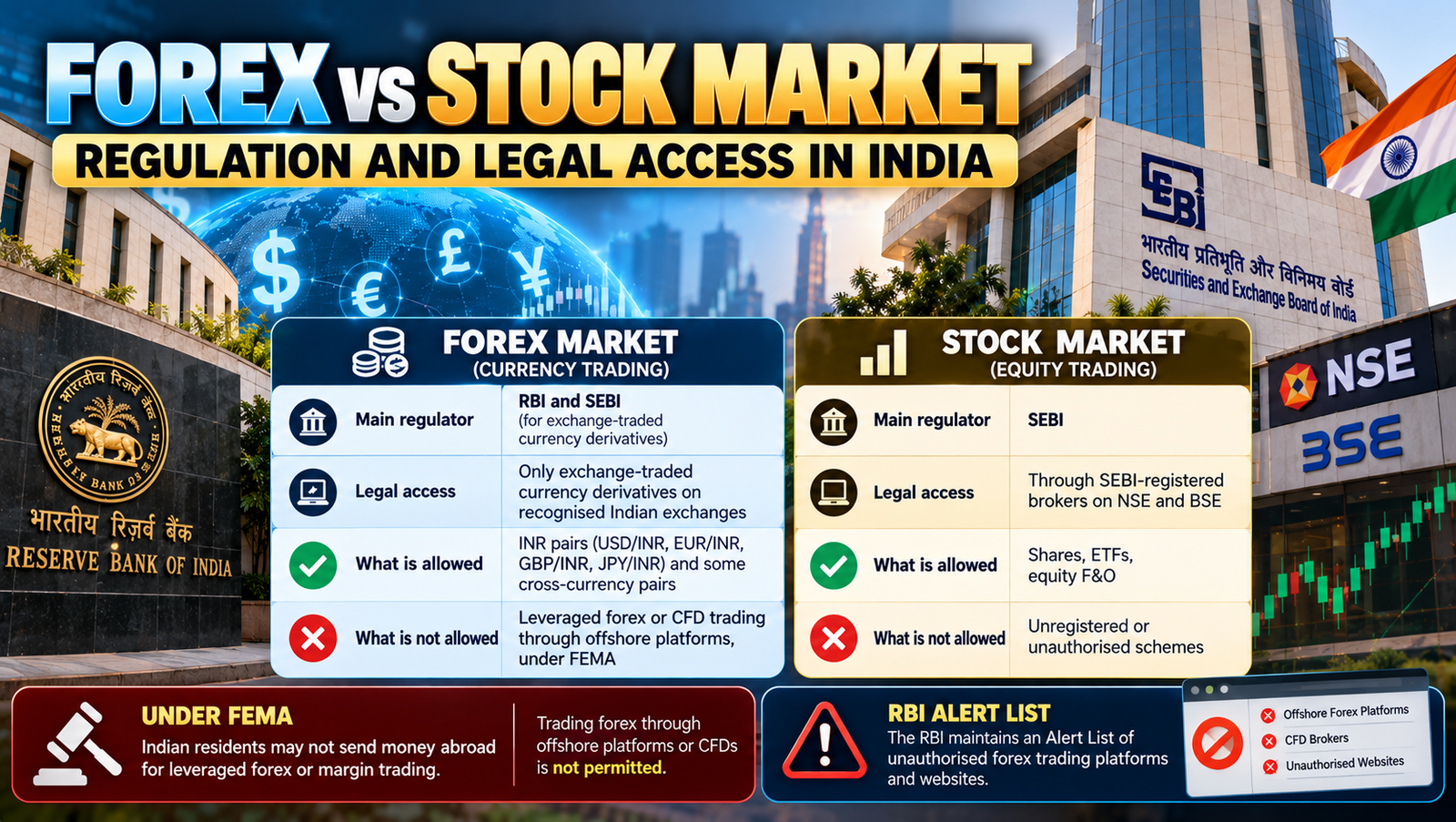
| Main regulator | SEBI | RBI and SEBI (for exchange-traded currency derivatives) |
| Legal access | Through SEBI-registered brokers on NSE and BSE | Only exchange-traded currency derivatives on recognised Indian exchanges |
| What is allowed | Shares, ETFs, equity F&O | INR pairs (USD/INR, EUR/INR, GBP/INR, JPY/INR) and some cross-currency pairs |
| What is not allowed | Unregistered or unauthorised schemes | Leveraged forex or CFD trading through offshore platforms, under FEMA |
Under the Foreign Exchange Management Act (FEMA), Indian residents may not send money abroad for leveraged forex or margin trading. The RBI maintains an Alert List of unauthorised forex trading platforms and websites. In the forex vs stock market comparison, this legal restriction is the biggest difference for Indian traders.
Forex vs Stock Market Trading Hours
| Market | Trading hours (IST) |
|---|---|
| NSE equity (cash and F&O) | 9:15 am – 3:30 pm, Monday to Friday (pre-open from 9:00 am) |
| NSE currency derivatives (INR pairs) | 9:00 am – 5:00 pm, Monday to Friday |
| Global spot forex market | Nearly 24 hours a day, five days a week |
Although the global forex market runs almost around the clock, Indian residents trading legally on NSE and BSE are limited to the exchange hours. Still, currency derivatives trade 90 minutes longer than equities, which overlaps with the start of European trading.
Forex vs Stock Market: Size and Liquidity
The global forex market is the largest financial market in the world. According to the Bank for International Settlements (BIS) Triennial Survey, global foreign exchange trading averaged about $9.6 trillion per day in April 2025.
However, Indian traders on NSE are trading exchange-listed currency contracts, not the entire global market. Liquidity is concentrated in USD/INR, while other pairs can be thinner.
The Indian stock market offers deep liquidity in large-cap stocks and index derivatives, especially Nifty and Bank Nifty options. Smaller stocks can be illiquid, with wider spreads.
Forex vs Stock Market: Leverage and Margin
- Stock delivery trades: You usually pay the full value of the shares, unless you use a margin trading facility.
- Equity F&O and intraday: Margins are set by exchanges and brokers under SEBI rules.
- Currency derivatives: Margins are typically a small percentage of contract value, because currencies usually move less than stocks in percentage terms.
Offshore forex brokers often advertise very high leverage, but using them is not permitted for Indian residents under FEMA. Within Indian exchanges, leverage is controlled and regulated.
Remember that leverage magnifies both profits and losses. Lower leverage is generally safer, especially for beginners. A useful habit is to calculate the full notional value of every position before you enter it, so you understand your true exposure rather than just the margin blocked.
Forex vs Stock Market Costs and Charges
| Cost | Stock market | Currency derivatives |
|---|---|---|
| Brokerage | Yes | Yes |
| Securities Transaction Tax (STT) | Yes | No |
| Exchange transaction charges | Yes | Yes |
| SEBI fees, stamp duty, GST | Yes | Yes |
One notable difference in the forex vs stock market cost structure is that STT does not apply to currency derivatives. This can make frequent trading slightly cheaper, although brokerage and other charges still apply.
Forex vs Stock Market Volatility and Price Drivers
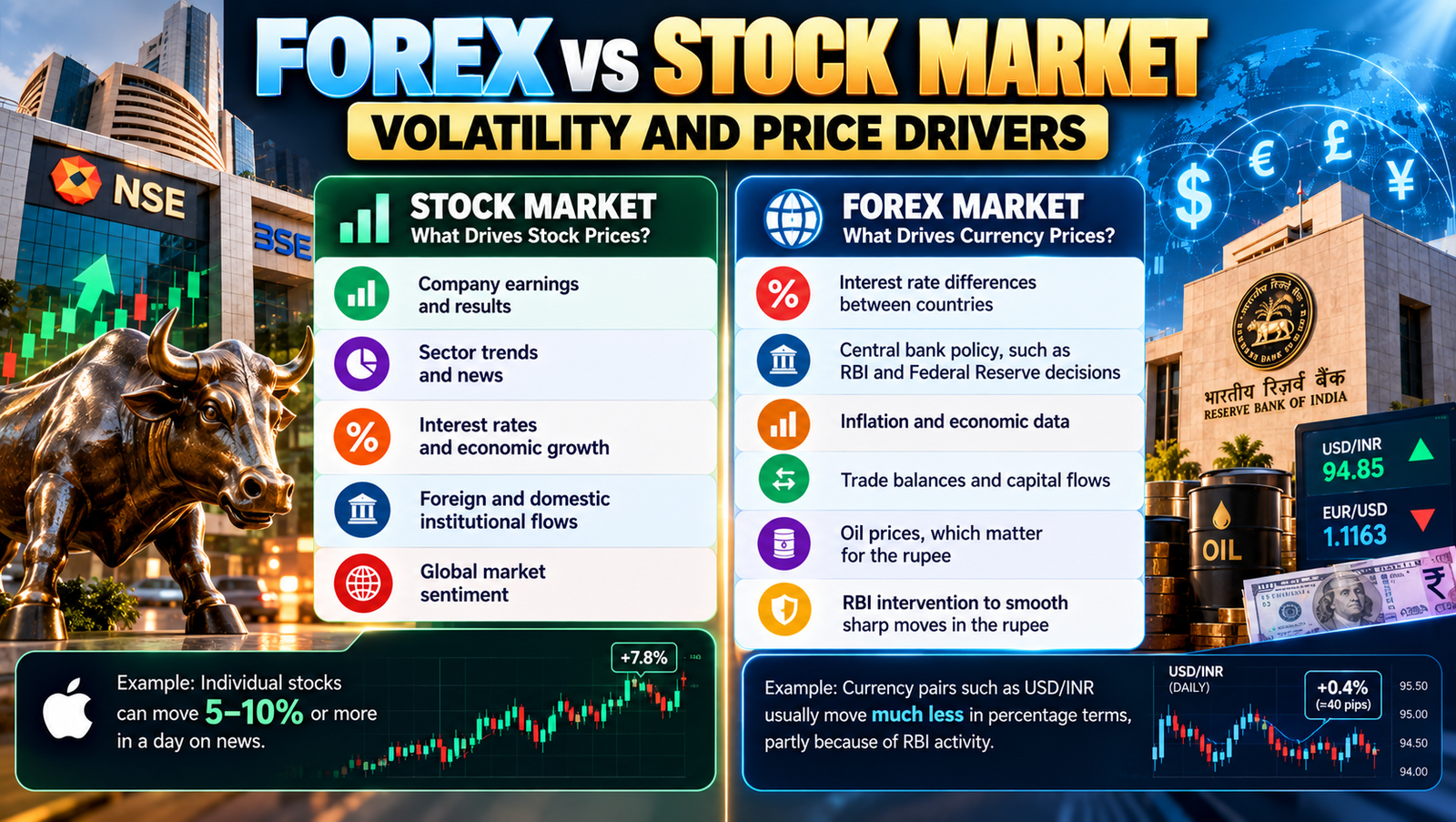
Stock market drivers
- Company earnings and results
- Sector trends and news
- Interest rates and economic growth
- Foreign and domestic institutional flows
- Global market sentiment
Forex market drivers
- Interest rate differences between countries
- Central bank policy, such as RBI and Federal Reserve decisions
- Inflation and economic data
- Trade balances and capital flows
- Oil prices, which matter for the rupee
- RBI intervention to smooth sharp moves in the rupee
Individual stocks can move 5–10% or more in a day on news. Currency pairs such as USD/INR usually move much less in percentage terms, partly because of RBI activity. This is why currency contracts often use higher leverage than stocks.
Forex vs Stock Market: Analysis Approach
- Stocks: Many investors use fundamental analysis, studying balance sheets, earnings and valuations. Traders also use technical analysis.
- Forex: Fundamental analysis focuses on macroeconomics: interest rates, inflation, growth and central bank policy. Technical analysis is widely used, as currency charts often respect key levels and trends.
Stocks require you to choose from thousands of companies. Forex trading in India focuses on a small number of currency pairs, which some traders find easier to follow.
Forex vs Stock Market: Taxation in India
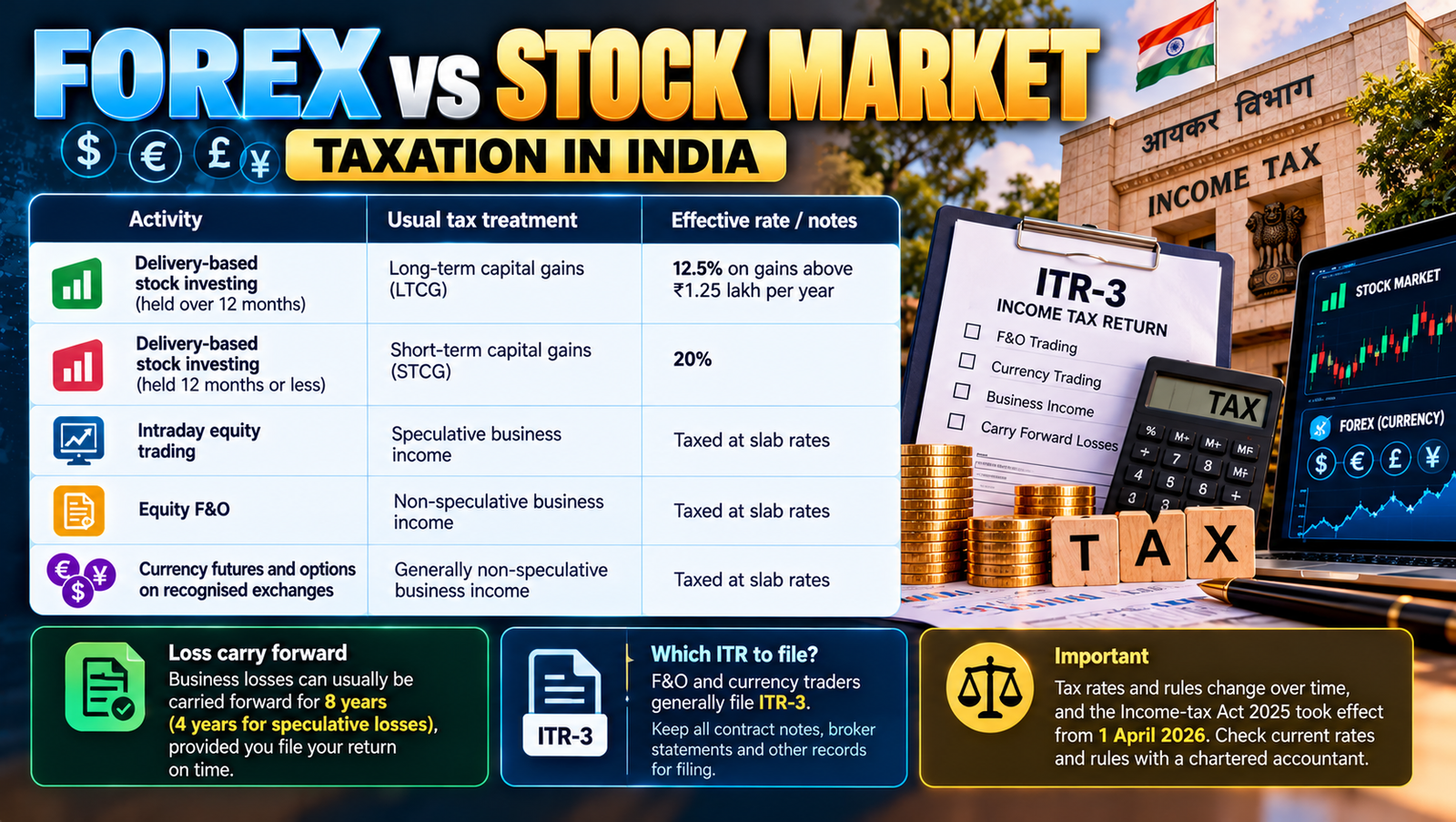
| Activity | Usual tax treatment |
|---|---|
| Delivery-based stock investing (held over 12 months) | Long-term capital gains, taxed at 12.5% on gains above ₹1.25 lakh per year |
| Delivery-based stock investing (held 12 months or less) | Short-term capital gains, taxed at 20% |
| Intraday equity trading | Speculative business income, taxed at slab rates |
| Equity F&O | Non-speculative business income, taxed at slab rates |
| Currency futures and options on recognised exchanges | Generally non-speculative business income, taxed at slab rates |
Business losses can usually be carried forward for eight years (four years for speculative losses), provided you file your return on time. F&O and currency traders generally file ITR-3. Check current rates and rules with a chartered accountant, because tax law changes and the Income-tax Act 2025 took effect from 1 April 2026.
Long-Term Investing vs Short-Term Trading
A major practical difference in the forex vs stock market debate is the time horizon.
- Stocks can be held for years, allowing investors to benefit from company growth and dividends. Long-term investing in quality companies is a common wealth-building strategy.
- Forex is mainly a trading market. Currency futures have fixed expiries, and there are no dividends or company growth to capture. Most participants are traders or businesses hedging currency risk.
Forex vs Stock Market: Pros and Cons
Stock market
- Pros: Ownership of businesses, long-term growth potential, dividends, wide choice and strong liquidity in large caps.
- Cons: Company-specific risk, gaps on news and results, STT costs and limited trading hours.
Forex (currency derivatives in India)
- Pros: Fewer instruments to follow, longer trading hours than equities, no STT, macro-driven trends and useful for hedging.
- Cons: Restricted to exchange-traded contracts, lower liquidity outside USD/INR, leverage risk and RBI intervention.
Which Market Should You Choose?
| If you… | You may prefer |
|---|---|
| Want long-term wealth building | Stock market investing |
| Enjoy company research | Stock market |
| Prefer following macroeconomics and central banks | Forex |
| Want fewer instruments to track | Forex |
| Need to hedge foreign currency exposure | Currency derivatives |
| Can trade until 5:00 pm | Currency derivatives |
Many traders participate in both: investing in stocks for the long term while trading currency or index derivatives for shorter-term opportunities. There is no single right answer in the forex vs stock market choice; it depends on your goals, time and temperament.
Forex vs Stock Market for Part-Time Traders
For people with a full-time job, timing often decides the forex vs stock market question. Equity markets close at 3:30 pm, which overlaps almost completely with office hours. Currency derivatives trade until 5:00 pm, giving a little more room in the late afternoon, but still not the evening.
Practical options for part-time traders include:
- Long-term stock investing: Requires little screen time during the day.
- Swing trading: Using daily charts to place orders before or after work, in either market.
- Pre-set orders: Using stop-loss and target orders so you do not need to watch the screen.
- Short windows: Trading the first hour of the session or the last hour of the currency market.
Whichever route you choose, a plan that fits your schedule will be easier to follow than one that requires constant attention.
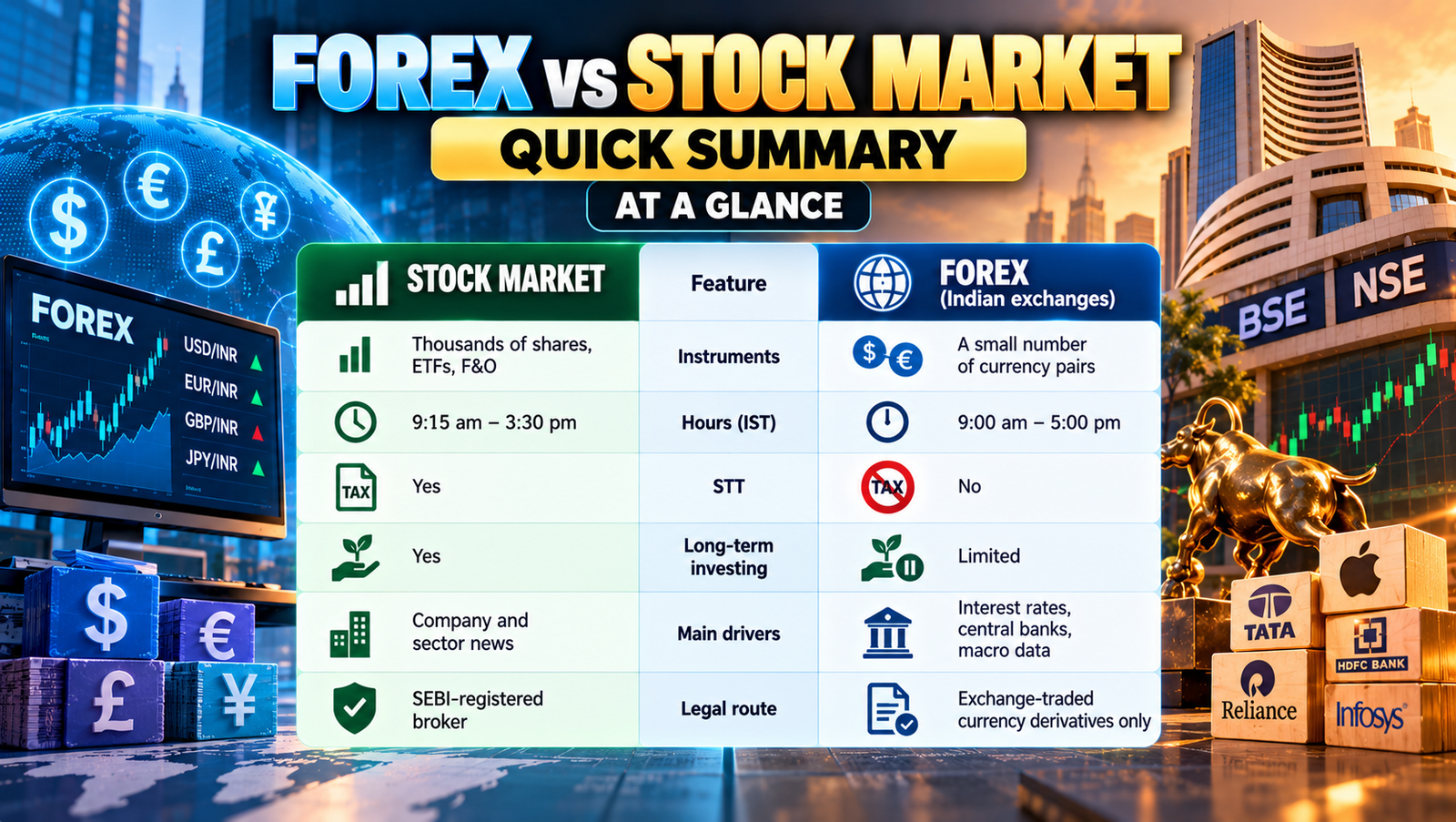
Quick Summary: Forex vs Stock Market at a Glance
| Feature | Stock market | Forex (Indian exchanges) |
|---|---|---|
| Instruments | Thousands of shares, ETFs, F&O | A small number of currency pairs |
| Hours (IST) | 9:15 am – 3:30 pm | 9:00 am – 5:00 pm |
| STT | Yes | No |
| Long-term investing | Yes | Limited |
| Main drivers | Company and sector news | Interest rates, central banks, macro data |
| Legal route | SEBI-registered broker | Exchange-traded currency derivatives only |
 Common Mistakes When Comparing the Two
- Using offshore forex brokers: This can breach FEMA and carries significant risk.
- Overusing leverage: High leverage in either market can wipe out accounts quickly.
- Assuming forex is easier: Fewer instruments does not mean less risk.
- Ignoring taxes: Different activities are taxed differently.
- Trading without a plan: Both markets require clear rules and risk management.
- Chasing tips: Unregistered tips and signal groups are common in both markets.
Getting Started Safely
Whatever you decide in the forex vs stock market comparison, the first steps are similar. Taking them carefully can save you from expensive early mistakes and help you build good habits from the start.
- Open an account with a SEBI-registered broker that offers the segment you want.
- Learn the contract specifications, trading hours and costs.
- Start with small positions and low leverage.
- Use stop-losses and a written trading plan.
- Keep records for tax purposes and review your trades regularly.
FAQs
Is forex trading legal in India?
Yes, through exchange-traded currency derivatives on recognised Indian exchanges such as NSE and BSE, via SEBI-registered brokers. Leveraged forex trading through offshore platforms is not permitted under FEMA.
Which is riskier, forex or stocks?
Both carry risk. Individual stocks can be more volatile, while forex contracts often use higher leverage. Risk depends mainly on position size and leverage.
Is STT charged on currency trading?
No. STT applies to equity transactions but not to currency derivatives.
Can I trade forex 24 hours in India?
Not legally through Indian exchanges. INR currency derivatives trade from 9:00 am to 5:00 pm IST.
Which is better for beginners?
Many beginners start with long-term stock investing, then explore trading. Whichever you choose, start small and learn the rules first.
Conclusion
The forex vs stock market comparison comes down to what you want from trading. Stocks offer ownership, long-term growth and a huge choice of companies. Forex offers macro-driven trading in a small number of currency pairs, longer trading hours and no STT, but in India it must be done through exchange-traded currency derivatives.
Whichever market you choose, use a SEBI-registered broker, understand the costs and taxes, control your leverage and follow a clear plan. Many traders find that the two markets complement each other rather than compete.