
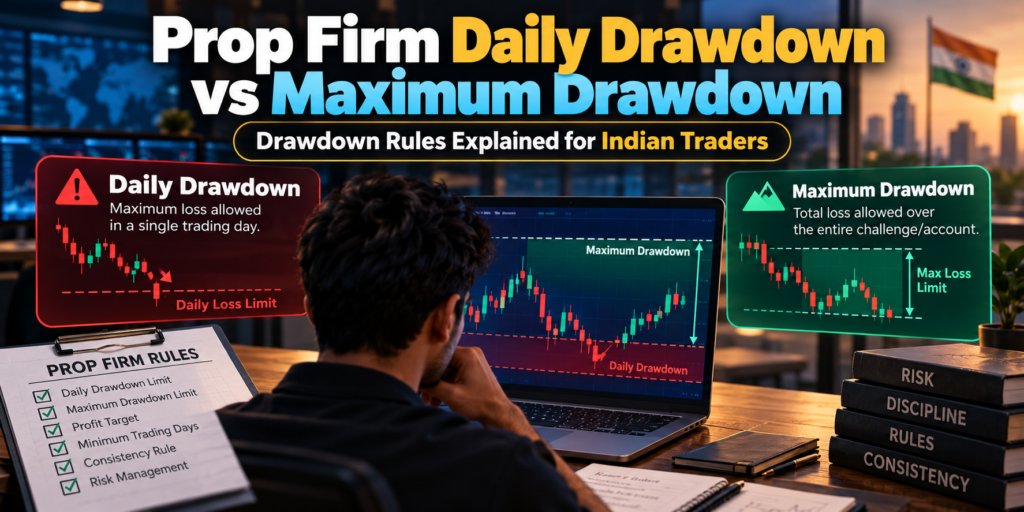
Most prop firm challenges are not failed because a trader misses the profit target. They are failed because the trader breaks a drawdown rule, often without realising how close they were. Prop firm drawdown rules usually come in two layers: a daily drawdown (or daily loss limit) and a maximum drawdown (or overall loss limit). They sound similar, but they are measured differently, reset differently and fail accounts in different ways. This guide explains both, how leading firms apply them, and what Indian traders should know about timing, legality and tax.
Prop Firm Drawdown Rules at a Glance
A prop firm’s daily drawdown limits how much you can lose in a single trading day, measured from a reference point that resets every day. Its maximum drawdown limits how much the account can lose in total over its life, measured from the starting balance or from a high-water mark. Breaching either one usually ends the evaluation or the funded account. Both rules normally count open (floating) losses, not just closed trades.
| Feature | Daily drawdown | Maximum drawdown |
|---|---|---|
| What it limits | Loss within one trading day | Total loss over the account’s life |
| Typical size | 3% to 5% of initial balance | 6% to 10% of initial balance |
| Reference point | Balance (or equity) at the daily reset | Initial balance, or the highest balance reached |
| Resets? | Yes, every trading day | No; static or trailing only upwards |
| Main risk | One bad session or news spike | Slow bleed over several weeks |
Typical ranges are based on the CFD challenge rules of FTMO and FundedNext described later in this article. Rules vary by firm and product.
What Is Daily Drawdown?
Daily drawdown, often called the maximum daily loss or daily loss limit, caps how far your account can fall during one trading day.
How Daily Drawdown Is Calculated
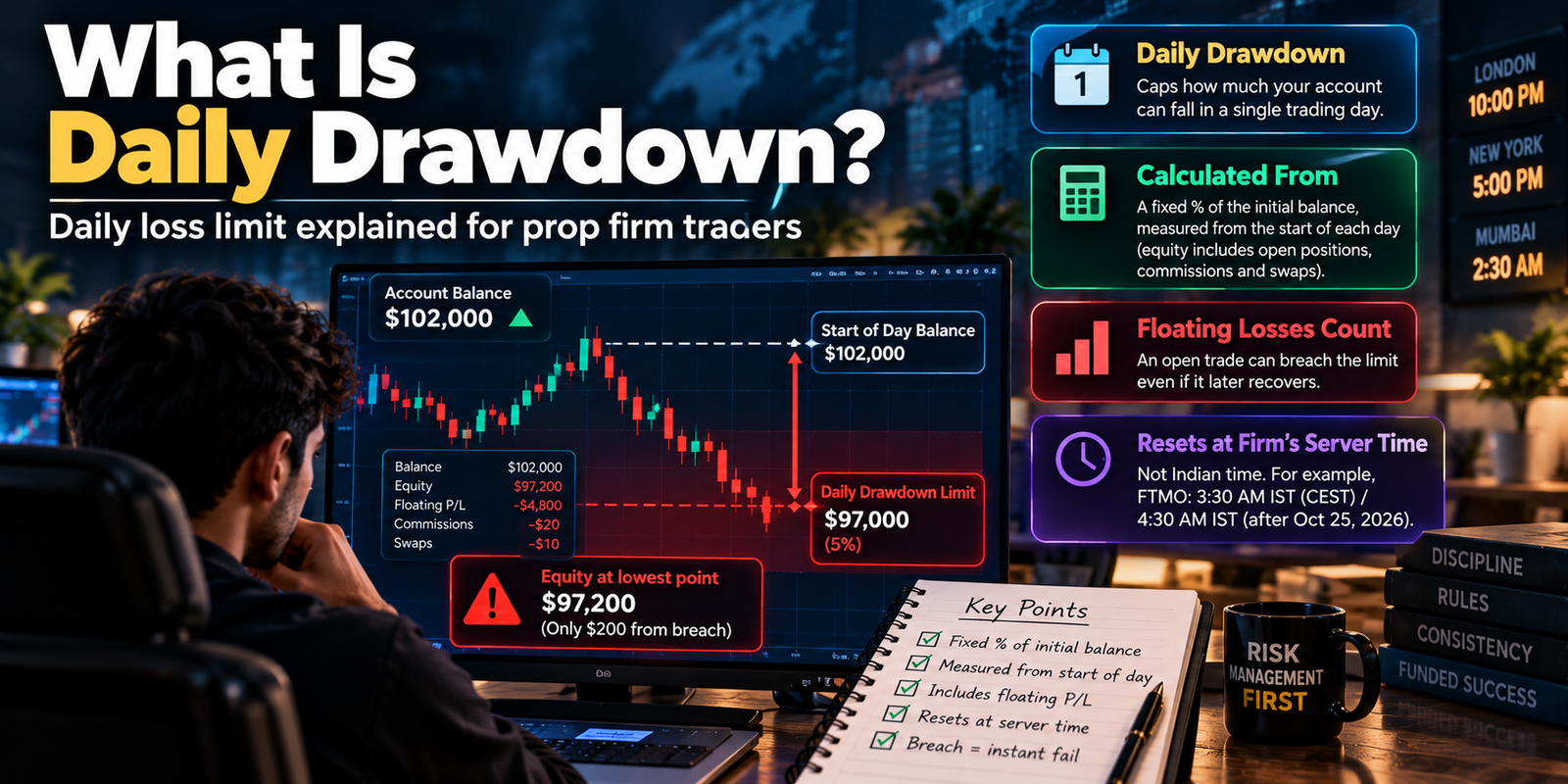
Most CFD prop firms set the daily limit as a fixed percentage of the initial account balance, but measure it from the balance at the start of each day. At FTMO’s 2-Step Challenge, for example, the maximum daily loss is 5% of the initial balance, measured from the midnight balance, and equity includes open positions, commissions and swaps, according to Tanto’s FTMO rules guide (updated June 2026).
So the size of the cap stays fixed, but its starting point moves daily: a profitable yesterday raises today’s floor, a losing one lowers it.
Firms also differ on whether intraday profit increases the day’s room. FundedNext’s Stellar accounts expand the daily allowance with realised profit: on a USD 100,000 2-Step account, a trader who books USD 2,000 by midday can lose up to USD 7,000 for the rest of that session, according to Tanto’s FundedNext guide (updated July 2026).
Floating Losses Count
The most common misunderstanding is thinking only closed trades matter. Major firms monitor equity continuously, so an open trade that dips deep into loss can breach the limit even if it later recovers. A September 2026 MQL5 analysis of FTMO, FundedNext, The5ers and Maven found that floating P&L, swaps and commissions count towards the daily limit, and that the breach is triggered by the worst intraday equity point, not the closing result.
Reset Times in IST
Daily limits reset at the firm’s server time, not Indian time, and positions held across the reset carry their floating loss into the new day.
- FTMO resets at midnight Central European time. That is 3:30 AM IST while Central European Summer Time applies, and 4:30 AM IST after clocks change on 25 October 2026.
- FundedNext resets at midnight server time, which is GMT+3 during daylight saving and GMT+2 otherwise, according to the MQL5 analysis. That is 2:30 AM or 3:30 AM IST.
Worked Example: Daily Drawdown
Hypothetical example: You hold a USD 100,000 account with a 5% daily limit (USD 5,000), measured from the start-of-day balance.
- Day 1 closes at USD 102,000. Day 2’s floor is USD 102,000 − USD 5,000 = USD 97,000.
- On Day 2, you open a trade that floats down USD 4,800 during a data release. Equity touches USD 97,200. You are USD 200 from a breach, even though the trade has not been closed.
- If equity touches USD 97,000 at any moment, the account fails, whatever happens to the trade afterwards.
What Is Maximum Drawdown?
Maximum drawdown, also called maximum loss or overall loss limit, caps the total decline the account can suffer. Unlike the daily limit, it does not reset. Firms use three main versions, and the type matters more than the percentage.
Static Maximum Drawdown
The floor is fixed below the starting balance and never moves. FTMO’s 2-Step uses a static 10% maximum loss, so equity on a USD 100,000 account can never fall below USD 90,000. FundedNext’s Stellar 2-Step also uses a static 10% floor. Static drawdown is the most forgiving type because profits increase your buffer: an account at USD 108,000 has USD 18,000 of room.
End-of-Day (EOD) Trailing Drawdown
The floor rises only when a daily closing balance sets a new high, and it never moves down. Intraday gains that are given back before the close do not raise it. FTMO’s 1-Step Challenge, launched in February 2026, uses a 10% maximum loss that trails on an end-of-day basis from the highest closing balance, according to Tanto.
Topstep, a US futures prop firm, uses an EOD-trailing Maximum Loss Limit. On a USD 50,000 Trading Combine, the starting floor is USD 48,000 (a USD 2,000 distance), it rises with the highest end-of-day balance, and it eventually locks at the starting balance, according to PropTradingVibes (checked 13 October 2026). If the account closes a session at USD 50,500, the floor rises to USD 48,500.
Intraday Trailing Drawdown
The floor rises in real time with every new equity peak, including unrealised profit. This is the strictest type. A trader can be up USD 1,500 at noon, give most of it back and close the day in profit, yet the floor has already moved to the noon peak, as Curved Trading’s June 2026 drawdown explainer illustrates. Accounts can therefore fail while net profitable.
Worked Example: Static vs Trailing
Hypothetical example: Two USD 100,000 accounts each have a 6% maximum drawdown. Both grow to USD 105,000, then fall.
| Account type | Floor at start | Floor after reaching USD 105,000 | Room left at USD 105,000 |
|---|---|---|---|
| Static | USD 94,000 | USD 94,000 | USD 11,000 |
| EOD trailing (closing high USD 105,000) | USD 94,000 | USD 99,000 | USD 6,000 |
Same performance, roughly half the room.
Daily Drawdown vs Maximum Drawdown: Key Differences
A trader can breach the maximum drawdown without ever hitting the daily limit, for example by losing 2% a day for five days on a 10% static account.
- Time frame: daily limits restart each day; maximum limits accumulate.
- Interaction: late in an account’s life, the maximum drawdown can be tighter than the daily limit. If you are already 8% down on a 10% static account, your real limit today is 2%, not 5%.
- Soft vs hard breach: some firms treat a daily breach as a pause rather than a failure. Topstep’s optional Daily Loss Limit flattens positions and blocks trading until the next session while the account stays eligible, and The5ers’ Hyper Growth programme ends trading for the day on a 3% breach while its Pro Growth programme ends the account, according to MQL5.
How Leading Prop Firms Apply Drawdown Rules
| Firm and programme | Daily drawdown | Maximum drawdown | Maximum drawdown type |
|---|---|---|---|
| FTMO 2-Step | 5% | 10% | Static |
| FTMO 1-Step | 3% | 10% | EOD trailing |
| FundedNext Stellar 2-Step | 5% | 10% | Static |
| FundedNext Stellar 1-Step | 3% | 6% | Static |
| Topstep 50K Combine (futures) | Optional, USD 1,000 | USD 2,000 | EOD trailing, locks at starting balance |
Sources: Tanto (FTMO, June 2026; FundedNext, July 2026) and PropTradingVibes (Topstep, October 2026). These are third-party summaries; firms change rules often, so confirm on each firm’s official site before buying a challenge.
Common Ways Traders Breach Drawdown Rules
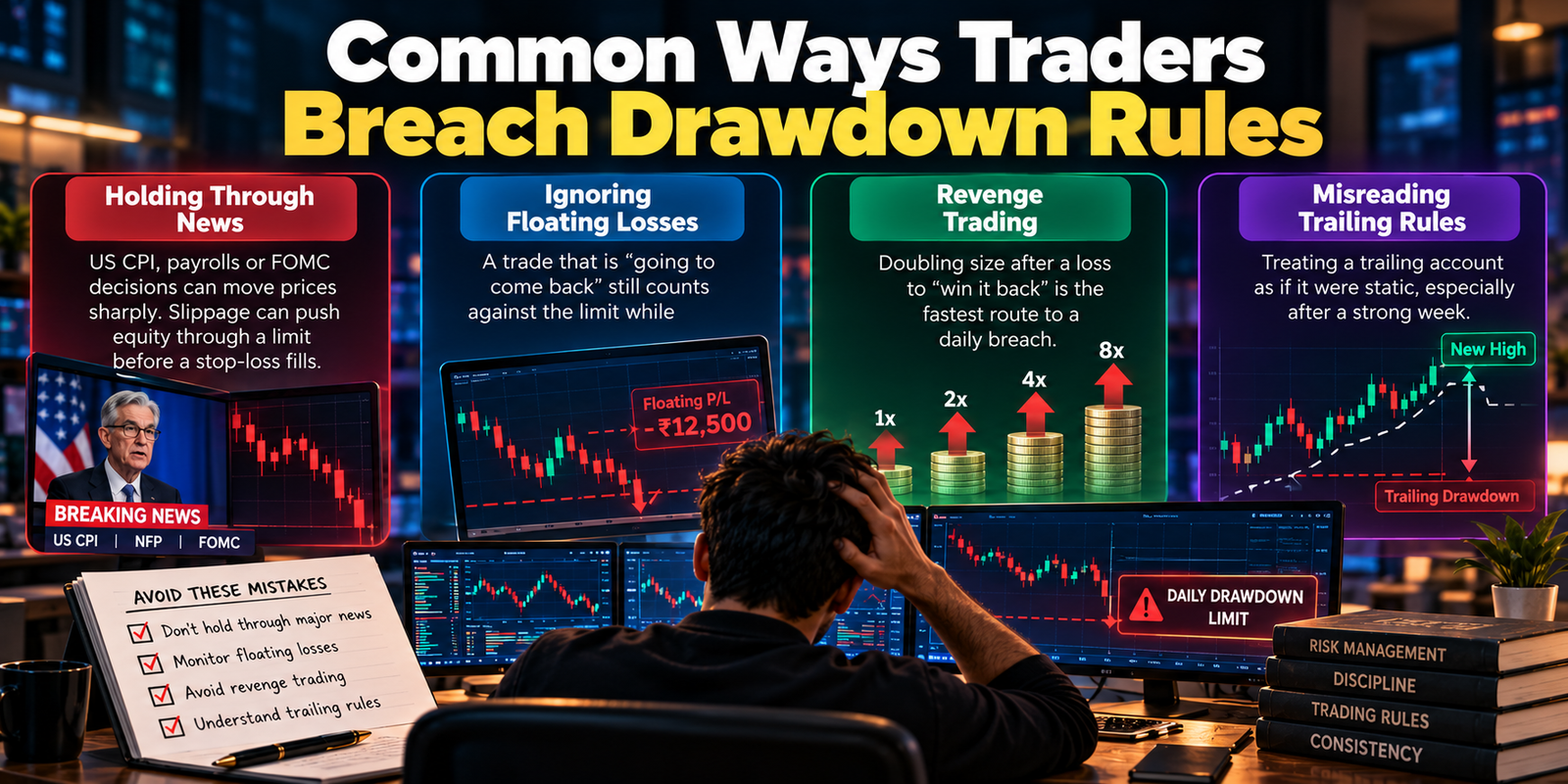
- Holding through news: US CPI, payrolls or FOMC decisions can move prices sharply. Slippage can push equity through a limit before a stop-loss fills.
- Ignoring floating losses: a trade that is “going to come back” still counts against the limit while it is open.
- Revenge trading: doubling size after a loss to “win it back” is the fastest route to a daily breach.
- Misreading trailing rules: treating a trailing account as if it were static, especially after a strong week.
A Practical Risk Framework
A common-sense approach, not a guarantee:
- Set a personal daily stop below the firm’s limit. For example, stop trading at half the official daily limit. On a 5% daily limit, that means stopping at 2.5%.
- Size trades from the distance to the nearest floor. Calculate the room left on both the daily and maximum limits, and use the smaller one.
- Risk a small fraction per trade. Hypothetical: risking 0.5% per trade means about ten consecutive losses before reaching a 5% daily limit.
- Reduce size after drawdown. If you are halfway to the maximum limit, cut position size so one bad day cannot finish the account.
The India Angle: Legality, Payments and Tax
Regulatory Position
Offshore prop firms are not regulated by SEBI or the RBI. Under FEMA, Indian residents may trade currency derivatives only on recognised Indian exchanges through SEBI-registered brokers, and the Liberalised Remittance Scheme (LRS) does not permit remittances for margin or leveraged trading in foreign exchange. There is no settled RBI ruling on retail offshore prop evaluations, according to The Complete Trader’s Edge (August 2026).
The RBI’s Alert List of entities not authorised to deal in forex or operate forex trading platforms had 95 names after its 19 November 2025 update, and it includes FundedNext, according to Outlook Money. The RBI says the list “is not exhaustive” and an entity not appearing on it “should not be assumed to be authorised by the RBI.” Check the live list on the RBI website before paying any firm.
Paying Fees and Receiving Payouts
- Outward remittances above ₹10 lakh a year under LRS attract tax collected at source (TCS); the first ₹10 lakh is exempt, according to The Complete Trader’s Edge.
- Payouts are foreign-source income for residents and are taxable in India. Classification (business or speculative income) affects the tax treatment, so consult a chartered accountant.
The fully regulated alternative is trading INR currency pairs on NSE or BSE through a SEBI-registered broker.
Frequently Asked Questions
What is the difference between daily drawdown and maximum drawdown?
Daily drawdown limits the loss within a single trading day and resets every day. Maximum drawdown limits the total loss over the account’s life and does not reset; it is either fixed (static) or rises with new highs (trailing).
Do floating losses count towards prop firm drawdown rules?
Yes, at most major firms. Equity, including open trades, swaps and commissions, is monitored continuously, so an open position can trigger a breach even if it later recovers.
Is static or trailing drawdown better?
Static drawdown is more forgiving because profits increase your buffer. Trailing drawdown, especially intraday trailing, reduces room as the account grows and can fail an account that is still in profit.
What time does the daily drawdown reset for Indian traders?
It depends on the firm. FTMO resets at midnight Central European time (3:30 AM IST in summer, 4:30 AM IST in winter). FundedNext resets at midnight server time (2:30 AM or 3:30 AM IST).
Are prop firms legal in India?
There is no settled RBI ruling on retail offshore prop firms. FEMA restricts leveraged offshore forex trading, and some firms appear on the RBI Alert List. Check the RBI list and consult a professional before participating.
Conclusion
Daily drawdown protects against one bad session; maximum drawdown protects against a slow decline. Passing a prop challenge depends on understanding both, especially how each firm calculates them, whether floating losses count, when the day resets in IST and whether the maximum limit is static or trailing. Set personal limits well inside the official ones, size trades from the nearest floor, and verify both the rules and the regulatory position before paying for any challenge.
Disclaimer
This article is for educational purposes only and does not constitute investment, trading, tax or legal advice. Prop firm rules change frequently; figures here are drawn from third-party summaries and should be confirmed on each firm’s official website. Examples are hypothetical. Leveraged trading involves substantial risk of loss. Offshore prop firms are not regulated by SEBI or the RBI; Indian residents should check the RBI Alert List, comply with FEMA and consult a SEBI-registered adviser and a chartered accountant before participating.