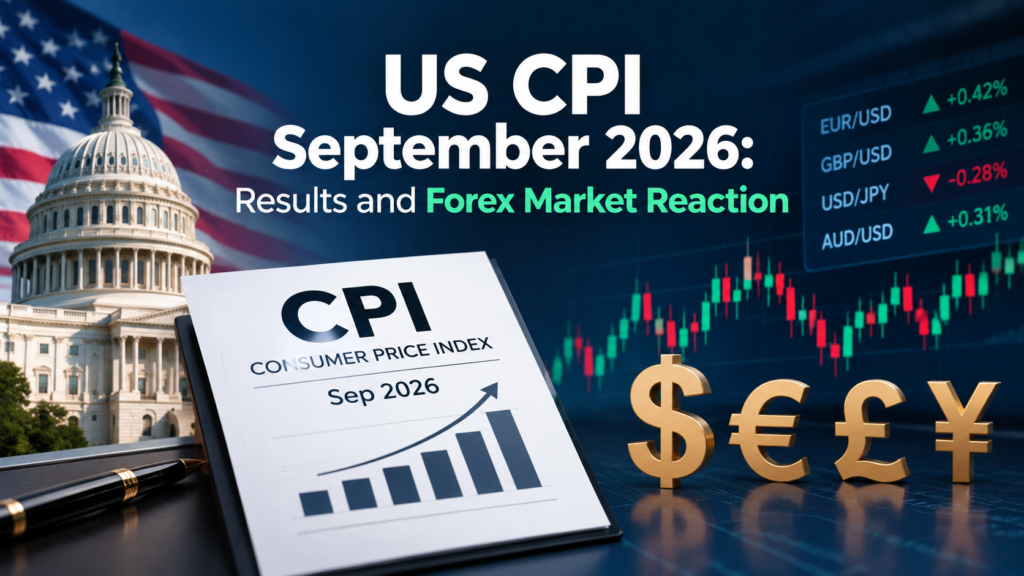
The US consumer price index is one of the data releases that moves currency markets most, and the September 2026 report was no exception. Released on 14 October 2026, it showed inflation rising faster than forecast. The dollar jumped, Treasury yields spiked and bets on another Federal Reserve rate hike more than doubled within minutes. Less than a day later, most of that move had reversed.
This article breaks down the September CPI numbers, traces how the dollar, euro, pound, yen and Indian rupee reacted, and explains what the episode teaches Indian traders who follow US CPI forex moves through USD/INR and other exchange-traded currency pairs.
September 2026 US CPI at a Glance
US consumer prices rose 0.6% in September 2026 on a seasonally adjusted basis, taking annual inflation to 3.7% from 3.4% in August, according to the US Bureau of Labor Statistics. Core CPI, which excludes food and energy, rose 0.3% for the month and 2.6% over the year. Both annual figures were 0.1 percentage point above consensus, and a 9.1% jump in gasoline prices drove most of the headline increase.
The table below compares the official figures with the forecasts reported by Fox Business (LSEG consensus) and StoneX.
| Measure | September 2026 | Forecast | August 2026 |
|---|---|---|---|
| Headline CPI, month on month | 0.6% | 0.6% | 0.4% |
| Headline CPI, year on year | 3.7% | 3.6% | 3.4% |
| Core CPI, month on month | 0.3% | 0.2% | 0.3% |
| Core CPI, year on year | 2.6% | 2.5% | 2.4% |
Source: BLS release of 14 October 2026; forecasts as reported by Fox Business and StoneX.
What Drove the Increase
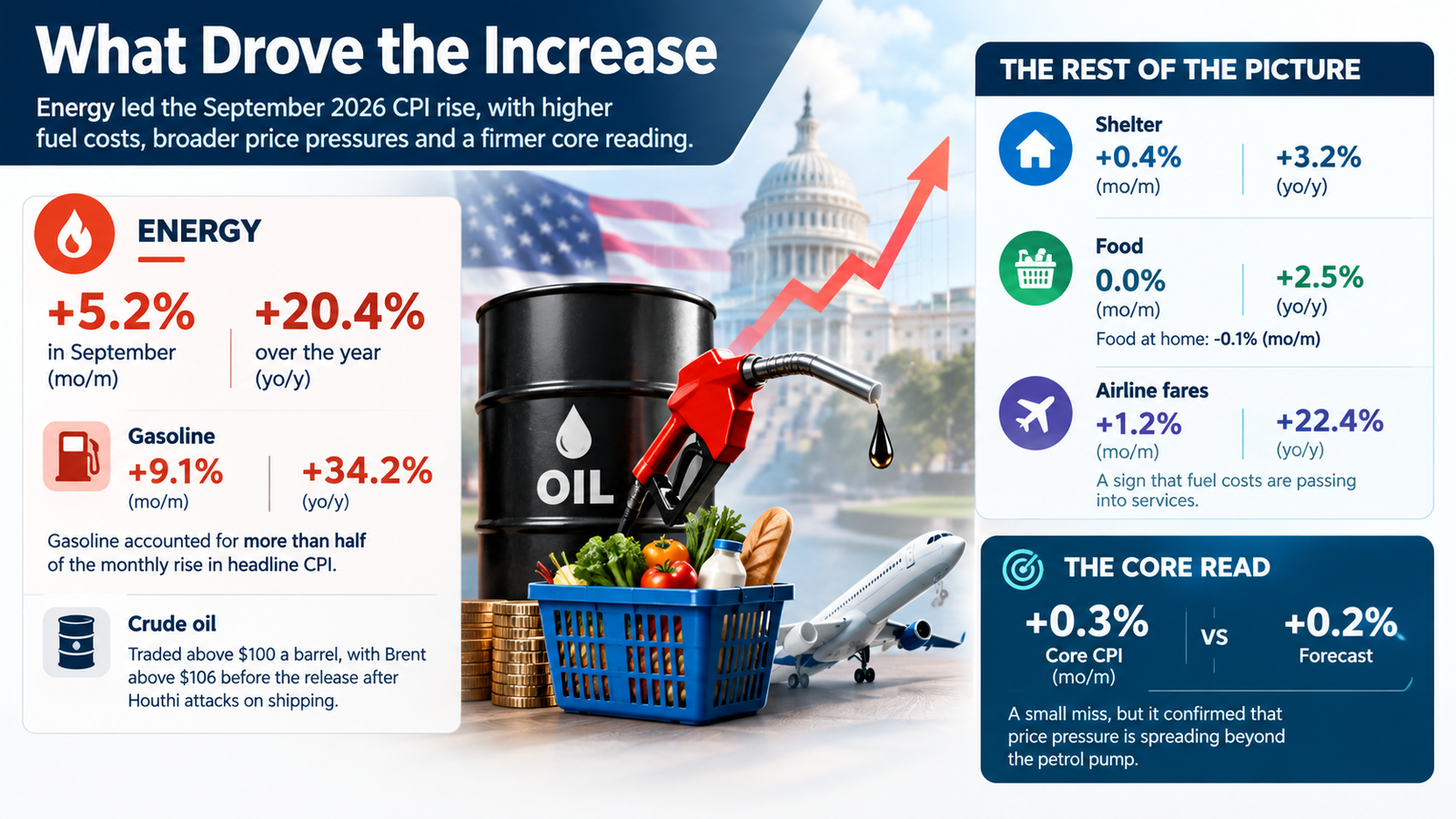
Energy was the main driver. The BLS energy index rose 5.2% in September and 20.4% over the year. Gasoline climbed 9.1% for the month and 34.2% from a year earlier, and the BLS said gasoline accounted for more than half of the monthly rise in headline CPI. Crude oil had been trading above $100 a barrel, with Brent quoted above $106 before the release after Houthi attacks on shipping.
Outside energy, the picture was mixed:
- Shelter rose 0.4% for the month and 3.2% over the year.
- Food was unchanged in September and up 2.5% over the year, with food at home down 0.1%.
- Airline fares rose 1.2% for the month and 22.4% over the year, a sign that fuel costs are passing into services.
The core reading matters more to the Fed than the headline. A 0.3% core increase against a 0.2% forecast is a small miss, but it confirmed that price pressure is spreading beyond the petrol pump.
The Fed Context Behind the Reaction
Markets reacted strongly because the Fed is in a tightening cycle. On 16 September 2026, the Federal Open Market Committee raised the federal funds target range by 25 basis points to 3.75% to 4.00%, stating that “inflation remains elevated.” Chair Kevin Warsh leads the committee, and the next policy meeting is on 27 and 28 October 2026.
Before the CPI release, futures markets put the chance of another hike in October at roughly 21% to 23%. That made the CPI report the deciding data point for whether the Fed would move again within six weeks.
How Forex Markets Reacted on 14 October
The CPI release came out at 8:30 AM Eastern Time, which is 6:00 PM in India. The table below summarises the reaction as reported by Babypips, StoneX and Vantage Markets. Figures are approximate and vary slightly between data providers.
| Market | Before CPI | Peak reaction | By the US close |
|---|---|---|---|
| US Dollar Index (DXY) | About 102.0 | About 102.7 to 102.9 | About 102.5 (+0.31%) |
| US 10-year Treasury yield | About 5.19% | About 5.33% | About 5.20% |
| October Fed hike odds | About 21% to 23% | About 50% | About 37% to 45% |
| EUR/USD | About 1.1206 | Fell | Down about 0.38% |
| GBP/USD | About 1.3265 | Fell | Down about 0.45% |
| USD/JPY | About 158.26 | High near 158.90 | Roughly flat |
| Gold | n/a | Down about 1% | Down 1.5%, near $4,100 |
Euro and Pound
The euro and sterling took the brunt of the dollar’s move. Sterling had the largest loss among the major currencies, down about 0.45%. EUR/USD had already fallen for three sessions, and StoneX noted that its daily RSI had dropped below 30, an oversold reading. The analysts identified 1.1260 as near-term resistance and 1.1086, a level not seen since May 2025, as major support.
The yield gap explains the pressure. US 10-year yields were near 5.3% at the peak, while European 10-year yields were near 4.0%, according to StoneX. A wider gap makes dollar assets more attractive to global investors.
Japanese Yen
USD/JPY broke above its 200-day moving average after the data and reached about 158.90 intraday. It gave up the gain in the US afternoon and finished roughly flat. StoneX flagged 160.00 as the next major test and the area where the Bank of Japan may intervene, which limits how far traders are willing to push the pair.
The Reversal on 15 October
The dollar’s rally did not last. By the Asian session on 15 October, the Dollar Index had fallen to about 101.87, below its pre-CPI level, according to Vantage Markets. That erased roughly 0.86 points, or about 0.8%, from the peak. The US 10-year yield dropped to a three-week low of about 5.13%.
Two factors drove the reversal:
- Fed officials signalled patience. Vice Chair for Supervision Michelle Bowman and San Francisco Fed President Mary Daly said the Fed could wait for a clearer picture before the October meeting. October hike odds fell back to about 25%.
- The core miss was small. ANZ’s Khoon Goh described the print as “not hot enough to force the Fed’s hand for October.” Most of the headline surprise came from gasoline, which the Fed tends to look through.
The sequence matters as much as the numbers. The first reaction to CPI reflects the surprise against forecasts. The second reaction, often hours later, reflects how Fed officials interpret it.
How the Indian Rupee Responded
The rupee followed a different path because the Reserve Bank of India was actively supporting it. The currency had come under heavy pressure in 2026 and breached 96 per dollar in May, hitting a reported record low of 96.25 on 18 May.
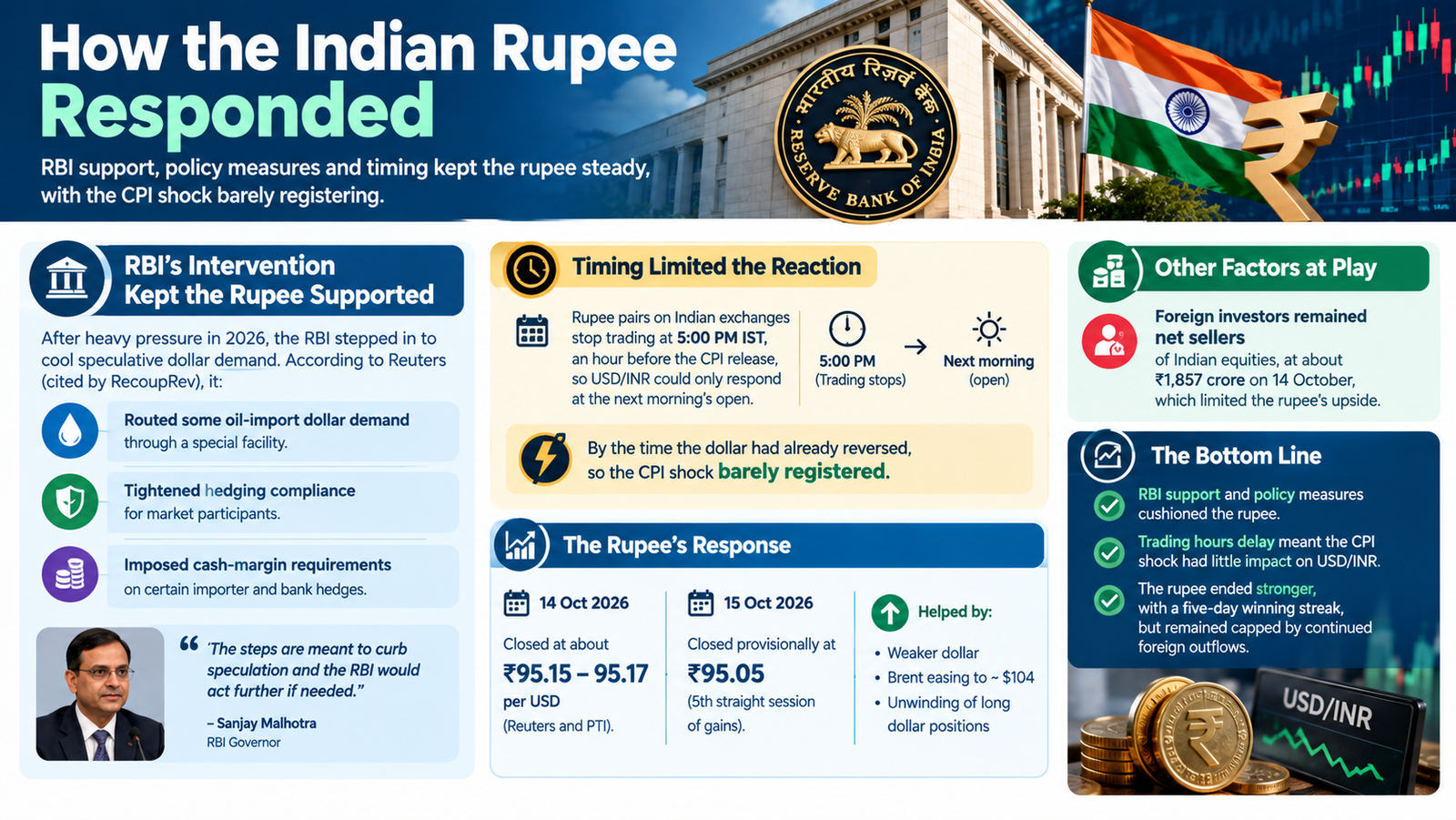
Before the CPI release, the RBI had moved to cut speculative dollar demand. According to Reuters reports cited by RecoupRev, it routed some oil-import dollar demand through a special facility, tightened hedging compliance and imposed cash-margin requirements on certain importer and bank hedges. Governor Sanjay Malhotra said the steps were meant to curb speculation and that the RBI would act further if needed.
Timing also mattered. Rupee pairs on Indian exchanges stop trading at 5:00 PM IST, an hour before the CPI release, so USD/INR could only respond at the next morning’s open, by which time the dollar had already reversed. As a result, the CPI shock barely registered:
- On 14 October, the rupee closed at about 95.15 to 95.17 per dollar, reported by Reuters and PTI.
- On 15 October, it closed provisionally at 95.05, its fifth straight session of gains, helped by a weaker dollar, Brent easing to about $104 and the unwinding of long dollar positions.
- Foreign institutional investors were still net sellers of Indian equities, at about ₹1,857 crore on 14 October, which limited the rupee’s upside.
Why US CPI Matters for USD/INR
US inflation reaches the rupee through three channels. Higher US yields draw foreign portfolio money away from Indian bonds and stocks. A stronger dollar raises the rupee cost of India’s oil imports. And because energy drove this CPI print, higher crude prices hurt India twice, by widening the trade deficit and by adding to dollar demand from importers. RBI intervention can blunt these forces in the short term, but it does not remove them.
What Indian Traders Can Learn From This CPI Release
Trade Only Through Permitted Channels
Resident Indians can trade currency derivatives only with authorised persons and on recognised exchanges such as NSE, BSE and the Metropolitan Stock Exchange, in contracts those exchanges list. The RBI maintains an Alert List of unauthorised forex platforms and states that the list is not exhaustive, so a platform’s absence from it does not mean it is legal. Leveraged offshore forex apps offering EUR/USD or gold CFDs to Indian residents fall outside the permitted framework.
Size Positions for the Volatility
NSE USD/INR futures have a contract size of US$1,000, so each 1 paisa move equals ₹10 per lot.
Hypothetical example: a trader holds 10 lots of USD/INR futures, a position of US$10,000. If the rupee moves 25 paise against the position after a CPI surprise, the loss is 25 × ₹10 × 10 = ₹2,500, before brokerage and taxes. If the account’s per-trade risk limit is ₹2,000, that position is too large to hold through the release.
A Practical CPI-Day Checklist
- Note the consensus for headline and core CPI, month on month and year on year.
- Remember that the release lands at 6:00 PM IST (7:00 PM IST when the US is on standard time from November).
- Know which contracts are open. Rupee pairs on NSE and BSE close at 5:00 PM, so USD/INR reacts at the next morning’s open; exchange-listed cross pairs such as EUR/USD trade until 7:30 PM.
- Compare core CPI with its forecast first. In September, core moved hike odds more than the headline did.
- Expect a second move once Fed officials comment, often the next day.
- Watch RBI statements and crude oil, which can matter more for USD/INR than CPI.

What to Watch Next
- 27 to 28 October 2026: FOMC meeting, where the market is pricing a modest chance of another hike.
- 10 November 2026: October CPI release from the BLS, at 8:30 AM ET.
- Crude oil: any further rise in Brent would keep headline inflation high and pressure the rupee.
- RBI action: further steps to defend the rupee would continue to dampen USD/INR‘s response to US data.
Check the Risk-On / Risk-Off Meter here!
Frequently Asked Questions
What was US CPI for September 2026?
Headline CPI rose 0.6% for the month and 3.7% over the year. Core CPI rose 0.3% for the month and 2.6% over the year. Both annual rates were 0.1 percentage point above forecasts.
Why does US CPI affect forex markets?
CPI shapes expectations for Federal Reserve interest rates. Higher-than-expected inflation raises the chance of rate hikes, which lifts US yields and usually strengthens the dollar against other currencies.
What time is US CPI released in India?
The BLS publishes CPI at 8:30 AM Eastern Time. That is 6:00 PM IST while the US observes daylight saving time and 7:00 PM IST during US standard time.
Why did the dollar fall after a hot CPI report?
The core surprise was small, gasoline drove most of the headline increase, and Fed officials said the following day that they could wait before acting. October hike odds fell back to about 25%, and the dollar index gave up its gains.
Did the rupee weaken after the September CPI release?
No. The rupee was largely unaffected and continued to gain, closing near 95.05 on 15 October, as RBI measures curbed dollar demand and the dollar weakened globally.
Can Indian residents trade EUR/USD after a CPI release?
Only through exchange-traded cross-currency contracts listed by recognised Indian exchanges and offered by authorised brokers; these trade until 7:30 PM IST. Trading through unauthorised offshore platforms is not permitted under FEMA.
Conclusion
The September 2026 US CPI report showed inflation at 3.7%, driven by a sharp rise in gasoline, with core prices also slightly ahead of forecasts. The dollar’s jump and its reversal within a day show that the market’s verdict depends on the core number and on how Fed officials read it, not on the headline alone. For Indian traders, the bigger lesson is that USD/INR now responds as much to RBI policy and oil prices as to US data. Plan CPI trades around all three, and size positions so that a 6:00 PM surprise cannot do lasting damage.
Disclaimer
This article is for educational purposes only and does not constitute investment, trading, tax or legal advice. Currency and derivatives trading involves substantial risk of loss. Market levels cited are approximate, drawn from third-party reports, and may differ between data providers. Examples are hypothetical. Indian residents should trade forex only through authorised persons and recognised exchanges as permitted under FEMA, and should consult a SEBI-registered adviser before making financial decisions.