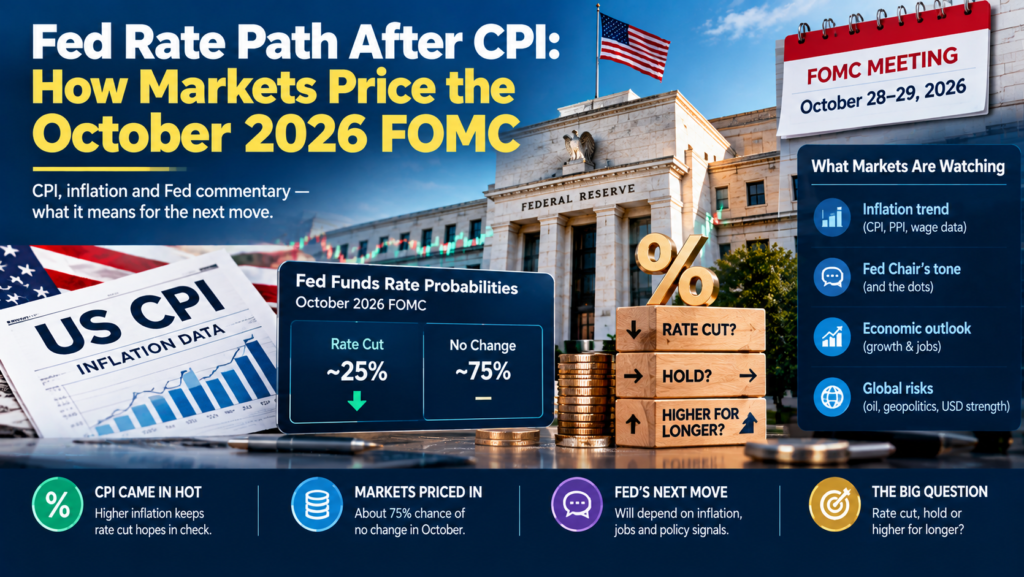
Expectations for the Federal Reserve’s next move drive currency markets, and before the 27 to 28 October 2026 meeting they have swung sharply. The chance of an October rate hike, as implied by futures prices, rose to about 50% within minutes of the September CPI report and then fell back below 30% a day later.
This article explains where Fed rate path after CPI, PPI and retail sales data, how those odds are calculated, why they keep changing, and what the Fed’s rate path means for the dollar and the Indian rupee.
Where Fed Rate Expectations Stand Now
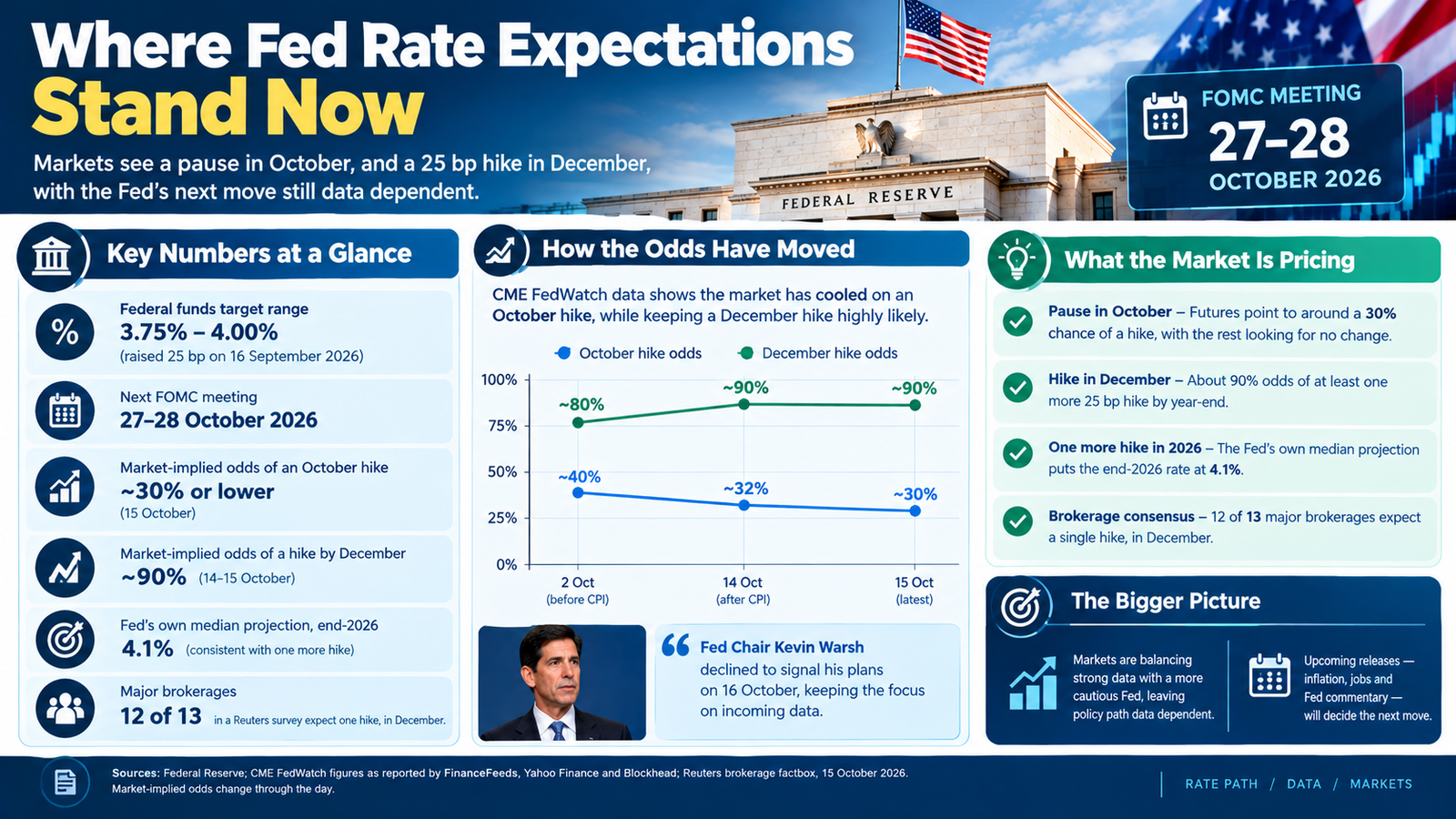
As of 16 October 2026, markets expect the Federal Reserve to keep its target range at 3.75% to 4.00% at the 27 to 28 October meeting and to raise it by 25 basis points in December. CME FedWatch data put the chance of an October hike at roughly 30% on 15 October, while the probability of at least one more hike by December was about 90%. Fed Chair Kevin Warsh declined to signal his plans on 16 October.
| Item | Current position |
|---|---|
| Federal funds target range | 3.75% to 4.00% (raised 25 bp on 16 September 2026) |
| Next FOMC meeting | 27 to 28 October 2026 |
| Market-implied odds of an October hike | Roughly 30% or lower (15 October) |
| Market-implied odds of a hike by December | About 90% (14 to 15 October) |
| Fed’s own median projection, end-2026 | 4.1%, consistent with one more hike |
| Major brokerages | 12 of 13 in a Reuters survey expect one hike, in December |
Sources: Federal Reserve; CME FedWatch figures as reported by FinanceFeeds, Yahoo Finance and Blockhead; Reuters brokerage factbox, 15 October 2026. Market-implied odds change through the day.
How the Fed Got Here
On 16 September 2026, the Federal Open Market Committee raised the federal funds target range by 25 basis points to 3.75% to 4.00% in a 12-0 vote. It was the Fed’s first rate increase since 2023 and followed a cut in December 2025. The statement said “inflation remains elevated” and that the move would “support a timelier return to the Committee’s 2 percent goal.”
At his press conference, Chair Kevin Warsh said “inflation is too high and has been for too long,” according to Schwab’s summary of the meeting. The Fed’s updated projections showed:
- A median federal funds rate of 4.1% for the end of 2026, up from 3.8% in June, implying one more 25 bp hike this year.
- A median of 4.1% for the end of 2027, up from 3.6%.
- Core PCE inflation of 3.4% in 2026, with the 2% target not expected until 2029.
- Unemployment of 4.1% and GDP growth of 2.3% for 2026.
The projections answered whether the Fed would hike again, but not when.
Two Weeks of Swinging Odds
The market’s answer to “when” has changed with almost every data release. The timeline uses CME FedWatch probabilities reported by financial media; each is a snapshot, so outlets can differ by several points.
| Date | Event | Odds of an October hike |
|---|---|---|
| 16 September | Fed hikes, signals one more move | About 49% after the press conference |
| Late September | Hawkish Fed comments, including Governor Barr | About 64% |
| 2 October | Before the weak September jobs report | About 28% |
| 14 October, before CPI | Waiting for inflation data | About 21% to 23% |
| 14 October, after CPI | CPI at 3.7%, above the 3.6% forecast | Peak of about 50%, then about 32% to 34% by evening |
| 15 October | PPI and retail sales; Fed officials signal patience | Below 30% |
| 16 October | Warsh declines to signal his plans | Expectations of a December move intact |
The Jobs Report Lowered the Odds
The September employment report, released on 2 October, showed nonfarm payrolls rising by only 29,000 and the unemployment rate at 4.2%, according to the Bureau of Labor Statistics. August was revised down to 133,000 and July to a loss of 10,000. Average hourly earnings rose 3.0% over the year.
CPI Raised Them, Briefly
September CPI showed headline inflation of 3.7% and core inflation of 2.6%, both 0.1 percentage point above forecasts. The odds of an October hike more than doubled within minutes. They fell back the same day once traders saw that gasoline drove most of the increase and that core prices rose 0.3% for the month, the same pace as August.
Fed Officials Cooled Them
Several officials signalled patience. New York Fed President John Williams said there was “no need for urgency” and that “one further upward adjustment” might be appropriate “late this year.” Governor Michelle Bowman said the Fed could wait to see how the economy responds to the September hike. San Francisco Fed President Mary Daly said another increase would likely be needed but that there was no urgency to act.
On 16 October, Warsh told an IMF audience in Bangkok: “I don’t prejudge meetings.” He said the Fed “removed a dose of accommodation about a month ago” and described “a synchronous tightening in monetary policy in most places around the world,” adding “there’s no free riders.” He also said AI investment is “hitting the demand side of the economy before it’s going to hit the supply side,” which is adding to inflation pressure.
How Markets Price an FOMC Meeting
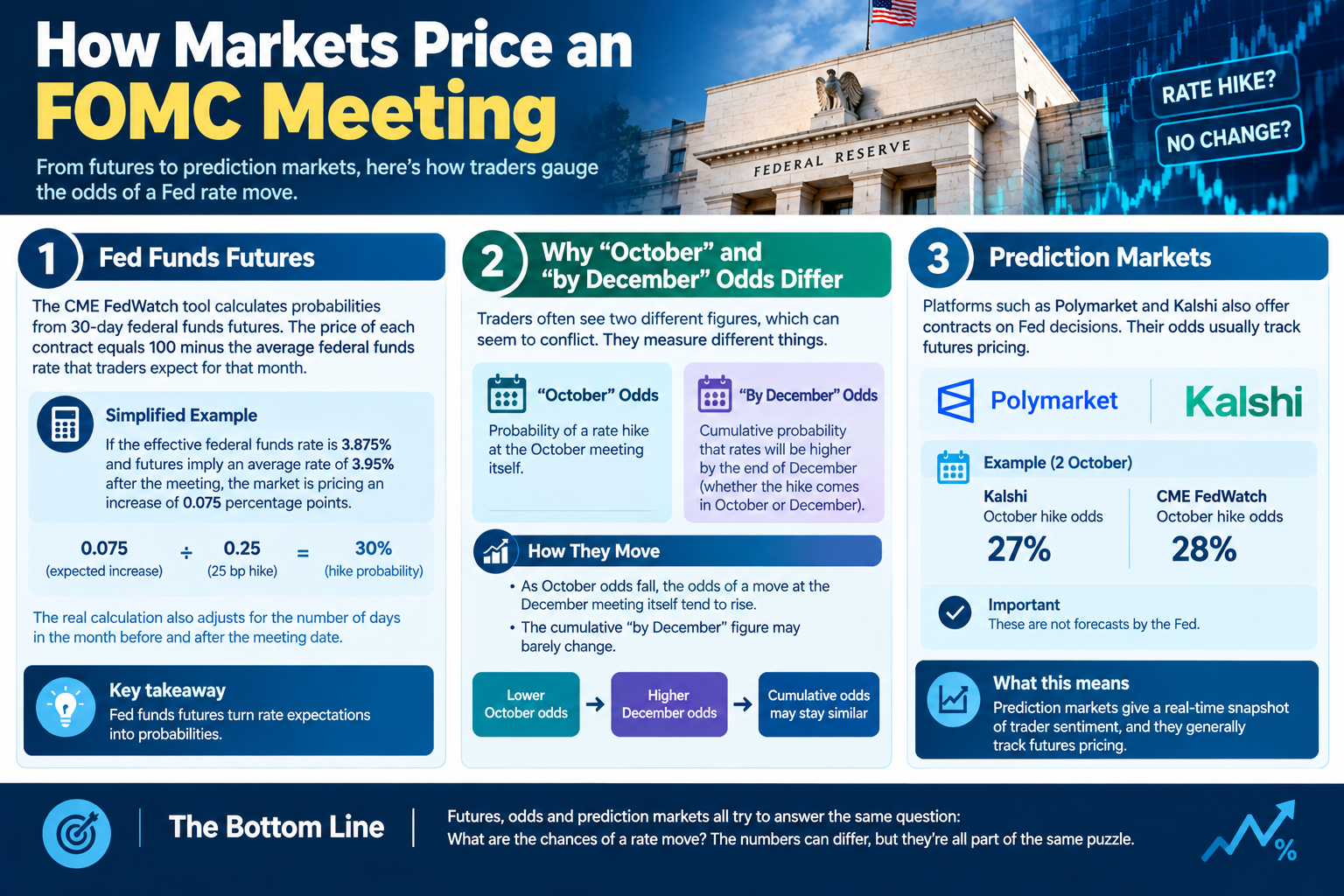
Fed Funds Futures
The CME FedWatch tool calculates probabilities from 30-day federal funds futures. The price of each contract equals 100 minus the average federal funds rate that traders expect for that month.
Simplified hypothetical example: suppose the effective federal funds rate is 3.875% and the only choice at the next meeting is no change or a 25 bp hike. If futures imply an average rate of 3.95% after the meeting, the market is pricing an increase of 0.075 percentage points. Dividing 0.075 by 0.25 gives a hike probability of 30%. The real calculation also adjusts for the number of days in the month before and after the meeting date.
Why “October” and “by December” Odds Differ
Readers often see two figures that seem to conflict, such as a 63% chance of a December hike and a 90% chance of a hike by December. The first is the probability of a move at the December meeting itself. The second is the cumulative probability that rates will be higher by the end of December, whether the hike comes in October or December. As October odds fall, the odds of a move at the December meeting itself tend to rise, while the cumulative figure may barely change.
Prediction Markets
Platforms such as Polymarket and Kalshi also offer contracts on Fed decisions. Their odds usually track futures pricing; on 2 October, Kalshi showed about 27% odds of an October hike against 28% on CME FedWatch. None of these are forecasts by the Fed.
What Analysts Expect
A Reuters survey published on 15 October found that 12 of 13 major brokerages expect one more 25 bp hike in 2026, in December, which would take the target range to 4.00% to 4.25%. They include Goldman Sachs, J.P. Morgan and Morgan Stanley. BofA Global Research was the exception, forecasting hikes in both October and December, which would take the range to 4.25% to 4.50%.
| Scenario | Target range after December | Likely dollar reaction |
|---|---|---|
| Hold in October, hike in December (consensus) | 4.00% to 4.25% | Limited, as this is largely priced in |
| Hike in October and December | 4.25% to 4.50% | Stronger dollar, higher US yields |
| Hold in both meetings | 3.75% to 4.00% | Weaker dollar, lower US yields |
The table shows typical reactions, not predictions; guidance matters as much as the decision.
What the Fed Rate Path Means for the Dollar
The dollar has followed rate expectations closely this month. The Dollar Index peaked near 103.0 after the CPI release and fell to about 101.70 by the morning of 16 October, its lowest in two weeks, according to FXStreet, as October hike odds faded. EUR/USD rose toward 1.1250 and GBP/USD to about 1.3320. The US 10-year Treasury yield, which had moved above 5.3% after CPI, was near 5.10% on 16 October.
The dollar responds less to decisions than to changes in expectations. A December hike that is about 90% priced in should have little effect when it happens; a surprise October hike, or signs the Fed will stop after December, would move it more.
What It Means for India and the Rupee
The Interest Rate Gap
The Reserve Bank of India raised its repo rate by 25 bp to 5.50% on 7 October 2026. The gap between the repo rate and the top of the Fed’s target range is therefore 1.50 percentage points. A Fed hike in December, with no change from the RBI, would narrow it to 1.25 points. A narrower gap reduces the extra return foreign investors earn by holding rupee assets, which tends to pressure the currency.
Hypothetical example: a foreign investor compares an Indian money market instrument yielding 5.50% with a US equivalent yielding 4.00%. The extra return is 1.50%. If the US rate rises to 4.25%, the extra return falls to 1.25%. If the rupee is expected to weaken by more than that, staying in dollars pays more.
Recent Rupee Moves
The rupee gained as the dollar softened, opening at 94.75 per dollar on 16 October, according to PTI. Brent crude above USD 100 a barrel and foreign equity outflows of about ₹5,285 crore on 15 October limited the gains.
For Indian Traders
- FOMC decisions are announced at 2:00 PM Eastern Time, which will be 11:30 PM IST on 28 October (US daylight saving time ends on 1 November). USD/INR will react at the next morning’s open.
- Track the cumulative “by December” odds as well as the single-meeting odds.
- Indian residents can trade currency derivatives only through authorised brokers on recognised exchanges such as NSE and BSE, as permitted under FEMA.
What to Watch Before 28 October
- Fed blackout period: under the Fed’s usual rules, officials stop commenting on policy from Saturday 17 October, so there will be few new signals before the meeting.
- Oil prices: higher energy costs lift headline inflation and could revive hike bets.
- Treasury yields: a move back above 5.3% in the 10-year yield would tighten financial conditions without a Fed decision.
- After the meeting: October jobs data on 6 November and October CPI on 10 November will shape December pricing.
Frequently Asked Questions
Will the Fed raise rates in October 2026?
Markets see an October hike as less likely than not. CME FedWatch put the probability at roughly 30% or lower on 15 October, and most major brokerages expect the next hike in December.
How are Fed rate expectations measured?
The most common measure is the CME FedWatch tool, which converts federal funds futures prices into probabilities for each meeting.
What does the Fed dot plot show for 2026?
The September 2026 projections showed a median federal funds rate of 4.1% at the end of 2026 and 4.1% at the end of 2027, implying one more 25 bp hike this year and little change next year.
How do Fed rate expectations affect the Indian rupee?
Higher expected US rates usually strengthen the dollar and draw investment away from emerging markets, which can weaken the rupee. Lower expected US rates usually have the opposite effect. RBI policy, oil prices and foreign flows also matter.
What time will the October FOMC decision be announced in India?
The decision is due at 2:00 PM Eastern Time on 28 October 2026, which is 11:30 PM IST.
Conclusion
Fed rate expectations have settled, for now, on a hold in October and a hike in December. The past two weeks show how fragile that view is: odds of an October move have ranged from about 20% to more than 60% on the back of single data releases and Fed comments. For traders, the useful signals are the cumulative odds of a hike by December, the core inflation trend and Fed guidance, not the first reaction to each headline. For India, a December Fed hike that is already priced in should matter less for the rupee than oil prices, foreign flows and the RBI’s own policy.
Disclaimer
This article is for educational purposes only and does not constitute investment, trading, tax or legal advice. Market-implied probabilities change continuously and are not forecasts by the Federal Reserve. Market levels cited are approximate and drawn from published reports. Examples are hypothetical. Currency and derivatives trading involves substantial risk of loss; Indian residents should trade only through authorised persons and recognised exchanges as permitted under FEMA, and consult a SEBI-registered adviser before making financial decisions.