
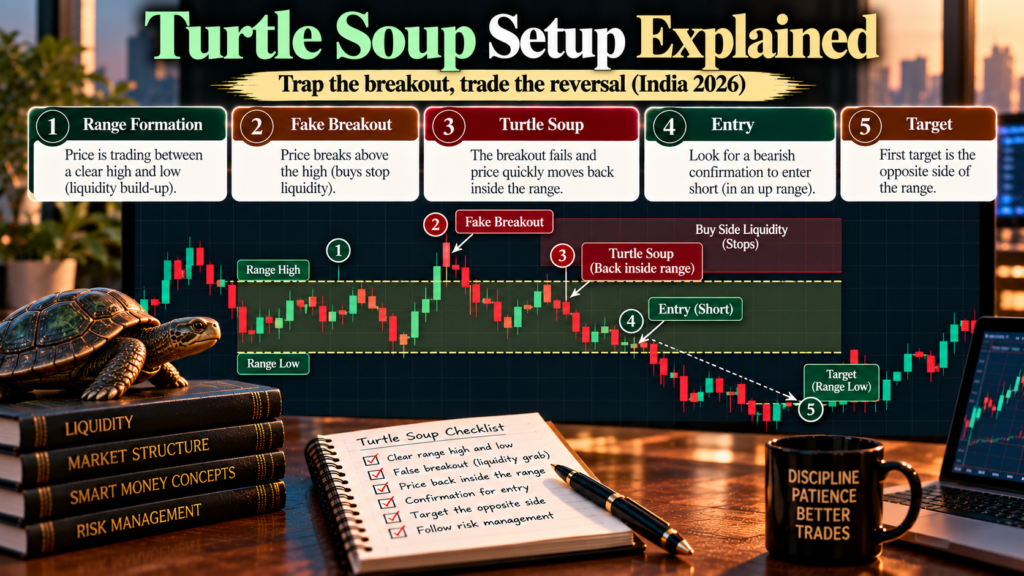
Turtle Soup Setup: The Quick Answer
Most beginners are taught to buy breakouts: when price breaks a recent high, momentum should carry it higher. But anyone who has traded for a few weeks knows how often that goes wrong. Price pokes above the high, triggers everyone’s buy orders and stop-losses, then reverses sharply. The turtle soup setup is a strategy built to profit from exactly those failed breakouts.
Quick answer: Turtle soup is a false-breakout reversal setup. In its original form, price makes a new 20-day low (or high), but the previous 20-day low was set at least four days earlier. Instead of selling the breakdown, you place a buy order just back above the old low, betting the breakdown fails. The stop goes just beyond the new extreme. ICT and Smart Money Concepts (SMC) traders later adapted the idea as a “liquidity sweep” of an old high or low followed by a reversal.
In this guide you will learn:
- Where the name comes from and who published the rules
- The original turtle soup rules and the “Plus One” variant
- How the ICT version differs
- A worked USD/INR trade with rupee risk and lot sizing
- What the evidence says, plus common mistakes, myths and 17 FAQs
Important for Indian readers: Resident Indians may trade forex only in permitted currency pairs on recognised exchanges (NSE, BSE) through a SEBI-registered broker. Offshore forex apps and websites are not permitted; the RBI maintains an Alert List of unauthorised platforms. For rupee pairs, RBI rules also link participation to having an underlying exposure, so check with your broker before you trade.
Where the Name “Turtle Soup” Comes From
In 1983, commodity trader Richard Dennis, together with William Eckhardt, trained a group of novices who became known as the Turtle traders. One of the entry rules they became famous for was buying a breakout to a new 20-day high and selling a breakdown to a new 20-day low.
Linda Bradford Raschke and Laurence (Larry) Connors noticed that many of those 20-day breakouts failed. Their book Street Smarts: High Probability Short-Term Trading Strategies, published in the mid-1990s (sources give 1995 or 1996), described a setup that deliberately takes the opposite side of a failed Turtle breakout. Hence the joke: the breakout traders get turned into “turtle soup”.

The Original Turtle Soup Rules
The rules below are as summarised by several trading-education sources (New Trader U, NetPicks, Complete Trader’s Edge). They were written for daily charts of US futures and stocks, where orders are placed in cents or ticks.
| Rule | Buy setup (bullish) | Sell setup (bearish) |
|---|---|---|
| Trigger | Price makes a new 20-day low | Price makes a new 20-day high |
| Age of the old extreme | Previous 20-day low set at least 4 trading days earlier | Previous 20-day high set at least 4 trading days earlier |
| Entry | Buy stop 5–10 ticks above the previous 20-day low | Sell stop 5–10 ticks below the previous 20-day high |
| Order validity | Same day only; cancel if not filled | Same day only; cancel if not filled |
| Stop-loss | 1–2 ticks below the day’s (new) low | 1–2 ticks above the day’s (new) high |
| Management | Take partial profit or trail the stop, often by 1R | Same, in reverse |
The “at least four days” rule matters. It means the old low has had time to attract stop-loss orders and breakout sellers. A new low only one or two days after the last one is just a normal down-move, not a trap.
Turtle Soup Plus One. A variant in the same book waits one extra day. Price makes the new 20-day low and closes at or below the old low; the buy order is then placed for the next day, back above the old low. It trades fewer signals but asks the market to show more rejection first. (Exact filters vary between summaries; check the book if you plan to use the precise rule.)
The ICT / SMC Version of Turtle Soup
ICT (Inner Circle Trader) and SMC traders borrowed the name but loosened the rules. According to FXOpen’s explainer, the ICT version is applied on intraday charts “using liquidity and order flow, not fixed 20-day breakout rules”. Typical steps:
- Mark an obvious old high or low (for example, the previous day’s high, or equal highs) where stop-losses are likely to cluster.
- Wait for price to sweep beyond it, usually with a wick, then close back inside the range.
- Look for a market structure shift on a lower timeframe, aligned with higher-timeframe bias.
- Enter on a pullback into an order block or fair value gap left by the reversal.
- Stop just beyond the sweep wick; target the opposite liquidity pool.
| Feature | Original (Connors & Raschke) | ICT / SMC version |
|---|---|---|
| Timeframe | Daily | Mostly intraday (15m to 4H) |
| Level | Mechanical 20-day high/low | Any obvious high/low (previous day, session, equal highs) |
| Age filter | At least 4 days | No fixed rule |
| Confirmation | Price trades back through the old level | Close back inside, then a market structure shift |
| Entry | Stop order through the old level | Limit order at an order block or FVG |
| Objectivity | High: two traders get the same signal | Lower: depends on judgment |
Worked Examples (Illustrative USD/INR Prices)
On NSE, one USD/INR lot is $1,000 and the tick size is ₹0.0025, so every ₹0.01 move equals ₹10 per lot. Five to ten ticks therefore means 1.25 to 2.5 paise.
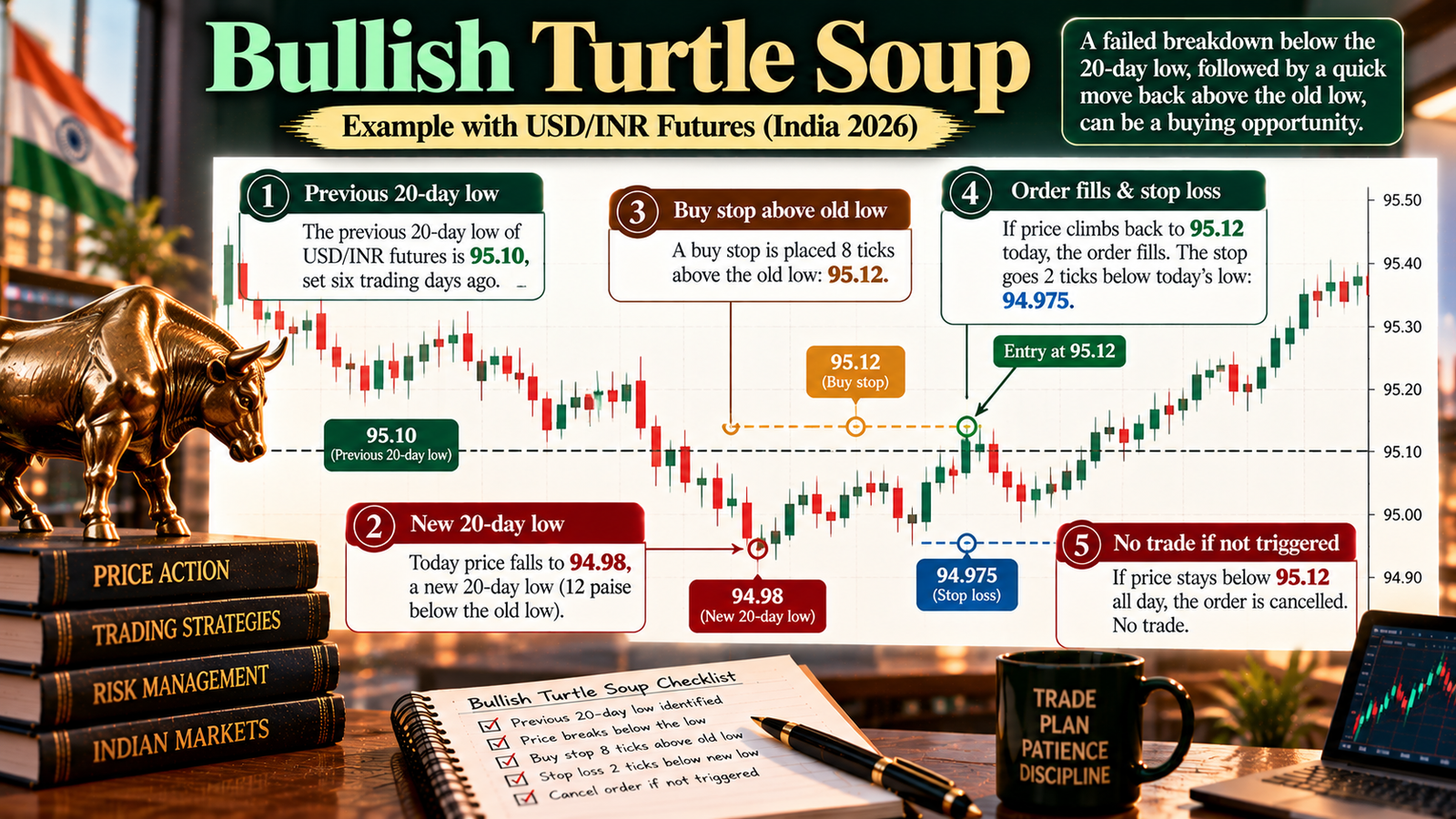
Bullish turtle soup:
- The previous 20-day low of USD/INR futures is 95.10, set six trading days ago.
- Today price falls to 94.98, a new 20-day low (12 paise below the old low).
- A buy stop is placed 8 ticks above the old low: 95.12.
- If price climbs back to 95.12 today, the order fills. The stop goes 2 ticks below today’s low: 94.975.
- If price stays below 95.12 all day, the order is cancelled. No trade.
Bearish turtle soup:
- The previous 20-day high is 96.20, set five days ago.
- Today price spikes to 96.31, a new 20-day high.
- A sell stop is placed 8 ticks below the old high: 96.18, with the stop 2 ticks above today’s high: 96.315.
How to Trade the Turtle Soup Setup: Step by Step
- Scan for the trigger. At the end of each day, list pairs making a new 20-day low or high on the daily chart.
- Check the age filter. Was the previous 20-day extreme set at least four trading days earlier? If not, skip it.
- Check the context. Avoid fading a breakout caused by major scheduled news (RBI policy, US Fed decision, CPI data) or a strong multi-week trend. See the economic calendar first.
- Place the entry order. Buy stop a few ticks above the old low (or sell stop below the old high), valid for that session only.
- Set the stop immediately. A few ticks beyond the new extreme; the setup is wrong if price keeps going.
- Size the position so the stop equals 1% or less of your capital, rounding lots down.
- Manage the trade. Take partial profit at 1R to 2R, or trail the stop. Failed-breakout reversals can be quick, so plan exits in advance.
- Journal every signal, including ones that never filled, so you can judge the setup on your own data.
USD/INR Trade Example in Rupees
Using the bullish example above, all prices illustrative:
- Capital: ₹1,00,000. Risk per trade: 1% = ₹1,000
- Entry: buy stop at 95.12 (8 ticks above the old 20-day low of 95.10)
- Stop-loss: 94.975 (2 ticks below the new low of 94.98)
- Target: 95.41 (2R)
| Item | Calculation | Result |
|---|---|---|
| Stop distance | 95.12 − 94.975 = ₹0.145 | 14.5 paise |
| Risk per lot | 0.145 × $1,000 | ₹145 |
| Lots | ₹1,000 ÷ ₹145 = 6.9, rounded down | 6 lots |
| Actual risk | 6 × ₹145 | ₹870 |
| Reward per lot | (95.41 − 95.12) × $1,000 | ₹290 |
| Total reward at 2R | 6 × ₹290 | ₹1,740 |
If the stop is hit, the loss is the planned ₹870 plus costs (brokerage, exchange fees, GST, stamp duty). If price never trades back to 95.12, there is no trade. (Trading JPY/INR instead? One lot is ¥100,000 quoted per 100 yen, so a ₹1 move equals ₹1,000 per lot.)
Turtle Soup vs Breakout vs Liquidity Sweep
| Feature | Breakout trading | Turtle soup (original) | Liquidity sweep (SMC) |
|---|---|---|---|
| Core bet | The break continues | The break fails | The break was a stop hunt |
| Direction | With the break | Against the break | Against the sweep |
| Rules | Fixed (e.g. 20-day high) | Fixed (20-day, 4-day age) | Discretionary |
| Entry trigger | Price beyond the level | Price back through the old level | Structure shift after the sweep |
| Typical risk | Strong trend days | Real breakouts that keep going | Mis-reading a real move as a sweep |
| Best conditions | Trending markets | Ranging, mean-reverting markets | Ranging markets near obvious liquidity |
In plain terms: breakout traders and turtle soup traders are betting on opposite outcomes of the same event. Neither is “right” all the time; the market regime (trending or ranging) matters most.
What Does the Evidence Say?
Fact: We did not find peer-reviewed studies testing the turtle soup setup specifically, either the original rules or the ICT version.
Related research (context only):
- Park and Irwin (2007), in the Journal of Economic Surveys, reviewed 95 modern studies of technical trading: 56 found positive results, 20 negative and 19 mixed. But they warned that many tests suffer from data snooping, after-the-fact rule selection and poor handling of risk and transaction costs.
- Moskowitz, Ooi and Pedersen (2012) documented time-series momentum across futures markets, including currencies: past 12-month returns tended to continue. That broadly supports trend following, which is the opposite bet to turtle soup, so fading breakouts in a strong trend deserves extra caution.
Analysis: Turtle soup is a counter-trend, mean-reversion idea. It may suit ranging markets and struggle when a genuine trend begins, because every real trend starts with a breakout that turtle soup would try to fade. The strict stop just beyond the new extreme keeps each loss small, which is the setup’s main risk-control strength.
Expert Analysis: Fact, Analysis and Opinion
Fact: Turtle soup was published by Laurence Connors and Linda Bradford Raschke in Street Smarts as a way to fade failed 20-day breakouts, the kind of breakouts the Turtle traders bought and sold. ICT and SMC traders later reused the name for a discretionary liquidity-sweep reversal. No peer-reviewed tests of either version were found.
Analysis: The original version’s strength is that it is fully mechanical: new 20-day extreme, old extreme at least four days old, entry back through the old level, stop beyond the new extreme. That makes it easy to back-test and journal. The ICT version adds context (liquidity pools, structure shifts, order blocks) but also adds judgment, which makes it easier to see a “sweep” in hindsight on every chart. Both are counter-trend setups, so they carry the same core risk: a real breakout that keeps going.
Opinion: For a beginner, learn the original rules first on daily USD/INR charts, paper-trade or journal at least 30 signals, and only then experiment with the intraday ICT version. Skip any signal that lines up with a major news release, and never widen the stop once the new extreme is set.
Common Mistakes Beginners Make
- Fading every breakout. Without the 20-day and four-day filters, you are just guessing against momentum.
- Entering before price trades back through the old level. The whole idea is confirmation that the break failed.
- Ignoring news. Breakouts on RBI or Fed announcements can run far; turtle soup is not built for them.
- Moving the stop further away when price makes another new low.
- Leaving the order open for days. The original entry order is valid for one session only.
- Fighting a strong trend. Counter-trend setups work best in ranges.
- Oversizing because the stop is tight. A tight stop can be hit quickly; keep risk at 1% or less.
- Using offshore apps to trade turtle soup on unpermitted pairs. For resident Indians, stick to exchange-traded pairs through a SEBI-registered broker.
Myths vs Facts
| Myth | Fact |
|---|---|
| Turtle soup is an ICT invention | The name and rules come from Connors and Raschke’s Street Smarts; ICT adapted it later |
| It was the Turtle traders’ own strategy | It was designed to trade against failed Turtle-style breakouts |
| Every false breakout reverses sharply | Many drift sideways or resume the breakout later |
| Turtle soup has a proven high win rate | No peer-reviewed tests were found; results depend on market, period and costs |
| It works on any timeframe the same way | The original rules were for daily charts; intraday versions are different setups |
| A liquidity sweep and turtle soup are identical | They overlap, but the original has fixed, objective rules and the SMC sweep does not |
Key Takeaways
- Turtle soup is a false-breakout reversal setup that fades failed 20-day highs and lows.
- Original rules: new 20-day extreme, previous extreme at least 4 trading days old, entry back through the old level, stop just beyond the new extreme.
- Turtle Soup Plus One waits a day for extra confirmation.
- The ICT version applies the idea to intraday liquidity sweeps with a structure-shift confirmation.
- It is counter-trend: favour ranging markets and avoid major news.
- Size to 1% risk and round lots down; in the example, 6 lots risked ₹870.
- In India, trade only permitted pairs on NSE/BSE through a SEBI-registered broker.
Frequently Asked Questions (FAQs)
- What is the turtle soup trading strategy?
A false-breakout reversal setup. When price makes a new 20-day low or high but quickly trades back through the old level, the trader takes the opposite side, betting the breakout has failed.
- Who created the turtle soup setup?
It was published by Laurence Connors and Linda Bradford Raschke in their book Street Smarts: High Probability Short-Term Trading Strategies in the mid-1990s.
- Why is it called turtle soup?
It trades against failed 20-day breakouts, the kind of breakouts made famous by Richard Dennis’s Turtle traders. When those breakouts fail, the breakout traders become ‘turtle soup’.
- What are the turtle soup buy rules?
Price makes a new 20-day low, the previous 20-day low was at least four trading days earlier, a buy stop is placed a few ticks above the old low for that day only, and the stop-loss goes just below the new low.
- What are the turtle soup sell rules?
Price makes a new 20-day high, the previous 20-day high was at least four trading days earlier, a sell stop is placed a few ticks below the old high, and the stop-loss goes just above the new high.
- Why must the previous low be at least four days old?
It gives time for stop-loss and breakout orders to build up around the old level. A new low only a day or two later is usually just a normal down-move.
- What is Turtle Soup Plus One?
A variant that waits one extra day. After price makes the new 20-day extreme and closes beyond the old level, the entry order is placed for the next session back through the old level.
- What is ICT turtle soup?
ICT traders adapted the idea to intraday charts: price sweeps an obvious old high or low, closes back inside the range, shows a market structure shift, and the trader enters against the sweep.
- Is turtle soup the same as a liquidity sweep?
They overlap. The original turtle soup has fixed, objective rules; an SMC liquidity sweep is discretionary and uses any obvious high or low.
- Where do I place the stop-loss in turtle soup?
Just beyond the new extreme: a tick or two below the new low for a buy, or above the new high for a sell. If price keeps going, the setup has failed.
- Which timeframe is best for turtle soup?
The original rules were written for daily charts. The ICT version is used on intraday charts, but it is effectively a different, more discretionary setup.
- Does the turtle soup strategy work?
We found no peer-reviewed tests of it. Broader research on technical trading is mixed and often affected by data snooping and costs, so test it in your own journal before relying on it.
- When does turtle soup fail?
Mostly during genuine breakouts and strong trends, and around major news, when price keeps moving beyond the new extreme instead of reversing.
- Can I use turtle soup on USD/INR in India?
You can apply the idea to exchange-traded currency futures and options on permitted pairs such as USD/INR on NSE or BSE through a SEBI-registered broker. RBI rules link rupee-pair participation to underlying exposure, so check with your broker.
- How many lots should I trade on a turtle soup setup?
Divide your rupee risk by the risk per lot and round down. In the example, a 14.5 paise stop costs ₹145 per lot, so ₹1,000 of risk allows 6 lots.
- Is it legal to trade turtle soup on offshore forex apps from India?
Resident Indians are not permitted to trade forex on unauthorised offshore platforms. The RBI publishes an Alert List of such entities. Use only recognised Indian exchanges.
- Should beginners trade turtle soup or breakouts?
Learn both, because they are opposite bets on the same event. Many beginners start with the mechanical daily turtle soup rules because they are easy to test, but journal the results before risking real money.