
Introduction
Five winning trades in a row feels like proof. You start to think you’ve “figured out” the market, you skip a checklist item, you double your size, and one or two losses later a month of profit is gone. That pattern is overconfidence in trading, and it usually shows up right after you’ve been doing well.
Quick answer: Confidence is trusting a process you’ve tested, so you take valid setups without hesitation at your normal risk. Overconfidence is believing recent wins prove your skill is higher than it is, so you raise position size, skip rules, trade more or take weaker setups. The fix is to judge yourself on large samples, keep risk per trade fixed after wins, and let only journal data, not feelings, change your size or rules.
Why this matters for Indian traders
- Fact: SEBI’s study found that over 91% of individual equity F&O traders made net losses in FY25.
- Fact: In the equity cash segment, 71% of individual intraday traders made net losses in FY23, and 80% of very frequent traders (over 500 trades a year) did.
- Analysis: SEBI doesn’t measure overconfidence directly. But research outside India links overconfidence to excessive trading, and excessive trading to lower returns, so recognising overconfidence is a practical way to protect your capital.
This guide explains the difference between confidence and overconfidence, what research shows about winning streaks, how to tell luck from skill, and how to build guardrails that keep a good run from turning into a big loss.
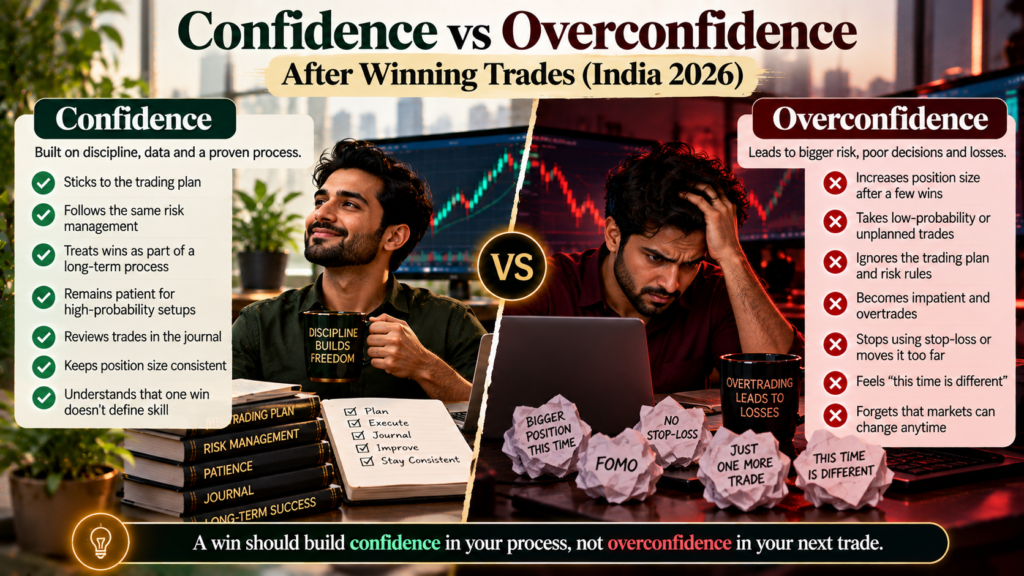
Confidence vs overconfidence
| Healthy confidence | Overconfidence | |
|---|---|---|
| Based on | A tested process and a large sample of trades | A recent streak or a few big wins |
| Position size after wins | Unchanged (fixed % risk) | Increased, often sharply |
| Rules and checklist | Followed every time | “I don’t need it today” |
| Trade selection | Only planned setups | Marginal setups, new instruments, more trades |
| View of wins | “The process worked, and luck helped” | “I’m good at this” |
| View of losses | Expected part of the process | Surprising, or someone else’s fault |
| Reaction to the next loss | Normal; next trade same size | Shock, often followed by revenge trading |
The key difference: confidence trusts the process. Overconfidence trusts yourself beyond what the evidence supports.
What research says
None of these studies looked at Indian traders specifically, so read them as evidence about human behaviour, not as India-specific findings.
1. Traders take too much credit for wins
Fact: Gervais and Odean (2001) modelled how traders learn about their own ability from successes and failures. In their model, traders take too much credit for successes, which makes them overconfident. Overconfidence tends to rise early in a trading career and falls as experience teaches traders their real ability. This is known as self-attribution bias.

Why it matters: early wins are exactly when beginners are most likely to overestimate themselves.
2. Gains make people take more risk
Fact: Thaler and Johnson (1990) ran real-money experiments and found a house money effect: after a prior gain, people became more willing to take risks. They also found a break-even effect: after losses, people were especially drawn to bets offering a chance to get back to even.
Why it matters: after a winning streak, profits can start to feel like “the market’s money”, which makes bigger bets feel less risky than they are.
3. Overconfidence leads to overtrading, and overtrading costs money
Fact: Barber and Odean (2000) studied 66,465 US households from 1991 to 1996. Those who traded most earned 11.4% a year, while the market returned 17.9%. The authors named overconfidence as a likely explanation.
Fact: In a second study of over 35,000 households, Barber and Odean (2001) used gender as a proxy for overconfidence, based on psychology research. Men traded 45% more than women, and trading cut men’s net returns by 2.65 percentage points a year, compared with 1.72 points for women.
Why it matters: the cost of overconfidence isn’t just one big bad trade. It’s also the steady drag of trading more than your edge supports.
Luck or skill? What a winning streak really tells you
Imagine a strategy with no edge at all, where every trade is a 50/50 coin flip. How often would pure luck produce a winning streak?
| Winning streak | Chance of that streak starting on any given trade | Chance of seeing it at least once in 100 trades |
|---|---|---|
| 3 in a row | 12.5% | Almost certain (over 99.9%) |
| 4 in a row | 6.25% | 97.3% |
| 5 in a row | 3.13% | 81.0% |
| 6 in a row | 1.56% | 54.6% |
| 7 in a row | 0.78% | 31.8% |
Calculated assuming independent trades with a 50% win rate.
What this means: over 100 trades, a trader with no edge at all has about an 81% chance of hitting at least one five-trade winning streak. A streak alone proves very little. Skill shows up in expectancy over a large sample, not in a run of wins.
Warning signs of overconfidence after wins
- You increase size “because you’re on a roll”.
- You skip parts of your pre-trade checklist.
- You start trading new instruments or strategies you haven’t tested.
- You take more trades per day than your plan allows.
- You widen or remove stop-losses because you “know” where price is going.
- You describe losses as bad luck, but wins as skill.
- You start planning what to buy with your trading profits.

Worked example: sizing up after a streak (illustrative)
A trader starts with ₹2,00,000, risks 1% per trade and makes 2R on each winner.
| Step | Risk per trade | Account after |
|---|---|---|
| Start | — | ₹2,00,000 |
| 5 wins in a row at 1% risk, 2R each | 1% | ₹2,20,816 |
| Option A: next 3 trades lose, risk kept at 1% | 1% | ₹2,14,258 (down 2.97% from the peak) |
| Option B: feeling confident, raises risk to 5%, then 3 losses | 5% | ₹1,89,322 (down 14.26% from the peak) |
In Option B, three normal losses wipe out the whole winning streak and put the account below its starting balance. Getting back to the ₹2,20,816 peak would need a gain of about 16.6%. Three losses in a row are completely normal for most strategies. Only the position size turned them into a serious drawdown.
How to stay confident, not overconfident
- Keep risk per trade fixed after wins. Change size only at a scheduled review, based on a large sample.
- Decide size-up rules in advance. For example: “I’ll review position size every 50 trades if expectancy is positive and rule adherence is above 90%.”
- Keep using the checklist after wins. The checklist matters most when you feel you don’t need it.
- Set a daily profit reflection point, not just a loss limit. After a big winning day, stop and journal before taking more trades.
- Credit luck honestly. For each winning trade, note in your journal what went right that you didn’t control.
- Separate process from outcome. Score each trade on whether you followed your rules, not only on P&L.
- Stay in your lane. Don’t jump to new instruments or strategies because recent trades went well.
- Remember the base rates. Most individual F&O traders in India lose money. A good week doesn’t exempt you.
Learn more about How to Keep a Trading Journal
Expert analysis
Fact: Research links overconfidence to excessive trading and lower returns, shows that people take more risk after gains (the house money effect), and models how traders over-credit their own skill for early successes. Winning streaks are common even with no edge: a 50/50 strategy has about an 81% chance of at least one five-trade streak in 100 trades.
Analysis: The danger isn’t the winning streak itself. It’s the changes a trader makes because of it: bigger size, looser rules and more trades. Those changes put the most capital at risk at exactly the moment the evidence for skill is weakest. When the inevitable losses arrive, they hit a larger position.
Opinion: For beginners, the simplest protection is a rule that position size can only change at a scheduled review, never during a streak. Confidence should come from your journal (expectancy, adherence and sample size), not from how the last five trades felt. Healthy confidence still matters: a trader who hesitates on valid setups after a loss has the opposite problem.
Common mistakes
- Doubling size after a few wins. This exposes the most capital right before normal losses arrive.
- Treating a streak as proof of skill. Short streaks happen by chance all the time.
- Dropping the checklist when things go well.
- Branching into untested instruments or strategies.
- Calling wins skill and losses bad luck. This is self-attribution bias in action.
- Treating profits as “house money”. Money in your account is yours, however you made it.
- Trading more often after a big day. More trades mean more costs and more exposure.
- Swinging to under-confidence after one loss. Skipping valid setups also hurts results.
Myths vs facts
| Myth | Fact |
|---|---|
| “A winning streak proves I’ve found an edge.” | Even a no-edge 50/50 strategy has about an 81% chance of a five-trade winning streak in 100 trades. |
| “Confidence and overconfidence are the same thing.” | Confidence trusts a tested process; overconfidence overestimates your skill from recent results. |
| “You should press your advantage when you’re hot.” | Changing size mid-streak is based on feelings, not evidence. Fixed risk protects the gains. |
| “Profits are the market’s money, so I can risk more.” | This is the house money effect. Profit is your capital, and losing it hurts just the same. |
| “Only beginners get overconfident.” | Research suggests overconfidence peaks early in a career, but anyone can fall into it after a good run. |
Key takeaways
- Confidence trusts your tested process; overconfidence trusts recent results.
- Winning streaks happen often by chance, so judge skill over large samples.
- Research links overconfidence to overtrading and lower returns, and prior gains to more risk-taking.
- Keep risk per trade fixed after wins; change it only at scheduled reviews based on journal data.
- Keep following your checklist, especially when you feel you don’t need it.
- Record luck honestly in your journal, alongside your process score.
FAQs
- What is overconfidence in trading? Believing your skill or knowledge is greater than the evidence supports, often after a few wins. It usually shows up as bigger position sizes, skipped rules and more trades.
- What’s the difference between confidence and overconfidence? Confidence is trusting a tested process and executing it at normal risk. Overconfidence is overestimating yourself from recent results and changing your behaviour because of them.
- Why do traders often lose after a winning streak? Many increase size or loosen rules after wins. When normal losses arrive, they hit a larger position, turning an ordinary losing run into a big drawdown.
- Should I increase my position size after winning trades? Not because of a streak. Keep risk per trade fixed and review size only at scheduled intervals, based on a large sample of journal data.
- What is self-attribution bias? The tendency to credit wins to your own skill and blame losses on bad luck or outside factors. Researchers link it to overconfidence in traders.
- What is the house money effect? The tendency to take more risk after a gain, treating profits as less “real” than original capital. It was documented in experiments by Thaler and Johnson (1990).
- Is a winning streak proof of skill? No. With a 50/50 strategy and no edge, the chance of at least one five-trade winning streak in 100 trades is about 81%.
- How many trades do I need to judge my skill? A single streak tells you little. Look at expectancy over a large sample, often 50 to 100 trades or more, taken with consistent rules.
- What are the warning signs of overconfidence? Increasing size mid-streak, skipping your checklist, trading new instruments, taking more trades than planned, widening stops, and calling losses bad luck.
- Does overconfidence lead to overtrading? Research suggests so. Barber and Odean found the most active traders earned 11.4% a year versus the market’s 17.9%, and linked this to overconfidence.
- Can overconfidence affect experienced traders? Yes. Research suggests it tends to peak early in a career, but anyone can become overconfident after an unusually good run.
- How do I stay humble after a big winning day? Stop and journal before taking more trades, note what went right that you didn’t control, and keep tomorrow’s risk the same as today’s.
- What’s the opposite problem to overconfidence? Under-confidence: hesitating or skipping valid setups after losses. Both come from reacting to recent results instead of following the process.
- How does a trading journal help with overconfidence? It shows your real expectancy and rule adherence over many trades, which keeps your self-assessment grounded in data.
- Should I trade bigger with profits I’ve made? Treat profits as your own capital and apply the same fixed-percentage risk rule. Profits don’t make losses any less real.
- Is overconfidence common among Indian traders? SEBI hasn’t measured overconfidence directly, but its data shows most individual F&O and intraday traders lose money, so assuming you’re the exception is risky.
- What is a size-up rule? A pre-set condition for increasing risk, for example: review size every 50 trades, and increase only if expectancy is positive and rule adherence is above 90%.