
Introduction
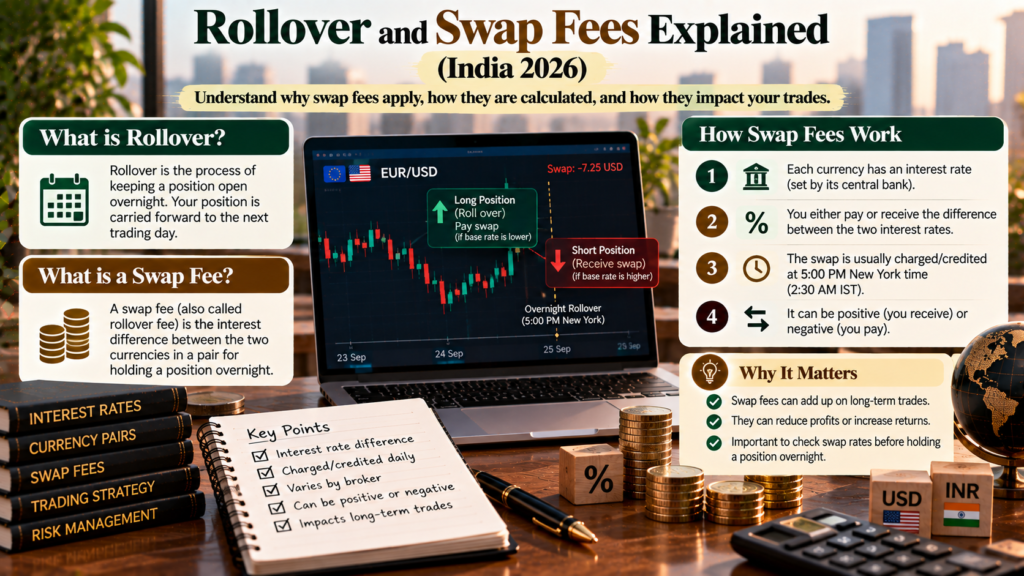
You open a forex trade, hold it overnight, and the next morning your statement shows a small charge (or sometimes a small credit) you didn’t expect. That line item is the swap, also called the rollover fee. With forex swap rollover explained in plain terms, you’ll know exactly where that number comes from and whether it matters for your trading.
Quick answer: A swap (rollover) is the interest adjustment applied when you hold a forex position past the daily cut-off, typically around 5 pm New York time. Every trade means buying one currency and selling another. You earn interest on the currency you buy and pay interest on the one you sell. The difference, minus the broker’s markup, is credited or debited to your account each night. On most platforms, Wednesday’s charge is tripled to cover the weekend.
Why this matters in 2026:
- Central banks moved rates in September 2026. The Fed raised its target range to 3.75%–4.00% on 16 September, the ECB raised its deposit rate to 2.50% (effective 16 September), and the Bank of Japan raised its policy rate to 1.25%. Every change shifts swap rates.
- A swap that looks tiny per night can add up to a meaningful share of your profit on trades held for weeks.
- Indian traders using NSE or BSE currency futures don’t see a nightly swap at all. The same cost is built into the futures price instead. This article explains both.
A note on legality in India: Resident Indians may trade only permitted currency pairs on recognised Indian exchanges through SEBI-registered brokers. Leveraged trading on offshore forex platforms is not permitted, and the RBI publishes an alert list of unauthorised entities. We explain swaps on global platforms here for education, because the concept also explains how Indian futures are priced.
How swap and rollover work
Why swaps exist
In the spot forex market, trades settle two business days later (T+2). A retail trader doesn’t want to deliver actual currency, so each day the broker “rolls” open positions forward to the next settlement date. Rolling over means effectively closing and reopening the position using short-term interest rates. That’s where the interest gap comes in.
- Buy a currency: you are treated as holding it, so you earn its interest rate.
- Sell a currency: you are treated as borrowing it, so you pay its interest rate.
- Net result: the interest rate differential between the two currencies, adjusted by the broker’s markup.
The formula
A simple version, calculated in the quote currency:
Swap per night = Position size × Price × (Rate of currency bought − Rate of currency sold − Broker markup) ÷ 365
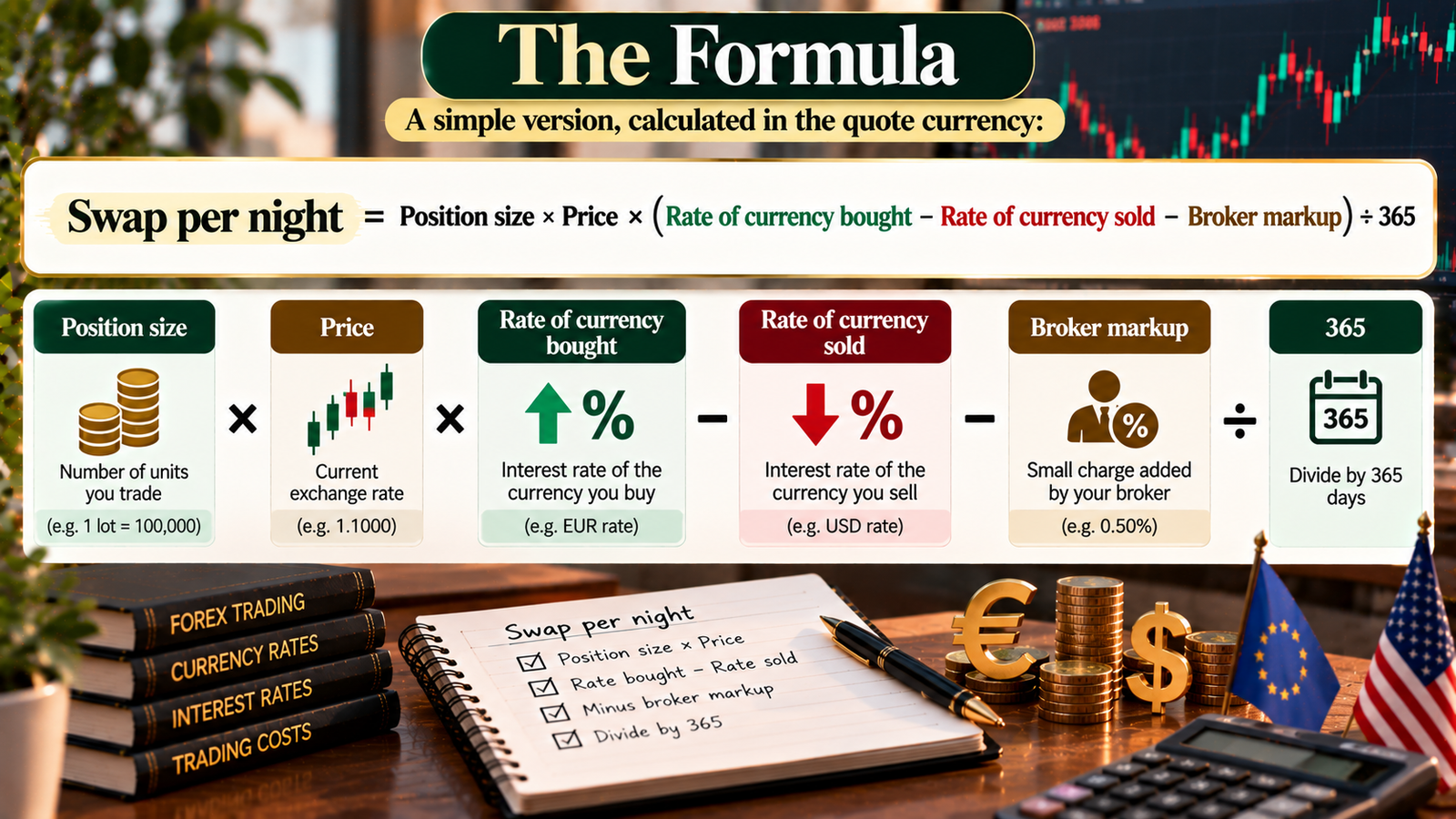
Brokers use short-term market rates rather than exactly the central bank rate, and each broker sets its own markup. Many platforms publish swap figures in points per lot, which you convert into your account currency. Always check your broker’s contract specifications for the real figure.
Worked examples (illustrative)
These use central bank policy rates as a simple stand-in for market rates, an illustrative broker markup of 0.5 percentage points, and one standard lot (100,000 units of the base currency). Prices are round illustrative numbers.
| Trade | Rate gap (bought − sold) | Swap per night after markup | Per 30 days |
|---|---|---|---|
| Buy USD/JPY at 150 (USD 4.00%, JPY 1.25%) | +2.75% | Credit of about ¥925 (≈ $6.16) | About +$185 |
| Sell USD/JPY at 150 | −2.75% | Debit of about ¥1,336 (≈ $8.90) | About −$267 |
| Buy EUR/USD at 1.17 (EUR 2.50%, USD 4.00%) | −1.50% | Debit of about $6.41 | About −$192 |
| Sell EUR/USD at 1.17 | +1.50% | Credit of about $3.21 | About +$96 |
Worked calculation, buy EUR/USD: 100,000 × 1.17 × (2.50% − 4.00% − 0.50%) ÷ 365 = 100,000 × 1.17 × (−2.00%) ÷ 365 ≈ −$6.41 per night.
Notice the asymmetry. Without markup, the long EUR/USD would pay $4.81 and the short would earn $4.81. The markup makes the payer pay more and the earner earn less. Sometimes a small positive gap turns into a charge on both sides.
Triple swap Wednesday
Because spot trades settle T+2, a position held past the Wednesday cut-off settles on the following Monday instead of Friday, which spans the weekend. So most brokers apply three days of swap on Wednesday night and none on Saturday or Sunday. For the long USD/JPY example, that’s roughly $18.49 instead of $6.16. Some brokers apply the triple charge on a different day for certain instruments, and extra days may be added around holidays.
Rollover timing
The daily cut-off is typically 5 pm New York time, which is about 2:30 am IST while the US is on daylight saving time, and about 3:30 am IST in winter. Positions opened and closed before the cut-off pay no swap. Check your platform, because some brokers use their own server time.
The India angle: futures have no nightly swap
If you trade USD/INR, EUR/INR, GBP/INR or JPY/INR futures on NSE or BSE, you won’t see a swap line on your contract note. That’s because exchange-traded futures work differently.
- Daily mark-to-market: your position is settled in cash every day against the exchange’s settlement price. Profits and losses move on T+1, per NSE Clearing.
- Final settlement: at expiry, positions settle in rupees against the RBI reference rate on the last trading day.
- No rolling: there’s no daily rollover, so there’s no nightly interest debit or credit.

Where the interest cost goes instead: the forward premium
The interest gap doesn’t disappear. It’s built into the futures price. Because Indian interest rates are higher than US rates, USD/INR futures usually trade above spot, and further-dated contracts trade higher still. This is called the cost of carry or forward premium.
Illustrative example: spot USD/INR at ₹95.50, an interest gap of 1.25 percentage points, and 30 days to expiry.
Fair futures price ≈ 95.50 × (1 + 1.25% × 30 ÷ 365) ≈ ₹95.60
That’s a premium of about 10 paise, or about ₹98 per lot (one NSE USD/INR lot is $1,000).
| Global spot forex (swap) | NSE/BSE currency futures (carry) | |
|---|---|---|
| How interest is charged | Nightly debit or credit | Built into the futures price |
| When you notice it | Each morning on your statement | When you buy at a premium or discount to spot |
| Triple charge on Wednesday | Yes, on most platforms | No |
| Who sets it | Your broker, including markup | The market (interest rates plus supply and demand) |
| Rolling a position | Automatic each night | You close the expiring contract and open the next month, paying the spread and brokerage |
| Legal for resident Indians | Only through authorised channels; offshore leveraged platforms are not permitted | Yes, on recognised exchanges through SEBI-registered brokers |
Practical point: if you buy USD/INR futures, you pay the premium upfront, and it shrinks toward spot as expiry nears. If the rupee doesn’t move, a long futures position tends to lose that premium slowly and a short position tends to gain it. That is the futures equivalent of a negative or positive swap.
Rule check: under the RBI’s rules for exchange-traded currency derivatives, rupee pairs are meant for users with an underlying exposure to hedge. Check the current requirements with your broker before trading.
How much swap matters: holding period vs cost
Using the illustrative long EUR/USD example (a debit of about $6.41 per night on one standard lot, where one pip is worth $10):
| Holding period | Swap cost | Cost in pips |
|---|---|---|
| 1 night | $6.41 | 0.6 |
| 5 nights | $32.05 | 3.2 |
| 10 nights | $64.10 | 6.4 |
| 30 nights | $192.30 | 19.2 |
| 90 nights | $576.90 | 57.7 |
Takeaway: for an intraday trader, swap is irrelevant. For a swing trader holding a few days, it is a small cost. For a position held for months, it can wipe out a large part of the profit, or become a meaningful income if the swap is positive.
Who is affected by swap?
| Trading style | Typical holding time | Swap impact |
|---|---|---|
| Scalping | Seconds to minutes | None (closed before the cut-off) |
| Day trading | Hours | None, unless held past the cut-off |
| Swing trading | Days to weeks | Small but real; watch Wednesdays |
| Position trading | Weeks to months | Can be a major cost or income |
| Carry trading | Months | Swap is the main source of return |
Swap-free accounts
Some global brokers offer swap-free (sometimes called Islamic) accounts that don’t charge or pay overnight interest. They are usually not free: brokers may widen spreads, charge a fixed admin fee after a set number of days, or limit which instruments you can trade. Compare total cost, not just the swap line.
How to reduce swap costs
- Check the swap table before you trade. Most platforms show the long and short swap for each pair in the contract specifications.
- Close before the cut-off if your strategy doesn’t need an overnight hold.
- Plan around Wednesday. If a trade is marginal, consider whether a triple charge changes the maths.
- Favour the positive-carry side only when your analysis already supports that direction. Never take a trade just for the swap.
- Size smaller for long holds. Swap scales with position size.
- In India, use exchange-traded futures through a SEBI-registered broker, where the carry cost is transparent in the futures price and there’s no broker swap markup.
Expert analysis
Fact: In September 2026, the Fed (to 3.75%–4.00%), the ECB (deposit rate to 2.50%) and the Bank of Japan (to 1.25%) all raised rates. Swap rates change whenever the underlying short-term rates change.
Analysis: Because all three moved at once, the gaps between them changed less than the headlines suggest. The USD–JPY gap is still wide, so swaps on USD/JPY remain meaningful in both directions. Changes in expected rates can shift swap tables quickly, and brokers update them without notice.
Opinion: For a beginner, swap is rarely the reason a trade wins or loses. It becomes important once you hold positions for weeks. Treat it as part of your trading costs alongside spread and commission, and include it in your record-keeping.
Common mistakes
- Ignoring swap on long holds. A month of negative swap can equal 15–20 pips or more on a single lot.
- Forgetting triple Wednesday. Traders who hold swing trades through Wednesday see a bigger charge and think it’s an error.
- Assuming a positive gap means a positive swap. Broker markup can make both sides negative.
- Taking trades just to earn carry. Carry trades can unwind sharply when risk sentiment turns, and one bad day can erase months of swap income.
- Treating a swap-free account as costless. Wider spreads or admin fees often replace the swap.
- Misreading the futures premium. In USD/INR futures, the premium is a cost of carry, not a prediction that the rupee will weaken.
- Using offshore apps to access swap-positive trades. For resident Indians, leveraged forex trading on unauthorised offshore platforms is not permitted.
Myths vs facts
| Myth | Fact |
|---|---|
| “Swap is a hidden fee the broker invents.” | It is based on the interest rate gap between the two currencies. The broker adds a markup on top. |
| “Swap is always a cost.” | It can be a credit if you buy the higher-yielding currency and the gap exceeds the markup. |
| “Triple swap Wednesday is a penalty.” | It covers weekend days caused by T+2 settlement. You don’t pay swap on Saturday or Sunday. |
| “NSE currency futures have no holding cost.” | There’s no nightly swap, but the interest gap is priced into the futures premium. |
| “Swap-free accounts are free to hold.” | Brokers usually recover the cost through spreads or fees. |
Key takeaways
- Swap (rollover) is the nightly interest adjustment for holding a forex position past the daily cut-off.
- You earn the rate of the currency you buy and pay the rate of the currency you sell, minus the broker’s markup.
- Swap = position size × price × (rate bought − rate sold − markup) ÷ 365.
- Wednesday usually carries three days of swap because of T+2 settlement.
- Swap matters little for intraday trades but can be large for positions held for weeks or months.
- NSE and BSE currency futures have no nightly swap; the carry is built into the futures price.
- Indian residents should trade only permitted pairs on recognised exchanges via SEBI-registered brokers.
FAQs
- What is swap in forex? Swap is the interest adjustment credited or debited when you hold a forex position past the daily cut-off. It reflects the interest rate difference between the two currencies in the pair.
- Are rollover and swap the same thing? Yes, for retail traders the terms are used interchangeably. “Rollover” describes moving the position to the next settlement date; “swap” is the resulting charge or credit.
- How is forex swap calculated? A simple formula is: position size × price × (rate of currency bought − rate of currency sold − broker markup) ÷ 365. Brokers usually publish the result as points per lot.
- What time is rollover charged? Typically around 5 pm New York time, which is about 2:30 am IST during US daylight saving time and 3:30 am IST otherwise. Check your broker’s server time.
- Why is swap tripled on Wednesday? Spot trades settle two business days later. A position rolled on Wednesday settles on Monday, spanning the weekend, so three days of interest are applied.
- Can swap be positive? Yes. If you buy the higher-interest currency and the rate gap exceeds the broker’s markup, you receive a credit each night.
- Why are both long and short swaps negative on some pairs? When the interest gap is small, the broker’s markup can outweigh it, so both directions pay.
- Do I pay swap on intraday trades? No. If you open and close a trade before the daily cut-off, no swap applies.
- Do NSE USD/INR futures have swap charges? No. They are marked to market daily and have no nightly swap. The interest gap is built into the futures price as a premium over spot.
- What is cost of carry in currency futures? It is the difference between the futures price and spot, which mainly reflects the interest rate gap between the two currencies over the time to expiry.
- Why do USD/INR futures trade above spot? Because Indian interest rates are higher than US rates. The premium compensates for that gap and is not a forecast of the rupee.
- What is a swap-free account? An account on some global platforms that doesn’t charge or pay overnight interest. Brokers usually recover the cost through wider spreads or fixed fees.
- How do central bank rate changes affect swaps? Swaps are based on short-term interest rates, so when a central bank raises or cuts rates, swap rates on its currency’s pairs change soon after.
- What is a carry trade? Buying a high-interest currency against a low-interest one to earn positive swap. It can lose money quickly if the exchange rate moves against you.
- Where can I find my broker’s swap rates? In the platform’s contract specifications or symbol information window, and often on the broker’s website.
- Is trading forex with swap legal in India? Resident Indians may trade only permitted currency pairs on recognised Indian exchanges through SEBI-registered brokers. Leveraged trading on offshore platforms is not permitted.
- Should beginners worry about swap? Only if you hold trades overnight regularly. Include it in your cost calculations for any trade you expect to hold for more than a few days.