
Introduction
Most beginners think trading is about acting: spotting a move and jumping in. In practice, a large part of a trader’s job is not acting. You wait for the right setup, wait for the trade to reach its target, and wait months or years for your skill to develop. That’s why patience in trading is one of the most underrated edges a beginner can build.
Quick answer: Patience in trading means taking only the trades your plan allows, letting those trades reach your planned exit instead of grabbing small profits early, and giving your skills time to develop. It improves profitability by cutting the number of low-quality trades (and their costs) and by keeping your average win large enough to cover your losses. Patience doesn’t make a losing strategy work, but impatience can ruin a good one.
Why this matters in India
- Fact: SEBI’s study of the equity cash segment found that 71% of individual intraday traders made a net loss in FY23. Among very frequent traders (more than 500 trades a year), the share of loss-makers rose to 80%.
- Fact: In the same study, loss-makers spent an extra 57% of their trading losses on trading costs, while profit-makers spent 19% of their profits on costs.
- Fact: In equity F&O, over 91% of individual traders made net losses in FY25, per SEBI.
- Analysis: SEBI’s data shows the link between very frequent trading and losses, but doesn’t prove that frequency caused the losses. Still, trading less, and only on planned setups, directly cuts the cost burden that the study highlights.
This guide covers the three kinds of patience traders need, what research says, worked examples in rupees, and practical ways to build patience.
The three kinds of patience in trading
| Type of patience | What it means | What impatience looks like |
|---|---|---|
| 1. Patience before the trade | Waiting until your exact setup appears | Entering on “almost” setups, boredom trades, chasing moves |
| 2. Patience during the trade | Letting the trade reach your planned stop or target | Booking small profits early; moving the target closer; closing on noise |
| 3. Patience with the process | Giving your skill and your account time to grow | Switching strategies every week; increasing size to “catch up” |
1. Patience before the trade: waiting for setups
Markets offer thousands of price moves every day, but your strategy only has an edge in a few specific situations. Every trade outside those situations is closer to a coin flip, and still costs brokerage, taxes and spread.
Fact: Barber and Odean studied 66,465 US households from 1991 to 1996. Those who traded most earned 11.4% a year, while the market returned 17.9%.
Fact: SEBI found that loss-makers among intraday traders rose to 80% for those making more than 500 trades a year, compared with 71% across all intraday traders.
2. Patience during the trade: letting winners run
Many beginners hold losing trades hoping they’ll recover, but close winning trades quickly to “lock in” profit. Researchers call this the disposition effect.
Fact: Odean (1998) studied 10,000 accounts at a US discount broker from 1987 to 1993. Investors realised gains much more readily than losses: outside December, about 14.8% of available gains were realised, compared with 9.8% of available losses. The winners they sold went on to beat the losers they kept by 3.4 percentage points over the following year.
Analysis: these studies are of stock investors, not short-term traders, but the same instinct shows up in trading: small wins and large losses. That pattern makes a strategy unprofitable even if it wins often.
3. Patience with the process
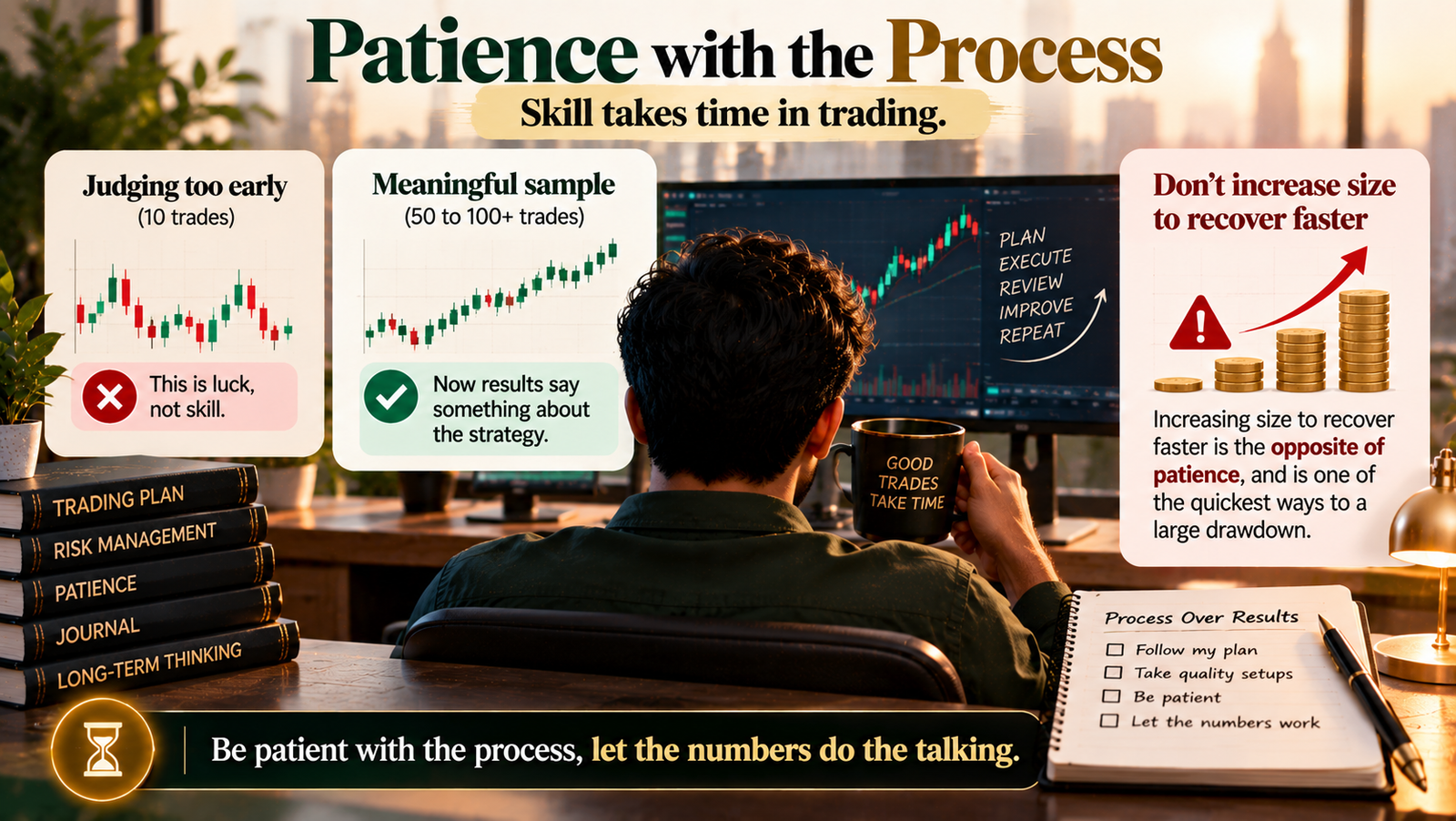
Skill takes time. A beginner who judges a strategy after 10 trades is judging luck, not skill. You need a meaningful sample, often 50 to 100 trades or more, before results say much about the strategy. Increasing size to recover faster is the opposite of patience, and is one of the quickest ways to a large drawdown.
What impatience costs: worked examples
All numbers below are illustrative, chosen to show the maths. They are not typical results.
Example 1: fewer, better trades
Two traders over one month, each paying an assumed ₹150 per round trip in brokerage, taxes and other charges.
| Trader A (impatient) | Trader B (patient) | |
|---|---|---|
| Trades taken | 60 (every move that looks interesting) | 16 (only planned setups) |
| Win rate | 45% (27 wins) | 50% (8 wins) |
| Average win | ₹1,000 (exits early) | ₹2,000 (holds to target) |
| Average loss | ₹1,000 | ₹1,000 |
| Gross result | −₹6,000 | +₹8,000 |
| Costs | ₹9,000 | ₹2,400 |
| Net result | −₹15,000 | +₹5,600 |
Trader A’s costs alone are larger than the gross loss. Trader B wins only slightly more often, but the larger average win and far lower costs make the difference.
Example 2: cutting winners early
You risk ₹1,000 per trade (1R) with a planned target of ₹2,000 (2R), and your setup wins 40% of the time.
| Behaviour | Expected result per trade (before costs) |
|---|---|
| Hold to the 2R target, win rate 40% | 0.40 × ₹2,000 − 0.60 × ₹1,000 = +₹200 |
| Exit at 1R, win rate still 40% | 0.40 × ₹1,000 − 0.60 × ₹1,000 = −₹200 |
| Exit at 1R, win rate rises to 50% | 0.50 × ₹1,000 − 0.50 × ₹1,000 = ₹0 (a loss after costs) |
Even if early exits raise your win rate, you may still end up worse off.
Break-even win rate by reward-to-risk
| Reward-to-risk | Win rate needed to break even (before costs) |
|---|---|
| 1 : 1 | 50.0% |
| 1.5 : 1 | 40.0% |
| 2 : 1 | 33.3% |
| 3 : 1 | 25.0% |
Formula: break-even win rate = 1 ÷ (1 + reward-to-risk). The more patiently you let winners reach target, the lower the win rate you need.
How to build patience
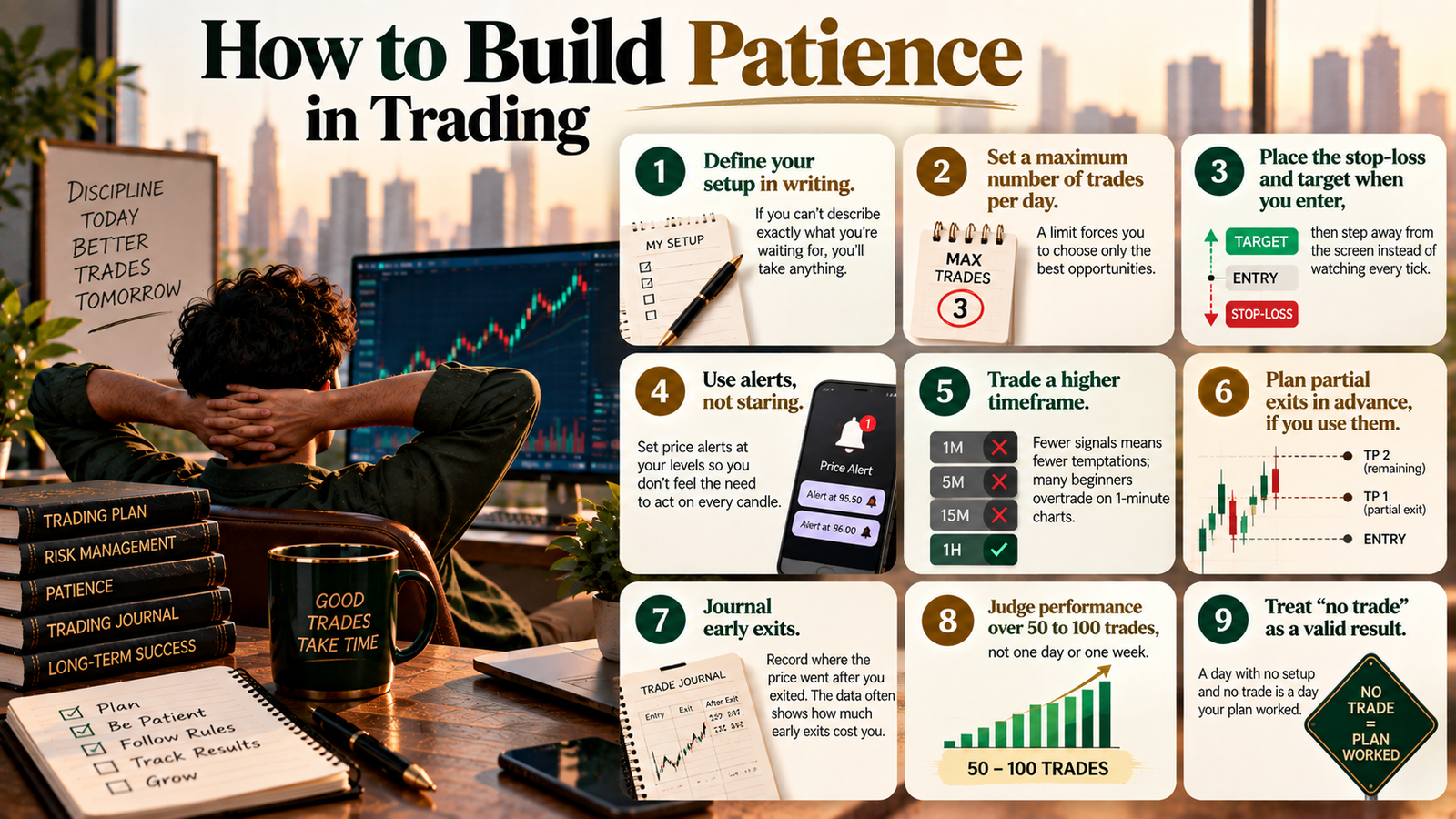
- Define your setup in writing. If you can’t describe exactly what you’re waiting for, you’ll take anything.
- Set a maximum number of trades per day. A limit forces you to choose only the best opportunities.
- Place the stop-loss and target when you enter, then step away from the screen instead of watching every tick.
- Use alerts, not staring. Set price alerts at your levels so you don’t feel the need to act on every candle.
- Trade a higher timeframe. Fewer signals means fewer temptations; many beginners overtrade on 1-minute charts.
- Plan partial exits in advance, if you use them. A pre-planned partial exit is a rule; a panicked one isn’t.
- Journal early exits. Record where the price went after you exited. The data often shows how much early exits cost you.
- Judge performance over 50 to 100 trades, not one day or one week.
- Treat “no trade” as a valid result. A day with no setup and no trade is a day your plan worked.
Learn more about Discipline vs Motivation in Trading
Expert analysis
Fact: SEBI data shows high loss rates among Indian intraday and F&O traders, with loss rates higher among the most frequent intraday traders. Research on individual investors links heavy trading to lower returns and shows a tendency to sell winners too early.
Analysis: Patience improves results through two channels you can measure: it lowers costs by cutting low-quality trades, and it raises your average win relative to your average loss. Both show up directly in expectancy. Neither helps if the underlying strategy has no edge, which is why patience must be paired with testing and journaling.
Opinion: The most useful kind of patience for a beginner is the ability to sit out. Waiting on the sidelines doesn’t feel like progress, but for most new traders a day without a trade is cheaper, and more educational, than a day of forced trades. Patience is not the same as passivity, though: once your setup appears, act on it without hesitation.
Common mistakes
- Confusing activity with progress. More trades don’t mean more learning if the trades aren’t planned.
- Booking profits early out of fear. This shrinks your average win and quietly breaks your risk-reward maths.
- Holding losers “patiently”. Patience applies to planned trades; refusing to take a stop-loss is hope, not patience.
- Entering before the setup is complete. Buying before a candle closes or before a level is confirmed is a common form of impatience.
- Watching every tick. Constant monitoring invites impulsive exits.
- Judging a strategy on a handful of trades. Small samples are mostly noise.
- Increasing size to recover losses faster. This turns a normal drawdown into a large one.
- Waiting forever. Over-filtering until you never trade is also a problem. Patience means waiting for your defined setup, not for certainty.
Myths vs facts
| Myth | Fact |
|---|---|
| “Good traders are always in the market.” | Many consistent traders spend much of their time waiting for specific setups. |
| “Patience means holding losing trades until they recover.” | Patience applies to following your plan. Losing trades should exit at the planned stop. |
| “Booking small profits is the safe option.” | If your wins are too small compared with your losses, you can lose money even with a high win rate. |
| “More trades means more chances to profit.” | Every trade has costs. SEBI found loss-makers spent an extra 57% of their losses on trading costs. |
| “Patient traders get rich slowly, impatient ones get rich fast.” | SEBI’s data shows most active individual traders lose money. Speed tends to magnify losses, not profits. |
| “Patience is a personality trait.” | It can be built with rules such as trade limits, alerts and pre-set exits. |
Key takeaways
- Patience in trading has three parts: waiting for setups, letting trades reach their planned exit, and giving your skill time to develop.
- Very frequent trading is linked to higher loss rates in SEBI’s intraday data, and to lower returns in research on individual investors.
- Exiting winners early can turn a profitable strategy into a losing one, even if your win rate rises.
- Break-even win rate = 1 ÷ (1 + reward-to-risk); the larger your average win, the lower the win rate you need.
- Build patience with written setups, trade limits, pre-set stops and targets, alerts and a journal.
- Patience never means holding a loser past your stop-loss.
FAQs
- Why is patience important in trading? Patience cuts low-quality trades and their costs, and lets winning trades reach their targets. Both improve your expected result per trade.
- What does patience in trading actually mean? Waiting for your defined setup, letting trades reach your planned stop or target, and giving your skill time to develop.
- How can I be more patient in trading? Write down your exact setup, cap your trades per day, set stops and targets at entry, use price alerts instead of watching every tick, and journal your early exits.
- Why do I exit winning trades too early? Fear of giving back profit is common. Research on investors calls the tendency to sell winners quickly and hold losers the disposition effect.
- Is patience important in intraday trading? Yes. SEBI found that 71% of individual intraday traders lost money in FY23, and 80% of those making more than 500 trades a year did.
- Does trading more often make you more money? Not necessarily. In one well-known US study, households that traded most earned 11.4% a year against the market’s 17.9%. Costs and poor trade selection often outweigh extra opportunities.
- What is the disposition effect? The tendency to sell investments that have gained value too soon while holding onto those that have lost value for too long.
- Is holding a losing trade a form of patience? No. Patience means following your plan. If price hits your stop-loss, exit. Holding a loser in hope is a different mistake.
- How many trades a day should a beginner take? There’s no universal number, but a small fixed limit, set in your plan, helps you focus on quality setups.
- How does patience affect risk-reward? Letting winners reach target keeps your average win large relative to your average loss, which lowers the win rate you need to break even.
- What win rate do I need with a 2:1 reward-to-risk? About 33.3% to break even before costs, using the formula 1 ÷ (1 + reward-to-risk).
- How do I stop boredom trading? Set a maximum trade count, trade a higher timeframe, use alerts, and treat a day with no setup as a successful day.
- How long before I know if my strategy works? You generally need a sample of at least 50 to 100 trades, taken consistently, before results are meaningful.
- Can you be too patient in trading? Yes. If you wait for a perfect setup that never comes, or hesitate when your valid setup appears, you miss trades your plan says to take.
- Should I watch the chart after entering a trade? Not constantly. Set your stop and target, then use alerts. Constant watching encourages impulsive exits.
- Does patience guarantee profits? No. Patience improves execution, but profitability also depends on a strategy with a genuine edge and sound risk management.
- What is the link between patience and discipline? Discipline is following your rules; patience is the part of discipline that involves waiting: for the setup, for the exit and for results.