Introduction
Most new traders start the week fired up. They’ve watched the videos, set up the charts and promised themselves they’ll follow the plan. By Thursday, after two losses and a missed move, the plan is gone and they are revenge trading on a 1-minute chart. The problem isn’t a lack of motivation. It’s a lack of trading discipline, and the two are not the same thing.
Quick answer: Motivation is a feeling that makes you want to act. Discipline is a system that makes you act the same way whether or not you feel like it. Motivation rises and falls with wins, losses and mood, so it can’t keep you consistent. Discipline comes from written rules, pre-trade checklists, if-then plans, fixed risk limits and a journal. Build those, and consistency follows even on days you don’t feel motivated.
Why this matters for Indian traders
- Fact: SEBI‘s study of equity F&O found that over 91% of individual traders made net losses in FY25. Their aggregate net loss was ₹1,05,603 crore, up 41% from ₹74,812 crore in FY24.
- Fact: Earlier SEBI research found that 93% of individual F&O traders lost money between FY22 and FY24, with aggregate losses above ₹1.8 lakh crore over three years.
- Analysis: SEBI’s data doesn’t break losses down by cause, so we can’t say how much was due to indiscipline. But common patterns such as oversized positions, trading without a plan and chasing losses are exactly what a disciplined process is designed to prevent.
This guide explains the difference between discipline and motivation, what research says about building consistent behaviour, and a practical system you can start using today.
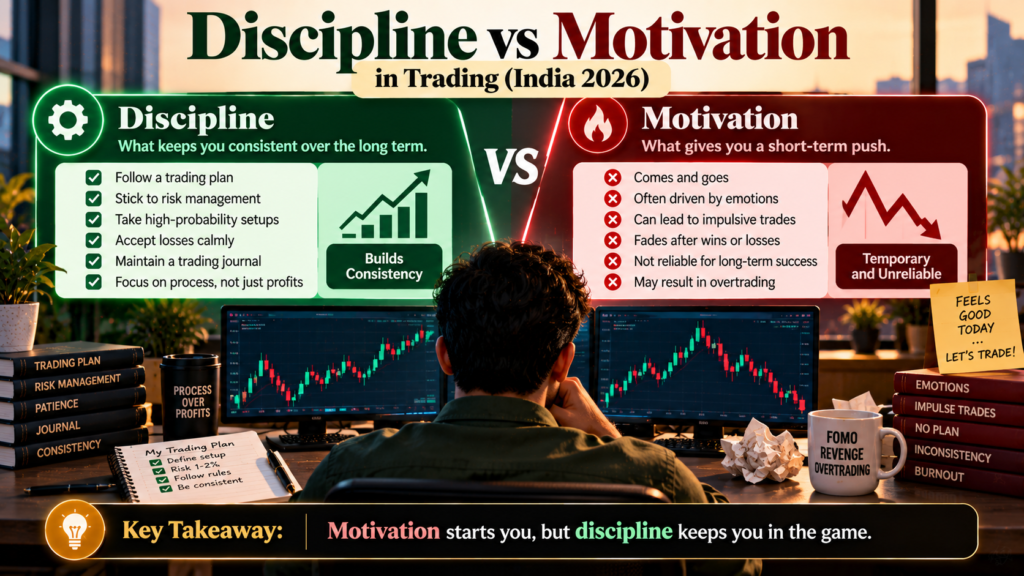
Discipline vs motivation: the real difference
| Motivation | Discipline | |
|---|---|---|
| What it is | A feeling or desire to act | A repeatable process you follow |
| Where it comes from | Wins, videos, social media, goals | Written rules, routines, limits, reviews |
| How long it lasts | Hours or days; drops after losses | As long as the system is in place |
| Effect after a loss | Often turns into frustration or revenge trading | Next trade follows the same rules |
| Effect after a win | Often turns into overconfidence and bigger size | Same size, same checklist |
| What it builds | Bursts of activity | Consistent behaviour and usable data |
The core idea: motivation gets you to open the trading platform. Discipline decides what you do once it’s open. Relying on motivation means your behaviour depends on your mood, and in trading your mood is constantly being pushed around by P&L.
What research says about consistency
None of these studies was done on traders, so treat them as general evidence about behaviour, not trading-specific proof.
1. If-then plans work better than good intentions
Fact: A 2006 meta-analysis by Gollwitzer and Sheeran covering 94 independent tests and 8,461 participants found that implementation intentions, plans in the form “If situation X happens, then I will do Y”, had a medium-to-large effect on reaching goals (d = 0.65).
Trading application: “If I lose two trades in a row today, then I close the platform and write in my journal” is far more reliable than “I’ll try not to revenge trade.”
2. Habits take time, and one slip doesn’t ruin them
Fact: Lally and colleagues (2010) followed 96 volunteers building a new daily habit. Among those whose data could be modelled, the median time to reach near-peak automaticity was 66 days, with a range of 18 to 254 days. Missing a single day did not materially set people back.
Trading application: expect your pre-trade routine to feel forced for weeks. Breaking a rule once isn’t failure; abandoning the system is.
3. Don’t count on willpower as a fuel tank
Fact: The popular “ego depletion” idea says self-control gets used up like fuel. A large replication across 23 labs and 2,141 participants (Hagger and colleagues, 2016) found an effect close to zero (d = 0.04).
Analysis: whatever the exact science, the practical lesson is the same: don’t design a trading routine that depends on heroic self-control in the moment. Decide in advance, when calm, and reduce the number of decisions you make while the market is moving.
4. More trading usually means worse results
Fact: In a study of 66,465 US households at a discount broker from 1991 to 1996, Barber and Odean found that those who traded most earned 11.4% a year, while the market returned 17.9%. They pointed to overconfidence as a likely cause.
Trading application: discipline often means doing less: fewer, planned trades instead of many impulsive ones.
How to build trading discipline: a 6-part system
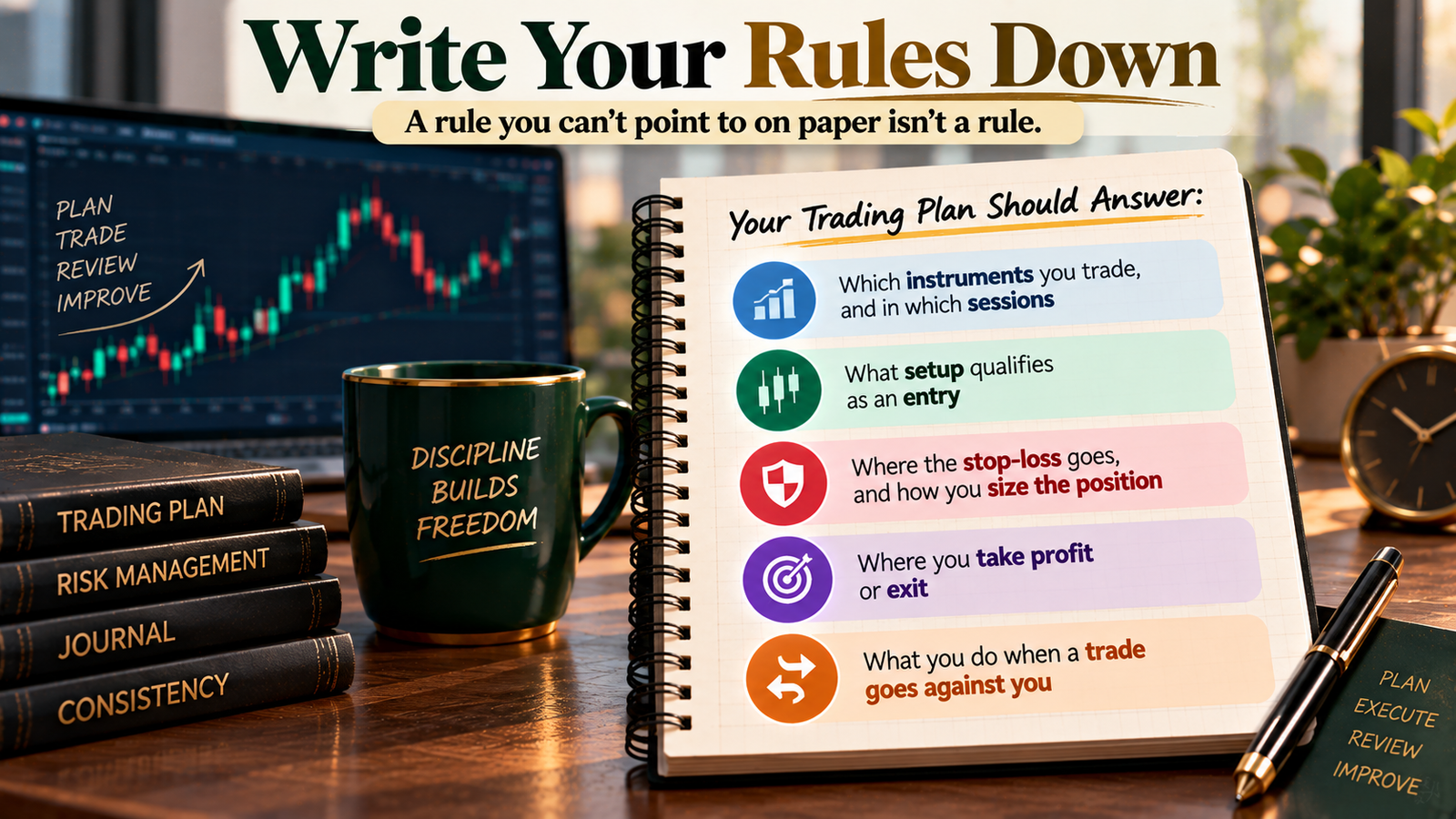
1. Write your rules down
A rule you can’t point to on paper isn’t a rule. Your written trading plan should answer:
- Which instruments you trade, and in which sessions
- What setup qualifies as an entry
- Where the stop-loss goes, and how you size the position
- Where you take profit or exit
- What you do when a trade goes against you
2. Fix your risk limits before the market opens
Worked example (illustrative): capital of ₹2,00,000.
| Limit | Rule | Amount |
|---|---|---|
| Risk per trade | 1% of capital | ₹2,000 |
| Daily loss limit | 2% of capital | ₹4,000 (two full losses, then stop) |
| Weekly loss limit | 4% of capital | ₹8,000 |
| Maximum trades per day | Fixed number | 3 |
These numbers aren’t a recommendation for your situation; they show how limits turn vague intentions into clear stopping points.
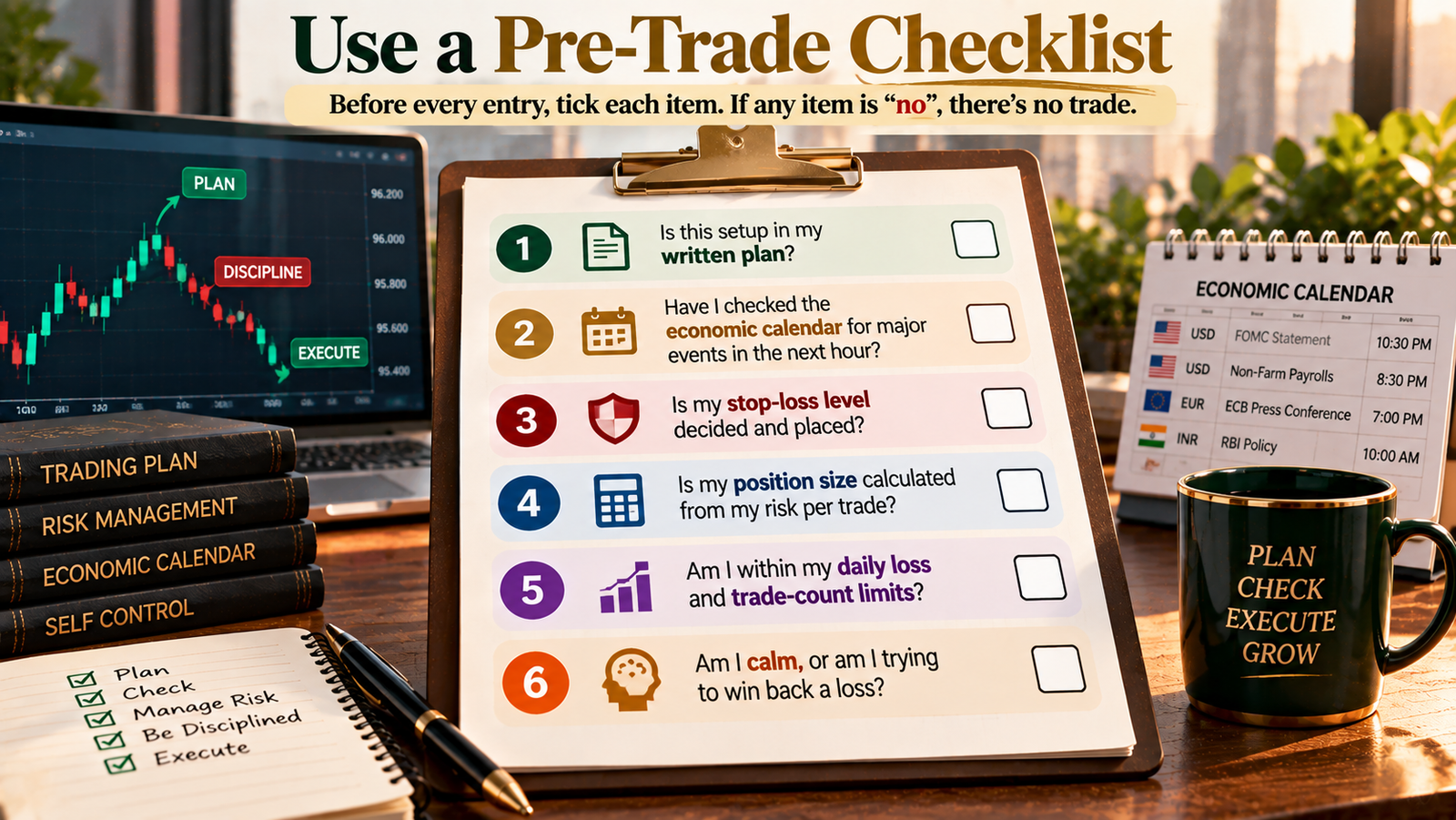
3. Use a pre-trade checklist
Before every entry, tick each item. If any item is “no”, there’s no trade.
- Is this setup in my written plan?
- Have I checked the economic calendar for major events in the next hour?
- Is my stop-loss level decided and placed?
- Is my position size calculated from my risk per trade?
- Am I within my daily loss and trade-count limits?
- Am I calm, or am I trying to win back a loss?
4. Turn weak spots into if-then plans
| If this happens… | …then I will |
|---|---|
| I hit my daily loss limit | Close the platform and write in my journal |
| I miss a big move | Write down what I saw; I won’t enter late |
| I win three trades in a row | Keep the same position size |
| I feel the urge to move my stop-loss | Leave it; exit only by plan |
| A major data release is due in 15 minutes | Stay flat until after the release |
5. Keep a trading journal
Record each trade: date, instrument, setup, entry, stop, exit, result in ₹, whether you followed your rules, and how you felt. Over time the journal shows whether losses come from the strategy or from breaking rules.
6. Measure discipline, not just profit
Track a rule-adherence score: trades that followed every rule ÷ total trades.
Example (illustrative): 20 trades in a month, 17 fully followed the plan. Adherence = 17 ÷ 20 = 85%. If the three rule-breaking trades caused most of the month’s losses, you know exactly what to fix.
On a day with a small loss but 100% adherence, you did your job. On a day with a big win but broken rules, you got lucky. Judge yourself on the process, because that’s what you control.
Learn more about Supply and Demand Zones
A sample weekly routine
| When | What |
|---|---|
| Sunday evening | Review last week’s journal and adherence score; mark event days on the calendar |
| Each morning | Read your rules; set daily limits; note key levels |
| During the session | Checklist before every trade; follow if-then plans |
| After the session | Journal every trade within 30 minutes |
| Month-end | Compare results on rule-following vs rule-breaking trades |
Expert analysis
Fact: Over 91% of individual equity F&O traders in India made net losses in FY25, per SEBI. Research outside trading shows that if-then plans reliably improve follow-through, habits take weeks to months to form, and heavy trading has historically been linked to lower returns.
Analysis: Discipline cannot make a losing strategy profitable. What it does is make your results measurable. If you follow the same rules every time, your journal tells you whether the strategy works. If you trade differently every day, you can’t tell a bad strategy from bad execution.
Opinion: For beginners, the most valuable discipline rules are the boring ones: small fixed risk per trade, a hard daily loss limit and a maximum number of trades. They won’t make you rich, but they keep you in the game long enough to learn. Motivation is still useful for starting to learn and for sticking with your review routine; just don’t rely on it to control your behaviour mid-session.
Common mistakes
- Waiting to “feel ready” before following the plan. Discipline means following it anyway.
- Keeping the rules in your head. Unwritten rules bend under pressure.
- Changing the strategy after every loss. You never collect enough data to judge it.
- Increasing size after wins. Overconfidence is as dangerous as fear.
- Judging each day by P&L alone. Score yourself on rule adherence too.
- Setting too many rules. A 30-point checklist gets skipped. Keep it to what actually matters.
- Quitting the system after one slip. Research on habits suggests a single miss doesn’t undo progress. Restart the next session.
- Consuming more motivational content instead of reviewing your journal. Inspiration feels productive; review is what improves results.
Myths vs facts
| Myth | Fact |
|---|---|
| “Successful traders are just more motivated.” | Consistent traders usually rely on systems, routines and limits rather than daily motivation. |
| “Discipline is a personality trait you either have or don’t.” | It can be built with written rules, checklists and if-then plans. |
| “Willpower is a tank that runs out by afternoon.” | A large 2016 multilab replication found almost no ego-depletion effect. Design your process so it doesn’t depend on willpower. |
| “It takes 21 days to build a habit.” | In Lally’s study the median was 66 days, and the range was 18 to 254 days. |
| “A disciplined trader never loses.” | Disciplined traders lose often. The difference is that the losses are small and planned. |
| “Trading more means learning faster.” | More trades without rules just repeat the same mistakes. Heavy trading has been linked to lower returns. |
Key takeaways
- Motivation is a feeling; discipline is a system. Only the system survives losing streaks.
- Write your rules down, fix risk limits before the session, and use a pre-trade checklist.
- Turn your usual mistakes into “if X, then Y” plans; research shows these improve follow-through.
- Expect habits to take weeks or months, and don’t quit after one slip.
- Keep a journal and track your rule-adherence score, not just your P&L.
- In India, trade only through SEBI-registered brokers on recognised exchanges, and remember that most individual F&O traders lose money.
FAQs
- What is trading discipline? Trading discipline is following your written trading plan (entries, exits, position size and risk limits) consistently, regardless of how you feel on a given day.
- Is discipline more important than motivation in trading? For consistency, yes. Motivation fluctuates with wins, losses and mood, while discipline relies on rules and routines that stay the same.
- Why do I break my trading rules even when I know them? Usually because decisions are made in the moment under emotional pressure, such as after a loss or a missed move. Deciding in advance with written rules and if-then plans reduces those in-the-moment choices.
- How can I become a more disciplined trader? Write your rules down, set risk and loss limits before the session, use a pre-trade checklist, create if-then plans for your weak spots, and keep a journal.
- How long does it take to build trading discipline? There’s no fixed number. In a general habit study, the median time to automaticity was 66 days, with a range of 18 to 254 days. Expect weeks to months.
- What should a trading plan include? Instruments and sessions, entry setup, stop-loss placement, position sizing, exit rules, daily and weekly loss limits, and a maximum number of trades.
- What is a daily loss limit? A fixed amount, often a percentage of capital, after which you stop trading for the day. It prevents one bad day from causing major damage.
- What is an if-then plan in trading? A pre-decided response to a specific situation, for example: “If I hit my daily loss limit, then I close the platform.” Research shows such plans improve goal achievement.
- How does a trading journal help discipline? It records whether you followed your rules on each trade, so you can separate strategy problems from execution problems.
- What is a rule-adherence score? The percentage of your trades that followed every rule in your plan. It measures discipline independently of profit.
- Can discipline make a bad strategy profitable? No. Discipline makes results consistent and measurable, so you can find out whether the strategy works and improve it.
- How do I stop revenge trading? Set a daily loss limit and a rule to stop after a fixed number of losses. Write an if-then plan that closes the platform when the limit is hit.
- Should I stop trading when I’m not motivated? Not necessarily. If you’re following your rules and within your limits, motivation isn’t required. Do stop if you’re tired, distracted or emotionally upset, since your checklist should include a state-of-mind check.
- Does watching motivational videos help traders? They can spark interest, but they don’t change in-session behaviour. Time spent reviewing your journal usually does more.
- What percentage of Indian F&O traders lose money? SEBI found that over 91% of individual equity F&O traders made net losses in FY25.
- Is it OK to break a rule once? It happens. Note it in your journal, understand why, and return to the plan the next session. One slip doesn’t undo the habit.
- How many rules should a beginner have? Few enough to follow every time: typically risk per trade, a stop-loss on every trade, a daily loss limit, a maximum trade count and a defined setup.