

Quick answer
To pass a prop firm challenge, treat it as a risk-management test, not a profit test. Read every rule first, risk a tiny amount per trade (often 0.25-1%) so you survive losing streaks, respect the daily and overall loss limits, don’t rush the modest profit target, and trade only your tested strategy.
Introduction
Most traders approach a prop firm challenge the wrong way – as a race to hit the profit target – and most of them fail. The traders who actually get funded understand something counterintuitive: the challenge isn’t really testing whether you can make money. It’s testing whether you can avoid losing it. Learning how to pass a prop firm challenge is far less about clever trades and far more about disciplined risk control.
This guide lays out the real method: the rules you must read first, the maths that keeps you alive, and the discipline that separates the small minority who pass from the majority who don’t. This is educational content, not financial advice – and a reminder that prop participation for Indian residents sits in a legal grey area, so read our separate compliance guides too.
The #1 Reason People Fail: They Don’t Read the Rules
Before any strategy, this: the single most common way to fail a challenge is to breach a rule you didn’t know existed. Traders blow past a daily loss limit, violate a consistency rule, or forget a minimum-trading-day requirement – not because they were bad at trading, but because they never read the fine print. Every prop firm’s rulebook is different. Read yours completely, twice, before you place a single trade. Passing starts with knowing exactly what will fail you.

Know the Key Rules
Challenges vary, but most revolve around the same handful of rules (confirm your firm’s exact numbers):
| Rule | Typical value | Why it matters |
|---|---|---|
| Profit target | ~8-10% (phase 1), ~5% (phase 2) | The goal – but modest and not the hard part |
| Max daily loss | ~5% of account | Breach it and you fail instantly |
| Max overall loss | ~10% of account | Breach it and you fail instantly |
| Minimum trading days | Often 0-5 days | Sometimes you can’t pass in a single day |
| Consistency rule | e.g. no day > 25-40% of total profit | Stops one lucky day from carrying you |
| Time limit | Often none now, or ~30 days | Removes or adds pressure – know which |
Notice the asymmetry: the profit target is modest, but the loss limits are unforgiving. That’s the whole game.
The Mindset Shift: It’s a Risk Test, Not a Profit Test
Internalise this and everything else follows. A prop firm doesn’t hand out funded accounts to gamblers who hit a target by luck – it wants traders who won’t blow up its capital. So the evaluation is engineered around loss limits: a 10% target sitting behind a 5% daily and 10% overall drawdown. A disciplined trader can reach a 10% target slowly with tiny risk; a reckless one hits the drawdown long before the target. Stop thinking ‘how do I make 10%?’ and start thinking ‘how do I make 10% without ever risking the drawdown?’ That reframing is the answer to how to pass a prop firm challenge.
Rule 1: Risk Tiny Amounts Per Trade
This is the most important lever you control. The smaller your risk per trade, the more losing trades you can survive within the loss limits. The maths is stark:
Max daily loss = 5% of the account
Risk 2% per trade -> ~2-3 losers in a row and your day is over
Risk 0.5% per trade -> ~10 losers in a row before the daily limit
Risk 0.25% per trade -> ~20 losers before the daily limit
Small risk = survival. Survival = time to reach the target.
Most traders who pass risk somewhere around 0.25% to 1% per trade. It feels slow – and that’s exactly the point. You’re not trying to win fast; you’re trying to not lose.
Rule 2: Respect the Daily Loss Limit – Stop for the Day
The daily loss limit fails more challenges than anything else, usually because a losing trader keeps trading to ‘get it back’ and spirals into the limit. Set your own personal daily stop well inside the firm’s limit – say, if the max daily loss is 5%, you stop trading for the day at 2-3%. When you hit it, close the platform. Walk away. Tomorrow is a fresh day. This one habit – refusing to revenge trade after a bad start – saves more challenges than any strategy. (Our revenge-trading guide goes deeper.)
Rule 3: Don’t Rush the Profit Target
Because the target is modest and the loss limits are tight, speed is your enemy. Trying to hit 10% in two days forces oversized positions that trip the drawdown. Instead, aim for small, steady gains – even 0.5-1% on a good day compounds toward the target over a couple of weeks, comfortably within any time limit. Slow is smooth, and smooth passes challenges. Treat the challenge as a marathon you finish, not a sprint you might not survive.
Rule 4: Mind the Consistency Rule
Many firms (FundedNext among them) enforce a consistency rule: no single day can account for more than a set share of your total profit. This exists to stop a trader passing on one lucky, oversized day. The practical effect is that you must spread your profits across several days rather than making it all at once – which, conveniently, is exactly what small, steady, well-sized trading produces anyway. If your firm has a consistency rule, read the exact percentage and plan your days around it, or a winning challenge can be disqualified at the finish line.
Rule 5: Trade Only Your Tested Strategy
A challenge is not the place to experiment. Trade only a strategy you’ve already tested and are consistent with – ideally one you’ve backtested and traded on a demo through varied conditions. The pressure of a paid evaluation is precisely when traders abandon their edge, chase setups, and improvise their way into the drawdown. If you don’t yet have a tested, rule-based strategy, you’re not ready for a challenge; build and prove one first. Consistency beats brilliance here every time.
Rule 6: Manage the Psychology
The fee you paid creates real pressure, and pressure wrecks discipline. You’ll feel the urge to trade bigger to speed up, to chase after a loss, to force a setup on a quiet day. Recognise these as the exact impulses that fail challenges. Trade small enough that no single loss hurts, take breaks, journal every trade, and remember the account is simulated – the money at risk is only your fee, so there’s no reason to trade scared or greedy. Emotional control is a core skill here, not an afterthought. (See our trading-psychology guide.)
A Simple Challenge Game-Plan
- Read the full rulebook twice – note the exact target, daily/overall loss, min days, consistency rule and time limit.
- Set your risk per trade – a fixed small percentage (often 0.25-1%), sized so a losing streak can’t breach the daily limit.
- Set a personal daily stop – well inside the firm’s daily limit; when you hit it, stop for the day.
- Trade your tested strategy only – no experiments; take only A-grade setups.
- Aim for steady progress – small daily gains spread across days; respect the consistency rule; don’t rush.
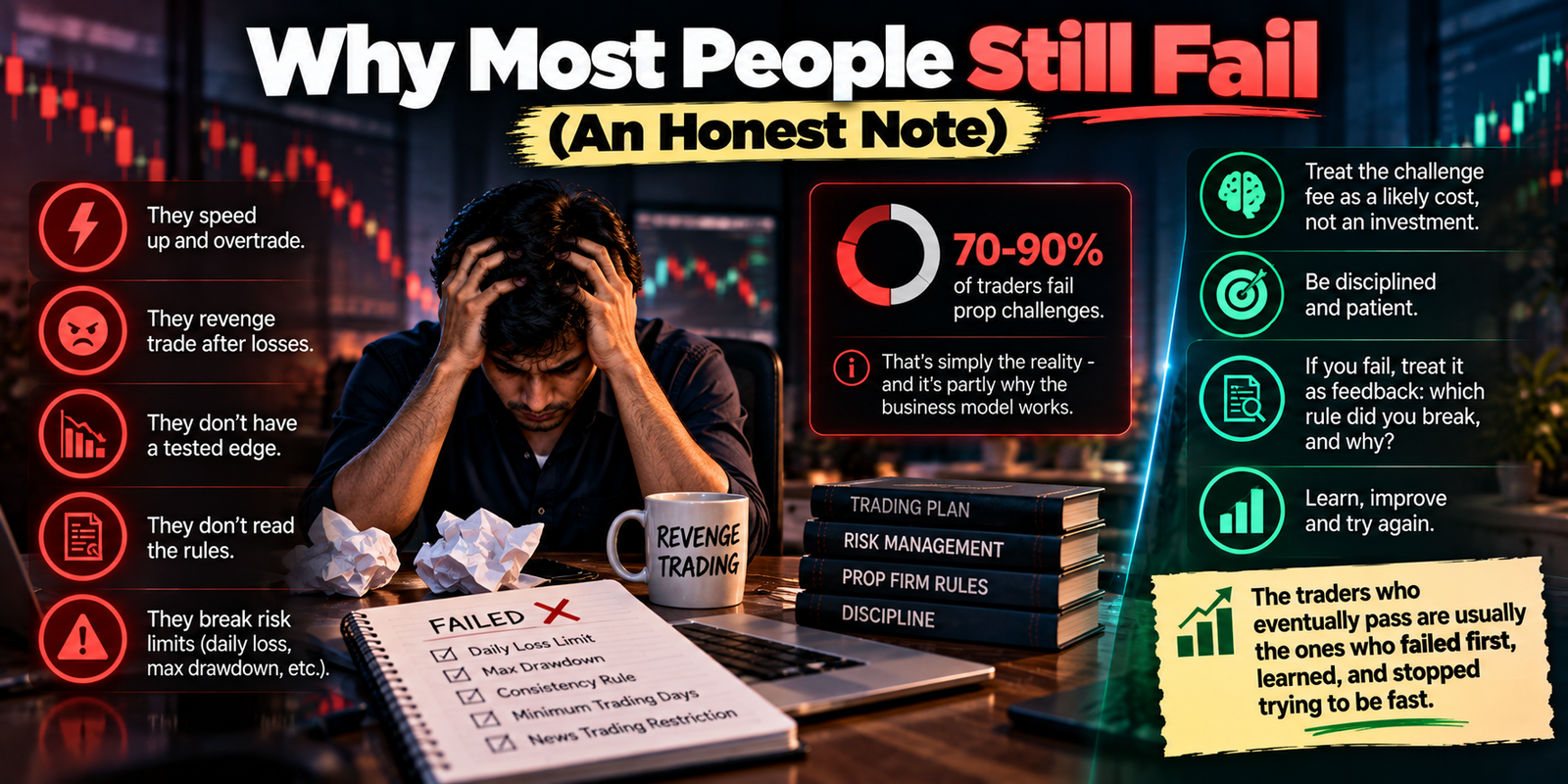
Why Most People Still Fail (An Honest Note)
Even with the right method, the majority of traders fail prop challenges – that’s simply the reality, and it’s partly why the business model works. People fail because they can’t resist speeding up, because they revenge trade, because they never had a tested edge, or because they didn’t read the rules. Passing requires genuine discipline that most traders haven’t yet built. So treat the challenge fee as a likely cost, not an investment, size your ambition accordingly, and if you fail, treat it as feedback: which rule did you break, and why? The traders who eventually pass are usually the ones who failed first, learned, and stopped trying to be fast.
Common Mistakes
- Not reading the rulebook and breaching a rule you didn’t know existed.
- Risking too much per trade and hitting the drawdown on a normal losing streak.
- Revenge trading after a losing start and blowing the daily limit.
- Rushing the profit target with oversized positions.
- Experimenting with a new, untested strategy under pressure.
Learn more about Scalping strategy forex
Myths vs Facts
| Myth | Fact |
|---|---|
| A challenge tests how much you can make. | It tests whether you can avoid the loss limits – a risk test. |
| You should hit the target fast. | Speed forces oversized risk; slow, steady gains pass more often. |
| Bigger risk per trade gets you funded quicker. | It gets you drawdown-ed quicker; tiny risk is how you survive. |
| Any strategy works if you’re disciplined. | You need a tested edge plus discipline; a challenge isn’t for experiments. |
Risk & compliance disclaimer
This article is for educational purposes only and is not financial, legal or tax advice. Most traders fail prop challenges, and the fee is a likely cost, not a guaranteed step to income. Prop firm rules vary and change – confirm your firm’s exact rules. Prop participation for Indian residents sits in a legal grey area with tax and disclosure obligations; see our compliance guides and consult a qualified professional before engaging.
Expert Analysis
The reason the ‘risk test, not profit test’ framing is so powerful is that it aligns your incentives with the prop firm’s, and the entire challenge is designed around that alignment. The firm makes money by funding traders who won’t blow up its capital, so it constructs an evaluation where the loss limits, not the profit target, are the binding constraint. A 10% target behind a 5% daily and 10% overall drawdown is not a puzzle about how to make money fast; it is a filter for whether you can make a modest amount slowly without ever losing control. Once you see that the firm is essentially asking ‘will you respect risk limits under pressure?’, the whole strategy simplifies to answering yes – repeatedly, boringly, for the duration of the challenge.
This is also why passing is far more about temperament than technique, and why the traders who struggle are often the more aggressive, more ‘talented’ ones. Small, consistent risk feels like leaving money on the table; stopping for the day at a 2% loss feels like giving up; refusing to size up to hit the target faster feels like cowardice. Every one of those feelings is the enemy, and every one of them is the exact impulse the drawdown limits are built to punish. The trader who wins the challenge is usually not the one with the best entries but the one who has made peace with slowness – who has internalised that the goal is survival first and profit second, and who has a tested edge boring enough to repeat under pressure. Build that temperament, respect the maths of position sizing, read every rule before you risk a rupee, and the challenge stops being a gamble and becomes a process you can execute. Whether you should be taking that challenge at all, given the costs and the grey area, is a separate and equally important question worth answering honestly first.
Key Takeaways
- A prop challenge is a risk-management test, not a profit test – the loss limits fail you, not the target.
- Read every rule first; breaching an unread rule is the top reason people fail.
- Risk tiny amounts per trade (often 0.25-1%) so losing streaks can’t breach the drawdown.
- Respect a personal daily stop, don’t rush the target, and mind the consistency rule.
- Trade only a tested strategy, manage the psychology, and treat the fee as a likely cost.
Frequently Asked Questions (FAQ)
Q: How do I pass a prop firm challenge?
A: Treat it as a risk test: read the rules first, risk a tiny amount per trade, respect the loss limits, don’t rush the modest target, and trade only your tested strategy.
Q: Why do most people fail prop challenges?
A: They risk too much, revenge trade after losses, rush the target with oversized positions, lack a tested edge, or breach a rule they didn’t read.
Q: How much should I risk per trade in a challenge?
A: Small – often 0.25% to 1% of the account – so a normal losing streak can’t breach the daily or overall loss limit.
Q: What fails a challenge fastest?
A: Breaching the max daily loss – usually because a losing trader keeps trading to recover and spirals into the limit.
Q: What is the profit target usually?
A: Commonly around 8-10% in phase one and 5% in phase two, though it varies by firm – modest compared with the loss limits.
Q: What is a consistency rule?
A: A rule that caps how much of your total profit can come from a single day, stopping one lucky day from carrying the challenge.
Q: How long does it take to pass?
A: As long as you need within any time limit – steady small gains over a couple of weeks is safer than rushing in a day or two.
Q: Should I hit the target quickly?
A: No. Speed forces oversized risk that trips the drawdown; small, steady gains pass far more reliably.
Q: Do I need a strategy before I start?
A: Yes. Use only a tested, rule-based strategy you’re consistent with; a challenge is not the place to experiment.
Q: How do I set a personal daily stop?
A: Set it well inside the firm’s daily limit (for example 2-3% when the limit is 5%) and stop trading for the day when you hit it.
Q: How do I manage the pressure?
A: Trade small so no loss hurts, take breaks, journal, and remember the account is simulated and only your fee is at stake.
Q: Can I use a bot or copy trader to pass?
A: Some firms restrict automation or copy trading; check the rules, and be wary of services that ‘guarantee’ a pass.
Q: What if I fail the challenge?
A: Treat it as feedback – identify which rule you broke and why – and only retry once you’ve fixed the behaviour, not just paid again.
Q: Is passing a challenge worth it for Indian traders?
A: It can be, but weigh the low pass rates, the fee as a likely cost, and India’s legal grey area and tax obligations first.
Q: Are challenge fees refundable?
A: Some firms refund the fee after you reach a certain payout milestone; check your firm’s specific policy.