Introduction to Forex Scalping
The forex market offers traders multiple opportunities to profit from price movements. While some traders prefer long-term positions, others seek quick profits by taking advantage of small market fluctuations. One of the most popular approaches among active traders is the forex scalping strategy.
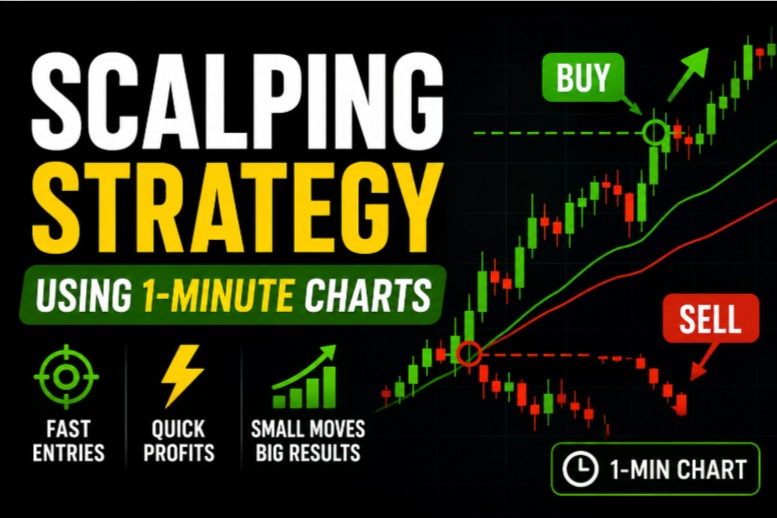
A forex scalping strategy focuses on capturing small price movements within short periods. Scalpers often enter and exit multiple trades throughout the trading session, aiming to accumulate profits from numerous small wins. Among all timeframes available, the 1-minute chart remains one of the most commonly used by scalpers because it provides frequent trading opportunities.
Trading on such a low timeframe requires discipline, speed, and precision. Since market conditions can change rapidly, traders must rely on effective analysis techniques and proven methods. Combining a forex scalping strategy with proper scalping indicators, disciplined execution, and sound risk management can significantly improve trading performance.
This article explores how traders can use 1-minute charts effectively, apply short-term trading principles, and build a profitable scalping system in volatile forex markets.
Understanding Scalping in Forex Trading
Scalping is a form of short-term trading where traders attempt to profit from minor price movements occurring within minutes or even seconds.
Unlike swing traders or position traders who may hold trades for days or weeks, scalpers generally remain in trades for only a few minutes. The objective is not to capture large market trends but rather to exploit small fluctuations repeatedly throughout the day.
A successful forex scalping strategy requires traders to maintain intense concentration and react quickly to changing market conditions. Since profits per trade are relatively small, consistency becomes essential.
Because forex markets are highly liquid and operate continuously during weekdays, they provide ideal conditions for fast forex strategy approaches. Major currency pairs such as EUR/USD, GBP/USD, and USD/JPY are especially popular among scalpers due to their tight spreads and high liquidity.
Mastering short-term trading techniques allows traders to take advantage of frequent market opportunities while minimizing overnight exposure.
Why Use 1-Minute Charts for Scalping?
The 1-minute timeframe offers unique advantages for traders implementing a forex scalping strategy.
First, 1-minute charts generate a high number of trading opportunities. Since each candle represents only sixty seconds of market activity, price patterns and setups develop rapidly.
Second, traders using a fast forex strategy can capitalize on intraday volatility without remaining exposed to overnight risks.
Third, the 1-minute timeframe allows scalpers to quickly compound profits by executing multiple trades during active trading sessions.
However, 1-minute charts also present challenges. Market noise increases significantly on lower timeframes, making it essential to use reliable scalping indicators and proper market filters.
Furthermore, market volatility can dramatically affect price movements on 1-minute charts. During periods of elevated market volatility, price can move aggressively, creating both opportunities and risks.
Therefore, understanding how to navigate rapidly changing market conditions is crucial for long-term success.
Best Trading Sessions for Scalping
Timing plays an important role in every successful forex scalping strategy.
The London and New York trading sessions typically provide the highest liquidity and strongest price movements. During these periods, market volatility often increases substantially, generating numerous trading opportunities.
The overlap between the London and New York sessions is particularly attractive for traders using a fast forex strategy because liquidity reaches peak levels.
Scalping during low-liquidity periods can be challenging because spreads widen and price movement often becomes inconsistent.
Traders engaged in short-term trading should carefully select trading hours that align with their preferred currency pairs and market conditions.
Monitoring market volatility throughout the trading day helps scalpers determine when favorable trading conditions exist.
Building a Forex Scalping Strategy on 1-Minute Charts
A profitable forex scalping strategy requires clear entry and exit rules.
Many traders begin by identifying the overall trend on higher timeframes such as the 15-minute or 1-hour chart. Once the broader market direction is established, traders switch to the 1-minute chart to search for entry opportunities aligned with that trend.
This approach helps reduce false signals and improves the probability of success.
A well-structured fast forex strategy often includes trend confirmation, entry triggers, stop-loss placement, and predefined profit targets.
Because short-term trading involves rapid decision-making, traders must follow their rules consistently without hesitation.
Combining trend direction with reliable scalping indicators frequently produces higher-quality setups than relying solely on raw price movement.
Consistency and discipline remain fundamental components of every effective forex scalping strategy.
Scalping Indicators for 1-Minute Trading
Selecting appropriate scalping indicators is essential when trading on very low timeframes.
Moving averages remain among the most popular scalping indicators because they help traders identify trend direction quickly. Short-period moving averages such as the 9 EMA and 20 EMA are commonly used in scalping systems.
The Relative Strength Index is another widely used tool. It helps traders identify momentum shifts and potential overbought or oversold conditions.
MACD also serves as an effective momentum indicator for confirming trade entries.
Bollinger Bands are particularly useful for assessing market volatility and identifying potential breakout opportunities.
Successful traders rarely rely on a single indicator. Instead, they combine multiple scalping indicators to improve signal accuracy and strengthen their overall fast forex strategy.
Integrating several indicators can significantly enhance the effectiveness of a forex scalping strategy.
The Role of Market Volatility in Scalping
Market volatility directly influences the profitability of scalping strategies.
Higher market volatility generally creates more trading opportunities because prices move more aggressively. However, increased volatility also introduces greater risk.
During major economic announcements, market volatility can surge dramatically, causing unpredictable price swings. While experienced scalpers may capitalize on these conditions, beginners often prefer avoiding news events.
Low volatility environments can also present challenges because price movement may become insufficient to generate meaningful profits.
Understanding changing volatility conditions is therefore critical for traders using a fast forex strategy.
Monitoring Average True Range, Bollinger Bands, or economic calendars can help traders anticipate shifts in market volatility and adjust their strategies accordingly.
Short-Term Trading Techniques for Scalpers
Successful short-term trading requires more than simply entering trades frequently.
One popular approach involves pullback trading within established trends. Traders wait for temporary retracements before entering positions in the direction of the prevailing trend.
Breakout trading is another common short-term trading technique. Scalpers monitor support and resistance levels and enter trades when price breaks beyond these zones with momentum.
Momentum-based approaches also play an important role in many fast forex strategy systems.
Regardless of the specific technique employed, traders should always ensure that their short-term trading methods align with prevailing market conditions.
Combining disciplined execution with effective scalping indicators significantly improves trading consistency.
Risk Management in Forex Scalping
Risk management remains one of the most important aspects of every forex scalping strategy.
Since scalpers execute numerous trades daily, even minor mistakes can accumulate quickly.
Stop-loss orders should always be used to protect trading capital. Due to the rapid nature of short-term trading, traders cannot rely on manual exits alone.
Position sizing is equally important. Many professional scalpers risk only a small percentage of their trading capital on each position.
Because market volatility can increase unexpectedly, maintaining appropriate risk exposure becomes essential.
A sustainable fast forex strategy balances profit opportunities with disciplined capital preservation.
Successful traders understand that long-term profitability depends not only on winning trades but also on controlling losses effectively.
Common Mistakes Scalpers Should Avoid

Many beginners implementing a forex scalping strategy make the mistake of overtrading.
The abundance of setups on 1-minute charts often tempts traders to enter low-quality trades. Patience remains essential despite the fast-paced nature of short-term trading.
Another common error involves ignoring broader market trends. Trading against higher timeframe direction frequently reduces the probability of success.
Overreliance on individual scalping indicators can also create problems. Indicators should complement market analysis rather than replace it entirely.
Failing to adapt to changing market volatility conditions often leads to unnecessary losses.
Finally, emotional decision-making can undermine even the best fast forex strategy. Maintaining discipline and following predefined rules remain crucial.
Avoiding these mistakes can significantly improve overall trading performance.
Creating a Complete Fast Forex Strategy
Developing a comprehensive fast forex strategy begins with selecting liquid currency pairs and identifying optimal trading sessions.
Next, traders determine trend direction using higher timeframes before searching for opportunities on the 1-minute chart.
Reliable scalping indicators then provide entry confirmation.
Trade execution should follow strict rules regarding entries, exits, stop losses, and profit targets.
Monitoring market volatility allows traders to adjust their approach according to changing market conditions.
A complete forex scalping strategy also includes detailed risk management guidelines and performance review procedures.
Consistency, discipline, and continuous improvement are essential for long-term success in short-term trading.
Conclusion
A well-designed forex scalping strategy offers traders an exciting and potentially profitable approach to forex trading.
By mastering short-term trading principles, utilizing effective scalping indicators, and adapting to changing market volatility, traders can capitalize on frequent market opportunities.
Although scalping requires discipline, concentration, and rapid decision-making, combining these skills with a structured fast forex strategy can produce consistent results over time.
Success in scalping does not come from taking more trades but from executing high-quality setups with precision and discipline. With proper preparation and risk management, traders can effectively navigate the fast-paced world of 1-minute forex trading.