

Quick answer
Prop firm payout tax India works like this: funded-account payouts from offshore prop firms are foreign-source income, generally taxed as business income at your slab rate (not capital gains), and reported on ITR-3 with Schedule FSI and Schedule FA. Prop firms are treated as evaluation services, not illegal offshore forex.
Introduction
Funded trading has exploded among Indian traders, and with it a wave of confusion about the tax. When your first prop-firm payout hits your bank, a whole set of questions arrives too: is this legal, is it taxable, which form, do I owe GST? Getting prop firm payout tax in India right matters, because the paperwork is heavier than most traders expect and the penalties for getting foreign income wrong are severe.
This guide walks through the whole picture: the legal status, how payouts are taxed and reported, the GST angle, and the disclosure risks. This is a genuinely complex and evolving area with no single tidy ruling, so treat it as an educational overview and use a chartered accountant who understands foreign income. Details were verified against current 2026 sources. This is not tax advice.
What Is a Prop Firm / Funded Account?
A proprietary trading firm (‘prop firm’) lets you trade its capital in exchange for a share of the profits. You typically pay a challenge fee, pass an evaluation on a simulated account by hitting profit targets within risk limits, and then receive a ‘funded’ account. When you trade it profitably, the firm pays you a profit split – the payout. Most prop firms (FTMO, FundedNext, The5ers and the like) are based outside India and run evaluations on simulated environments, which is central to how they’re treated legally and for tax.

Are Prop Firms Legal in India?
Generally, yes – and understanding why explains the tax treatment. Prop firms are based abroad and provide a simulated evaluation service, not brokerage. Because they aren’t offering you a brokerage account to trade real money in the market, they sit outside SEBI’s brokerage licensing regime, and participating is usually viewed as procuring a legitimate service rather than doing illegal offshore retail forex.
- The challenge fee travels out as an outward remittance (buying a service) – typically small and from your own funds.
- The payout comes in as an inward remittance for services rendered, which is generally a permitted current-account transaction under FEMA.
The caveat: this is distinct from funding an offshore retail-forex broker to trade leveraged FX yourself, which does raise FEMA concerns. The prop-firm/evaluation model is treated more favourably, but the area is nuanced – confirm your specific arrangement with a professional.
How Prop-Firm Payouts Are Taxed
Now the core of prop firm payout tax in India. A resident is taxed on global income, so your payouts are taxable here regardless of where the firm sits. The classification and rate:
- Foreign-source income – the payout is income from a foreign payer, taxable in India.
- Usually business income – active funded traders are generally treated as having business income; occasional traders may fall under ‘income from other sources’.
- Taxed at slab rates – your normal income-tax slab applies (up to 30% plus cess), not a special or flat rate, and not capital gains.
- Deduct expenses – as business income, related costs (challenge fees, data, tools) can generally be deducted; confirm with your CA.
So the money is added to your total income and taxed at your slab, exactly like other business income – the twist is only that it’s foreign-source, which changes the reporting.
Where and How to Report It
Foreign income means extra schedules, and this is where most traders slip:
- File ITR-3 – the return for business income (active traders); ITR-2 may apply for other-sources cases. Confirm with your CA.
- Convert to INR – report each payout in rupees using the prescribed exchange rate on the date of receipt.
- Report in Schedule FSI – the Foreign Source Income schedule captures the payout.
- Report in Schedule FA – if you hold any foreign account or balance (Wise, Payoneer, broker wallet), disclose it.
- Keep documentation – the firm’s payout records, the agreement and bank inward-remittance proof.
GST on Prop-Firm Payouts
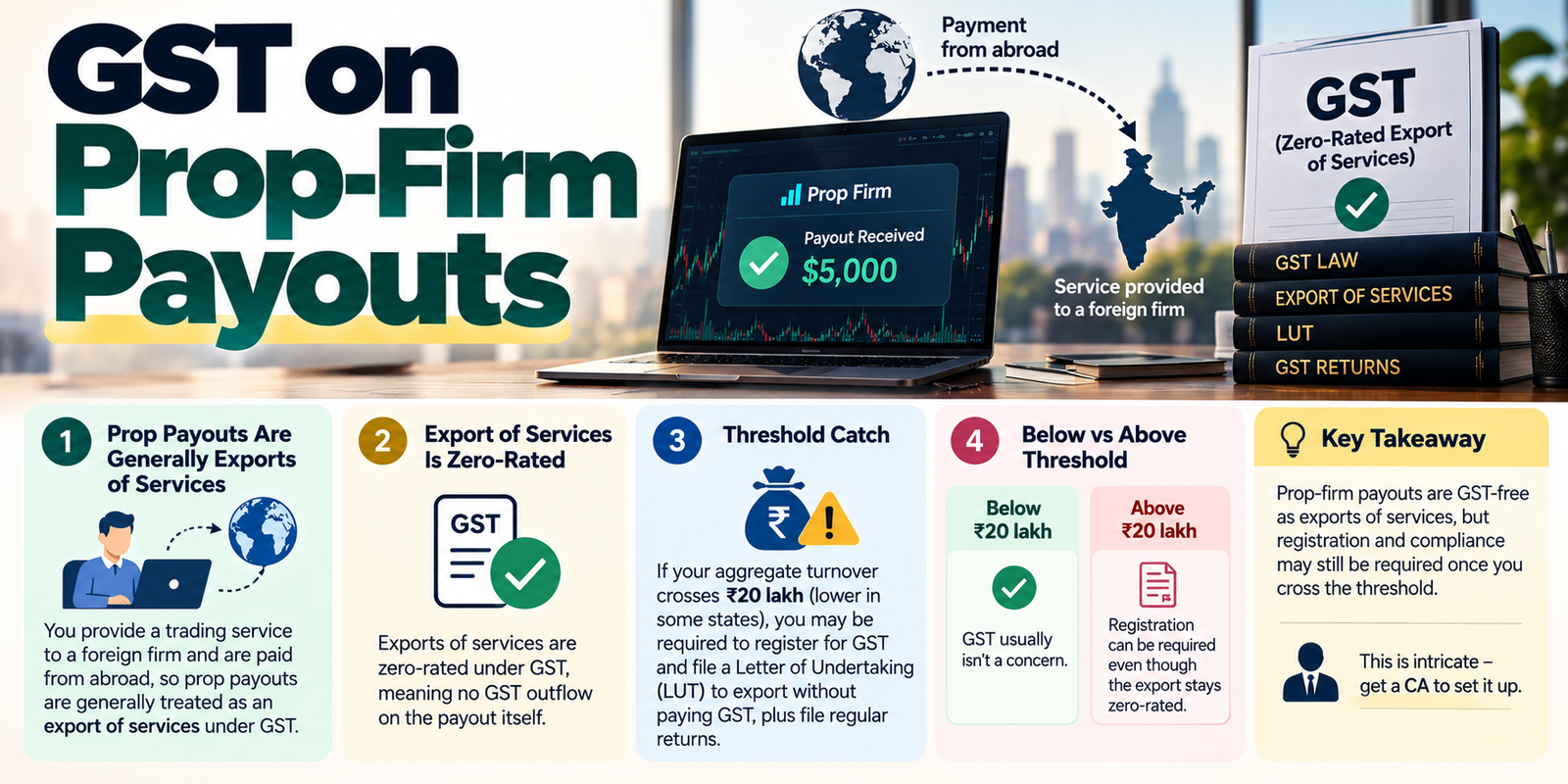
This is one of the most misunderstood parts. Because you’re providing a service to a foreign firm and being paid from abroad, prop payouts are generally treated as an export of services – which is zero-rated under GST, meaning no GST outflow on the payout itself. However, there’s a threshold catch: if your aggregate turnover crosses ₹20 lakh (lower in some states), you may still be required to register for GST and file a Letter of Undertaking (LUT) to export without paying GST, plus file regular returns. So below the threshold, GST usually isn’t a concern; above it, registration can be required even though the export stays zero-rated. This is genuinely intricate – get a CA to set it up.
DTAA and Foreign Tax Credit (Form 67)
If the prop firm’s country withheld any tax on your payout, you may be able to claim a foreign tax credit under the Double Taxation Avoidance Agreement (DTAA) between India and that country, so you’re not taxed twice. There’s a hard procedural step: you generally must file Form 67 online before filing your return to claim the credit – miss it and the credit can be disallowed. Treat Form 67 as part of the filing, not an afterthought.
The Black Money Act Risk (Don’t Skip Disclosure)
This is the most serious pitfall, and the most commonly ignored. Not disclosing foreign income and foreign assets – the Schedule FSI and Schedule FA reporting above – can attract action under India’s Black Money (Undisclosed Foreign Income and Assets) Act, 2015, which carries heavy penalties well beyond ordinary tax. Because your payouts arrive through banking channels and processors, they’re visible; assuming the department won’t know is a costly mistake. Disclose fully, every year, even for modest amounts.
Crypto Payouts: An Extra Complication
Some prop firms pay in cryptocurrency (like USDT). This adds a layer: the moment the crypto arrives in your wallet it’s income, reportable at its rupee value on that date – and later converting that crypto to INR can create a separate virtual digital asset (VDA) gain, taxed at a flat 30% plus surcharge and cess. So crypto payouts can trigger two taxable events. If you can, taking payouts through banking channels (or bringing them onshore promptly) keeps the tax simpler.
Compliance Checklist
- Treat payouts as taxable foreign income – usually business income at your slab rate.
- File ITR-3 with Schedule FSI and FA – report the income and any foreign balances.
- Handle GST properly – export of services (zero-rated); register above the ₹20 lakh threshold via LUT.
- Claim DTAA credit via Form 67 – before filing, if foreign tax was withheld.
- Keep records and use a specialist CA – foreign income, GST and disclosure make this a job for a professional.
Common Misconceptions
- ‘Prop payouts aren’t taxable since the firm is abroad.’ – Residents are taxed on global income; they’re taxable.
- ‘It’s capital gains.’ – It’s business income (or other sources), taxed at slab rates.
- ‘The department won’t know about foreign income.’ – Payouts arrive through banks; non-disclosure risks the Black Money Act.
- ‘Export means I pay 18% GST.’ – Export of services is zero-rated; the threshold only triggers registration.
- ‘Prop firms are the same as illegal offshore forex.’ – They’re evaluation services, treated differently, though nuanced.
Myths vs Facts
| Myth | Fact |
|---|---|
| Foreign prop payouts aren’t taxable in India. | Residents are taxed on global income; payouts are taxable here. |
| Payouts are capital gains. | They’re generally business income, taxed at slab rates on ITR-3. |
| No Indian form from the firm means no reporting. | You must self-report foreign income in Schedule FSI/FA regardless. |
| Export of services means 18% GST. | It’s zero-rated; the ₹20 lakh threshold only triggers registration. |
Tax & compliance disclaimer
This article is for educational purposes only and is not tax, legal or investment advice. The tax and regulatory treatment of prop-firm payouts is complex, evolving and situation-specific; classification (business vs other sources), GST, FEMA and disclosure rules can change, and the new Income-tax Act, 2025 applies from FY 2026-27. Details here were checked against 2026 sources but may since have changed. Always verify current rules with the Income Tax Department and the RBI, and consult a qualified chartered accountant who specialises in foreign income before filing.
Expert Analysis
The reason prop firm payout tax in India causes so much anxiety is that it sits at the intersection of three regimes that traders usually meet separately: income tax, GST and foreign-exchange/disclosure law. Taken one at a time, each is manageable – the income is business income at slab rates, the export is zero-rated for GST, the inflow is a permitted service remittance under FEMA – but funded traders meet all three at once, often for the first time, and the temptation is to either overthink it into paralysis or ignore it entirely. The correct posture is neither. Prop payouts are ordinary foreign business income with some extra paperwork; the paperwork is the whole game, and it’s learnable.
What genuinely matters, and what the affiliate-heavy commentary around this topic tends to underplay, is disclosure. The single largest risk isn’t paying a slightly wrong rate – it’s failing to report foreign income and foreign balances, which moves the problem out of ordinary tax and into Black Money Act territory, where the consequences are severe and the defences few. Because payouts arrive through banks and money processors that report, the income is visible whether or not the foreign firm issues an Indian form, so non-disclosure is not a hidden path but an exposed one. The clean approach is almost boring: treat each payout as taxable business income, report it in Schedule FSI, disclose any foreign balance in Schedule FA, handle GST above the threshold, claim DTAA credit through Form 67 where relevant, and keep the firm’s records. Done consistently with a competent CA, prop-firm income is fully compliant and unremarkable – which, given the alternative, is exactly what a serious funded trader should want.
Key Takeaways
- Prop-firm payouts are taxable foreign-source income in India, generally as business income at slab rates.
- Report on ITR-3 with Schedule FSI (foreign income) and Schedule FA (foreign balances).
- Prop firms are treated as evaluation services, distinct from illegal offshore retail forex.
- GST: export of services is zero-rated, but registration may apply above ₹20 lakh turnover.
- Disclose fully – non-disclosure risks the Black Money Act; use a specialist CA.
Frequently Asked Questions (FAQ)
Q: How are prop firm payouts taxed in India?
A: As foreign-source income, generally business income at your slab rate (not capital gains), reported on ITR-3 with Schedule FSI and FA.
Q: Is prop trading legal in India?
A: Generally yes – prop firms sell a simulated evaluation service, not brokerage, placing them outside SEBI’s brokerage regime. Payouts are permitted service remittances.
Q: Which ITR form do prop traders file?
A: ITR-3 for business income (typical for active traders); ITR-2 may apply for other-sources cases. Confirm with your CA.
Q: Are prop payouts capital gains?
A: No. They’re generally business income taxed at slab rates, or income from other sources for occasional traders.
Q: Do I need to report foreign prop income?
A: Yes. Report it in Schedule FSI and disclose any foreign balances in Schedule FA, regardless of whether the firm issues an Indian form.
Q: Do I pay GST on prop firm payouts?
A: Prop payouts are generally an export of services, which is zero-rated, so no GST outflow – but registration may be required above ₹20 lakh turnover.
Q: What rate applies to prop firm income?
A: Your normal income-tax slab rate (up to 30% plus cess), because it’s business income added to your total income.
Q: Can I deduct expenses like challenge fees?
A: As business income, related expenses can generally be deducted; confirm the specifics with your chartered accountant.
Q: What is Schedule FSI and Schedule FA?
A: Schedule FSI reports foreign-source income; Schedule FA discloses foreign accounts and assets. Both are commonly required for prop income.
Q: What is the Black Money Act risk?
A: Failing to disclose foreign income or assets can attract the Black Money Act, 2015, with heavy penalties – so disclose fully every year.
Q: How do I claim credit for foreign tax withheld?
A: Via the DTAA, by filing Form 67 online before your return; missing it can cause the credit to be disallowed.
Q: How are crypto payouts taxed?
A: The crypto is income at its rupee value on receipt, and converting it to INR can create a separate VDA gain taxed at a flat 30% plus cess.
Q: How do I convert payouts to INR for tax?
A: Use the prescribed exchange rate on the date each payout is received, and report in rupees.
Q: Do I need a CA for prop firm taxes?
A: Strongly recommended. Foreign income, GST registration, DTAA and disclosure make this a job for a specialist chartered accountant.
Q: Is receiving prop payouts a FEMA problem?
A: Receiving payment for services rendered is generally permitted under FEMA; keep clean bank records and documentation of the source.