
Quick answer
ICT trading concepts come from the Inner Circle Trader methodology, which reads how institutional ‘smart money’ delivers price. Beyond liquidity, order blocks and fair value gaps, ICT adds distinctive tools – time-based Kill Zones, Optimal Trade Entry, the Judas Swing and the Power of 3 (accumulation, manipulation, distribution).
Introduction
If you’ve fallen down the trading-education rabbit hole, you’ve met ICT – a dense, jargon-heavy methodology with a cult following and a language all its own. Stripped of the mystique, ICT trading concepts are a structured way of reading how big institutions move price, and many of the ideas are genuinely useful once translated into plain English. That translation is exactly what this guide does.
We’ll cover where ICT comes from, how it relates to Smart Money Concepts, and then the toolkit itself – liquidity, displacement, fair value gaps, order blocks, Optimal Trade Entry, Kill Zones, the Judas Swing and the Power of 3 – before an honest look at whether it works. This is educational content, not investment advice, and no method guarantees profits.
What Is ICT?
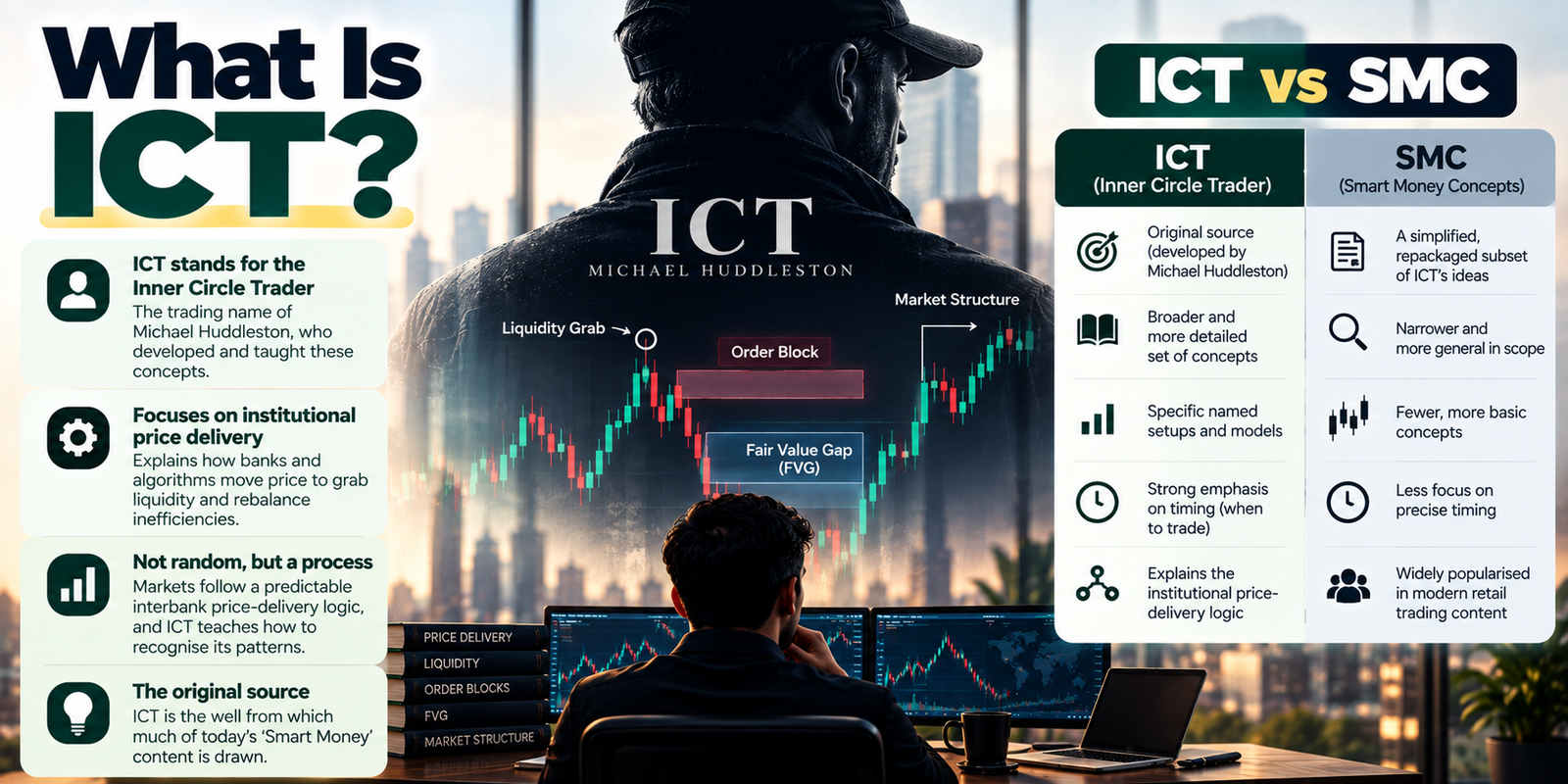
ICT stands for the Inner Circle Trader, the trading name of Michael Huddleston, who developed and taught a large body of concepts about how price is ‘delivered’ by institutional algorithms. The central premise is that markets aren’t random: a kind of interbank price-delivery logic moves price to grab liquidity and rebalance inefficiencies, and if you learn its patterns you can anticipate the next move. ICT is the original well from which much of today’s ‘Smart Money’ content is drawn.
ICT vs SMC: Smart Money Concepts (SMC) is essentially a simplified, repackaged subset of ICT’s ideas. ICT is broader and more specific, with named setups and a strong emphasis on timing. If you’ve read our SMC guide, treat this as the deeper, source-level view.
The Core Premise: Price Is Delivered, Not Random
Everything in ICT rests on the idea that price is engineered to do two things: reach for liquidity (the stop-losses and orders resting at obvious highs and lows) and rebalance inefficiencies (gaps left by fast moves). Institutions, in this view, drive price to where they can fill big orders – typically by running retail stops first. Once you accept that framing, ICT’s tools are just different ways of spotting where liquidity sits and where price is likely to react.
The Shared Building Blocks (Quick Version)
ICT and SMC share a foundation, so we’ll move through these briefly (our SMC guide covers them in depth):
- Liquidity – buy-side liquidity rests above highs, sell-side below lows; price hunts it.
- Displacement – a strong, energetic candle or move that signals genuine institutional intent (and often creates a fair value gap).
- Fair value gap (FVG) – an imbalance left by a fast move that price tends to revisit.
- Order block – the institutional candle before a displacement; a zone to watch on a return.
- Breaker block – a failed order block that then flips to act as support or resistance.
- Premium / discount – above or below the 50% equilibrium of a range; sell premium, buy discount.
Optimal Trade Entry (OTE)
A distinctly ICT refinement of ‘buy the discount’ is the Optimal Trade Entry. After a displacement move, ICT looks for price to retrace into a specific Fibonacci zone – roughly the 62% to 79% retracement – as the highest-probability entry, ideally overlapping an order block or fair value gap. The OTE gives a precise, repeatable area to enter a pullback in the direction of the move, rather than guessing. It’s one of ICT’s more concrete, testable ideas.
Kill Zones: The Timing Element
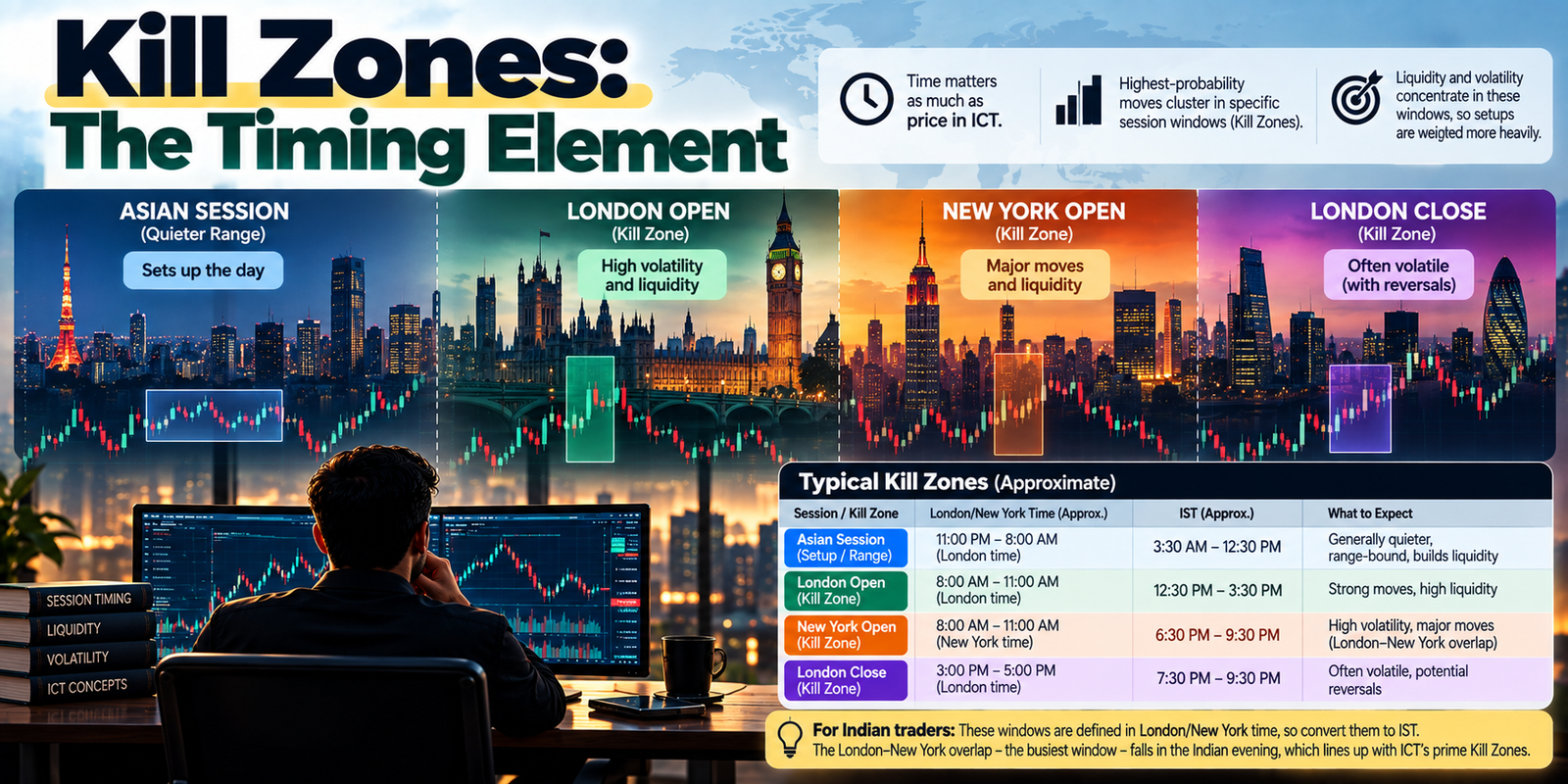
This is where ICT most clearly diverges from generic SMC: time matters as much as price. ICT teaches that the highest-probability moves cluster in specific session windows called Kill Zones – typically around the London open, the New York open, and the London close, with the quieter Asian range setting up the day. The idea is that liquidity and volatility concentrate in these windows, so setups that appear inside them are weighted more heavily than the same pattern in a dead hour.
For Indian traders: these windows are defined in London/New York time, so convert them to IST (our forex-sessions-in-IST guide does this). The London-New York overlap – the busiest window – falls in the Indian evening, which conveniently lines up with ICT’s prime Kill Zones.
The Judas Swing
The Judas Swing is one of ICT’s most evocative ideas: a false move at the start of a session that ‘betrays’ traders. Price pushes in one direction early – luring breakout traders and triggering stops – before reversing into the real move for the session. Recognising a Judas Swing means not chasing the first move after an open, but waiting to see whether it’s a genuine push or a trap designed to grab liquidity before the true direction reveals itself.
The Power of 3 (Accumulation, Manipulation, Distribution)
ICT compresses a lot of its philosophy into the Power of 3, or AMD, which describes how a session or daily candle often forms in three phases:
- Accumulation – price ranges quietly as institutions build positions.
- Manipulation – a sharp false move (often the Judas Swing) grabs liquidity in the wrong direction.
- Distribution – the real, sustained move in the intended direction, delivering price toward the next liquidity.
Seeing a candle or session as accumulation, then manipulation, then distribution helps you avoid being trapped in the manipulation phase and instead position for the distribution.
The ICT Glossary (Quick Reference)
| Term | What it means |
|---|---|
| ICT | Inner Circle Trader – the methodology by Michael Huddleston |
| Liquidity | Resting orders above highs (buy-side) and below lows (sell-side) |
| Displacement | A strong, energetic move signalling institutional intent |
| Fair value gap (FVG) | An imbalance left by a fast move that price tends to fill |
| Order block | The institutional candle before a displacement move |
| Breaker block | A failed order block that flips to support/resistance |
| OTE (Optimal Trade Entry) | The ~62-79% retracement entry zone after displacement |
| Kill Zone | High-probability session time windows (London/NY) |
| Judas Swing | A false move at the open that traps traders |
| Power of 3 (AMD) | Accumulation, Manipulation, Distribution phases |
How ICT Concepts Combine (a Simplified Model)
The pieces assemble into a routine. A simplified bullish day:
- Set a daily bias – decide the likely direction from higher-timeframe structure and liquidity.
- Wait for the Kill Zone – focus on the London or New York window, not dead hours.
- Spot the manipulation – a Judas Swing sweeps sell-side liquidity (a dip that grabs stops).
- Confirm displacement – a strong move back up leaves a fair value gap and shifts structure.
- Enter at OTE / order block – buy the retracement into the OTE zone or order block, stop below, target the next liquidity.
The bearish version mirrors this. As with all such methods, the routine is about patience and confluence, not prediction.
Does ICT Work? An Honest Take
ICT provokes strong opinions, and honesty requires acknowledging both sides. The observations underneath it are real: liquidity does get hunted, volatility does concentrate in session windows, and fast moves do leave gaps that often fill. Traders who’ve internalised ICT’s timing and liquidity lens frequently say it sharpened their reads. But ICT is also extraordinarily complex, heavily jargonised, highly discretionary, and surrounded by intense guru-style marketing – and its flexibility means almost any chart can be explained after the fact. It is not a guaranteed system, and no set of concepts substitutes for edge, discipline and risk management. The sensible path is to learn a small, well-defined slice of ICT, backtest it rigorously, and treat it as one lens among several – not a religion. Kept in proportion, it’s a useful framework; taken as gospel, it’s a very deep rabbit hole.
Common Mistakes
- Trying to learn every ICT concept at once instead of a few clean setups.
- Over-fitting the chart in hindsight until any move ‘makes sense’.
- Trading outside Kill Zones and wondering why setups fail.
- Chasing the Judas Swing instead of waiting for the real move.
- Treating ICT as certainty and abandoning stops and position sizing.
Myths vs Facts
| Myth | Fact |
|---|---|
| ICT is a guaranteed money-making system. | It’s a discretionary framework; edge still comes from execution and risk control. |
| ICT and SMC are completely different. | SMC is largely a simplified subset of ICT’s concepts. |
| You must master all ICT concepts to trade. | A small, well-defined slice, backtested, is far more practical. |
| Timing doesn’t matter if the setup is good. | ICT weights setups inside Kill Zones far more heavily. |
Risk disclaimer
This article is for educational purposes only and is not investment advice. ICT is a complex, discretionary framework, not a guaranteed system, and much promotion around it is marketing. Trading involves risk of loss, and most retail traders lose money. Always backtest, use a stop-loss and sound position sizing, trade only through SEBI-registered brokers on recognised exchanges, and consult a qualified professional before trading.
Expert Analysis
The fairest way to judge ICT trading concepts is to separate the observations from the packaging. The observations are largely sound and not even unique to ICT: markets reach for liquidity at obvious levels, volatility concentrates around major session opens, and inefficient fast moves tend to be revisited. What ICT adds is a dense, branded vocabulary and, crucially, a strong emphasis on timing that plainer methods often neglect – the insistence that where a setup occurs in the trading day matters as much as what the setup is. For a trader who has only ever thought about price, the introduction of time as a first-class variable is genuinely valuable, and it’s the part of ICT most worth taking seriously.
The packaging, however, is where discipline is required. ICT’s enormous surface area and loose definitions make it the ultimate hindsight machine: with enough named tools, any chart can be narrated into a clean ‘accumulation, manipulation, distribution’ story after the move has happened, which feels like understanding but proves nothing about the future. The traders who benefit are those who resist the urge to learn everything, instead isolating one or two concrete, testable pieces – an OTE entry inside a Kill Zone after a liquidity sweep, say – defining precise rules, and backtesting them over a large sample before risking real money. And no amount of ICT fluency removes the basics: a stop-loss, a sensible position size, and the humility to accept that even a textbook setup is a probability, not a promise. Learn ICT as a lens, hold it lightly, and let risk management, not the vocabulary, carry your account.
Key Takeaways
- ICT (Inner Circle Trader) is the source methodology that Smart Money Concepts draw from.
- It reads price as engineered to grab liquidity and rebalance inefficiencies.
- Distinctive ICT tools: Kill Zones (timing), Optimal Trade Entry, the Judas Swing and the Power of 3.
- A typical model: bias, Kill Zone, manipulation sweep, displacement, then an OTE/order-block entry.
- It’s a discretionary lens, not a guaranteed system – learn a small slice, backtest, and manage risk.
Frequently Asked Questions (FAQ)
Q: What are ICT trading concepts?
A: A body of concepts from the Inner Circle Trader methodology that reads how institutions deliver price – liquidity, displacement, order blocks, Kill Zones and more.
Q: What is ICT in trading?
A: ICT stands for the Inner Circle Trader, the methodology by Michael Huddleston focused on institutional price delivery and liquidity.
Q: Is ICT the same as Smart Money Concepts?
A: They overlap heavily; SMC is largely a simplified subset of ICT’s broader, more specific and timing-focused concepts.
Q: What is a Kill Zone?
A: A high-probability session time window (around the London and New York opens and London close) where ICT expects the best setups.
Q: What is Optimal Trade Entry (OTE)?
A: An ICT entry method: after a strong move, price retracing into roughly the 62-79% Fibonacci zone, ideally at an order block or fair value gap.
Q: What is the Judas Swing?
A: A false move at the start of a session that traps traders and grabs liquidity before price reverses into the real move.
Q: What is the Power of 3?
A: ICT’s accumulation-manipulation-distribution model: price accumulates, then a false move manipulates liquidity, then the real move distributes.
Q: What is displacement in ICT?
A: A strong, energetic price move that signals genuine institutional intent and often creates a fair value gap.
Q: What is a fair value gap?
A: An imbalance left when price moves so fast it skips levels; ICT expects price to return and fill it.
Q: What is an order block in ICT?
A: The institutional candle before a displacement move – a zone traders watch for a reaction when price returns.
Q: Does ICT work?
A: Its core observations about liquidity and timing are real, but it’s discretionary and not guaranteed; edge comes from disciplined execution and risk control.
Q: Is ICT good for beginners?
A: The ideas are learnable but the volume and hype make it easy to misuse; start with a small slice, backtest, and always manage risk.
Q: Do ICT concepts work on Indian markets?
A: Yes, they apply to any liquid market, including forex and Indian currency-derivative charts; convert Kill Zones to IST.
Q: How do I convert Kill Zones to IST?
A: They’re set in London/New York time, so add the offset to IST (with daylight saving); the London-NY overlap falls in the Indian evening.
Q: Do I still need risk management with ICT?
A: Absolutely. No method removes the need for a stop-loss and sound position sizing – ICT included.