

Quick answer
ICT killzones are specific session windows where the Inner Circle Trader method expects the best moves. The London killzone runs about 2-5 AM New York time (roughly 12:30-3:30 PM IST) and the New York killzone about 7-10 AM NY time (roughly 5:30-8:30 PM IST) – shifting an hour with US daylight saving.
Introduction
Most traders stare at charts all day and wonder why their setups keep failing in the quiet hours. ICT killzones fix that by answering a simple question: when should you actually be trading? The London and New York killzones are the two most powerful windows in the Inner Circle Trader method – the hours when institutional order flow concentrates and the cleanest moves appear. Trade inside them and you filter out the low-participation chop; trade outside them and even good analysis tends to fizzle.
This guide gives the exact killzone times in both New York time and IST, explains why each window behaves as it does, and walks through a step-by-step way to trade them. This is educational content, not investment advice – timing is a filter, not a guarantee.
What Are ICT Killzones?
ICT killzones are specific, roughly three-hour time windows tied to the opening and closing of the world’s major financial centres, when – in the Inner Circle Trader framework – institutional activity and volatility peak. The idea is that the market’s algorithmic price delivery injects its biggest moves, hunts liquidity, and sets the day’s range during these windows, so the highest-quality setups (displacement, fair value gaps, Optimal Trade Entries) cluster inside them. There are four killzones – Asian, London, New York and London Close – but the London and New York windows are where most of the action, and this guide, focuses. (For the broader method, see our ICT concepts guide.)

Why Killzones Matter
The logic is participation. Banks, funds and market makers don’t trade around the clock – they’re most active during business hours in their financial centres. When London’s desks switch on, and again when New York’s do, real institutional volume enters the market. That’s when liquidity is deep enough for big players to fill orders (often by grabbing retail stops first) and when genuine directional moves begin. Outside these windows, volume thins and price drifts. Treating killzones as a filter – only taking setups inside them – is one of the simplest ways to raise the quality of your trades.
The London Killzone
The London killzone opens the European session and is the most liquid window in the forex day. It typically runs 2:00-5:00 AM New York time (the sharpest action often in the first hour or two). London’s open frequently sets the initial direction and liquidity grab for the day, with the strongest moves on euro and pound pairs. In IST, this falls in the early afternoon – roughly 12:30-3:30 PM (about an hour earlier during US daylight saving). For an Indian trader, that’s a convenient post-lunch window.
The New York Killzone
The New York (AM) killzone is the heavyweight – often the highest-volume window of the entire day. It typically runs 7:00-10:00 AM New York time, powered by three forces at once: the tail of the London session overlapping New York, major US economic data at 8:30 AM, and the US equity open at 9:30 AM. The result is the sharpest displacement, the cleanest fair value gaps, and the most precise Optimal Trade Entries of the day – and it’s the home of ICT’s famous ‘Silver Bullet’ (a focused 10-11 AM window). In IST, the New York killzone lands in the evening – roughly 5:30-8:30 PM (about an hour earlier in US summer) – which for many Indian traders is prime after-work time.
Killzone Times: New York Time and IST
Here are all four killzones, anchored in New York time and converted to IST (approximate; confirm against a live killzone clock, as daylight saving shifts them):
| Killzone | New York time (ET) | Approx. IST (winter / summer) |
|---|---|---|
| London Open | 2:00-5:00 AM | 12:30-3:30 PM / 11:30 AM-2:30 PM |
| New York Open (AM) | 7:00-10:00 AM | 5:30-8:30 PM / 4:30-7:30 PM |
| London Close | 10:00 AM-12:00 PM | 8:30-10:30 PM / 7:30-9:30 PM |
| Asian | 7:00-10:00 PM | 5:30-8:30 AM / 4:30-7:30 AM |
The two to focus on: the London killzone (Indian afternoon) and the New York killzone (Indian evening). Notice the New York killzone overlaps the tail of London – the London-New York overlap – which is exactly why it’s the most volatile window.
The Daylight-Saving Catch
Killzones are quoted in New York time, and both the US and Europe observe daylight saving while India does not. That means the IST equivalents shift by about an hour depending on the season – the London and New York killzones land roughly an hour earlier in IST during the US summer (EDT). Because the shifts in different regions don’t line up perfectly, the cleanest habit is to anchor to New York time and use a daylight-saving-aware killzone clock rather than memorising a fixed IST table. (Our forex-sessions-in-IST guide covers this timing in more depth.)
How to Trade a Killzone (Step by Step)
Killzones tell you when to trade; your ICT process tells you what and which way. A simplified bullish routine:
- Set your daily bias first – before the window, decide the likely direction from higher-timeframe structure and liquidity.
- Mark key levels – note the session highs/lows and liquidity pools the killzone is likely to target.
- Wait for the window to open – only look for setups once the London or New York killzone is live.
- Spot the manipulation – a liquidity sweep (a stop hunt against your bias) is often the killzone’s opening move.
- Confirm displacement – a strong move back in your bias direction that shifts structure and leaves a fair value gap.
- Enter at OTE / the zone – buy the retracement into the Optimal Trade Entry or order block, stop below, target the next liquidity.
The bearish version mirrors this. The killzone concentrates the whole sequence into a defined window, so you’re hunting rather than waiting all day.
London vs New York: Which Killzone Should You Trade?
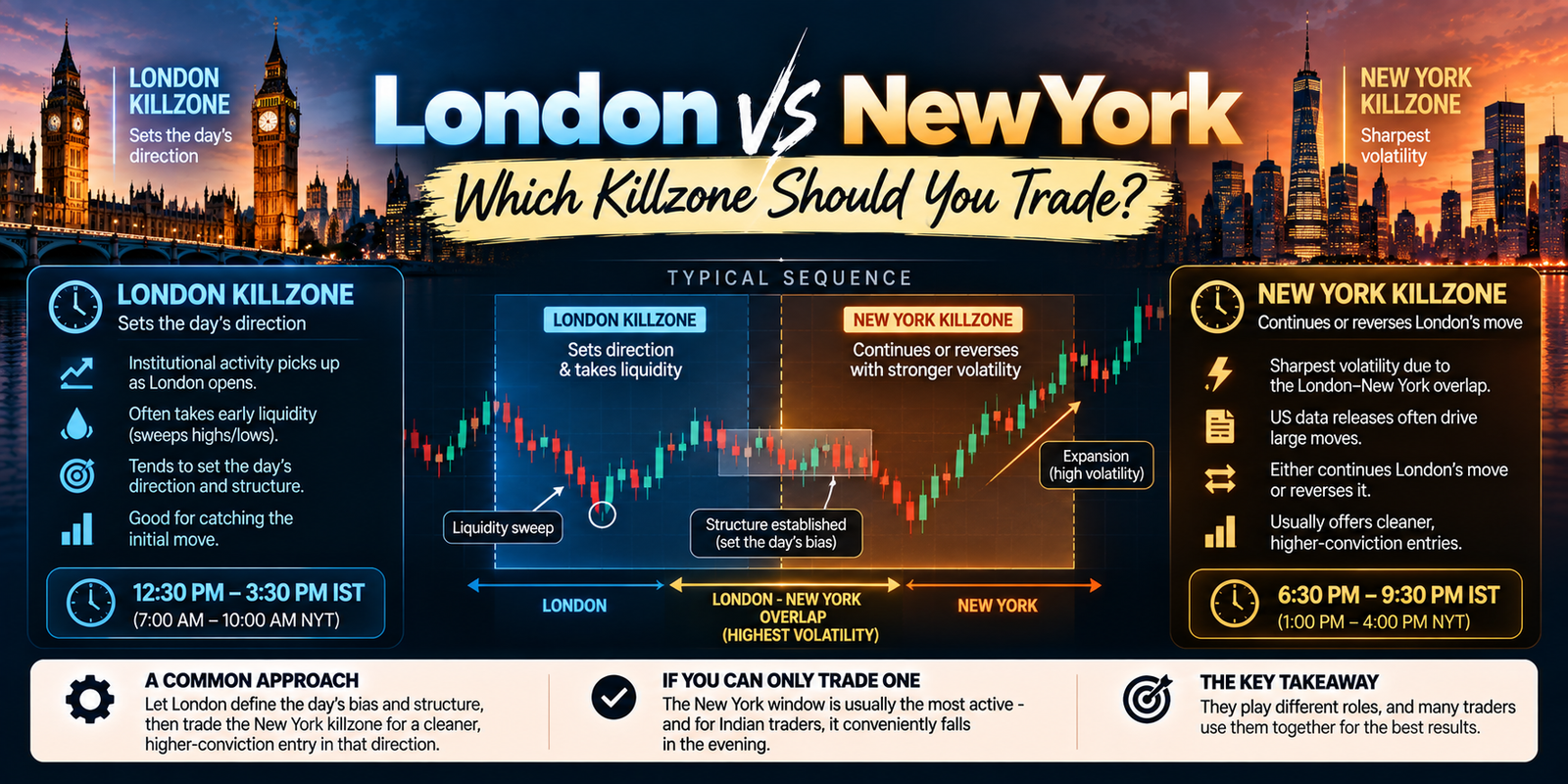
They play different roles, and many traders use them together. The London killzone tends to set the day’s direction and take early liquidity, making it ideal for catching the initial move. The New York killzone then either continues London’s move or reverses it, with the sharpest volatility thanks to the overlap and US data. A common approach is to let London define the day’s bias and structure, then trade the New York killzone for a cleaner, higher-conviction entry in that direction. If you can only trade one, the New York window is usually the most active – and for Indian traders it conveniently falls in the evening.
For Indian Traders: Killzones and Legal Hours
A practical note specific to India. Remember that legal currency trading for residents happens on Indian exchanges (NSE/BSE), roughly 9 AM-5 PM IST, with cross-currency pairs running to about 7:30 PM. The London killzone (Indian afternoon) falls comfortably within exchange hours, and the early part of the New York killzone overlaps the extended cross-currency window – so a compliant Indian trader on the permitted pairs can catch meaningful killzone activity without ever touching an offshore platform. The killzone concept is about timing; you still apply it on the legal, SEBI-regulated venue.
Learn more about ICT Trading Concepts
Common Mistakes
- Trading outside the killzones, in the low-liquidity dead hours.
- Entering the moment the window opens, before the manipulation/sweep.
- Forgetting to convert for daylight saving and being an hour off.
- Trading a killzone with no daily bias – timing without direction.
- Treating the killzone as a signal rather than a filter, and dropping risk management.
Does It Work? An Honest Take
The observation behind killzones is real and not even controversial: volatility and volume genuinely concentrate around the London and New York opens, a pattern any market participant can verify. Restricting your trading to these windows is a sensible filter that keeps you out of thin, choppy hours. But two honest caveats apply. First, exact killzone times vary between ICT sources (2-4 vs 2-5 AM, 7-9 vs 7-10 AM), so treat the windows as approximate ranges, not magic minutes. Second, a killzone only tells you when to look – it says nothing about direction or whether a setup will work. As practitioners put it, timing narrows the field of view; price action, context and disciplined risk management do the rest. Use killzones as a filter layered on top of a real strategy, not as a strategy by themselves.
Myths vs Facts
| Myth | Fact |
|---|---|
| Killzones guarantee a good move. | They concentrate volatility; direction and outcome still depend on your analysis. |
| Killzone times are exact and universal. | They vary by source; treat them as approximate ranges. |
| You can ignore daylight saving. | IST equivalents shift ~1 hour with US/EU daylight saving – check a live clock. |
| A killzone is a trade signal. | It’s a timing filter, not a signal; you still need bias, entry and risk control. |
Risk disclaimer
This article is for educational purposes only and is not investment advice. ICT killzones are a discretionary timing filter, not a guaranteed system, and exact times vary between sources and with daylight saving. Trading involves risk of loss, and most retail traders lose money. Always use a stop-loss and sound position sizing, trade only through SEBI-registered brokers on recognised exchanges, and consult a qualified professional before trading.
Expert Analysis
Killzones are the part of ICT with the least mystique and arguably the most practical value, because they encode a truth that predates ICT entirely: markets have a heartbeat, and it beats hardest when the big financial centres are awake. The London and New York opens are when the institutions that actually move currency prices engage, so volatility, liquidity and clean directional moves genuinely cluster there. For a retail trader, the single most impactful change is often not a new indicator but simply refusing to trade the dead hours and concentrating attention on these windows. That alone filters out a large share of the low-quality, choppy trades that quietly bleed accounts, which is why even traders sceptical of the broader ICT framework often keep the killzone discipline.
The trap is mistaking the clock for the edge. A killzone tells you when institutional participation is likely high; it tells you nothing about whether price will go up or down, or whether your particular setup will win. Traders who enter simply because ‘it’s the New York killzone’ – with no daily bias, no liquidity read, no confirmation – are just trading randomly in a more volatile window, which if anything is worse. The professional use is layered: establish a directional bias from higher-timeframe structure before the window, wait for the killzone to produce its characteristic liquidity sweep and displacement, and only then execute a defined-risk entry in the direction of that bias. For Indian traders there’s a happy accident of geography – the London killzone falls in the afternoon and the New York killzone in the evening, both landing within or near legal exchange hours – so the discipline can be applied without ever leaving the regulated market. Timing narrows the field of view; everything else in your process still has to do its job.
Key Takeaways
- ICT killzones are high-probability session windows where volatility and liquidity concentrate.
- London killzone: ~2-5 AM NY time (~12:30-3:30 PM IST); New York killzone: ~7-10 AM NY (~5:30-8:30 PM IST).
- The New York killzone is the most volatile, thanks to the London overlap and US data.
- Trade with a daily bias: wait for the sweep, confirm displacement, enter at OTE/order block.
- Killzones are a timing filter, not a signal – and their IST times shift with daylight saving.
Frequently Asked Questions (FAQ)
Q: What are ICT killzones?
A: Specific session windows in the Inner Circle Trader method – around the London and New York opens – when volatility, liquidity and the best setups concentrate.
Q: What time is the London killzone?
A: About 2:00-5:00 AM New York time, which is roughly 12:30-3:30 PM IST (an hour earlier during US daylight saving).
Q: What time is the New York killzone?
A: About 7:00-10:00 AM New York time, which is roughly 5:30-8:30 PM IST (an hour earlier during US daylight saving).
Q: Which killzone is the best?
A: The New York (AM) killzone is usually the most volatile, driven by the London overlap, 8:30 AM US data and the 9:30 AM equity open.
Q: Why do killzones matter?
A: Institutional volume concentrates when major centres open, so liquidity and clean directional moves cluster in these windows and thin out otherwise.
Q: How do I trade a killzone?
A: Set a daily bias first, wait for the window, look for a liquidity sweep then displacement, and enter at an OTE or order block with defined risk.
Q: What is the London-New York overlap?
A: The period when the London and New York sessions are both open – the day’s peak liquidity – which sits inside the New York killzone.
Q: Do killzone times change with daylight saving?
A: Yes. They’re anchored to New York time, so the IST equivalents shift about an hour when the US (and Europe) change clocks.
Q: What is the ICT Silver Bullet?
A: A focused one-hour window (around 10-11 AM New York time) inside the New York killzone where ICT expects especially clean setups.
Q: Are killzones a trading signal?
A: No. They’re a timing filter that tells you when to look; direction, entry and outcome still depend on your analysis and risk control.
Q: Can Indian traders use killzones legally?
A: Yes. Apply the timing on the legal NSE/BSE currency segment; the London killzone (afternoon) and early New York killzone fall within/near exchange hours.
Q: Which pairs move best in each killzone?
A: Euro and pound pairs are active in the London killzone; dollar pairs move most in the New York killzone around US data.
Q: Should I trade both London and New York killzones?
A: Many traders let London set the bias and trade New York for the cleaner entry; if you pick one, New York is usually the most active.
Q: Why are exact killzone times different across sources?
A: ICT educators define the windows slightly differently (for example 2-4 vs 2-5 AM), so treat them as approximate ranges.
Q: Do killzones work on Indian currency pairs?
A: The timing logic applies to any liquid market; on Indian exchanges, cross-currency pairs run into the early evening, overlapping part of the New York killzone.