
Quick answer
The tax on forex trading in India treats profits from exchange-traded currency derivatives as non-speculative business income under Section 43(5)(d) – taxed at your income-tax slab rate, not as capital gains – and filed on ITR-3. Losses can be carried forward eight years, and currency derivatives don’t attract STT.
Introduction
Making money trading currencies is only half the job in India – reporting it correctly is the other half. The tax on forex trading in India confuses many traders, who wonder whether it’s capital gains, business income, or something taxed at a special rate. The answer is clearer than the confusion suggests, but the details – which return to file, how losses work, what changed in 2026 – genuinely matter.
This guide explains how legally traded currency-derivative income is taxed, step by step. Details were verified against current 2026 sources, but tax rules change with every Budget and individual situations vary hugely, so treat this as an educational overview and consult a qualified chartered accountant for your own filing. This is not tax advice.
How Forex Trading Income Is Taxed in India
Here’s the core rule. Profit from exchange-traded currency derivatives (currency futures and options on the NSE and BSE) is treated as non-speculative business income under Section 43(5)(d) of the income-tax law. That classification drives everything else:
- It’s business income – not capital gains and not a separate flat rate.
- It’s non-speculative – the friendlier category, with broad loss set-off and long carry-forward.
- It’s taxed at your slab rate – added to your other income and taxed at whatever slab that total falls into.
- It’s reported on ITR-3 – the return for individuals with business or professional income.
This holds even if you only trade a few times a year: the classification is about the nature of the activity, not the volume.

Why It’s Not Capital Gains
A common misconception is that trading profits get the lower capital-gains rates. They don’t. A derivatives contract is not a ‘capital asset’ under the law, so currency-derivative profit is never taxed as short-term or long-term capital gains. This means you cannot claim the reduced capital-gains rates – but it also means you get the more generous business-loss rules, which many active traders find far more valuable.
Tax Rates: The Slab Structure
Because it’s business income, forex profit is added to your total income and taxed at the applicable slab. Two regimes exist (the new regime is the default); the structures for the current year are (confirm the exact bands and any rebate with a CA):
| Regime | Rate structure | Notes |
|---|---|---|
| New regime (default) | 0 / 5 / 10 / 15 / 20 / 25 / 30% | No Chapter VI-A deductions (80C etc.); business expenses still allowed |
| Old regime | 0 / 5 / 20 / 30% | Allows 80C/80D etc.; opt in via Form 10-IEA |
Note on switching: for those with business income, opting out of the default new regime (and back) is restricted – broadly a once-in-a-lifetime switch – so choose carefully. A rebate under the new regime can make income up to a threshold effectively tax-free; confirm the current threshold and bands, as they change each Budget.
Loss Set-Off and Carry-Forward (the Friendly Part)
The non-speculative classification gives currency-derivative losses unusually helpful treatment:
- Same-year set-off – a trading loss can be set off against most other income in the same year, except salary.
- Carry-forward for 8 years – unadjusted losses can be carried forward up to eight assessment years and set off against future business income.
- But you must file on time – the carry-forward right is preserved only if you file ITR-3 by the due date; miss it and you lose the ability to carry losses forward.
This is a genuine advantage over speculative income (like intraday equity trading), whose losses can only offset speculative gains and carry forward just four years.
Transaction Taxes: No STT on Currency Derivatives
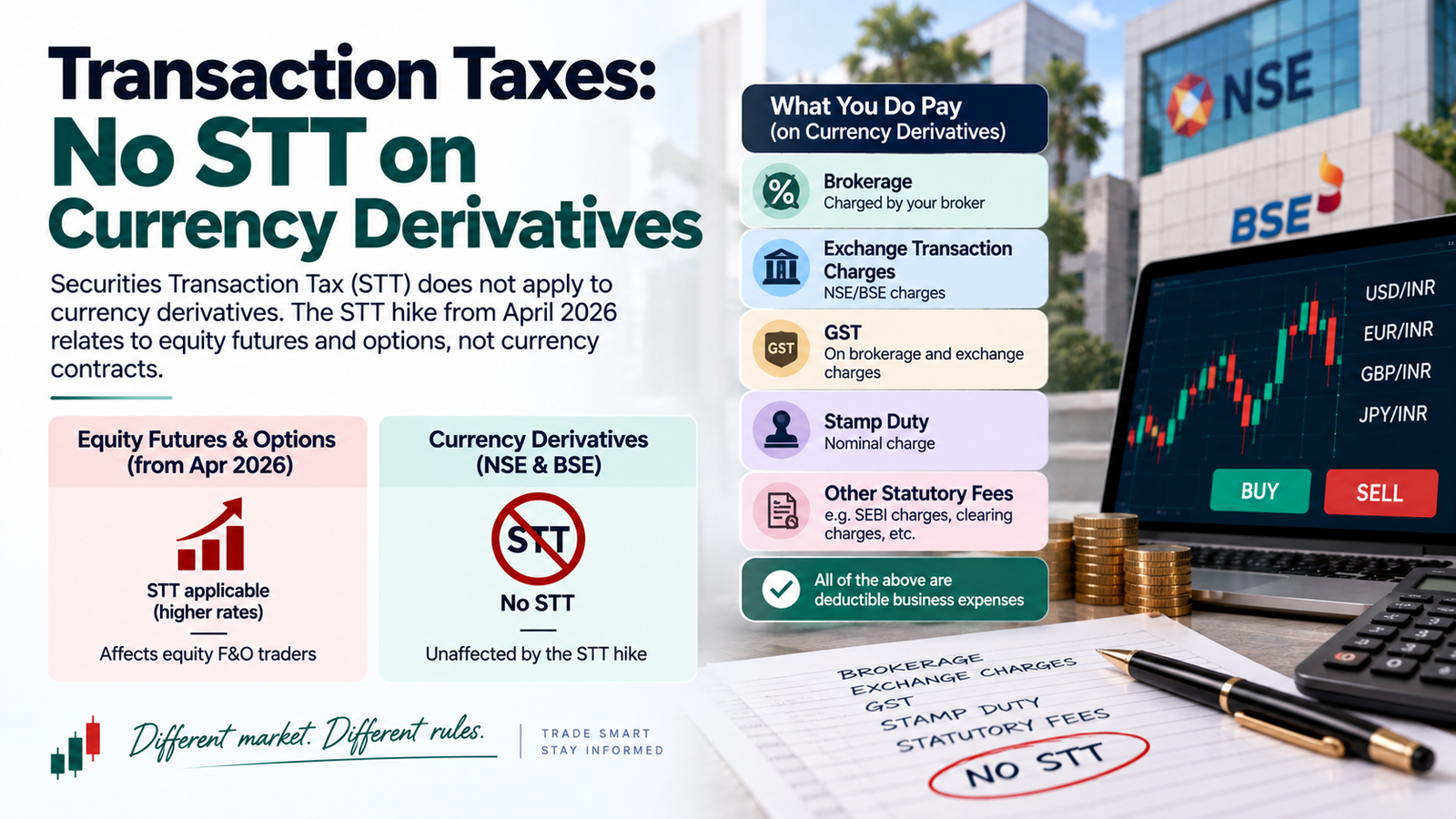
A point that trips up many traders: Securities Transaction Tax (STT) does not apply to currency derivatives. The widely reported STT hike from April 2026 relates to equity futures and options, not currency contracts. What you do pay on currency-derivative trades – brokerage, exchange transaction charges, GST on those charges, stamp duty and small statutory fees – are all deductible business expenses. So while equity F&O traders face higher STT costs, currency-derivative traders are unaffected by that particular change.
Tax Audit: Do You Need One?
A tax audit under Section 44AB may be required depending on your turnover. For derivatives, where transactions are digital, an audit is generally required if turnover exceeds Rs 10 crore. Additional audit triggers can apply in low-profit situations. Importantly, F&O turnover isn’t your trade value – it’s computed in a special way (broadly, the absolute total of your profits and losses), which is a common source of error. Because the turnover calculation and audit rules are nuanced, this is exactly the area to hand to a chartered accountant.
Which ITR Form and When to File
Currency-derivative income goes on ITR-3, the return for business or professional income. Deadlines for a given assessment year are typically:
| Situation | Typical due date (confirm each year) |
|---|---|
| No tax audit required | 31 July (sometimes extended) |
| Tax audit required | 31 October |
| Loss carry-forward | Only preserved if you file by the applicable due date |
Dates can be extended by the government, so always check the current year’s deadline – and note that late filing can cost you the loss carry-forward benefit.
The New Income-tax Act, 2025
A structural change worth knowing: the new Income-tax Act, 2025 came into force from 1 April 2026, replacing the Income-tax Act, 1961. For returns relating to FY 2025-26 the old Act still applied; from FY 2026-27 (the new ‘tax year’) the new Act governs. Reassuringly, for currency-derivative traders the core treatment – non-speculative business income at slab rates – has been retained; the main changes are structural, with simplified language and reorganised sections rather than a new way of taxing your trading. Still, confirm the current provisions, as terminology and section numbers have changed.
Deductible Business Expenses
Because it’s business income, you can reduce your taxable profit by legitimate trading expenses, including:
- Brokerage, exchange transaction charges, GST on those and stamp duty.
- Internet, electricity and a share of home-office costs used for trading.
- Advisory or subscription fees, and depreciation on trading equipment.
- Accounting and professional fees for maintaining books and filing.
Keep clean records of every expense – they directly lower your tax, and support your position if the department asks.
A Worked Example
Suppose you’re salaried and also trade currency derivatives:
Salary income: Rs 8,00,000
Currency-derivative profit: Rs 2,00,000 (business income)
Total income: Rs 10,00,000
The Rs 2,00,000 is ADDED to salary, and the whole
Rs 10,00,000 is taxed at the applicable slab –
not at a separate or lower rate.
If instead you made a trading loss, you could set it off against most other income except salary in the same year, or carry it forward – provided you file on time. (Illustrative; actual tax depends on your regime, deductions and the current slab bands.)
Offshore Forex and NRIs (Briefly)
Two edge cases. First, income from offshore forex platforms is still taxable even though using them is illegal under FEMA – but you’d be reporting income from an activity that itself breaches the law, so the right fix is to move to the legal exchange route, not to rely on it. Second, NRIs trading Indian currency instruments have their own rules, and the Double Taxation Avoidance Agreement (DTAA) between India and their country of residence can affect the final tax. Both situations need specialist advice.
Compliance Checklist
- Classify correctly – currency-derivative profit is non-speculative business income, not capital gains.
- Maintain records – trade statements, P&L, and every deductible expense.
- Compute turnover properly – use the absolute-profit method; check audit applicability.
- File ITR-3 on time – to pay correctly and preserve loss carry-forward.
- Use a chartered accountant – for audit, regime choice, advance tax and the new Act’s provisions.
Common Mistakes
- Treating trading profit as capital gains and using the wrong rate and form.
- Filing ITR-1 or ITR-2 instead of ITR-3 for business income.
- Miscomputing F&O turnover, triggering wrong audit conclusions.
- Filing late and losing the 8-year loss carry-forward.
- Not paying advance tax on business income when liability crosses the threshold.
Myths vs Facts
| Myth | Fact |
|---|---|
| Forex profit is capital gains. | It’s non-speculative business income taxed at slab rates, on ITR-3. |
| Currency derivatives attract STT. | They don’t; the 2026 STT hike applies to equity F&O, not currency. |
| Trading losses can’t be used. | They can be set off (not against salary) and carried forward 8 years. |
| Small trading volume isn’t taxable. | Even occasional F&O income is business income and must be reported. |
Tax disclaimer
This article is for educational purposes only and is not tax, legal or investment advice. Tax law changes with every Budget, the new Income-tax Act, 2025 applies from FY 2026-27, and individual circumstances vary greatly. Details here were checked against 2026 sources but may since have changed. Always verify current rules with the Income Tax Department and consult a qualified chartered accountant before filing or making decisions
Expert Analysis
The single most consequential fact about the tax on forex trading in India is the classification, because everything else flows from it. Once you accept that currency-derivative income is non-speculative business income rather than capital gains, the apparent complications resolve into a coherent system: slab rates apply, ITR-3 is the form, expenses are deductible, and losses enjoy the generous eight-year carry-forward. Traders who fight this – hoping for capital-gains rates or trying to file a simpler return – create their own problems, sometimes expensive ones, because the department treats even a handful of F&O trades as business activity. Accepting the business-income framing early makes the whole filing straightforward.
The under-appreciated advantage in that framing is the loss treatment, which quietly rewards honest, complete reporting. Because a bad year’s losses can offset most other income and roll forward for eight years, a trader who files ITR-3 on time effectively banks a tax asset for the future – but only if they file correctly and punctually. This flips the usual instinct to hide losses or skip filing in a losing year: for a currency-derivative trader, filing a loss return is often the financially smart move. Combined with clean expense records and a chartered accountant to handle turnover computation and audit questions, the system is far more trader-friendly than its reputation suggests. The 2026 arrival of the new Income-tax Act changes the wrapping, not the substance – so the enduring advice remains simple: classify it as business income, keep good records, file on time, and get professional help for the edges.
Key Takeaways
- Currency-derivative profit is non-speculative business income under Section 43(5)(d), taxed at slab rates.
- It’s not capital gains and is filed on ITR-3, added to your total income.
- Losses set off against most income (not salary) and carry forward 8 years – if you file on time.
- Currency derivatives don’t attract STT; the 2026 STT hike is on equity F&O.
- The new Income-tax Act 2025 (from FY 2026-27) keeps this treatment; consult a CA for your filing.
Frequently Asked Questions (FAQ)
Q: How is forex trading taxed in India?
A: Profit from exchange-traded currency derivatives is non-speculative business income under Section 43(5)(d), taxed at your slab rate and filed on ITR-3.
Q: Is forex trading business income or capital gains?
A: Business income. A derivatives contract isn’t a capital asset, so currency-derivative profit is never taxed as short- or long-term capital gains.
Q: Which ITR form do I use for forex trading?
A: ITR-3, the return for individuals with business or professional income.
Q: At what rate is forex profit taxed?
A: At your applicable income-tax slab rate, because it’s added to your total income – not at a special or flat rate.
Q: Do currency derivatives attract STT?
A: No. STT does not apply to currency derivatives; the 2026 STT hike relates to equity futures and options.
Q: Can I carry forward forex trading losses?
A: Yes. Non-speculative losses can be carried forward up to 8 years and set off against future business income, if you file ITR-3 on time.
Q: Can I set off forex losses against my salary?
A: No. Non-speculative business losses can be set off against most income except salary in the same year.
Q: Do I need a tax audit for forex trading?
A: Possibly. An audit is generally required if turnover exceeds Rs 10 crore, with extra triggers in low-profit cases; turnover is computed specially.
Q: How is F&O turnover calculated?
A: Broadly by the absolute-profit method (the total of absolute profits and losses), not by trade value – a common source of error.
Q: What expenses can I deduct?
A: Brokerage, exchange and statutory charges, GST on charges, internet, advisory fees, depreciation and professional fees, among others.
Q: When is the ITR filing deadline?
A: Typically 31 July for non-audit cases and 31 October if audited, but dates can be extended – check the current year.
Q: Does the new Income-tax Act 2025 change forex tax?
A: The core treatment (non-speculative business income at slab rates) is retained; changes are mainly structural. It applies from FY 2026-27.
Q: Is offshore forex income taxable?
A: Yes, income is taxable even from illegal activity – but using offshore platforms breaches FEMA, so move to the legal exchange route.
Q: Do NRIs pay tax on Indian currency-derivative income?
A: NRIs have specific rules, and the DTAA with their country of residence can affect the tax; specialist advice is essential.
Q: Should I hire a CA for forex tax?
A: For audit, regime choice, turnover computation and the new Act’s provisions, yes – it’s strongly recommended.