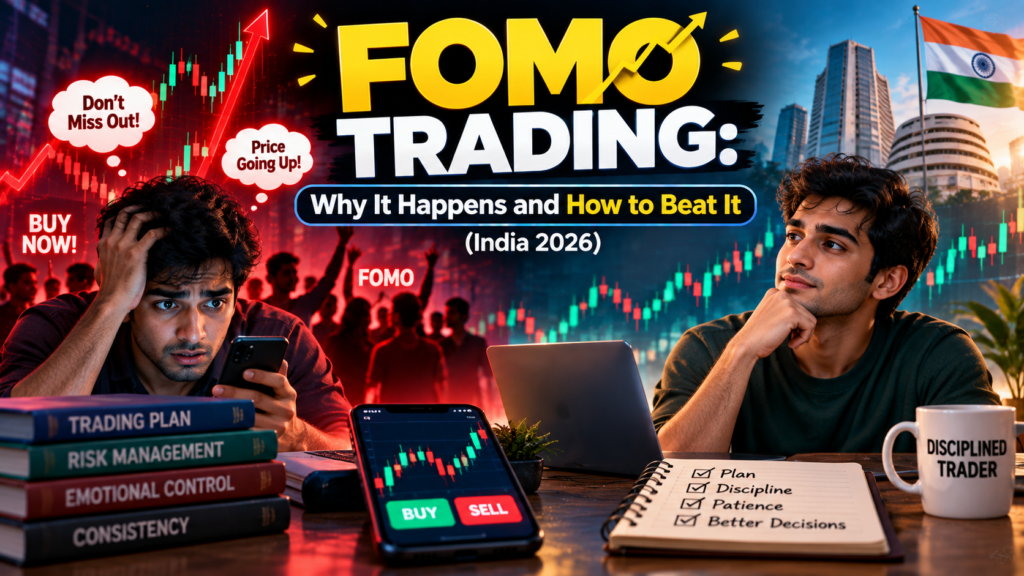
Quick answer: FOMO trading means entering a trade because you’re afraid of missing a move, not because it meets your plan. It usually happens after a sharp rally, a viral tip or a big news event. The result is buying late, near the top, with a far-away stop and little room left to profit. You beat FOMO with rules set in advance: trade only written setups, accept that you’ll miss some moves, never chase a trade that no longer offers at least 1:2 risk/reward, and cut your exposure to tip channels and live P&L screens.
Every trader has watched a stock or index surge without them and felt the urge to jump in. That urge is normal. Acting on it without a plan is what costs money. The damage is mathematical: a late entry shrinks your reward and enlarges your risk.
This guide explains what FOMO is, what it costs, why Indian traders are especially exposed, and a 7-step system to control it.
What is FOMO in trading?
Definition: FOMO (fear of missing out) in trading is the anxious urge to enter a position because others seem to be profiting from a move you’re not in. It swaps your plan for the crowd’s momentum.
Warning signs
- You enter after a big candle has already moved far from your planned entry.
- You buy because “everyone on Telegram/YouTube is in it.”
- You skip your checklist because “there’s no time.”
- You move to a bigger position or a riskier instrument (e.g., cheap out-of-the-money options) to “catch up.”
- You feel relief when you finally get in, rather than calm about a planned trade.
- You re-enter immediately after being stopped out because the move is still going.
The psychology behind FOMO
| Bias | What happens | How it fuels FOMO |
|---|---|---|
| Herd behaviour | Copying what others are doing | The crowd’s move feels like proof |
| Social proof | Using others’ actions as evidence | Screenshots of profits look like certainty |
| Recency bias | Overweighting the latest move | A strong last hour feels like it will continue all day |
| Loss aversion (of missed gains) | Missing a gain feels like a loss | You “pay” to stop the regret |
| Overconfidence | Believing you can time the late entry | You underestimate how often chases fail |
FOMO sits on the “greed” side of the fear-and-greed spectrum, but it’s driven by fear: fear of regret and of being left behind.
What FOMO really costs
The maths of a late entry (illustrative Nifty futures example)
A trader plans to buy a breakout above 25,040, with a stop under the setup’s low at 24,990 and a target of 25,170. They miss the entry. Price runs to 25,130, and they chase.
| Planned entry | FOMO entry | |
|---|---|---|
| Entry | 25,050 | 25,130 |
| Stop (same logical level) | 24,990 | 24,990 |
| Target | 25,170 | 25,170 |
| Risk (points) | 60 | 140 |
| Reward (points) | 120 | 40 |
| Risk / reward | 1 : 2 | 1 : 0.29 |
| Risk per lot (× 65) | ₹3,900 | ₹9,100 |
| Reward per lot (× 65) | ₹7,800 | ₹2,600 |
| Win rate needed to break even | 33.3% | 77.8% |
Break-even win rate = 1 ÷ (1 + reward/risk). The chase needs to win almost four times out of five just to break even, before charges. Most traders compensate by tightening the stop, which then gets hit by normal noise.
What the data shows in India
| Finding | Source | What it suggests |
|---|---|---|
| About 91% of individual F&O traders lost money in FY25; net losses of ₹1,05,603 crore | SEBI study, July 2025 | Most retail derivatives trading loses money |
| More than 75% of loss-making F&O traders kept trading after consecutive losing years | SEBI study, September 2024 | The pull to stay in the game is strong |
| Traders under 30 rose from 31% of F&O traders in FY23 to 43% in FY24; about 93% of them lost money | SEBI study, September 2024 | Younger traders, often reached through social media, are heavily exposed |
| Loss-makers made more intraday trades on average than profit-makers | SEBI study of FY23 intraday traders | More impulse trades, worse results |
These studies don’t measure FOMO directly. They show patterns (heavy participation, persistence after losses, high trade counts) that FOMO helps drive.
A global example: Bitcoin
Bitcoin peaked above $126,000 in October 2025. By June 2026 it was trading around $60,000–$62,000, roughly half its peak, according to market reports. Buyers who chased near the top faced large losses. Crypto is volatile, and FOMO-driven buying near highs is a common pattern in every speculative asset.
Where FOMO comes from in India
1. Finfluencers and tip channels
Telegram groups, YouTube channels and Instagram reels often post profit screenshots and “live” calls. These are built to trigger FOMO. SEBI has acted repeatedly:
| Date | SEBI action |
|---|---|
| August 2024 | Barred SEBI-regulated entities (brokers, advisers and others) from associating with unregistered people who give investment advice or claim returns. SEBI said over 15,000 pieces of content from unregulated finfluencers had been taken down in three months. |
| January 2025 | Restricted education-only entities from using recent market price data to talk about specific securities, to stop “education” being used to pass tips. The lag was set at three months. |
| July 2026 | The lag for using market price data in educational content was set at 30 days. |
What this means for you: a person giving specific buy/sell calls should be SEBI-registered as an investment adviser or research analyst. You can check registration on SEBI’s website. Unregistered tips add FOMO without accountability.
2. Weekly options expiries
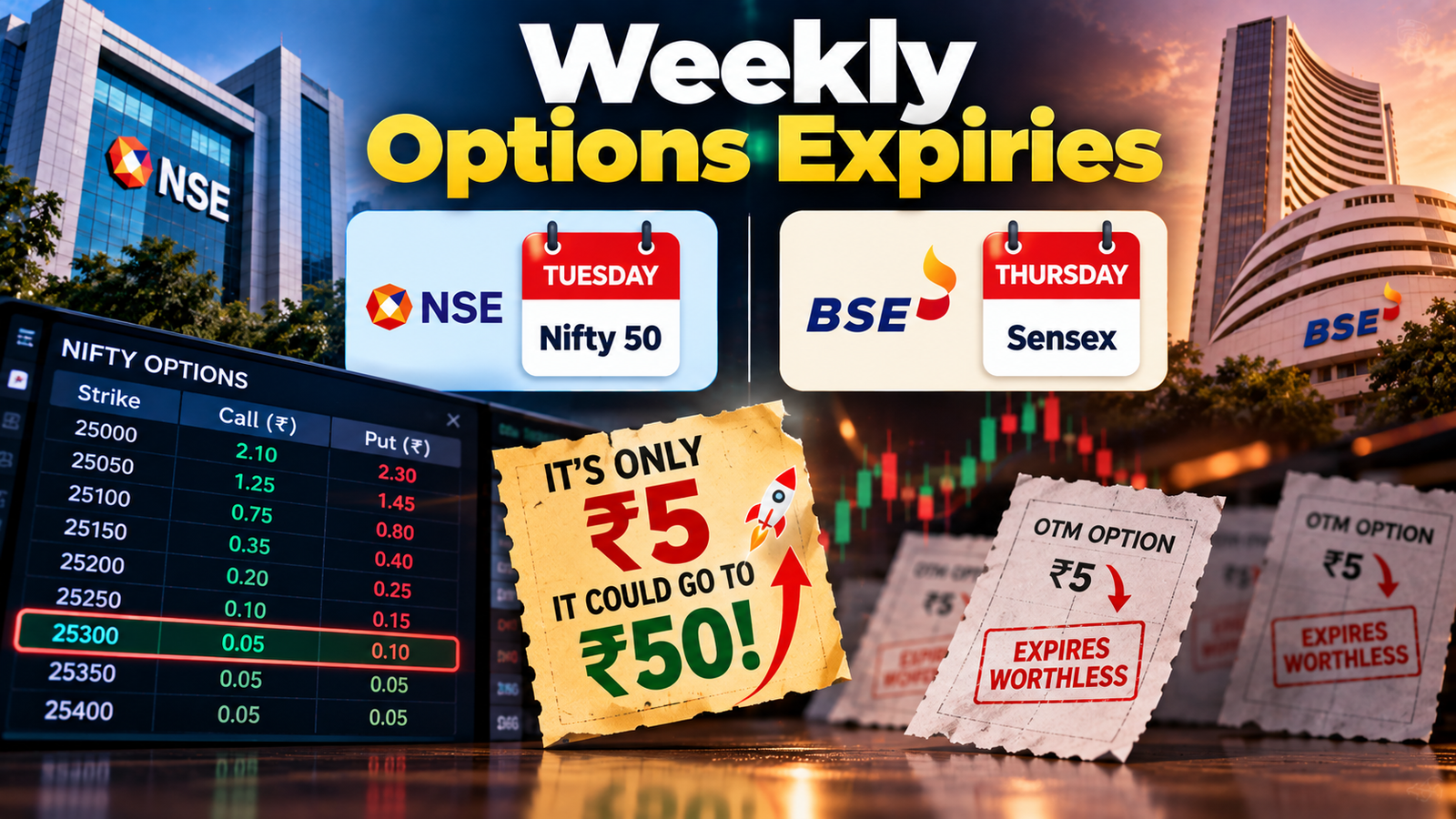
Since November 2024, each exchange can offer weekly expiry on only one benchmark index: Nifty 50 on NSE (Tuesday) and Sensex on BSE (Thursday). Cheap near-expiry option premiums still create a lottery-ticket feeling: “it’s only ₹5, it could go to ₹50.” Far out-of-the-money options bought near expiry often expire worthless.
3. Mobile apps and live P&L
Push alerts, top-gainer lists and one-tap orders shorten the time between feeling FOMO and acting on it to a few seconds.
4. Hot IPOs and themes
Heavily oversubscribed IPOs and “theme” rallies (a sector everyone is talking about) draw in new investors late in the move. Oversubscription shows demand for the issue; it does not guarantee listing gains or long-term returns.
5. Offshore forex and crypto apps
Ads for offshore forex apps promise fast profits. Trading on overseas online forex platforms is illegal for Indian residents under FEMA, and the RBI keeps an Alert List of unauthorised platforms. FOMO is often the hook these ads use.
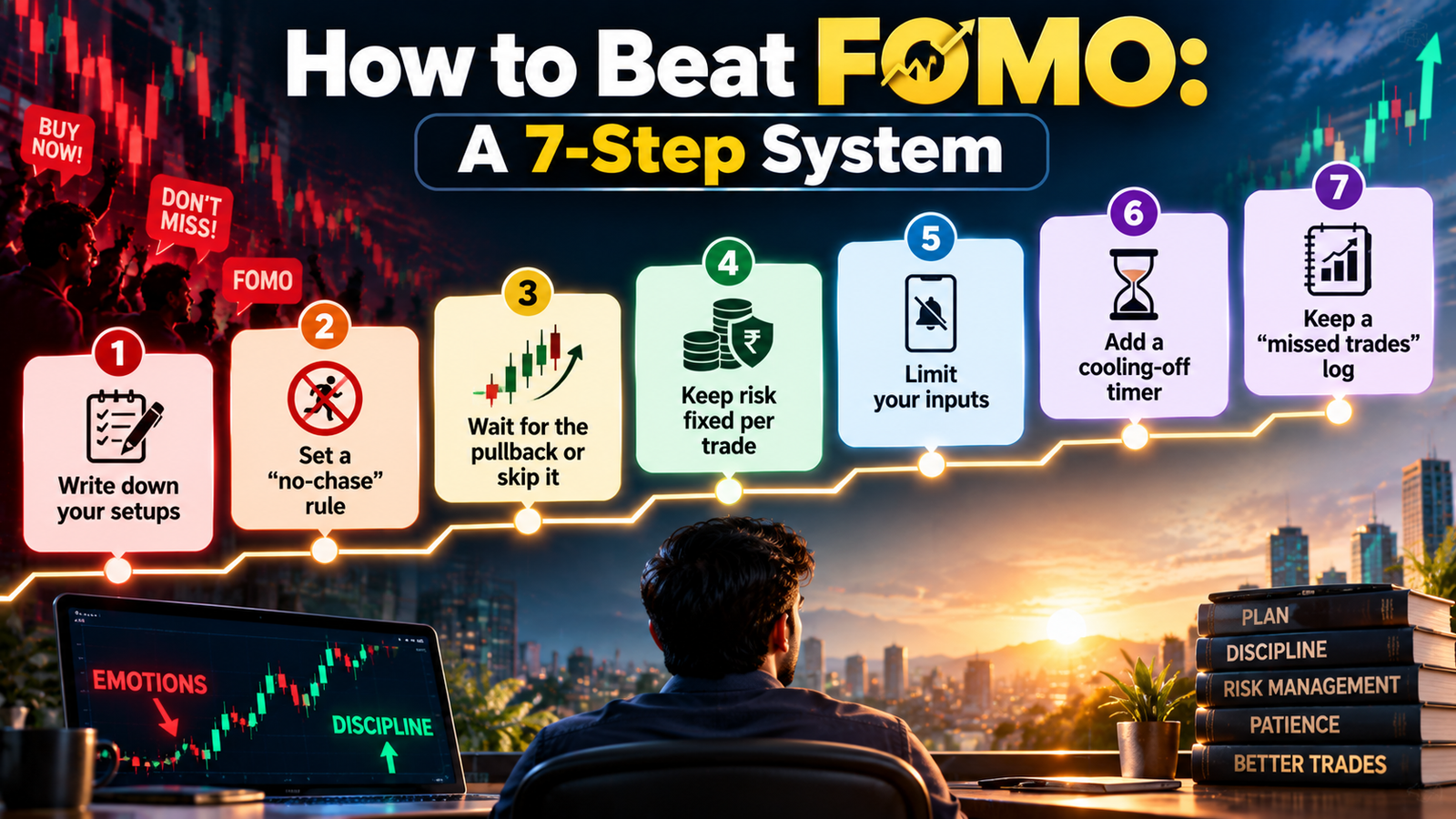
How to beat FOMO: a 7-step system
Step 1: Write down your setups
If a trade isn’t one of your written setups, it isn’t a trade. “Everyone is buying” is not a setup.
Step 2: Set a “no-chase” rule
Don’t enter if price has moved more than a set distance past your planned entry. A simple version: skip the trade if price is more than 0.5 × ATR beyond your entry level, or if the remaining risk/reward is below 1:2.
Example: Nifty 15-minute ATR = 40 points. Planned entry at 25,050, so the no-chase limit is 25,050 + 20 = 25,070. At 25,130, the trade is off.
Step 3: Wait for the pullback or skip it
Strong moves often retest the breakout level. Place a limit order at your planned price instead of chasing. If it doesn’t fill, you missed a trade, not money.
Step 4: Keep risk fixed per trade
Position size = risk budget ÷ risk per lot. With a ₹5,000 budget (1% of ₹5 lakh):
| Entry | Risk per Nifty lot | Lots |
|---|---|---|
| Planned (60-point stop) | ₹3,900 | 1 |
| Chase (140-point stop) | ₹9,100 | 0; trade doesn’t fit |
If the chase doesn’t fit your risk budget at one lot, the plan decides for you.
Step 5: Limit your inputs
- Leave or mute tip channels, especially those without SEBI registration.
- Turn off top-gainer and price-spike push alerts.
- Hide live P&L while a trade is open if it tempts you to act.
Step 6: Add a cooling-off timer
When you feel the urge to jump in, wait 10 minutes and run through your checklist. Most FOMO urges fade once the candle closes and the move slows.
Step 7: Keep a “missed trades” log
Record moves you didn’t take and what happened next. Many look great in hindsight but would have hit your stop first. Seeing that in writing reduces regret, which is the fuel of FOMO.
Anti-FOMO checklist
- This trade matches a written setup.
- Price is within 0.5 × ATR of my planned entry.
- Risk/reward is at least 1:2 from here.
- Size keeps risk within 1–2% of capital.
- The idea came from my analysis, not a tip or a screenshot.
- I have waited for the candle to close.
Expert analysis
Fact: SEBI studies found about 91% of individual F&O traders lost money in FY25, and more than 75% of loss-makers kept trading after consecutive losing years.
Fact: SEBI has restricted regulated entities from associating with unregistered finfluencers and limited the use of recent price data in educational content. The current lag is 30 days from July 2026.
Analysis: FOMO turns a good idea into a bad trade through price alone. The same breakout that offered 1:2 at the planned entry offered 1:0.29 after the chase. Nothing about the market changed; only the entry did.
Analysis: FOMO and overtrading feed each other. Each chased trade that fails creates regret, and regret drives the next chase. Trade caps, loss limits and a no-chase rule break that cycle at different points.
Opinion: for beginners, missing trades is part of the job. A plan that catches half the good moves with fixed risk will usually do better than one that chases every move at poor prices.
Common mistakes
- Entering after a large candle has already covered most of the move.
- Switching to cheap out-of-the-money options to “catch up.”
- Tightening the stop to make a chased trade fit your risk.
- Trading calls from unregistered channels.
- Re-entering immediately after a stop-out because the move continues.
- Treating oversubscribed IPOs or viral themes as guaranteed winners.
Myths vs facts
| Myth | Fact |
|---|---|
| If you don’t act now, you’ll miss the move | Markets offer new setups every day; missing one costs nothing |
| Cheap options limit your risk | You can still lose 100% of the premium, and far out-of-the-money options near expiry often expire worthless |
| A crowd buying means the move will continue | Crowded moves often reverse sharply |
| Screenshots prove a strategy works | They show winners, not the losses or the full record |
| FOMO means you have good instincts | It means your entry is being driven by emotion, not your plan |
Key takeaways
- FOMO trading is entering because you fear missing a move, not because it fits your plan.
- Chasing worsens risk/reward: 1:2 at the plan can become 1:0.29 after a chase.
- A chase can need a 78% win rate just to break even.
- In India, finfluencers, weekly expiries, app alerts and hot IPOs fuel FOMO.
- SEBI has cracked down on unregistered finfluencers; check registration before following any call.
- Beat FOMO with written setups, a no-chase rule, fixed risk, a cooling-off timer and a missed-trades log.
FAQs
1. What is FOMO in trading?
FOMO, or fear of missing out, is the urge to enter a trade because others seem to be profiting from a move you’re not in, rather than because it meets your plan.
2. Why is FOMO trading dangerous?
It usually means entering late, with a larger risk and a smaller reward. A trade that offered 1:2 risk/reward at the planned entry can fall below 1:1 after a chase.
3. How do I stop FOMO trading?
Trade only written setups, use a no-chase rule, keep risk fixed per trade, limit tip channels and alerts, wait 10 minutes before acting, and log the trades you miss.
4. What is a no-chase rule?
It is a rule that you won’t enter if price has moved too far past your planned entry, for example more than half the ATR, or if risk/reward from the current price is below 1:2.
5. Is FOMO the same as greed?
They overlap. FOMO looks like greed because you want the gain, but it is driven by fear of regret and of being left behind.
6. How does FOMO relate to overtrading?
FOMO adds trades you didn’t plan. Failed chases create regret, which drives more chasing. That cycle is a major cause of overtrading.
7. Why do traders buy at the top?
Because the rally is most visible and most talked about near its peak. Herd behaviour and recency bias make late buying feel safest just when it’s riskiest.
8. Are finfluencers legal in India?
Anyone can share education, but giving specific investment advice or recommendations requires SEBI registration. SEBI bars regulated entities from associating with unregistered advisers.
9. How do I check if someone is SEBI-registered?
Search for their name or registration number in the intermediary lists on SEBI’s website before acting on any advice.
10. Are cheap weekly options a good way to catch a big move?
They are high-risk. You can lose the entire premium, and far out-of-the-money options near expiry often expire worthless.
11. What should I do after missing a big move?
Log it, check whether your plan would really have caught it, and wait for the next valid setup. Don’t chase the current move.
12. Does FOMO affect long-term investors too?
Yes. Buying hot IPOs, themes or assets near their highs because everyone is talking about them is FOMO investing.
13. How did FOMO show up in Bitcoin?
Bitcoin peaked above $126,000 in October 2025 and was trading around $60,000–$62,000 by June 2026, according to market reports. Late buyers near the peak saw large losses.
14. Can a trading journal reduce FOMO?
Yes. Recording why you entered, and logging missed trades, shows how often chased trades fail and how many missed trades would have been losers.
15. Is it okay to miss trades?
Yes. Missing trades is normal and costs nothing. Taking bad-value trades is what costs money.
16. Are offshore forex apps a way to catch fast moves?
Trading on overseas online forex platforms is illegal for Indian residents under FEMA, and the RBI lists unauthorised platforms on its Alert List.