

Quick answer
Under SEBI forex trading rules, Indian residents may trade currencies only as exchange-traded futures and options, through SEBI-registered brokers, on recognised exchanges (NSE, BSE, MSE). Only seven pairs are allowed. Trading forex through offshore brokers, or remitting money abroad for margin trading, breaches FEMA and can bring penalties.
Introduction
Forex is one of the most searched trading topics in India, yet also one of the most misunderstood – largely because thousands of offshore platforms advertise aggressively while operating outside Indian law. The SEBI forex trading rules exist to draw a clear line between what is legal and what is not, and understanding them protects you from both financial fraud and legal trouble.
This guide explains those rules in plain language: who regulates forex, exactly what you’re allowed to trade, what’s banned, and how to do it legally. Regulatory details here were checked against current 2026 sources, but rules change – always confirm with SEBI, the RBI or a qualified professional. This is educational information, not legal or financial advice.
Who Regulates Forex Trading in India?
Three pillars govern currency trading in India, and the SEBI forex trading rules sit within this larger framework:
- FEMA (Foreign Exchange Management Act, 1999) – the governing law that defines which foreign-exchange transactions are permitted.
- RBI (Reserve Bank of India) – administers FEMA, controls the movement of foreign currency, and authorises electronic trading platforms.
- SEBI (Securities and Exchange Board of India) – regulates the brokers and the exchanges that offer currency derivatives to retail traders.
In short: RBI and FEMA decide what forex activity is allowed at all, while SEBI regulates how it happens on the exchanges. Legal forex trading has to satisfy both.
Is Forex Trading Legal in India?
Yes – but conditionally. Forex trading is legal in India only when it is done as exchange-traded currency derivatives, through a SEBI-registered broker, on a recognised Indian exchange, using an approved pair. Step outside any of those conditions – for example by using an offshore broker – and the activity falls outside FEMA and becomes illegal. The ‘yes’ is real, but narrow.
What the SEBI Forex Trading Rules Allow
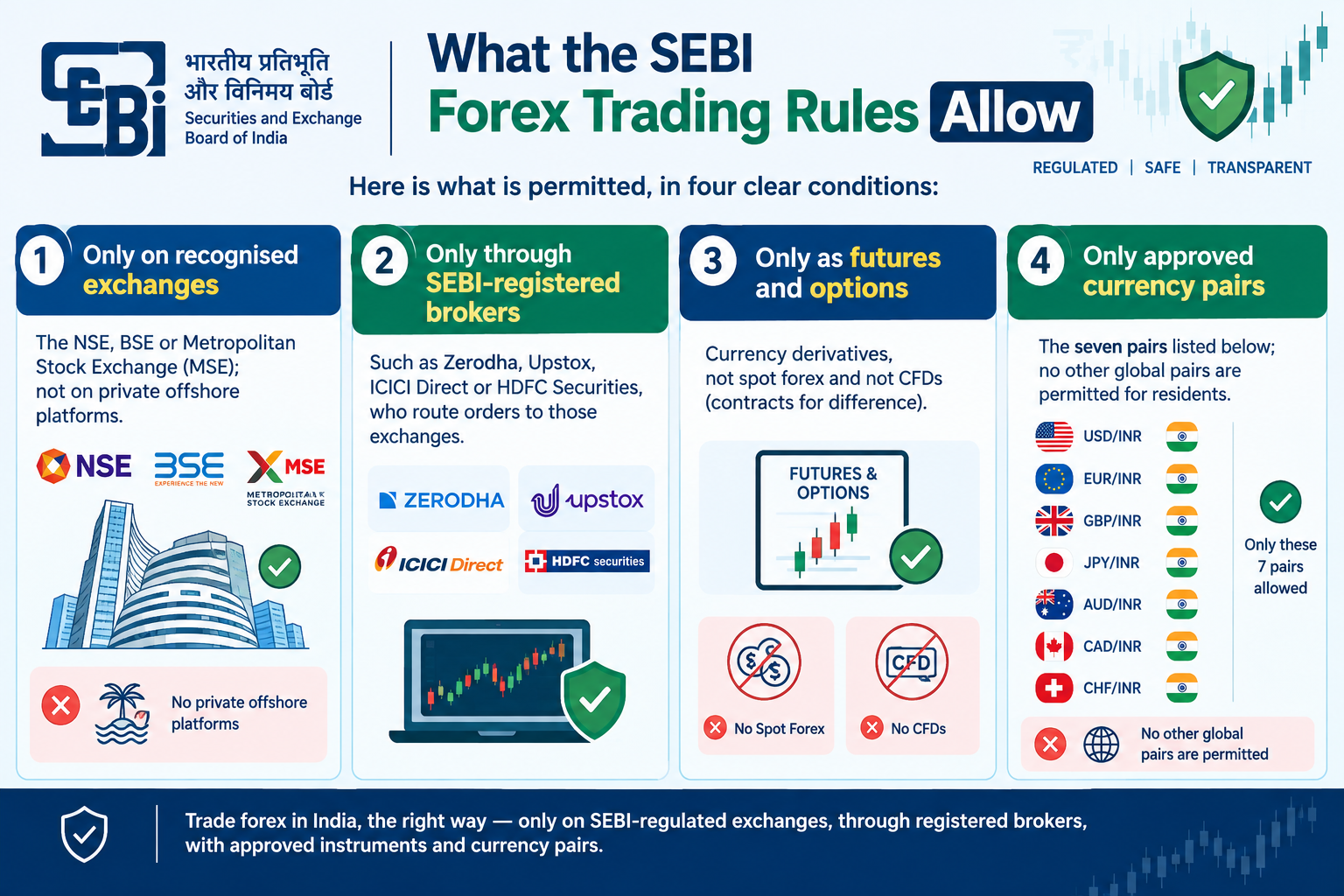
Here is what is permitted, in four clear conditions:
- Only on recognised exchanges – the NSE, BSE or Metropolitan Stock Exchange (MSE); not on private offshore platforms.
- Only through SEBI-registered brokers – such as Zerodha, Upstox, ICICI Direct or HDFC Securities, who route orders to those exchanges.
- Only as futures and options – currency derivatives, not spot forex and not CFDs (contracts for difference).
- Only approved currency pairs – the seven pairs listed below; no other global pairs are permitted for residents.
The Seven Permitted Currency Pairs
Indian residents can legally trade just seven currency pairs as exchange-traded derivatives – four involving the rupee and three cross-currency pairs added in recent years:
| Category | Permitted pairs |
|---|---|
| INR pairs | USD/INR, EUR/INR, GBP/INR, JPY/INR |
| Cross-currency pairs | EUR/USD, GBP/USD, USD/JPY |
Any pair outside this list – AUD/USD, USD/CAD, GBP/JPY and so on – cannot legally be traded by residents through offshore platforms. The three cross pairs are legal only as exchange-traded contracts on Indian exchanges, not through overseas OTC brokers.
What Is NOT Allowed
The SEBI forex trading rules, together with RBI and FEMA, prohibit a large slice of what offshore ads promote:
- Offshore / global OTC brokers – international retail platforms are not authorised for Indian residents.
- Spot forex and CFDs – these products fall outside the permitted exchange-traded framework.
- Binary options and ‘guaranteed profit’ schemes – not permitted and often outright scams.
- Remitting money abroad for margin trading – the Liberalised Remittance Scheme (LRS) does not allow it.
- Using a VPN to access banned platforms – this does not make the activity legal; it still breaches FEMA.
The LRS Restriction (a Key Point Many Miss)
The Liberalised Remittance Scheme lets residents send money abroad for certain purposes – travel, education, investment – but it explicitly does not permit remittances for margin or forex trading on overseas platforms. This is one of the most misunderstood parts of the SEBI forex trading rules ecosystem: even if an offshore broker accepts your deposit (sometimes via UPI or cards), funding it for forex margin trading is a FEMA violation. Legality is about the route and the product, not just whether a payment goes through.
The RBI ‘Alert List’ of Unauthorised Platforms
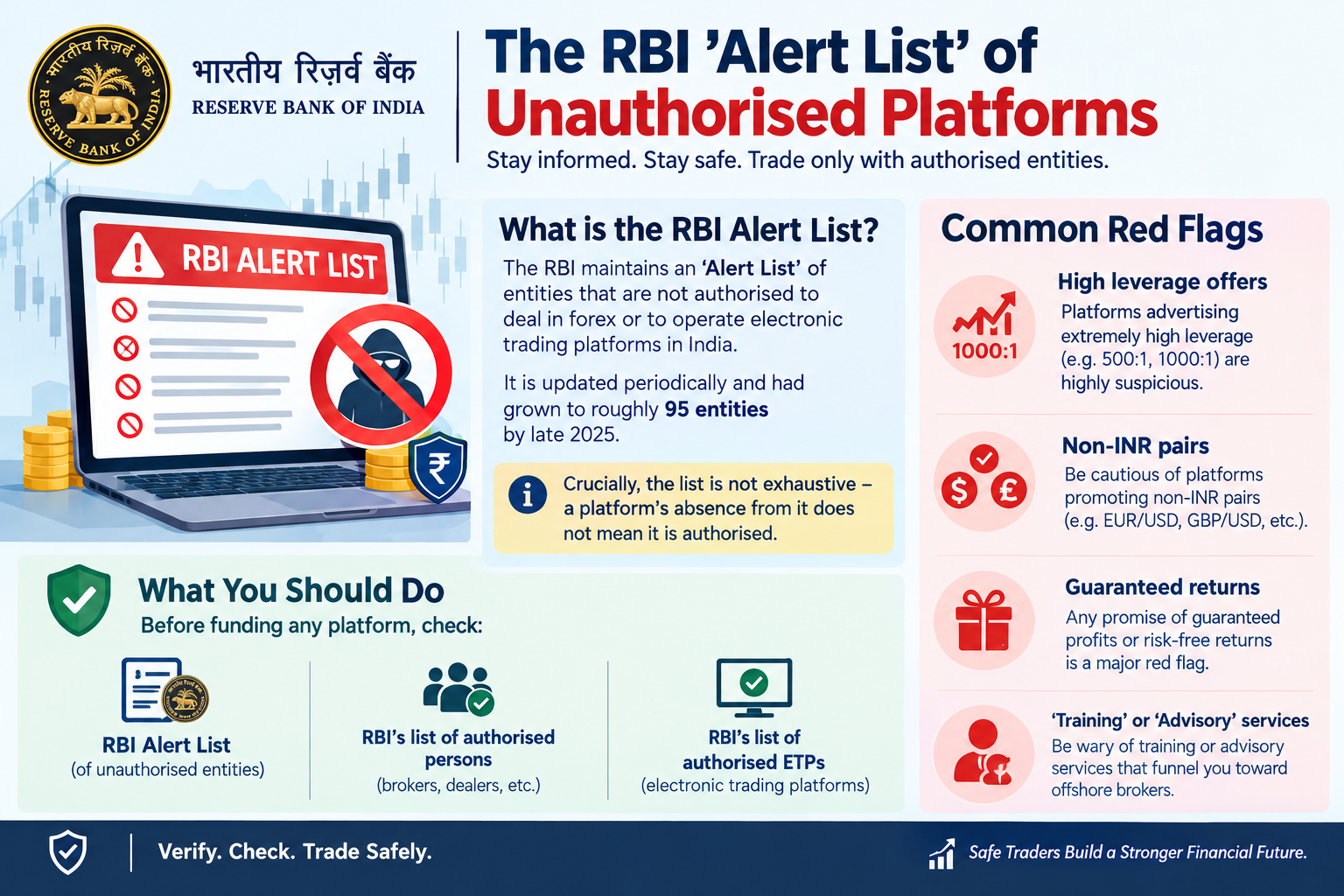
To help the public, the RBI maintains an ‘Alert List’ of entities that are not authorised to deal in forex or to operate electronic trading platforms in India. It is updated periodically and had grown to roughly 95 entities by late 2025. Crucially, the RBI stresses the list is not exhaustive – a platform’s absence from it does not mean it is authorised.
- Before funding any platform, check the RBI Alert List and the RBI’s lists of authorised persons and authorised ETPs.
- Be wary of platforms advertising high leverage, non-INR pairs, or guaranteed returns.
- Training or ‘advisory’ services that funnel you toward offshore brokers can also appear on the list.
Penalties for Breaking the Rules
Trading forex outside the permitted framework is a FEMA contravention, not a minor technicality. Penalties under FEMA can be significant – up to three times the sum involved where the amount is quantifiable – along with possible further action. Beyond the legal risk, the practical danger is losing your money entirely: offshore and scam platforms operate outside Indian jurisdiction, so if funds disappear, neither SEBI nor the RBI can help you recover them.
How to Trade Forex Legally in India (Checklist)
- Open an account with a SEBI-registered broker – verify their registration on SEBI’s intermediary list.
- Activate the currency derivatives segment – complete KYC with PAN and bank details.
- Trade only the seven permitted pairs – as futures or options on the NSE, BSE or MSE.
- Avoid offshore platforms entirely – check the RBI Alert List and authorised-ETP list first.
- Keep records and pay tax – maintain trade records and report income; consult a chartered accountant.
A Note on Tax
Income from exchange-traded currency derivatives is generally taxed as business income in India, added to your total income and taxed at your applicable slab. The precise classification and treatment can be nuanced and depend on your overall trading activity, so confirm specifics with a qualified chartered accountant rather than relying on a general rule.
Common Misconceptions
- ‘A VPN makes it legal.’ – It doesn’t; the activity still breaches FEMA.
- ‘It’s popular, so it must be allowed.’ – Heavy advertising is not authorisation.
- ‘The platform accepts UPI, so it’s fine.’ – Payment acceptance is not legal permission.
- ‘All forex is banned in India.’ – False; exchange-traded currency derivatives are legal.
- ‘If it’s not on the Alert List, it’s approved.’ – The list is not exhaustive; verify authorisation directly.
Myths vs Facts
| Myth | Fact |
|---|---|
| Forex trading is fully banned in India. | Exchange-traded currency derivatives on NSE/BSE/MSE are legal for residents. |
| You can trade any global pair. | Only seven approved pairs are permitted for residents. |
| Offshore brokers are a grey area. | They are not authorised for residents; using them breaches FEMA. |
| LRS can fund overseas forex margin. | LRS explicitly does not allow remittance for margin/forex trading. |
Compliance disclaimer
This article is for educational purposes only and is not legal, tax or investment advice. Regulations under SEBI, the RBI and FEMA change and are enforced strictly. Details here were checked against 2026 sources but may since have changed. Always verify current rules directly with SEBI and the RBI, and consult a qualified professional before trading or remitting funds.
Expert Analysis
The logic behind the SEBI forex trading rules becomes clear once you see them as capital-control policy rather than trading policy. India manages the flow of foreign currency across its borders through FEMA, so the concern is less about whether citizens speculate and more about where the money goes and whether it leaves the country through unmonitored channels. That is why the rules permit currency derivatives on domestic exchanges – where trades are rupee-settled and supervised – while prohibiting offshore platforms that would move capital outside the system. Understanding this intent helps a trader predict which activities will always be off-limits.
For the retail trader, the practical takeaway is that the legal path is also the safer one. The same offshore platforms that break FEMA are the ones offering reckless leverage, opaque pricing and no recourse if funds vanish – and they dominate Indian forex advertising precisely because the regulated venues cannot make such promises. Sticking to a SEBI-registered broker and the seven approved pairs is therefore not just about avoiding penalties; it is the single most effective consumer-protection decision a beginner can make. When a platform’s pitch sounds far better than what a regulated exchange offers, that gap is usually the risk you would be taking on.
Key Takeaways
- Forex is legal in India only as exchange-traded currency derivatives via SEBI-registered brokers on NSE, BSE or MSE.
- Only seven pairs are permitted: four INR pairs and three cross pairs (EUR/USD, GBP/USD, USD/JPY).
- Offshore brokers, spot forex, CFDs and binary options are not permitted and breach FEMA.
- The LRS does not allow remitting money abroad for forex margin trading.
- Penalties can reach up to three times the amount involved; always verify a platform on the RBI Alert List.
Frequently Asked Questions (FAQ)
Q: What are SEBI’s rules for forex trading?
A: Residents may trade currencies only as exchange-traded futures and options, through SEBI-registered brokers, on recognised exchanges (NSE, BSE, MSE), and only in the seven approved pairs.
Q: Is forex trading legal in India?
A: Yes, but only within the SEBI/RBI/FEMA framework – exchange-traded currency derivatives on Indian exchanges. Offshore platform trading is illegal.
Q: Which currency pairs can I legally trade?
A: Four INR pairs (USD/INR, EUR/INR, GBP/INR, JPY/INR) and three cross pairs (EUR/USD, GBP/USD, USD/JPY), all as exchange-traded derivatives.
Q: Are offshore forex brokers legal for Indians?
A: No. International OTC brokers are not authorised for Indian residents, and using them breaches FEMA.
Q: Can I trade spot forex or CFDs in India?
A: No. Only exchange-traded currency futures and options are permitted; spot forex and CFDs fall outside the framework.
Q: What is the RBI Alert List?
A: A regularly updated list of entities not authorised to deal in forex or run electronic trading platforms in India. It is not exhaustive.
Q: Can I use LRS to fund a forex account abroad?
A: No. The Liberalised Remittance Scheme does not permit remittances for margin or forex trading on overseas platforms.
Q: What are the penalties for illegal forex trading?
A: It is a FEMA contravention, with penalties that can reach up to three times the sum involved, plus the risk of losing funds entirely.
Q: Does using a VPN make offshore trading legal?
A: No. A VPN hides your location but does not change the law; the activity still breaches FEMA.
Q: Which exchanges can I trade currencies on?
A: The National Stock Exchange (NSE), BSE and the Metropolitan Stock Exchange (MSE).
Q: How do I check if a broker is legal?
A: Verify the broker on SEBI’s registered-intermediary list and ensure trades route through a recognised exchange.
Q: Is forex income taxable in India?
A: Yes. Income from currency derivatives is generally taxed as business income at your slab; confirm specifics with a chartered accountant.
Q: Why are offshore platforms so heavily advertised?
A: Because they operate outside Indian jurisdiction and can promise high leverage and returns that regulated venues cannot – which is also the risk.
Q: Who regulates forex trading in India?
A: RBI and FEMA govern what forex activity is allowed; SEBI regulates the brokers and exchanges offering currency derivatives.
Q: Can NRIs trade forex in India?
A: Rules for NRIs differ and depend on account type and residency status; NRIs should seek specific professional advice before trading.