One of the first questions every new trader asks is a simple one: what is the minimum capital for forex trading India? For Indian residents, the honest answer is refreshingly small — but it comes wrapped in rules that matter far more than the number itself. Understanding the minimum capital forex trading India requires means understanding not just the rupee figure, but the legal framework that decides where, how, and even whether you can trade at all.
This guide breaks down the realistic minimum capital for forex trading in India, the hidden costs beyond your margin, how much you should genuinely set aside before placing your first trade, and why the “low deposit” offers you see online are usually a trap.
First, What “Forex Trading” Legally Means in India
Before discussing any starting amount, you need to know what you are actually allowed to trade. Forex trading in India is not the same as the “spot forex” popular in the US, UK, or Dubai, where traders buy and sell currencies directly through leveraged margin accounts on platforms like MetaTrader.
In India, retail traders can legally trade only currency derivatives — futures and options — on recognised exchanges: the NSE, BSE, and the Metropolitan Stock Exchange (MSE). Every trade must be routed through a SEBI-registered broker. The market sits under a dual regulatory system: the Reserve Bank of India (RBI) controls foreign exchange policy under the Foreign Exchange Management Act (FEMA), while the Securities and Exchange Board of India (SEBI) regulates the brokers and the exchanges themselves.
The currency pairs you can legally trade are limited by design. The four permitted rupee pairs are USD/INR, EUR/INR, GBP/INR, and JPY/INR. Since 2018, three cross-currency pairs — EUR/USD, GBP/USD, and USD/JPY — are also allowed on the NSE. Anything outside this list, traded through an unregistered offshore broker, falls outside Indian law.
This matters for your budget because the minimum capital forex trading India involves is defined by exchange margin rules, not by whatever tiny deposit a foreign website happens to advertise.
The minimum capital for forex trading India
Here is the number most people come looking for. On the NSE, one USD/INR futures contract has a notional size of $1,000. Because you trade on margin, you do not pay the full value — you post only a fraction of it. The initial margin for a single USD/INR lot typically works out to roughly ₹2,500 to ₹3,500, depending on current volatility and the exchange’s daily risk calculations.
That figure surprises people. With the rupee near ₹88 to the dollar, a single lot controls a contract worth close to ₹88,000, yet you can open it with under ₹3,500 — leverage of roughly 25 to 30 times. In theory, then, you could enter a position with less than ₹3,000. But the initial margin is not the same as the minimum capital forex trading India realistically demands. Trading with exactly the margin amount leaves you zero buffer — a small adverse move can trigger a margin call or an automatic square-off within minutes.
A more practical starting balance sits between ₹10,000 and ₹25,000. This range gives you enough cushion to absorb normal price swings, hold a position through intraday volatility, and avoid being forced out of a trade on a temporary dip. So while the technical minimum investment forex on an Indian exchange can be a few thousand rupees, the working minimum capital for forex trading in India is closer to ten or twenty thousand.
Traders who prefer options over futures can sometimes start with even less, since buying a currency option costs only the premium rather than a full margin. Options carry their own complications, though, and most beginners are wisely steered toward understanding futures first.
What You Need Besides Money to Get Started
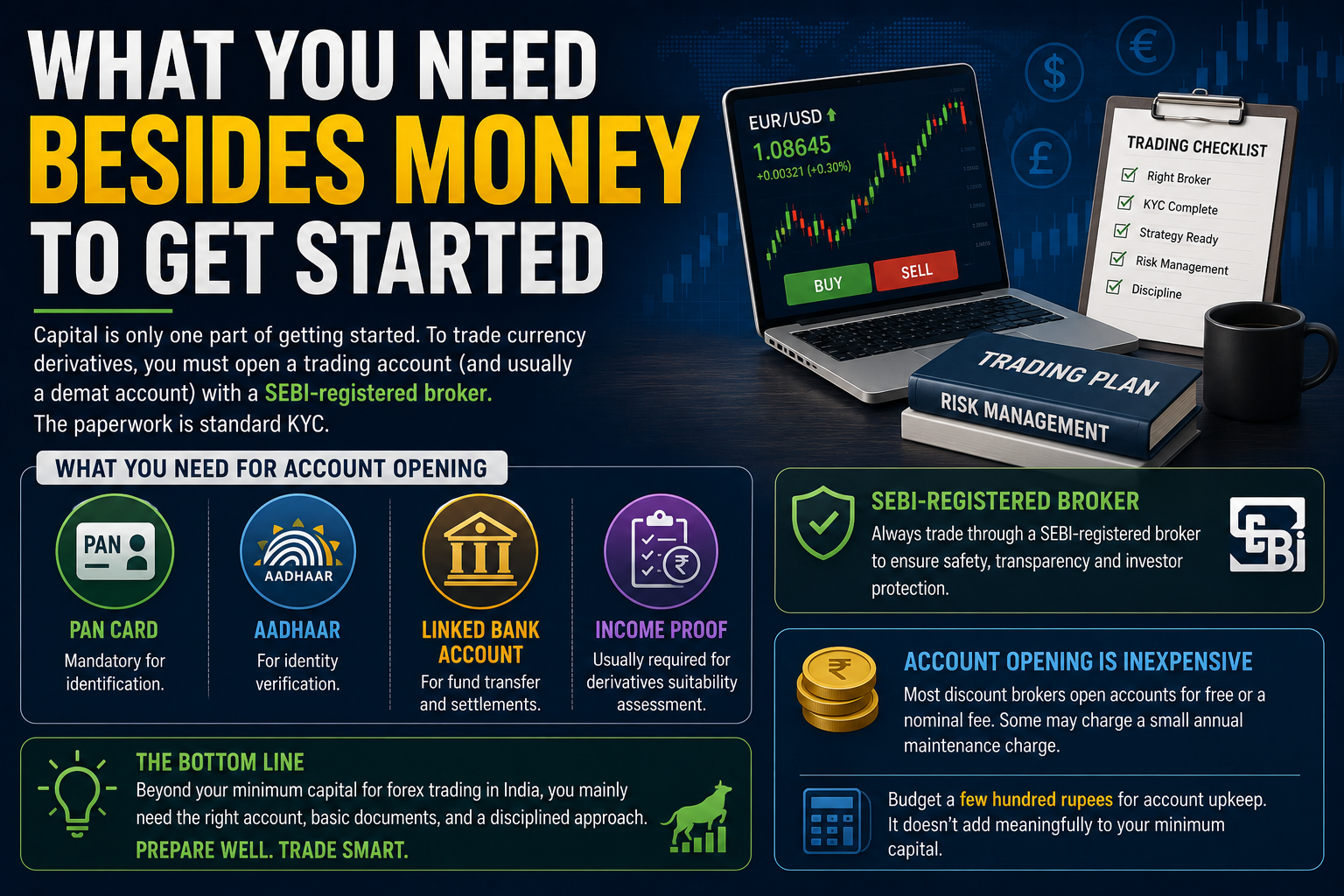
Capital is only one part of getting started. To trade currency derivatives, you must open a trading account (and usually a demat account) with a SEBI-registered broker. The paperwork is standard KYC: a PAN card, Aadhaar for verification, a linked bank account, and often income proof, since derivatives require a basic suitability check.
The good news is that account opening is inexpensive. Most discount brokers open accounts for free or a nominal fee, though some charge a small annual maintenance charge. None of this adds meaningfully to the minimum capital for forex trading in India, but budgeting a few hundred rupees for account upkeep keeps your expectations realistic.
Costs Beyond Your Margin
The margin is only part of the financial picture. When calculating how much to start forex trading, you must factor in the transaction costs that quietly eat into every single trade.
A single USD/INR futures round-trip — one buy and one sell — at a discount broker generally includes brokerage of around ₹20 per order, NSE exchange transaction charges, 18% GST on that brokerage, small SEBI turnover fees, and stamp duty. Helpfully, currency derivatives attract zero Securities Transaction Tax (STT), unlike equity trades. Add it all together and a round-trip costs roughly ₹25 to ₹35 per contract.
Those numbers look trivial, but they compound fast. A trader placing several trades a day soon finds that costs alone demand consistent, disciplined performance just to break even. This is precisely why your minimum capital for forex trading in India should account for costs, not just margin — a ₹10,000 account churned with dozens of trades will bleed out through fees regardless of which way the market moves.
How Much Should You Realistically Start With?
If the exchange minimum is a few thousand rupees and the practical minimum is ten to twenty-five thousand, what is the right forex trading starting amount India traders should actually aim for?
For a genuine beginner, a sensible answer is ₹15,000 to ₹25,000. This is not because you need that much to place a trade, but because you need enough to trade sanely — to size positions conservatively, keep a buffer, and treat early losses as tuition rather than catastrophe.
There is a hard truth worth stating plainly. SEBI’s FY2025 study found that 91% of individual traders in the futures and options segment lost money, with collective losses running into lakhs of crores. Currency derivatives are leveraged instruments, which means losses can exceed your initial outlay if you are careless. The right forex trading starting amount India beginners should use is therefore money you can afford to lose entirely — never borrowed funds, and never money earmarked for essentials or emergencies.
A reasonable rule is to risk only 1% to 2% of your capital on any single trade. On a ₹20,000 account, that means risking ₹200 to ₹400 per position. This discipline stretches a modest minimum investment forex account far enough to actually learn the craft, rather than blowing up within a week. The traders who survive are almost never the ones who started with the most money — they are the ones who protected the capital they had.
The Offshore “Low Minimum” Trap
Search “how much to start forex trading” and you will find dozens of foreign brokers boasting minimum deposits of $10, $50, or $100. For Indian residents, these attractive numbers are a trap dressed up as an opportunity.
Trading through offshore brokers that are not SEBI-registered — or remitting money abroad under the Liberalised Remittance Scheme to fund speculative forex margin — violates FEMA. The penalties are serious: fines of up to three times the amount involved, or a flat ₹2 lakh where the sum cannot be quantified. The RBI also publishes a regularly updated “Alert List” naming unauthorised platforms, and it continues to grow.
So while a foreign site might advertise a far lower entry point than the minimum capital forex trading India exchanges require, choosing that route simply swaps a small legal deposit for a large legal liability. A reliable warning sign of an illegal setup is a broker offering MT4 or MT5 to Indian clients; SEBI-registered brokers use their own proprietary platforms and route every trade through Indian exchanges. The genuine minimum capital for forex trading in India is the one that keeps you firmly on the right side of the law.
Matching Your Capital to Your Strategy
The right minimum investment forex figure also depends heavily on how you intend to trade.
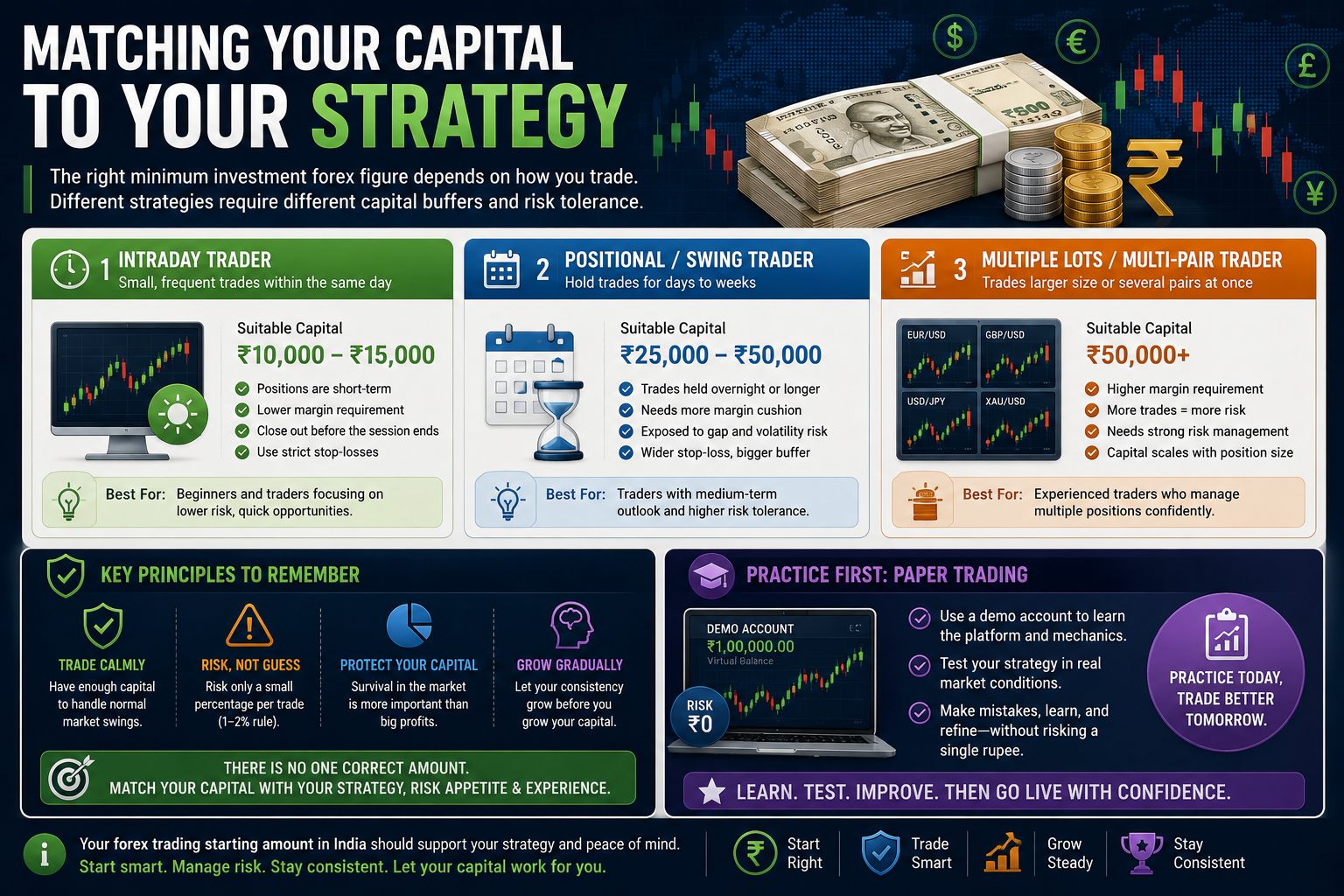
An intraday trader taking small, frequent positions can operate with ₹10,000 to ₹15,000, provided they respect strict stop-losses and close out before the session ends. A positional or swing trader holding contracts over several days needs a larger buffer — closer to ₹25,000 to ₹50,000 — because overnight and multi-day moves demand more margin cushion and expose the account to gap risk. Someone trading multiple lots, or several pairs at once, naturally needs proportionally more.
There is no single correct forex trading starting amount India suits everyone; the number scales with your risk appetite, chosen strategy, and experience level. What stays constant is the principle: start with enough to trade calmly, and never so much that a losing streak threatens your financial stability.
Many experienced traders also recommend paper trading — practising with a simulated account — before committing real money. It costs nothing, teaches you the mechanics and the platform, and lets you test a strategy without risking a single rupee of your minimum capital.
Should You Add More Capital Over Time?
A common mistake beginners make is topping up a losing account, hoping more funds will turn things around. In reality, extra capital only magnifies losses if your strategy is not yet profitable. A far healthier approach is to start at the minimum capital for forex trading in India that lets you trade comfortably, prove you can manage risk consistently over several months, and only then scale up.
Think of your first account as a controlled experiment rather than an income source. Once you have a track record of disciplined, profitable trading on a small balance, adding capital becomes a rational business decision instead of an emotional reaction. Growing your minimum capital forex trading India account in step with your proven skill — not your hopes — is what separates traders who last from those who quietly disappear.
Final Thoughts
So, how much money do you need to start forex trading in India? Technically, the margin on a single USD/INR lot means you could begin with under ₹3,000. Practically, the minimum capital forex trading India rewards is around ₹10,000 to ₹25,000, giving you the buffer to trade properly. And responsibly, you should only ever start with money you can afford to lose.
The far more important lesson is that the size of your account matters less than trading legally, managing risk, and keeping your costs in check. A small, well-managed account on a SEBI-registered platform will always outperform a large one exposed to illegal offshore risk. Get the framework right first, and deciding on the minimum capital for forex trading in India becomes the easiest part of the whole decision.
Frequently Asked Questions
What is the minimum amount to start forex trading in India? The exchange margin on one USD/INR futures lot is roughly ₹2,500 to ₹3,500, but a practical minimum capital for forex trading in India is around ₹10,000 to ₹25,000 to allow for a safe buffer.
Can I start forex trading with ₹5,000 in India? Yes, technically you can post margin for a single lot with ₹5,000, but it leaves little room for adverse moves. Most beginners are better served treating ₹10,000 to ₹15,000 as their realistic minimum investment forex account.
Is forex trading through international brokers legal in India? No. Indian residents can legally trade currency derivatives only through SEBI-registered brokers on recognised exchanges. Using unregistered offshore brokers can attract penalties under FEMA.
How much to start forex trading if I am a complete beginner? A conservative forex trading starting amount India beginners can consider is ₹15,000 to ₹25,000, used with strict risk management and only money you can genuinely afford to lose.