Key Takeaways
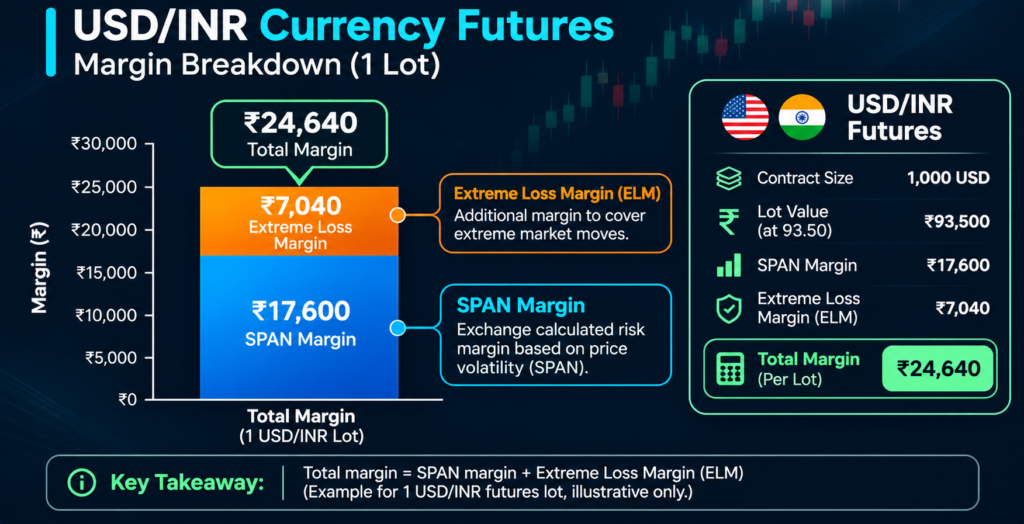
- Margin on NSE currency futures has two main parts: SPAN initial margin plus extreme loss margin (ELM).
- SPAN is a portfolio-based risk margin set to cover a one-day loss at 99% value at risk (two days for futures where mark-to-market cannot be collected before the next day’s trading).
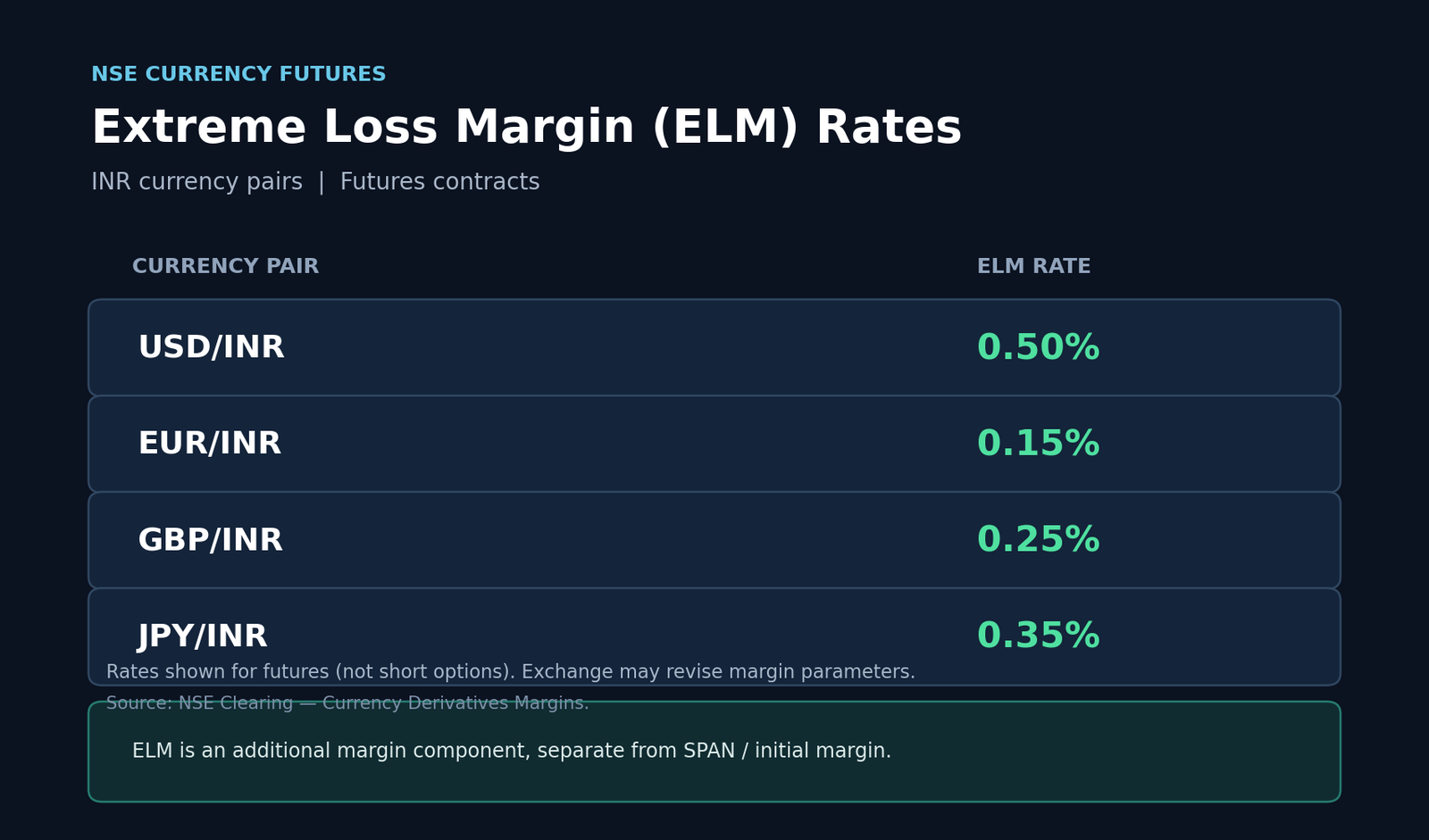
- ELM on futures is 0.50% for USD/INR, 0.15% for EUR/INR, 0.25% for GBP/INR and 0.35% for JPY/INR, per NSE Clearing.
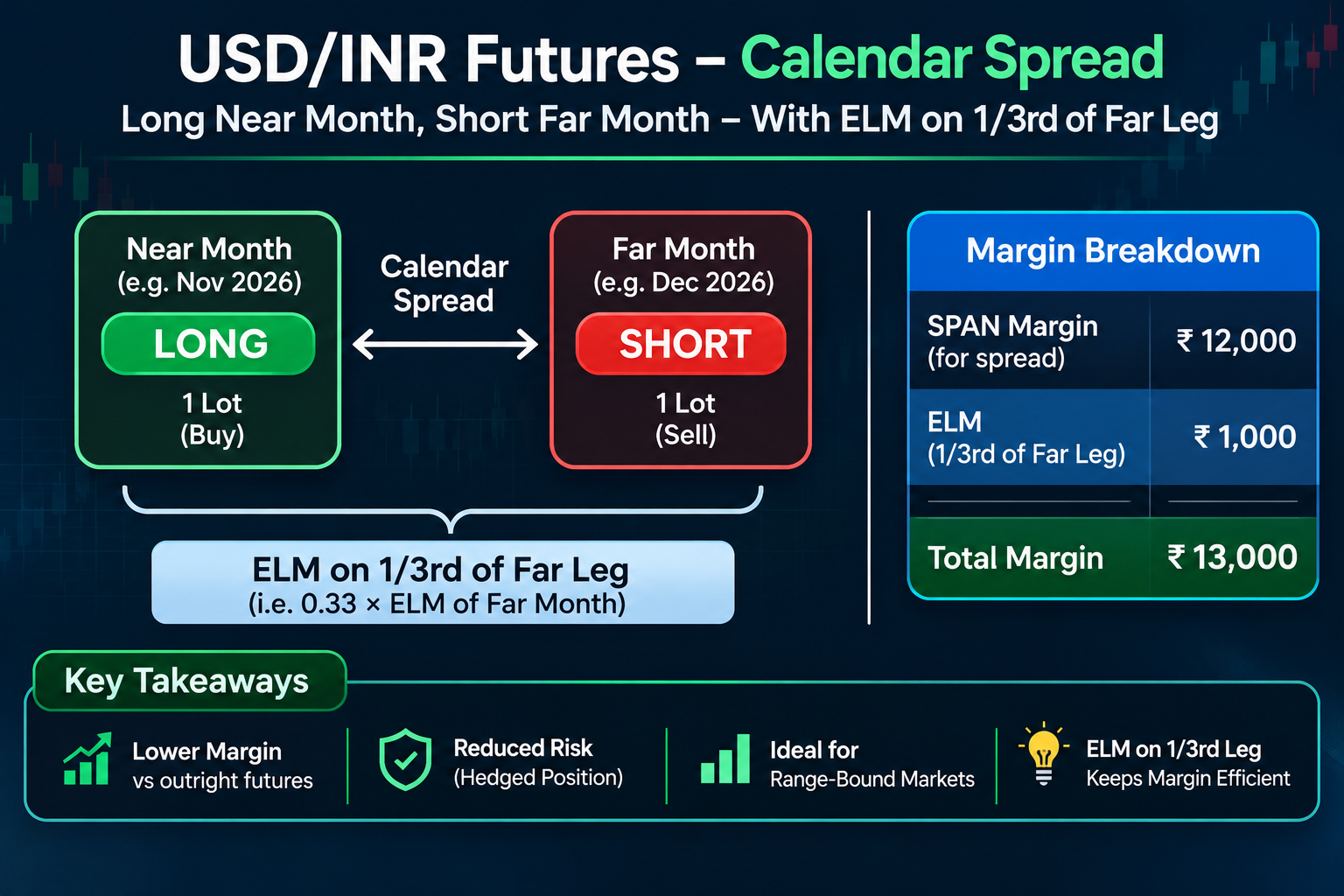
- Calendar spreads get a large ELM benefit: ELM is charged on only one-third of the far-month leg.
- Under SEBI’s peak margin rules, your broker must collect the full margin upfront, including for intraday trades.
If you have ever placed one USD/INR futures order and wondered why your broker blocked a particular amount, the answer is SPAN. This guide explains SPAN margin for currency futures in plain terms for Indian traders on NSE. It covers what SPAN measures, how the extreme loss margin is added on top, why calendar spreads need less margin, and how SEBI’s peak margin rules affect intraday traders. You will also see a worked ₹ example for one and ten lots of USD/INR, so you can check your broker’s margin screen with confidence.
What is SPAN margin for currency futures?
SPAN margin in currency futures is the initial margin NSE Clearing calculates using the SPAN system to cover the likely one-day loss on your whole portfolio. It is based on 99% value at risk over one day, or two days for futures where mark-to-market cannot be collected before the next day’s trading, and is charged along with extreme loss margin.
SPAN stands for Standard Portfolio Analysis of Risk. It is a portfolio-based system: rather than charging each contract in isolation, it simulates a set of price and volatility scenarios across your open positions and asks, “What is the worst likely one-day loss?” That figure becomes your SPAN requirement.
Value at risk (VaR) is a statistical estimate of the maximum loss over a set period at a given confidence level. A 99% one-day VaR means the loss on a typical day should exceed that amount only about 1% of the time.
NSE Clearing’s currency derivatives margin page states that margins are computed online and intraday, that the VaR percentage follows SEBI recommendations from time to time, and that SPAN parameters are specified separately. In practice, you never compute SPAN by hand. Your broker downloads NSE’s SPAN risk parameter files and calculates it for you.
If margin itself is new to you, start with our explainer on what margin is in forex. Exchange-traded SPAN margin works very differently from the leveraged margin offshore forex platforms advertise.
How is the total margin on currency futures calculated?
Total upfront margin on a currency futures position is broadly:
Total margin = SPAN initial margin + Extreme loss margin (ELM)
ELM is an additional buffer, charged on the mark-to-market value of gross open positions, meant to cover moves beyond what VaR captures. NSE Clearing publishes fixed ELM rates per pair.
| Pair | ELM on futures | ELM on short options |
|---|---|---|
| USD/INR | 0.50% | 0.75% |
| EUR/INR | 0.15% | 0.75% |
| GBP/INR | 0.25% | 0.75% |
| JPY/INR | 0.35% | 0.75% |
| EUR/USD, GBP/USD, USD/JPY | 0.50% | 0.50% |
Source: NSE Clearing, currency derivatives margins.
For options, ELM is calculated on the notional value of open short positions using the latest RBI reference rate. Long options do not attract ELM because the buyer’s maximum loss is the premium already paid. For cross-currency pairs such as EUR/USD, ELM is collected in rupees using the previous day’s RBI reference rate until 2:00 pm and the latest rate after that.
Margin on crystallised obligations
NSE Clearing also blocks margin on “consolidated crystallised obligations”. Intraday, this is your net payable at client level from premiums and realised futures profit or loss. At end of day it includes futures mark-to-market, option premiums and settlement amounts. Once settlement completes, that margin is released.
Example: margin for one lot of USD/INR futures
NSE’s contract specifications set one USD/INR lot at US$1,000 with a tick size of 0.25 paise. Daily settlement happens on T+1, and the final settlement price is the RBI reference rate.
Example (hypothetical numbers): USD/INR near-month futures trade at 93.90. Assume a SPAN rate of 1.5% purely for illustration; the real figure changes with NSE’s risk parameters.
- Contract value: 1,000 × ₹93.90 = ₹93,900
- SPAN (hypothetical 1.5%): ₹1,408.50
- ELM (0.50%): ₹469.50
- Total margin for 1 lot: about ₹1,878
- Total margin for 10 lots: about ₹18,780 on a contract value of ₹9,39,000
Now the risk side. Each paise move is worth ₹10 per lot. If USD/INR falls 20 paise against a 10-lot long, the mark-to-market loss is 20 × ₹10 × 10 = ₹2,000. That is debited in daily settlement, and your margin must stay topped up.
A trader with ₹1,00,000 in her account could, on paper, block margin for about 50 lots at these hypothetical rates. That would be a notional exposure of nearly ₹47 lakh, where a 50-paise move equals ₹25,000, a quarter of her capital. Margin tells you what the exchange needs; it does not tell you what you can afford to lose. Our guide on how to trade USD/INR covers sensible sizing for this pair.
| Lots | Contract value | Total margin (hypothetical) | ₹ P&L per 10-paise move |
|---|---|---|---|
| 1 | ₹93,900 | ₹1,878 | ₹100 |
| 5 | ₹4,69,500 | ₹9,390 | ₹500 |
| 10 | ₹9,39,000 | ₹18,780 | ₹1,000 |
| 50 | ₹46,95,000 | ₹93,900 | ₹5,000 |
You can run your own numbers in our margin calculator to compare required margin against your account size.
Why do calendar spreads need less margin?
A calendar spread is a position that is long one expiry and short another expiry of the same pair, such as long November and short December USD/INR. Because both legs move together most of the time, the risk is much lower than an outright position.
NSE Clearing recognises this in two ways. SPAN, being portfolio-based, already offsets much of the risk between the two legs. And for ELM, NSE charges only one-third of the value of the far-month leg, with spread treatment continuing until the near-month contract expires.
Example (hypothetical): Long 5 lots November at 93.90 and short 5 lots December at 94.20.
- Outright ELM, if each leg were charged separately: about ₹2,348 + ₹2,355 = about ₹4,703
- Spread ELM: one-third of far-month value (5 × ₹94,200 = ₹4,71,000, so ₹1,57,000) × 0.50% = ₹785
On expiry day of the near month, the spread benefit ends and the remaining leg is margined as an outright position. Traders who forget this can see margin jump overnight.
SEBI peak margin rules and intraday currency trades
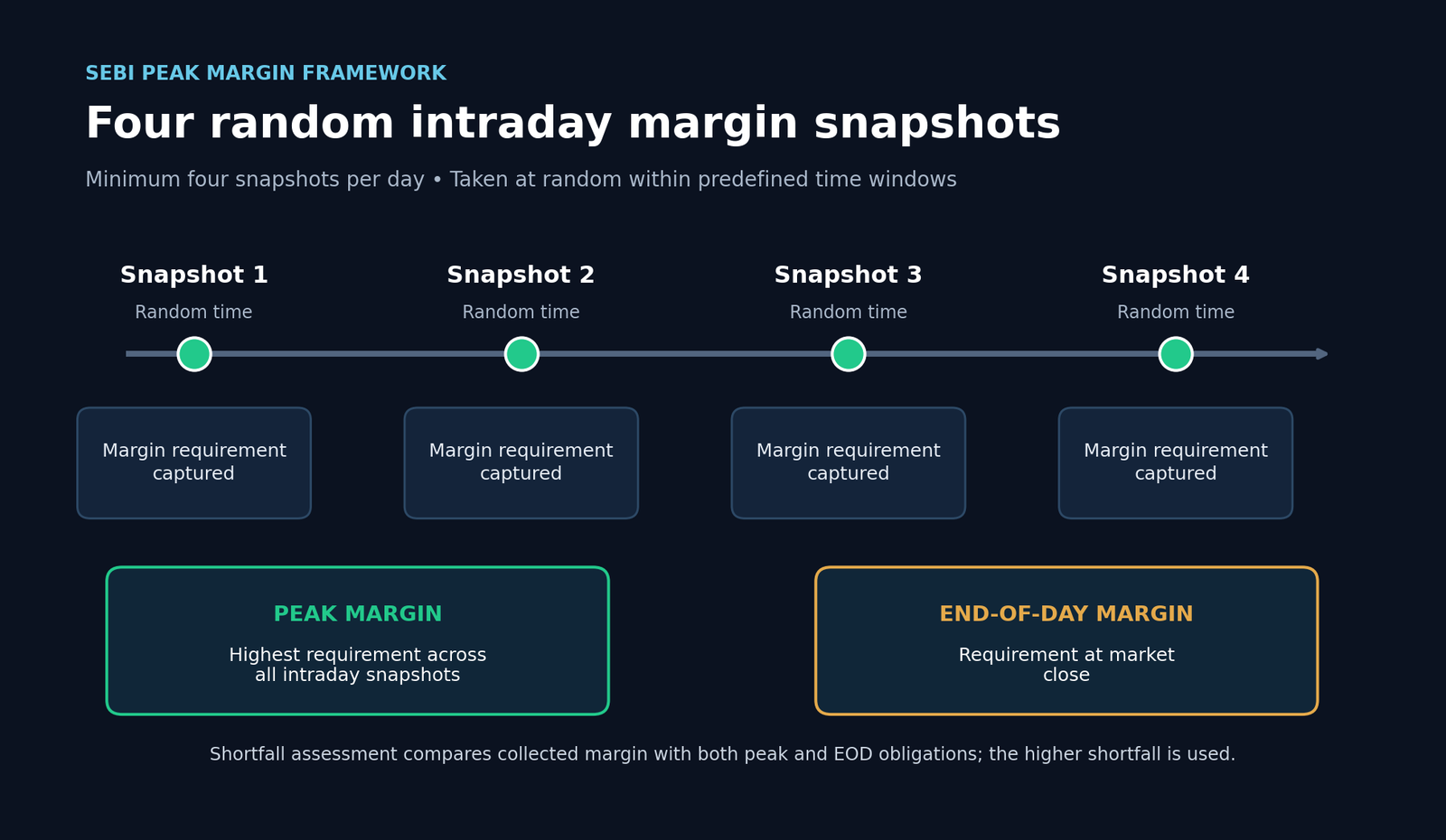
Before 2020, many brokers let clients trade intraday with less than the exchange margin and collected the rest at end of day. SEBI’s peak margin framework ended that. It was phased in from 25% in December 2020 to 100% from 1 September 2021, and peak margin is measured using four snapshots taken during the trading day, with the highest becoming the requirement, as 5paisa’s explainer sets out.
For currency futures traders, this means:
- You need the full SPAN plus ELM in your account before an intraday position is opened.
- Margin shortfalls at any snapshot can attract penalties for the broker, which are usually passed on to you.
- “Intraday leverage” offers on exchange-traded currency futures are limited by these rules.
Our margin requirement guide covers how brokers display these components on order screens.
How to check your SPAN margin before trading: 6 steps
- Open your broker’s margin calculator or order window. Most show SPAN, exposure (ELM) and total separately.
- Enter the exact contract. Choose pair, expiry and futures or options, because margin differs by expiry and product.
- Enter quantity in lots. Remember one USD/INR lot is US$1,000.
- Check spread benefit. If you enter a calendar spread as a basket, total margin should fall sharply.
- Add a buffer. Keep extra cash for mark-to-market losses and for margin rising on volatile days.
- Size by risk, not margin. Convert your stop in paise into ₹ per lot and limit lots to your rupee risk.
Common mistakes with currency futures margin
- Treating available margin as a position limit. Low margin per lot lets you build a large notional exposure quickly.
- Forgetting mark-to-market. Daily losses are settled in cash; a margin-sized balance alone can go into shortfall overnight.
- Ignoring spread expiry. Margin on the remaining leg rises the day the near month expires.
- Writing options on the basis of premium received. Short options attract SPAN plus 0.75% ELM on notional.
- Comparing with offshore leverage. Indian residents may trade currency derivatives only on recognised Indian exchanges in permitted pairs. Margin forex on overseas platforms via LRS is not permitted. Our F&O vs forex trading in India guide explains the legal routes.
FAQs
What is the difference between SPAN margin and exposure margin?
SPAN margin is the portfolio-based initial margin that covers the likely one-day loss at 99% value at risk. Exposure margin, called extreme loss margin (ELM) on NSE’s currency segment, is an extra buffer charged as a fixed percentage of position value, such as 0.50% for USD/INR futures. Total upfront margin is SPAN plus ELM.
How much margin is required for one lot of USD/INR futures?
There is no fixed figure because SPAN changes with NSE’s risk parameters. The ELM part is 0.50% of contract value. With USD/INR at a hypothetical 93.90 and a hypothetical SPAN rate of 1.5%, one lot would need about ₹1,878. Always check your broker’s live margin calculator for the actual amount.
Do calendar spreads in currency futures get a margin benefit?
Yes. SPAN offsets much of the risk between near and far legs because it is portfolio-based. ELM is also charged on only one-third of the far-month position value, and this treatment lasts until the near-month contract expires. After that, the remaining leg is margined as an outright position.
Does SEBI’s peak margin rule apply to currency futures?
Yes. Peak margin rules apply across cash and derivatives segments, including currency derivatives. Brokers must collect the full upfront margin, with peak margin measured through intraday snapshots. You cannot open an intraday currency futures position with less than the required SPAN plus ELM in your account.
Is extreme loss margin charged on long options?
No. On NSE’s currency segment, extreme loss margin on options applies only to short positions, calculated on notional value using the latest RBI reference rate. Option buyers pay the premium upfront, which is their maximum loss, so they do not attract SPAN or ELM in the same way as option sellers.
Why did my USD/INR futures margin increase overnight?
Margin can rise for three common reasons. NSE may revise SPAN risk parameters after volatile sessions, your calendar spread benefit may have ended because the near-month contract expired, or a rise in the USD/INR price increased contract value and therefore ELM. Brokers may also add their own buffer. Keep spare cash so a margin increase does not force a square-off.
Conclusion
SPAN margin for currency futures is the exchange’s estimate of your worst likely one-day loss, and ELM adds a fixed buffer on top: 0.50% for USD/INR futures, less for EUR/INR, GBP/INR and JPY/INR. Calendar spreads cost far less to hold, and SEBI’s peak margin rules mean the full amount must be in your account upfront, even intraday. The key lesson is that margin shows what the exchange requires, not what your account can bear. Size each trade by rupee risk per paise. Before your next order, compare margin with account size in our margin calculator.