Key Takeaways
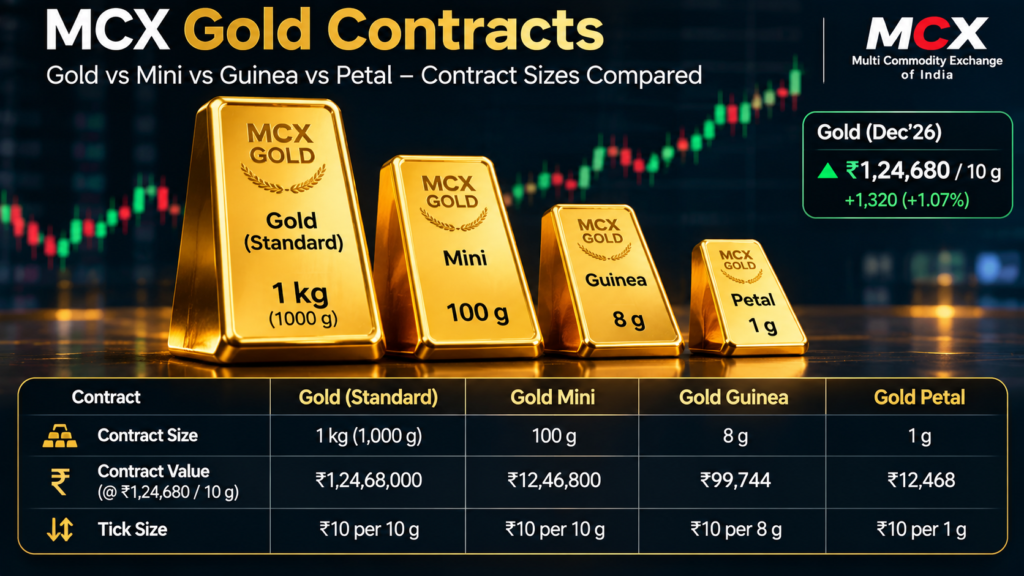
- MCX lists four main gold futures: Gold (1 kg), Gold Mini (100 g), Gold Guinea (8 g) and Gold Petal (1 g).
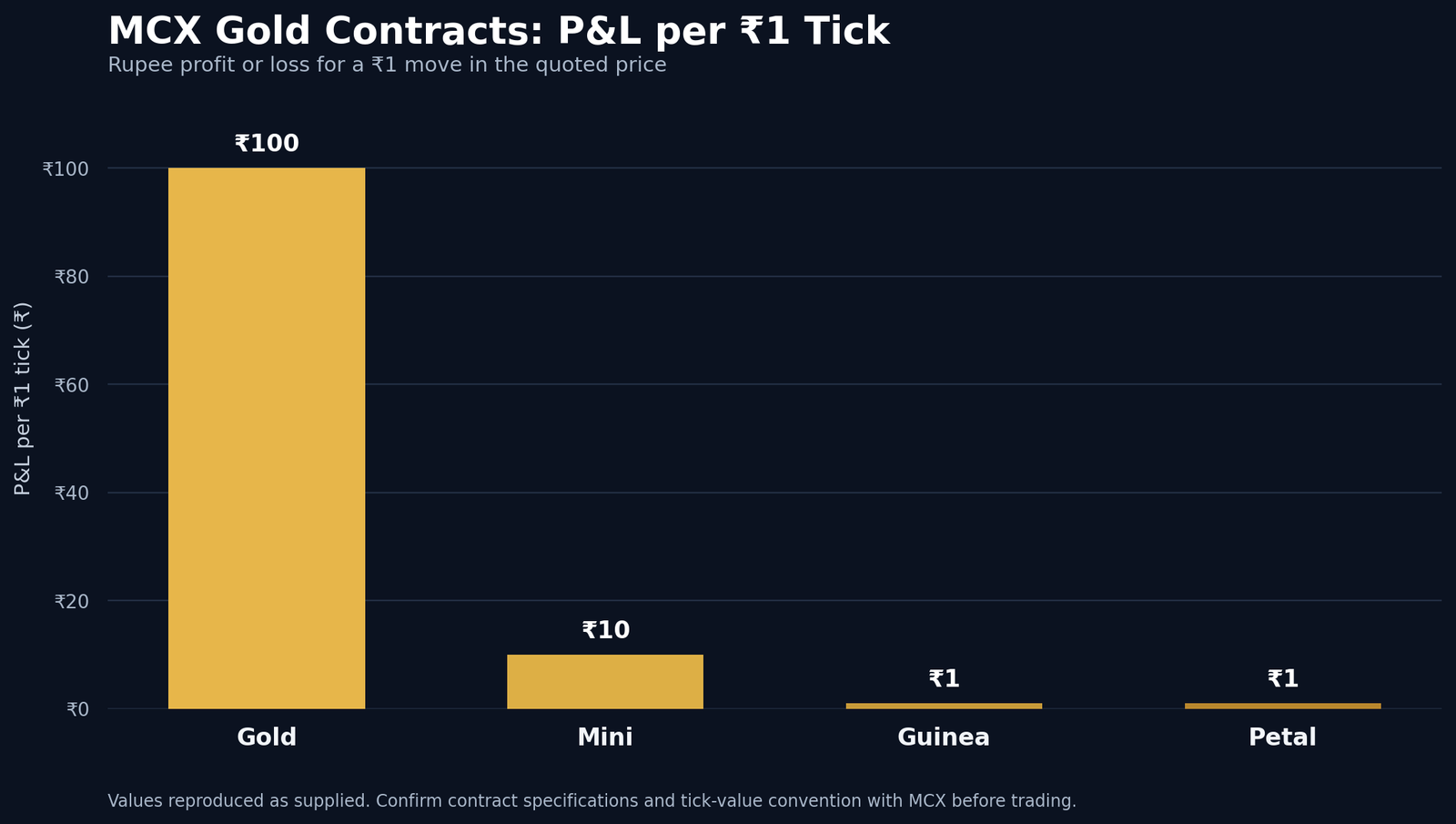
- A ₹1 move in the quoted price is worth ₹100 per lot in Gold, ₹10 in Gold Mini, and ₹1 each in Guinea and Petal.
- Gold Mini is the smallest contract with deep liquidity; Guinea and Petal suit very small accounts but carry wider spreads.
- Pick the contract from your rupee risk per trade and stop distance, not from the margin figure alone.
- All are delivery-based, so square off before expiry unless you want physical gold and have completed delivery KYC.
Most Indian traders who want gold exposure on MCX hit the same question in week one: Gold Mini or Gold Petal, and where does Gold Guinea fit? The quick answer depends on how much capital you have, how far your stop sits and how much spread you can tolerate. This guide compares the MCX gold mini vs gold petal vs guinea contracts on lot size, ₹ value per tick, indicative margin and liquidity, for traders with ₹25,000 to ₹5,00,000 of capital. A worked ₹1,00,000 example shows which contract keeps risk at 1%.
MCX gold mini vs gold petal: which one should a small trader choose?
For most small traders, Gold Mini is the better trading contract if your account can absorb its ₹10-per-tick value within your risk limit, because it is far more liquid. Gold Petal (1 g) suits accounts too small for Mini, but its wide bid-ask spread can eat a large share of each trade’s expected profit.
The contract you choose controls three things: what one tick costs, how much margin is blocked, and how much spread you pay on every entry and exit.
A futures contract is an exchange-traded agreement to buy or sell a fixed quantity of an asset at a set price on a future date. On MCX, gold futures are quoted in rupees, and the quoted price already includes import duty and related levies, according to Zerodha Varsity’s breakdown of the contract specifications. Our gold price outlook covers what moves the international gold price.
MCX gold contracts compared: lot size, quote and tick value
The four contracts differ mainly in size and in the unit the price is quoted in. Gold and Gold Mini are quoted per 10 grams. Gold Guinea is quoted per 8 grams, and Gold Petal per 1 gram. The minimum price move, or tick, is ₹1 for all four.
The value of one tick per lot follows a simple formula:
P&L per tick = (lot size ÷ quotation unit) × tick size
| Contract | Lot size | Quoted per | Tick | ₹ per tick per lot | Expiry |
|---|---|---|---|---|---|
| Gold | 1 kg | 10 g | ₹1 | ₹100 | 5th of contract month |
| Gold Mini | 100 g | 10 g | ₹1 | ₹10 | 5th of contract month |
| Gold Guinea | 8 g | 8 g | ₹1 | ₹1 | Last day of contract month |
| Gold Petal | 1 g | 1 g | ₹1 | ₹1 | Last day of contract month |
Sources: contract details as published by Zerodha Varsity and bhaavbrief, with the per-tick value computed from the formula above. Always confirm live terms on the MCX bullion contracts page before trading, because the exchange can revise them.
Guinea and Petal both show ₹1 per tick but are not the same size: a Petal tick is ₹1 on the price of one gram, a Guinea tick ₹1 on the price of eight grams. The same gold move therefore produces more ticks in Petal.
How the same gold move hits each contract
Assume MCX gold moves ₹1,000 on the per-10-gram quote, roughly a 0.8% move at a hypothetical price of ₹1,25,000 per 10 g. Here is what each contract does:
- Gold (1 kg): ₹1,000 × 100 = ₹1,00,000 per lot.
- Gold Mini (100 g): ₹1,000 × 10 = ₹10,000 per lot.
- Gold Guinea (8 g): the per-8-gram quote moves about ₹800, so about ₹800 per lot.
- Gold Petal (1 g): the per-gram quote moves about ₹100, so about ₹100 per lot.
Gold Mini is ten times smaller than big Gold, Guinea about twelve times smaller than Mini, and Petal eight times smaller than Guinea.
What does Gold Mini margin look like compared with Guinea and Petal?
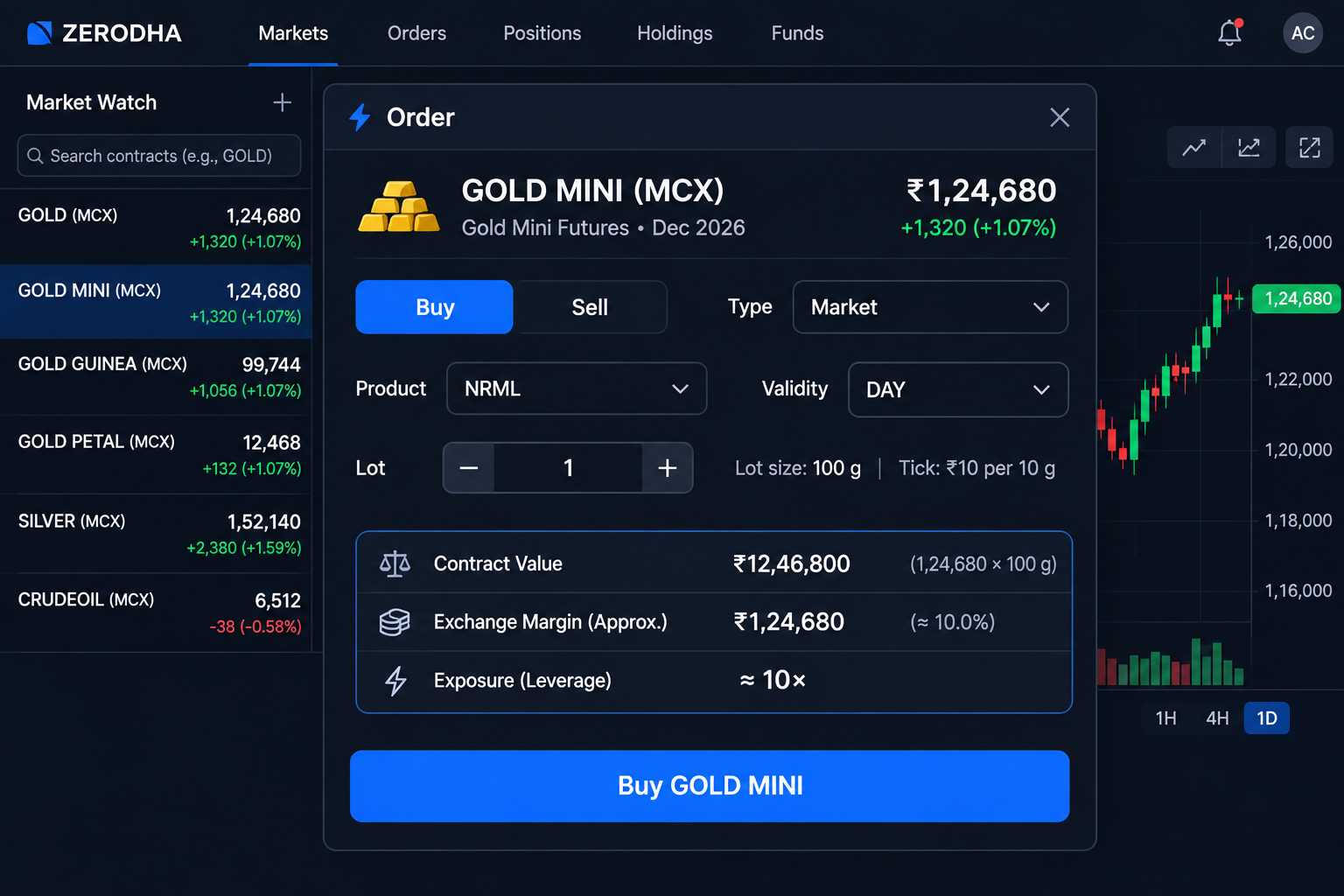
Margin on MCX is a percentage of contract value, set daily by the exchange and often topped up by brokers. bhaavbrief puts the typical range at about 5% to 8.5% of contract value, and it changes with volatility. The figures below use a hypothetical gold price and a hypothetical 6% margin purely to show scale.
Hypothetical assumptions: MCX gold at ₹1,25,000 per 10 g; margin 6% of contract value.
| Contract | Contract value (hypothetical) | Margin at 6% (hypothetical) |
|---|---|---|
| Gold (1 kg) | ₹1,25,00,000 | ₹7,50,000 |
| Gold Mini (100 g) | ₹12,50,000 | ₹75,000 |
| Gold Guinea (8 g) | ₹1,00,000 | ₹6,000 |
| Gold Petal (1 g) | ₹12,500 | ₹750 |
Gold Mini’s margin alone can block most of a ₹1,00,000 account. And low margin does not mean low risk: margin is what is blocked, while your loss is set by tick value and how far price moves against you. You can plug your own numbers into our margin calculator to see how much of your capital each trade blocks.
Since September 2021, SEBI’s peak margin framework requires brokers to collect the full upfront margin from clients, with peak margin measured through intraday snapshots, as 5paisa’s explainer of the phased rollout notes.
Liquidity and spreads: the hidden cost in small contracts
Liquidity is how easily you can buy or sell without moving the price, and it shows up as the bid-ask spread. Zerodha Varsity notes that liquidity in Guinea and Petal is much lower than in Gold and Gold Mini, and suggests most traders stick to the bigger two. bhaavbrief says Petal spreads are often ₹5 to ₹10 per lot, and describes Gold Mini as very liquid with tighter spreads.
Why this matters: in Petal, a ₹1 tick is ₹1 per gram, and a typical intraday move might be ₹40 to ₹80 per gram. If you pay a ₹5 to ₹10 spread on entry, that is a large slice of a ₹60 move before brokerage and taxes. In Gold Mini, the spread is usually a far smaller share of the same move.
Strategies that work on Gold Mini often fail on Petal for this reason: same setup, higher cost per trade.
Example: choosing a contract for a ₹1,00,000 account
Example (hypothetical numbers): A trader in Jaipur has ₹1,00,000 of trading capital and risks 1% per trade, which is ₹1,000. She plans a long trade in the 9:00 pm to 11:00 pm IST window, when US data often moves gold, with a stop ₹600 below entry on the per-10-gram quote.
Step 1 – Gold Mini. A ₹600 stop on the 10-gram quote is 600 ticks × ₹10 = ₹6,000 per lot. That is six times her ₹1,000 limit. Gold Mini is ruled out for this stop.
Step 2 – Gold Guinea. The same move on the 8-gram quote is about ₹480, so about ₹480 per lot. Two lots risk about ₹960, inside her limit. Margin at a hypothetical 6% on two lots is about ₹12,000.
Step 3 – Gold Petal. The same move on the 1-gram quote is about ₹60, so ₹60 per lot. Sixteen lots risk about ₹960. Margin at 6% on sixteen lots is about ₹12,000. But a ₹5 spread per lot on entry costs about ₹80 across sixteen lots, roughly 8% of her planned risk, before brokerage.
Result: Guinea or Petal fit her risk rule; Mini does not. Between the two, she compares live spreads on her terminal before choosing. If she wants Gold Mini, she needs a tighter stop (about ₹100 on the 10-gram quote for one lot at ₹1,000 risk) or a larger account. Our position size calculator does the same arithmetic for any stop.
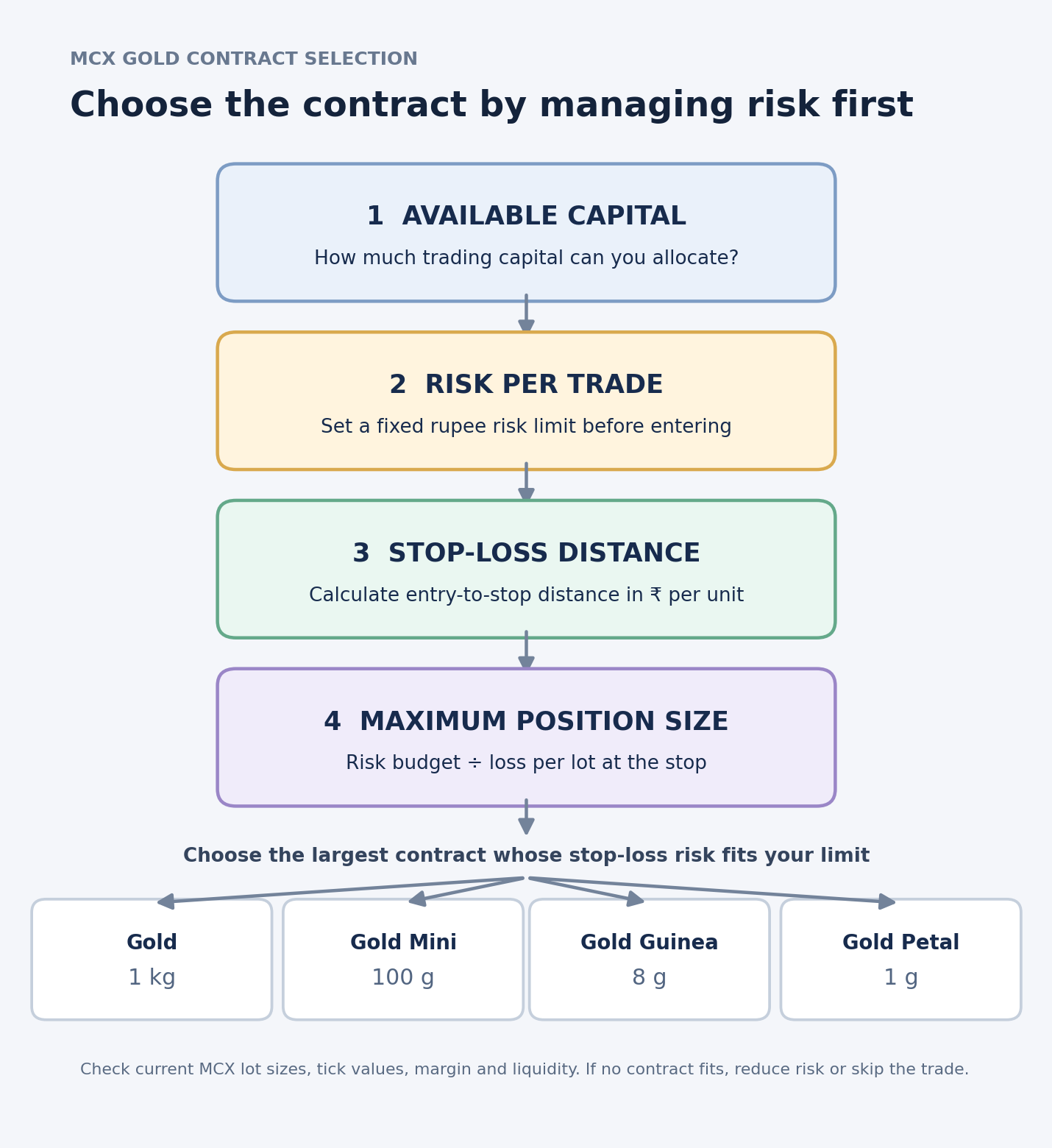
How to choose the right MCX gold contract in 6 steps
- Fix your rupee risk per trade. Many traders use 0.5% to 2% of capital.
- Set your stop from the chart first. Base it on structure or volatility.
- Convert the stop into ₹ per lot for each contract. Use the per-tick table above.
- Divide your rupee risk by ₹ risk per lot. If the answer is below 1 for a contract, that contract is too big for this trade.
- Check live spread and volume. Compare bid-ask on your terminal at the time you plan to trade.
- Confirm margin and expiry. Ensure margin leaves cash for mark-to-market swings, and note that Gold and Gold Mini expire on the 5th while Guinea and Petal expire at month-end.
If your capital is small overall, our guide on minimum capital for trading in India explains realistic starting sizes and why undercapitalised accounts struggle.
Trading hours and timing in IST
MCX revised commodity trading hours from 2 November 2026, with non-agricultural commodities, which include bullion, trading from 9:00 am to 11:55 pm IST, according to a Zerodha bulletin on the revision. That late close matters because many gold-moving US releases, such as jobs and inflation data, now land around 7:00 pm IST in winter, and Federal Reserve decisions arrive after midnight.
The Asian morning tends to be quieter for gold. Our piece on trading gold during Asian hours explains how range behaviour differs from the evening session.
Common mistakes when picking between Gold Mini, Guinea and Petal
- Choosing by margin, not risk. Petal’s tiny margin tempts traders to buy 50 lots. Fifty Petal lots carry about the same rupee risk per gram move as 6 Guinea lots.
- Ignoring the different quote units. Comparing a Guinea price (per 8 g) with a Mini price (per 10 g) and thinking one is “cheaper” is a frequent beginner error.
- Holding into expiry by accident. These contracts are delivery-based. Missing the 5th-of-month expiry on Gold Mini can trigger delivery obligations or broker auto square-off with charges.
- Underestimating spread in Petal. A ₹5 to ₹10 spread on a ₹1-per-tick contract makes scalping very hard.
- Using offshore apps for “gold CFDs”. Indian residents should trade gold through SEBI-registered brokers on MCX or NSE, not leveraged offshore platforms.
FAQs
What is the lot size of Gold Mini on MCX?
Gold Mini has a lot size of 100 grams and is quoted in rupees per 10 grams with a ₹1 tick. Each ₹1 move in the quoted price changes the value of one lot by ₹10. It expires on the 5th of the contract month, the same as the 1 kg Gold contract.
What is the difference between Gold Guinea and Gold Petal?
Gold Guinea is an 8-gram contract quoted per 8 grams, while Gold Petal is a 1-gram contract quoted per gram. Both have a ₹1 tick worth ₹1 per lot, but a given gold move produces about eight times more ticks in Petal than in Guinea. Both expire at month-end and have thinner liquidity than Gold Mini.
How much margin is needed for one lot of Gold Mini?
Margin is a percentage of contract value and changes daily with volatility, so there is no fixed figure. Indicative ranges are about 5% to 8.5% of contract value. At a hypothetical ₹1,25,000 per 10 g and 6% margin, one Gold Mini lot would need about ₹75,000. Check your broker’s margin screen before each trade.
Which MCX gold contract is best for beginners?
Beginners with small accounts often start with Gold Petal or Gold Guinea because one lot risks very little. Once their account and stop sizes allow, many move to Gold Mini for better liquidity and lower relative spread. The right choice is the contract that keeps your loss at your chosen rupee limit when the stop is hit.
Can I take delivery of gold through Gold Petal?
MCX gold contracts, including Petal, are delivery-based, so a position held to expiry can lead to physical delivery. Delivery needs commodity-specific KYC and payment of the full contract value, and delivery units and centres are set by the exchange. Most traders square off before expiry. Check MCX’s contract terms and your broker’s delivery policy first.
Conclusion
The MCX gold mini vs gold petal choice comes down to arithmetic, not preference. Gold Mini gives the best liquidity among the smaller contracts, but its ₹10-per-tick value and margin suit accounts that can absorb wider stops. Gold Guinea and Gold Petal let a ₹1,00,000 account trade gold at 1% risk, at the price of wider spreads and thinner order books. Start from your rupee risk, convert your stop into ₹ per lot for each contract, and then compare live spreads. Before your next gold trade, run the numbers through our position size calculator to see exactly how many lots fit your plan.