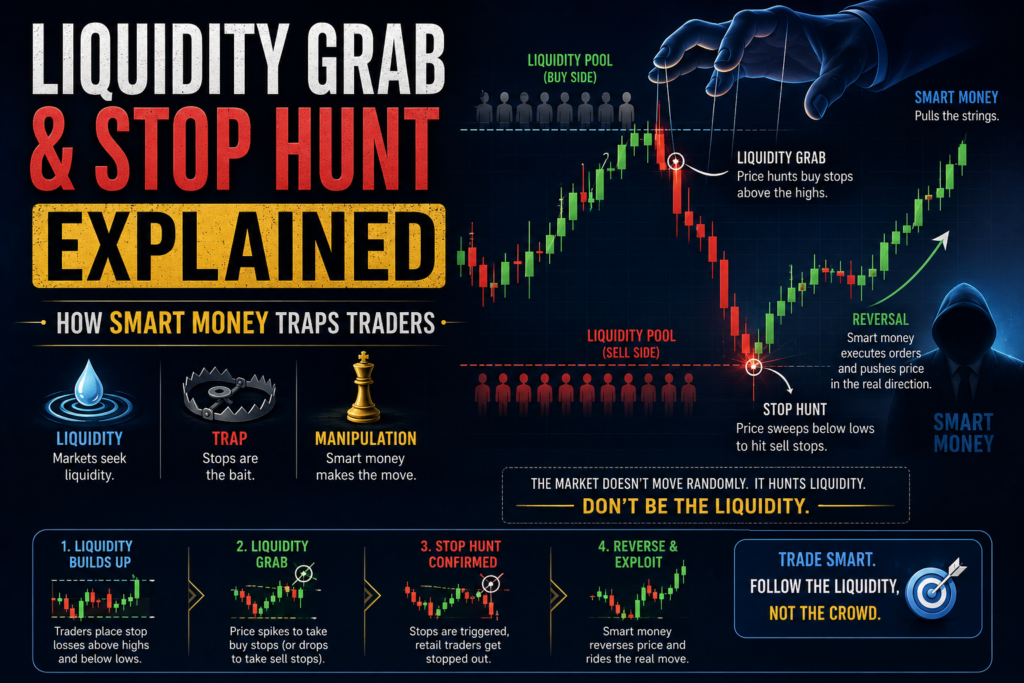
Ever placed a well-reasoned trade, watched the market spike hard against you to hit your stop-loss, and then reverse straight back in your original direction — as if the market knew exactly where your order sat? You are not imagining it. That painful pattern has a name, and understanding it can change the way you read charts forever. This is the world of the liquidity grab forex traders talk about in hushed, frustrated tones, and it sits at the heart of how large institutions move price.
In this guide we break down what a liquidity grab actually is, why stop hunts happen, and how the smart money liquidity concept explains the traps that catch retail traders again and again. By the end, you will see the market less as a random battlefield and more as a structured hunt for orders.
What Is Liquidity in Forex Trading?
Before you can spot a trap, you need to understand what the market is hunting for. Liquidity in forex trading simply refers to the availability of orders — buyers and sellers willing to transact at a given price. High liquidity means you can enter and exit positions easily without much slippage. Low liquidity means the opposite: price can move sharply on relatively small volume.
But liquidity is not spread evenly across the chart. It clusters. It pools in specific, predictable places. And that clustering is the reason liquidity grabs exist at all.
Think of large institutions — banks, hedge funds, and proprietary trading desks — as players who need to move enormous positions. A retail trader can buy a few lots instantly. An institution trying to fill a position worth hundreds of millions cannot simply click “buy” without moving the market against itself. It needs a large pool of opposing orders to fill against. In other words, big players need liquidity to enter and exit efficiently. Understanding liquidity in forex trading is therefore the foundation for understanding why price behaves the way it does around key levels.
What Is a Liquidity Grab in Forex?
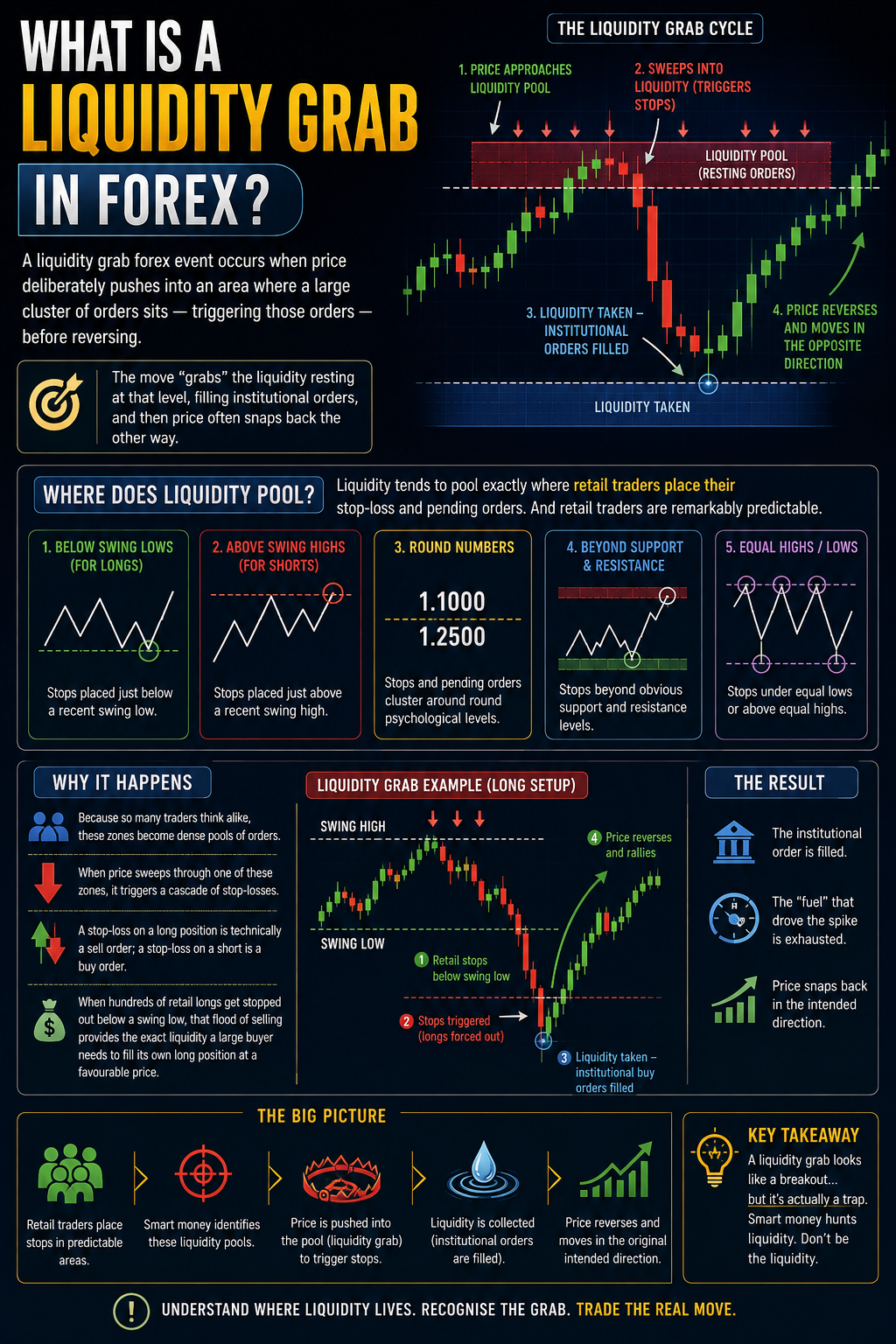
A liquidity grab forex event occurs when price deliberately pushes into an area where a large cluster of orders sits — triggering those orders — before reversing. The move “grabs” the liquidity resting at that level, filling institutional orders, and then price often snaps back the other way.
Here is the key insight: liquidity tends to pool exactly where retail traders place their stop-loss and pending orders. And retail traders are remarkably predictable. Most place stops:
- Just below a recent swing low (for long positions)
- Just above a recent swing high (for short positions)
- Around round numbers like 1.1000 or 1.2500
- Beyond obvious support and resistance lines
- Under equal lows or above equal highs
Because so many traders think alike, these zones become dense pools of orders. When price sweeps through one of these zones, it triggers a cascade of stop-losses. A stop-loss on a long position is technically a sell order; a stop-loss on a short is a buy order. So when hundreds of retail longs get stopped out below a swing low, that flood of selling provides the exact liquidity a large buyer needs to fill its own long position at a favourable price. That, in essence, is the liquidity grab forex traders keep falling victim to.
The move looks violent and convincing in the moment, but it is often surgical. Price dips just far enough to sweep the resting orders, then reverses because the institutional order is now filled and the “fuel” that drove the spike is exhausted.
Stop Hunt Trading: The Mechanics of the Trap
The phrase “stop hunt” is closely tied to the liquidity grab, and the two are often used interchangeably — though there is a subtle distinction worth understanding when you study stop hunt trading.
A stop hunt is the specific act of driving price toward a concentration of stop-loss orders to trigger them. A liquidity grab is the broader concept of collecting resting orders (which includes stops, but also pending limit orders and breakout entries). In practice, when you watch a stop hunt play out, you are watching a liquidity grab in action.
Stop hunt trading revolves around a simple, almost cynical logic: the market moves toward liquidity because that is where transactions can happen at scale. If you want to understand where price is likely to be drawn, ask yourself where the largest pools of stops are sitting. Price is magnetically attracted to those areas.
Consider a typical scenario. A currency pair has formed a clean range with equal lows sitting at a well-defined level. Every breakout trader is watching that level, planning to short if it breaks. Every long-position holder inside the range has a stop just beneath it. To an institution, that level is not support — it is a target. It is a buffet of liquidity. Price is engineered down through the level, stops trigger, breakout sellers pile in expecting continuation, and then price reverses sharply upward, trapping the breakout crowd and the stopped-out longs simultaneously. This double-trap is the signature of sophisticated stop hunt trading.
The frustration for retail traders is that the “obvious” trade — sell the breakout — is exactly the trade the move was designed to punish. Recognising this inversion is the first real step toward trading with the smart money rather than being its liquidity.
The Smart Money Liquidity Concept
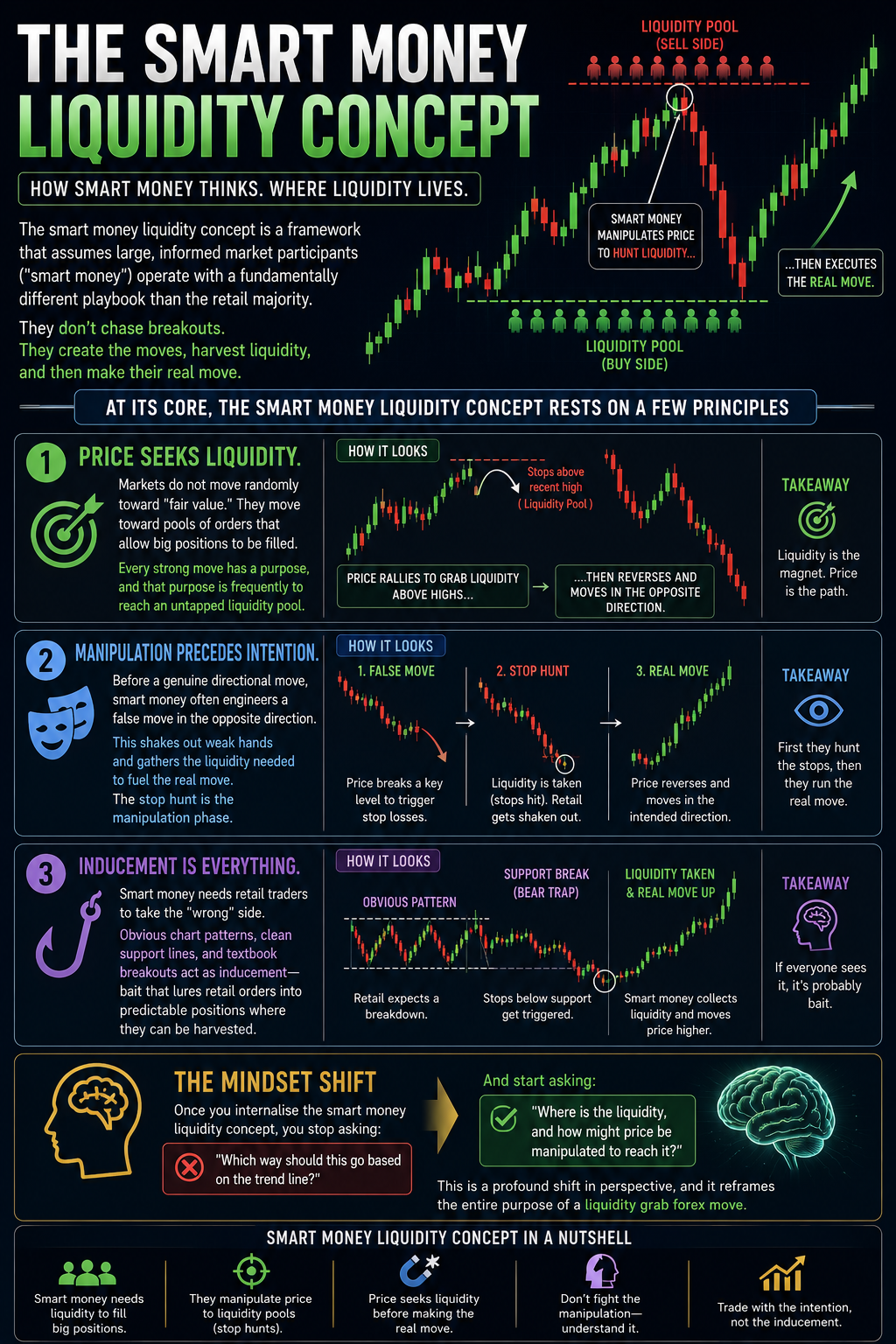
The smart money liquidity concept is a framework that assumes large, informed market participants (“smart money”) operate with a fundamentally different playbook than the retail majority. Rather than chasing breakouts and reacting to indicators, smart money is thought to accumulate and distribute positions by manipulating price around liquidity zones.
At its core, the smart money liquidity concept rests on a few principles:
Price seeks liquidity. Markets do not move randomly toward “fair value.” They move toward pools of orders that allow big positions to be filled. Every strong move has a purpose, and that purpose is frequently to reach an untapped liquidity pool.
Manipulation precedes intention. Before a genuine directional move, smart money often engineers a false move in the opposite direction. This shakes out weak hands and gathers the liquidity needed to fuel the real move. The stop hunt is the manipulation phase.
Inducement is everything. Smart money needs retail traders to take the “wrong” side. Obvious chart patterns, clean support lines, and textbook breakouts act as inducement — bait that lures retail orders into predictable positions where they can be harvested.
Once you internalise the smart money liquidity concept, you stop asking “which way should this go based on the trend line?” and start asking “where is the liquidity, and how might price be manipulated to reach it?” This is a profound shift in perspective, and it reframes the entire purpose of a liquidity grab forex move.
How to Identify a Liquidity Grab on the Chart
Spotting a liquidity grab in real time takes practice, but there are recognisable footprints. Here is what to look for when hunting for a liquidity grab forex setup:
A sweep of a key level with a quick rejection. The clearest sign is a candle (or a small cluster of candles) that pierces a swing high, swing low, or equal highs/lows and then closes back on the other side. A long wick poking beyond the level, followed by a strong close in the opposite direction, is a classic liquidity grab signature.
Failure to hold beyond the level. If price breaks a level but cannot sustain the move — no follow-through, no continuation — the “break” was likely a grab, not a genuine breakout. Genuine breakouts tend to hold and build. Liquidity grabs snap back.
A shift in market structure after the sweep. After liquidity is taken, watch for a break in the short-term structure in the opposite direction. If price grabs liquidity below a swing low and then breaks a minor high, that structure shift confirms the reversal narrative behind the liquidity grab forex move.
Location, location, location. Grabs are most meaningful at obvious, heavily watched levels — session highs and lows, previous day’s high and low, round numbers, and equal highs or lows. The more traders are watching a level, the more liquidity sits there, and the more likely it becomes a target.
Volume and speed. These sweeps often happen fast, sometimes around news releases or session opens when liquidity in forex trading is thin and price can be pushed more easily. A sudden violent spike into a level, then an immediate reversal, is a tell.
How to Trade Around Liquidity Grabs Instead of Falling for Them
Understanding the trap is one thing; adjusting your approach is another. Here are practical ways to protect yourself and even trade in harmony with these moves.
Stop placing stops in obvious places. If everyone puts their stop just below the swing low, that is precisely where the liquidity grab forex sweep will go. Consider placing stops beyond the likely sweep zone, or using structure that is less crowded. Give your trade room to survive the manipulation phase.
Wait for the grab, then trade the reversal. Instead of buying support blindly, wait for price to sweep below support, grab the liquidity, and then look for a bullish structure shift before entering long. You are essentially letting smart money do the dirty work, then joining the real move. This patience is central to effective stop hunt trading strategy.
Treat clean levels with suspicion. The cleaner and more obvious a support or resistance line, the more likely it is to be used as inducement. Equal highs and equal lows are especially attractive targets because they scream “breakout” to the retail crowd.
Combine liquidity logic with confirmation. A liquidity grab alone is not a signal to blindly reverse. Pair it with a break of structure, a return to a key zone, or confluence with higher-timeframe levels. Multiple factors aligning gives a far higher-probability read on any liquidity grab forex opportunity.
Respect the timeframe hierarchy. A grab on a five-minute chart is far weaker than one aligned with liquidity on the four-hour or daily. Higher-timeframe liquidity pools carry more weight, so anchor your analysis of liquidity in forex trading to the bigger picture first, then refine your entry on lower timeframes.
Common Mistakes Traders Make
Even after learning about liquidity grabs, traders trip over a few recurring errors:
- Seeing grabs everywhere. Not every wick is a liquidity grab. Overfitting the concept to every candle leads to forced trades. Wait for grabs at genuinely significant levels.
- Reversing too early. A sweep is not a signal on its own. Entering the instant price wicks a level, without waiting for confirmation, often means catching a knife.
- Ignoring the trend. Liquidity grabs work best when aligned with the higher-timeframe direction. Fighting a strong trend on the basis of one sweep is risky.
- Forgetting risk management. No concept, however powerful, removes the need for sensible position sizing. The smart money liquidity concept improves your read on the market — it does not guarantee outcomes.
Bringing It All Together
The market is not out to get you personally — but it is absolutely built to hunt liquidity, and your predictable orders are part of that liquidity. Once you understand the liquidity grab forex dynamic, the seemingly random spikes and reversals start to make sense. Price moves toward pools of orders. Stops get hunted because triggering them provides the fuel and the counterparties that large players need. And the smart money liquidity concept ties it all together: manipulation, inducement, and the relentless pursuit of orders.
The goal is not to feel like a victim of stop hunt trading, but to think one layer deeper than the crowd. Ask where the liquidity sits. Ask who is being induced, and how. Wait for the grab, watch for the structure shift, and trade with the flow that follows rather than the bait that came before. Mastering liquidity in forex trading is a long journey, but every chart you analyse through this lens sharpens your edge.
Frequently Asked Questions (FAQ)
What is a liquidity grab in forex? A liquidity grab in forex is when price deliberately pushes into an area where a large cluster of orders sits — usually stop-losses and pending orders around swing highs, swing lows, or round numbers — triggers those orders, and then reverses. The move “grabs” the resting liquidity to fill large institutional positions before price snaps back the other way.
Is a liquidity grab the same as a stop hunt? They are closely related but not identical. A stop hunt is specifically the act of driving price toward stop-loss orders to trigger them. A liquidity grab is the broader concept of collecting all resting orders, which includes stops as well as breakout entries and pending limit orders. In practice, most stop hunt trading you observe is a liquidity grab in action.
Why does the market hunt my stop-loss? Because your stop-loss is liquidity. Retail traders place stops in predictable spots — just beyond obvious support and resistance — so those zones become dense pools of orders. When triggered, a stopped-out long becomes a sell order and a stopped-out short becomes a buy order. That flood of orders gives large players the counterparties they need to fill big positions, which is the core of the smart money liquidity concept.
How can I tell a liquidity grab from a real breakout? Watch for a quick sweep and rejection. A genuine breakout tends to hold and build follow-through, while a liquidity grab forex move pierces a level with a long wick, fails to sustain beyond it, and reverses — often followed by a shift in short-term market structure in the opposite direction.
Where do liquidity grabs happen most often? At heavily watched levels: previous day’s high and low, session highs and lows, round numbers, and especially equal highs or equal lows. Thin-liquidity moments such as news releases and session opens also make it easier for price to be pushed into these zones, so liquidity in forex trading is often at its most volatile then.
Can beginners actually trade around liquidity grabs? Yes, but patience and confirmation matter more than speed. Rather than reversing the instant price wicks a level, wait for the grab to complete, look for a break of structure in your intended direction, and align the setup with the higher-timeframe trend. Combining liquidity logic with sound risk management is the safest way to apply stop hunt trading concepts as a beginner.