Introduction
The forex market trades almost around the clock, but it does pause. It closes on Friday evening in New York and reopens on Sunday evening, and many markets also have a short daily break. When price reopens at a different level from where it closed, it leaves a gap on the chart. In the ICT (Inner Circle Trader) method, these gaps are treated as important reference levels.
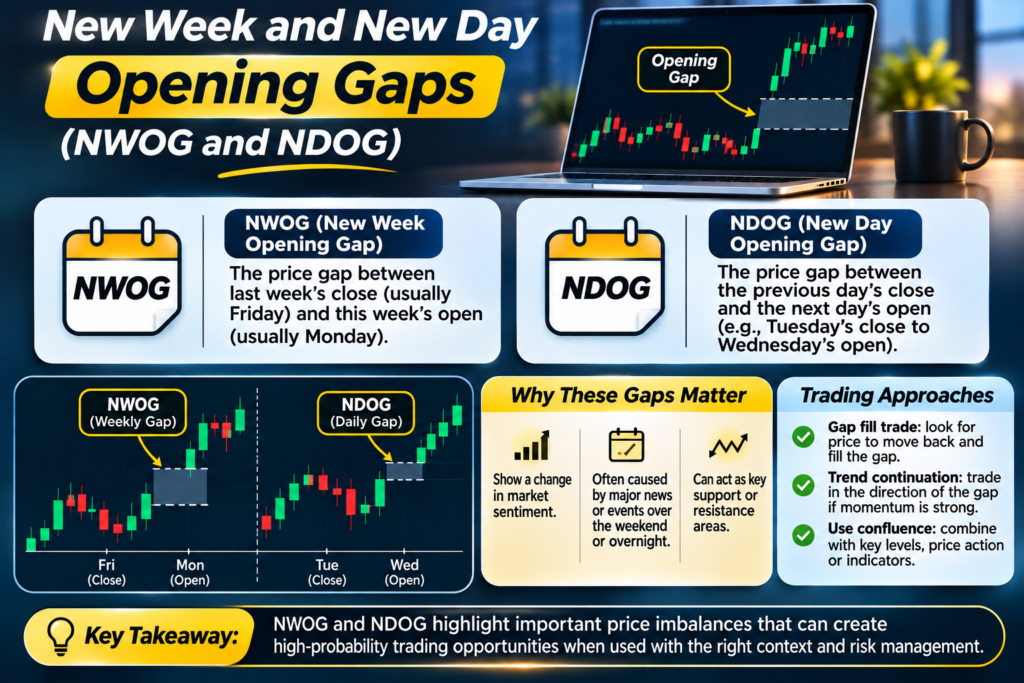
The weekly version is called the new week opening gap (NWOG), and the daily version is the new day opening gap (NDOG). ICT traders mark them, watch how price reacts to them, and use them for entries, targets and directional bias.
This guide explains what a new week opening gap is, how it differs from the NDOG, how to mark both, the role of consequent encroachment, IST timings for Indian traders, practical trading strategies, a worked example and the key risks.
What Is a New Week Opening Gap (NWOG)?
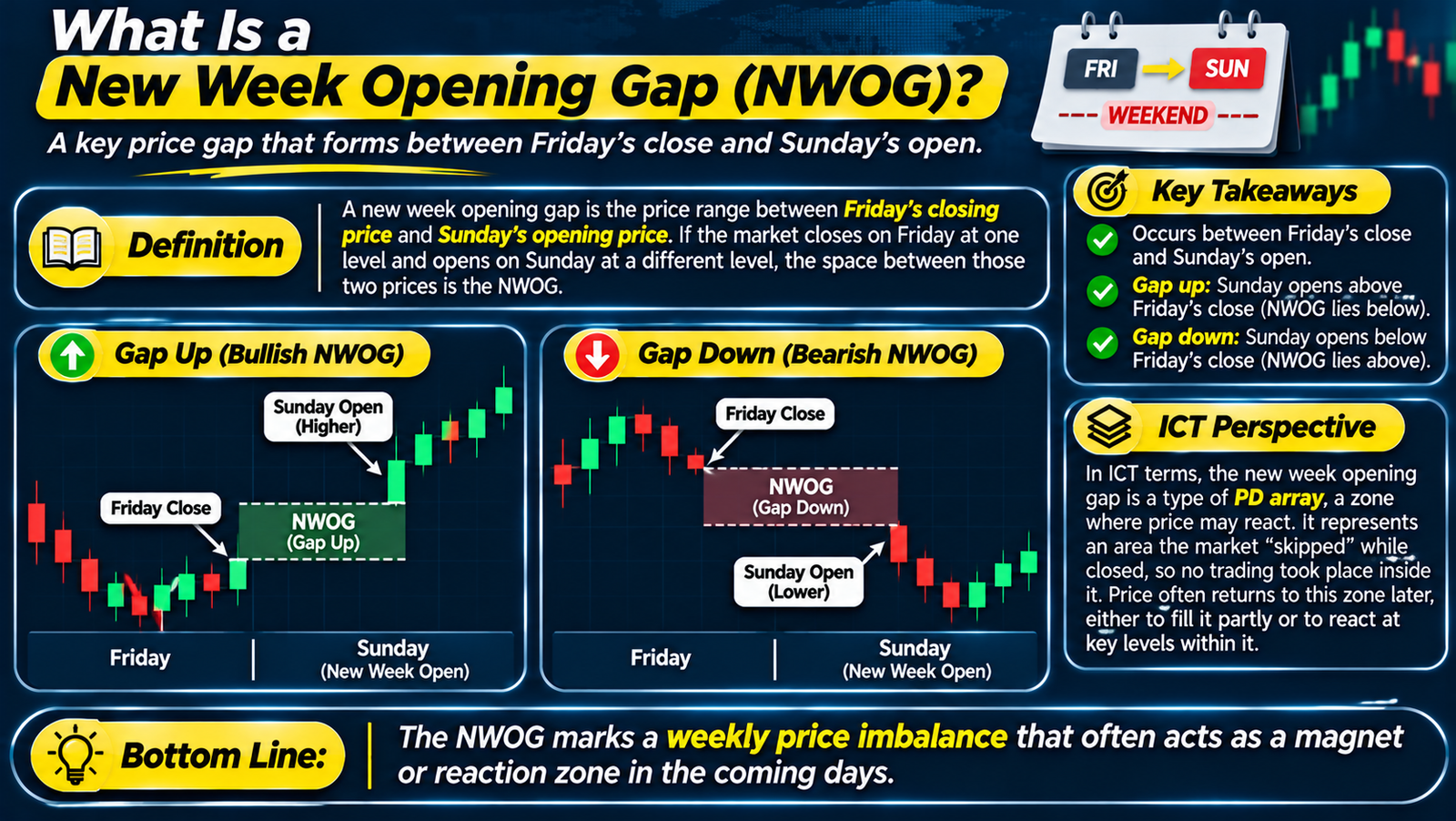
A new week opening gap is the price range between Friday’s closing price and Sunday’s opening price. If the market closes on Friday at one level and opens on Sunday at a different level, the space between those two prices is the NWOG.
- Gap up: Sunday opens above Friday’s close. The NWOG lies below the opening price.
- Gap down: Sunday opens below Friday’s close. The NWOG lies above the opening price.
In ICT terms, the new week opening gap is a type of PD array, a zone where price may react. It represents an area the market “skipped” while closed, so no trading took place inside it. Price often returns to this zone later, either to fill it partly or to react at key levels within it.
What Is a New Day Opening Gap (NDOG)?
A new day opening gap is the same idea on a daily scale. It is the range between the market’s close at 5:00pm New York time and its reopening at 6:00pm New York time, the daily break used by CME futures and many forex platforms.
In spot forex, prices often continue to update during this period, so NDOGs are usually very small. They are more visible on futures charts, such as the CME euro futures or index futures. ICT traders still mark them, because they can act as short-term reference levels during the following session.
NWOG vs NDOG
| Feature | New week opening gap (NWOG) | New day opening gap (NDOG) |
|---|---|---|
| Formed between | Friday close and Sunday open | Daily close and daily reopen |
| New York time | Friday 5:00pm to Sunday 6:00pm | 5:00pm to 6:00pm each weekday |
| Typical size in forex | Small to large, depending on weekend news | Usually very small |
| Main use | Weekly reference level, bias and targets | Intraday reference level |
| How long it stays relevant | Several weeks | A few days |
NWOG and NDOG Timings in IST
India does not use daylight saving time, so IST timings shift when US clocks change.
| Event (New York time) | IST in US winter (early Nov to mid-Mar) | IST in US summer (mid-Mar to early Nov) |
|---|---|---|
| Friday close, 5:00pm | Saturday 3:30am | Saturday 2:30am |
| Sunday open, 6:00pm | Monday 4:30am | Monday 3:30am |
| Daily close, 5:00pm | 3:30am the next day | 2:30am the next day |
| Daily reopen, 6:00pm | 4:30am the next day | 3:30am the next day |
So for Indian traders, the new week opening gap forms early on Monday morning, and most of the price reaction to it happens later that day, during the London session (from 1:30pm IST in winter) and the New York session.
How to Mark a New Week Opening Gap
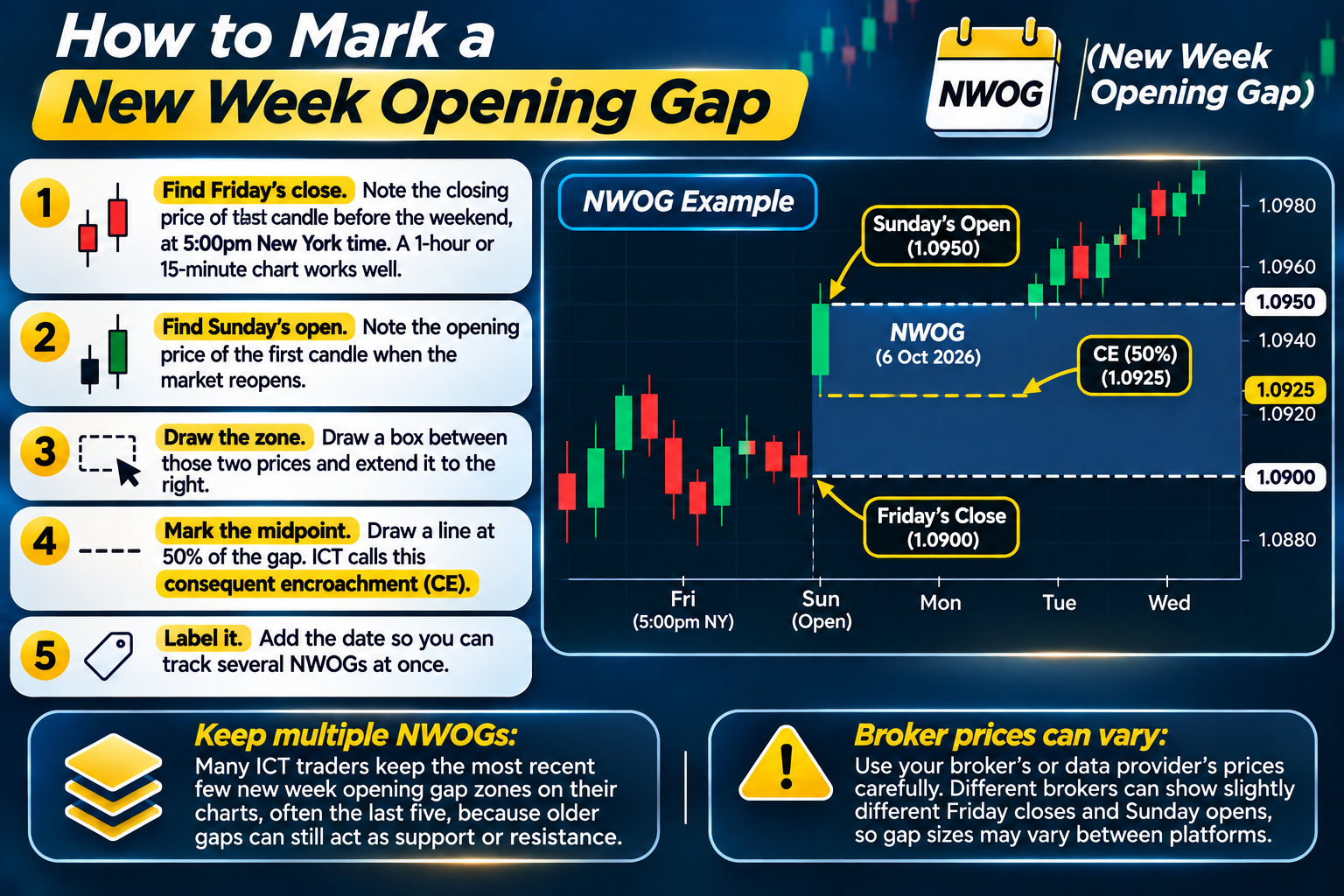
- Find Friday’s close. Note the closing price of the last candle before the weekend, at 5:00pm New York time. A 1-hour or 15-minute chart works well.
- Find Sunday’s open. Note the opening price of the first candle when the market reopens.
- Draw the zone. Draw a box between those two prices and extend it to the right.
- Mark the midpoint. Draw a line at 50% of the gap. ICT calls this consequent encroachment (CE).
- Label it. Add the date so you can track several NWOGs at once.
Many ICT traders keep the most recent few new week opening gap zones on their charts, often the last five, because older gaps can still act as support or resistance weeks later.
Use your broker’s or data provider’s prices carefully. Different brokers can show slightly different Friday closes and Sunday opens, so gap sizes may vary between platforms.
Consequent Encroachment: The Key Level
The 50% level of a gap is often the most important price inside it. ICT teaches that price frequently reacts at the consequent encroachment of a new week opening gap, either:
- bouncing from it and continuing in the direction away from the gap, or
- moving through it and filling the rest of the gap.
How price behaves at the CE can give clues about strength. A clean rejection suggests the gap is acting as support or resistance. A strong close through it suggests price wants to fill the whole gap.
Why Opening Gaps Matter
- They show an imbalance. No trading took place inside the gap, so it is an inefficient area that price may revisit.
- They reflect weekend news. A large new week opening gap often follows weekend events, such as elections, central bank comments or geopolitical news.
- They act as magnets. Unfilled gaps often attract price later in the week.
- They act as support and resistance. Once price returns, the gap’s edges and midpoint can stop or reverse moves.
- They help define bias. Price holding above an NWOG can suggest bullish strength; holding below can suggest weakness.
New Week Opening Gap Trading Strategies
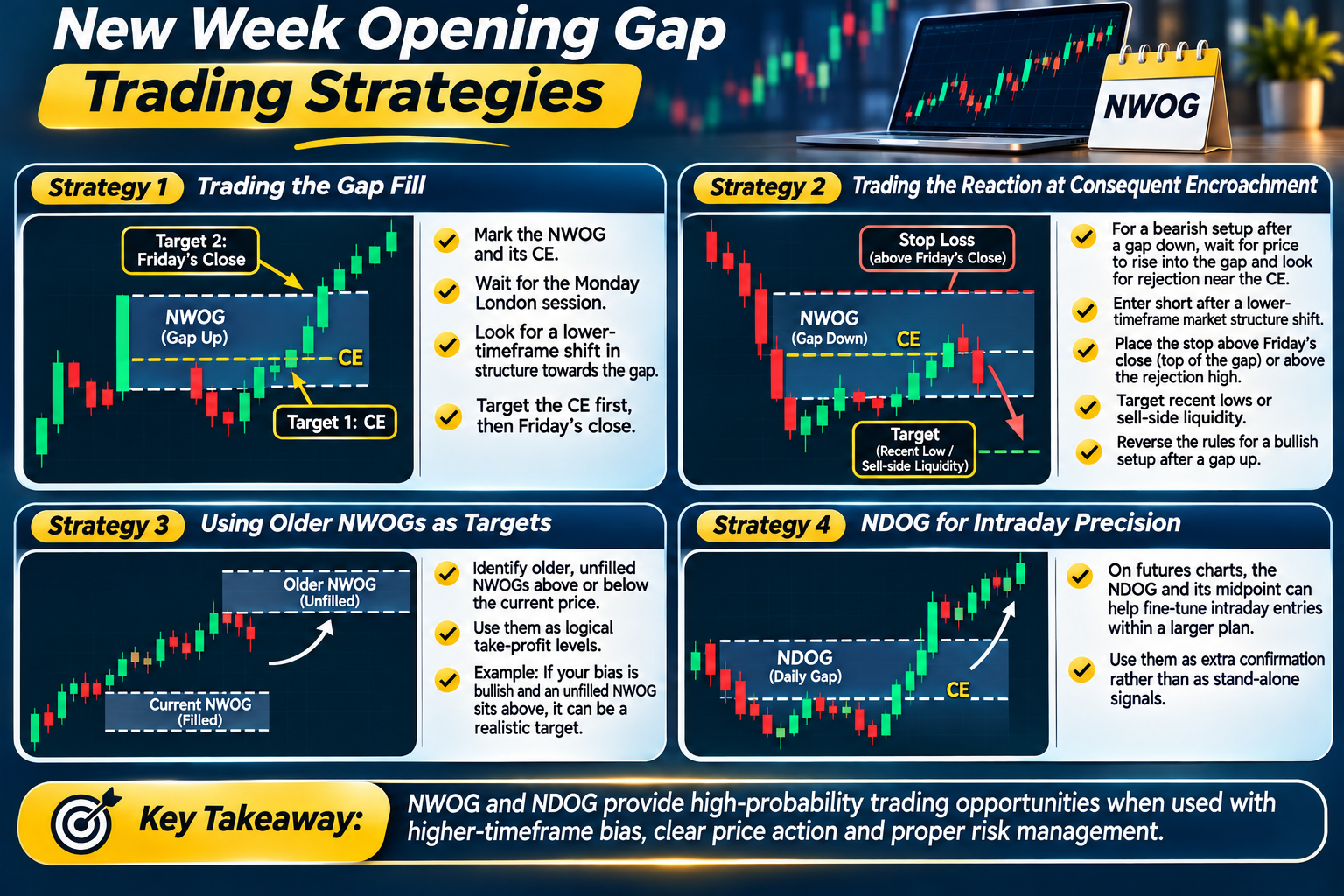
Strategy 1: Trading the gap fill
If Sunday opens with a gap and the higher-timeframe bias points back towards Friday’s close, traders look for price to move into the gap.
- Mark the NWOG and its CE.
- Wait for the Monday London session.
- Look for a lower-timeframe shift in structure towards the gap.
- Target the CE first, then Friday’s close.
Strategy 2: Trading the reaction at consequent encroachment
When the higher-timeframe bias agrees with the direction of the gap, traders look for price to retrace into the gap and react at the CE.
- For a bearish setup after a gap down: wait for price to rise into the gap, then look for rejection near the CE.
- Enter short after a lower-timeframe market structure shift.
- Place the stop above Friday’s close (the top of the gap) or above the rejection high.
- Target recent lows or sell-side liquidity.
Reverse the rules for a bullish setup after a gap up.
Strategy 3: Using older NWOGs as targets
Older, unfilled gaps above or below current price can serve as take-profit levels. If your bias is bullish and an unfilled new week opening gap sits above, it is a logical target.
Strategy 4: NDOG for intraday precision
On futures charts, the NDOG and its midpoint can help fine-tune intraday entries within a larger plan. Use them as extra confirmation rather than as stand-alone signals.
Worked Example: Bearish Setup on EUR/USD
This example is illustrative and uses hypothetical prices.
EUR/USD closes on Friday at 1.1640. Over the weekend, weak eurozone news is released, and on Sunday the pair opens at 1.1610. That leaves a 30-pip new week opening gap from 1.1610 to 1.1640, with consequent encroachment at 1.1625. The daily bias is bearish.
During Monday’s London session (from 1:30pm IST), price rises back into the gap and reaches 1.1627. On the 5-minute chart, a bearish rejection candle forms just above the CE and a minor swing low breaks.
- Entry: Sell at 1.1624.
- Stop-loss: 1.1645, just above Friday’s close (21 pips).
- Target: 1.1580, below last week’s low where sell-side liquidity rests (44 pips).
- Risk-reward: about 1:2.1.
- Position size: With a 10,000 account risking 1% (100) and $10 per pip per standard lot, 21 pips risks $210 per lot, so the trader sells about 0.48 lots.
If price instead closes above 1.1645 and fills the whole gap, the bearish idea fails, the stop is hit and the loss is limited to about $100. The trader would then treat the filled gap as possible support.
Risk Management
- Avoid trading the Sunday open itself. Spreads are wide and liquidity is thin when the market reopens, which in IST is around 4:30am on Monday in winter.
- Wait for confirmation. A gap is a zone of interest, not an entry signal.
- Risk 0.5% to 1% per trade.
- Check weekend news. A large gap caused by major news can keep running rather than filling.
- Hold positions over weekends with care. The new week opening gap is also a reminder that weekend gaps can jump past stop-losses.
Common Mistakes
- Assuming every gap must fill. Many gaps fill only partly, and some stay open for weeks.
- Using the wrong times. Forgetting US clock changes leads to wrong closes and opens.
- Ignoring broker differences. Different data feeds can produce different gap sizes.
- Trading against the higher-timeframe bias. Gap trades work best when they align with the daily trend.
- Treating tiny NDOGs as major levels. In spot forex, daily gaps are often too small to matter on their own.
A Note for Indian Traders
The new week opening gap concept is a price-action idea that you can study on any chart. NSE currency futures on USD/INR, EUR/INR, GBP/INR and JPY/INR have their own daily and weekend gaps, because they trade only from 9:00am to 5:00pm IST, so the opening gaps there are often larger and more frequent. Indian residents should note that leveraged forex trading on offshore platforms is not permitted under the Foreign Exchange Management Act (FEMA), and the RBI publishes an Alert List of unauthorized platforms. The legal route is exchange-traded derivatives on NSE and BSE through SEBI-registered brokers.
New Week Opening Gap Checklist
- Have I marked Friday’s close and Sunday’s open correctly?
- Have I drawn the gap and its consequent encroachment?
- Do I know the daily and weekly bias?
- Was there major weekend news?
- Am I waiting for the London or New York session rather than the Sunday open?
- Do I have lower-timeframe confirmation?
- Is my stop beyond the gap and my risk 1% or less?
FAQs
What is a new week opening gap in ICT?
It is the price range between Friday’s close and Sunday’s open. ICT traders use it as a reference zone where price may react later in the week.
What is the difference between NWOG and NDOG?
The NWOG forms over the weekend, while the NDOG forms during the daily break between 5:00pm and 6:00pm New York time.
What is consequent encroachment?
It is the 50% level of a gap. Price often reacts at this midpoint.
Does every new week opening gap get filled?
No. Many gaps are only partly filled, and some remain open for weeks, especially after major news.
When does the new week opening gap form in IST?
In US winter, between about 3:30am on Saturday and 4:30am on Monday IST. In US summer, each time is one hour earlier.
Conclusion
The new week opening gap and the new day opening gap mark places where the market reopened at a different price from where it closed. Because no trading happened inside these gaps, ICT traders treat them as imbalances that price may revisit, with the 50% consequent encroachment as a key level.
Use these gaps as reference zones within a complete plan: mark them correctly in IST, combine them with higher-timeframe bias, wait for confirmation during active sessions, and keep risk small. Practise on historical charts and a demo account before trading them with real money.