
Introduction
Exchange rates can move sharply on a central bank decision, an inflation report or unexpected political news. For a trader, that can turn a profitable position into a loss. For a business, it can wipe out the profit on an import or export order. Hedging is the practice of reducing that risk by taking an offsetting position.
A forex hedging strategy does not aim to make extra money. It aims to limit losses, protect profits or make future cash flows more predictable. Like insurance, it usually has a cost, and it often limits gains as well as losses.
This guide explains how a forex hedging strategy works, the main types of hedging, worked examples, costs and risks, common mistakes and the key points for traders and businesses in India.
What Is Forex Hedging?
Forex hedging means opening a position, or buying a contract, whose value moves in the opposite direction to an existing exposure. If the exchange rate moves against your original position, the hedge gains and offsets part or all of the loss.
There are two broad groups that hedge:
- Traders and investors, who hedge open trading positions or foreign investments to manage short-term risk, such as a news event.
- Businesses and individuals with real currency exposure, such as importers, exporters, freelancers and students paying overseas fees, who hedge future payments or receipts.
The right forex hedging strategy depends on which group you belong to, how large the exposure is, how long it lasts and how much you are willing to pay for protection.

Why Use a Forex Hedging Strategy?
- Protect against event risk: Reduce exposure before major releases or weekends without closing a long-term position.
- Lock in profits: Protect gains on an open trade while keeping the position.
- Stabilise business cash flows: Fix the rupee cost of an import or the rupee value of export income.
- Reduce portfolio volatility: Limit the currency effect on foreign investments.
- Manage uncertainty: Buy time to make a decision without carrying full risk.
Types of Forex Hedging Strategy
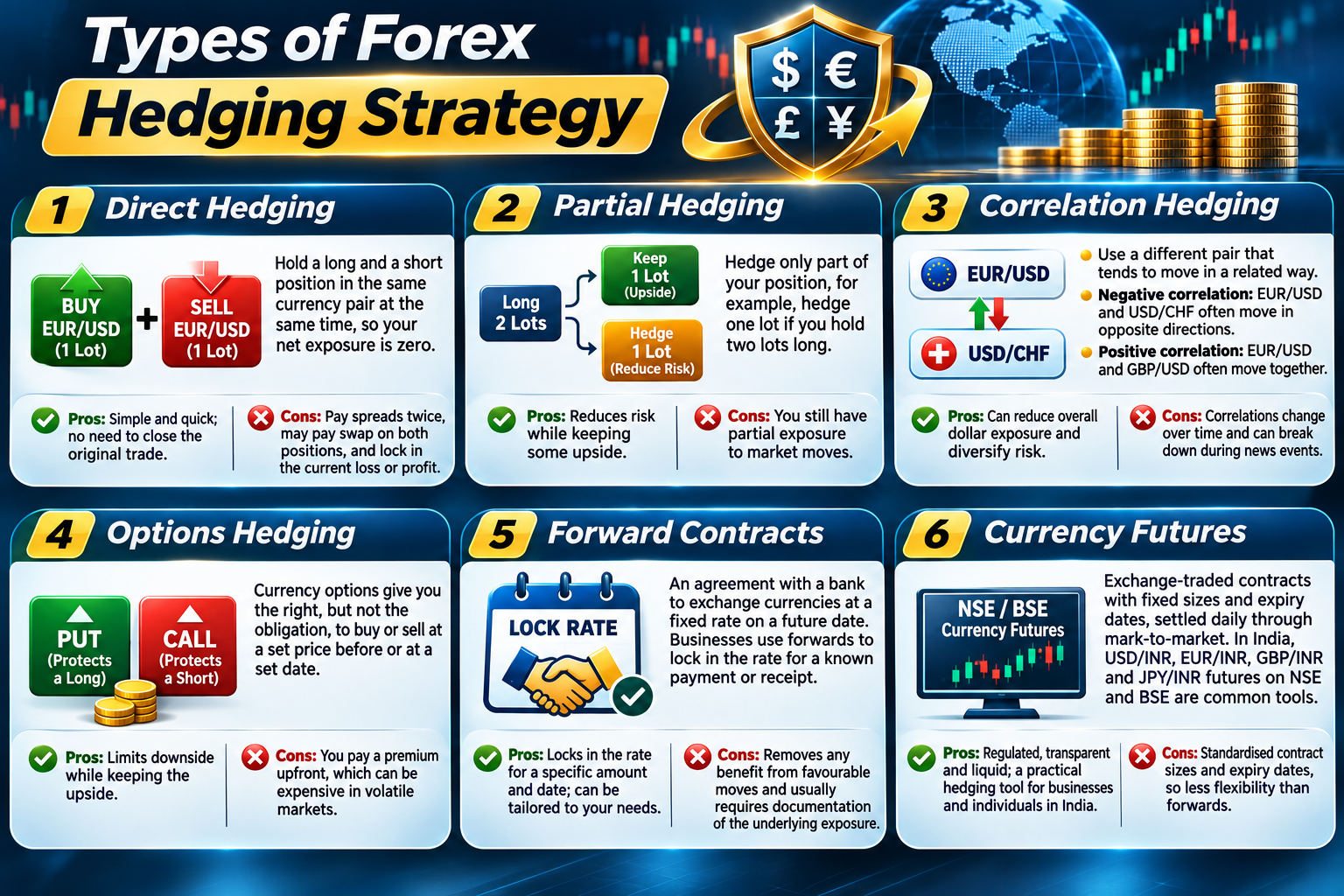
1. Direct hedging
The simplest forex hedging strategy is the direct hedge. It means holding a long and a short position in the same currency pair at the same time. For example, you are long one lot of EUR/USD and open a short of one lot of EUR/USD. While both are open, your net exposure is zero.
- Pros: Simple and quick; you do not need to close the original trade.
- Cons: You pay spreads twice, may pay swap on both positions, and lock in the current loss or profit. Some regulators and brokers do not allow it; for example, US brokers follow a no-hedging (FIFO) rule.
In most cases, a direct hedge achieves the same result as simply closing the trade or reducing its size, but at a higher cost. Many professionals therefore avoid it.
2. Partial hedging
Instead of offsetting the whole position, you hedge only part of it. For example, if you hold two lots long, you might hedge one lot. This reduces risk while keeping some upside. Partial hedging is common for businesses that hedge only confirmed payments and leave forecast amounts unhedged.
3. Correlation hedging
This forex hedging strategy uses a different pair that tends to move in a related way.
- Negative correlation: EUR/USD and USD/CHF have historically moved in opposite directions. Holding long positions in both can partly offset dollar risk.
- Positive correlation: EUR/USD and GBP/USD often move together. Being long one and short the other can reduce overall dollar exposure while expressing a view on the euro against the pound.
Correlation hedging is imperfect. Correlations change over time and can break down during news events, so the hedge may not work when you need it most.
4. Options hedging
Currency options give you the right, but not the obligation, to buy or sell at a set price before or at a set date.
- To protect a long position, buy a put option.
- To protect a short position, buy a call option.
You pay a premium upfront. If the market moves against you, the option gains and limits your loss. If the market moves in your favor, you keep the upside, minus the premium. This is often the most flexible forex hedging strategy, though the premium can be expensive in volatile markets.
5. Forward contracts
A forward contract is an agreement with a bank to exchange currencies at a fixed rate on a future date. Businesses use forwards to lock in the rate for a known payment or receipt. Forwards can be tailored to exact amounts and dates, but they remove any benefit from favourable moves and usually require documentation of the underlying exposure.
6. Currency futures
Exchange-traded currency futures work like standardised forwards. They have fixed contract sizes and expiry dates, are settled daily through mark-to-market, and are traded through a broker. In India, USD/INR, EUR/INR, GBP/INR and JPY/INR futures on NSE and BSE are a common hedging tool for small businesses and individuals.
Forex Hedging Strategy Comparison
| Method | Cost | Keeps upside? | Best for |
|---|---|---|---|
| Direct hedge | Double spread and swaps | No, while hedged | Short-term pauses, where allowed |
| Partial hedge | Lower than a full hedge | Partly | Reducing, not removing, risk |
| Correlation hedge | Spreads and swaps on two pairs | Partly | Experienced traders |
| Options | Upfront premium | Yes, minus premium | Event risk and flexible protection |
| Forward contract | Built into the forward rate | No | Businesses with known cash flows |
| Currency futures | Brokerage, margin, premium or discount | No | Businesses and individuals hedging on exchange |
Worked Example 1: Hedging a Trade with an Option
This example is illustrative. Prices and premium are hypothetical, and costs and taxes are ignored.
A trader is long 1 standard lot of EUR/USD at 1.1650 ahead of a central bank meeting. She wants to keep the trade but limit the downside. She buys a 1.1600 put option for a premium of 25 pips, or $250.
| Outcome | Spot position | Put option | Premium | Net result |
|---|---|---|---|---|
| EUR/USD falls to 1.1500 | −150 pips = −$1,500 | +100 pips = +$1,000 | −$250 | −$750 |
| EUR/USD rises to 1.1800 | +150 pips = +$1,500 | Expires worthless | −$250 | +$1,250 |
Without the hedge, the fall would have cost $1,500. With the hedge, the loss is cut to $750, while most of the upside is kept. That is the core trade-off of an options-based forex hedging strategy: pay a known cost to limit an unknown loss.
Worked Example 2: An Importer Hedging with Futures
This example is illustrative. Rates are hypothetical.
An Indian importer must pay $20,000 in two months. She buys 20 lots of USD/INR futures at 89.00. At expiry, the rupee has weakened and the reference rate is 90.00.
- Extra cost of buying $20,000 at the higher rate: about ₹20,000.
- Futures gain: 1.00 × 1,000 × 20 = ₹20,000.
- Net effect: the futures gain offsets the higher cost, so her effective rate stays close to 89.00.
If the rupee had strengthened instead, she would have lost on the futures but paid less for the dollars, again ending near 89.00.
Costs of a Forex Hedging Strategy
- Spreads and commissions: Every hedge involves at least one extra trade.
- Swaps: Holding positions overnight can cost interest on both sides of a direct or correlation hedge.
- Option premiums: Paid upfront and lost if the option is not needed.
- Forward points and futures premium: Forward and futures rates differ from spot because of interest rate differences.
- Opportunity cost: Most hedges reduce your gains if the market moves in your favour.
A sound forex hedging strategy compares these costs with the risk being reduced. Hedging every small position can cost more than the losses it prevents.
Risks and Limitations of Any Forex Hedging Strategy
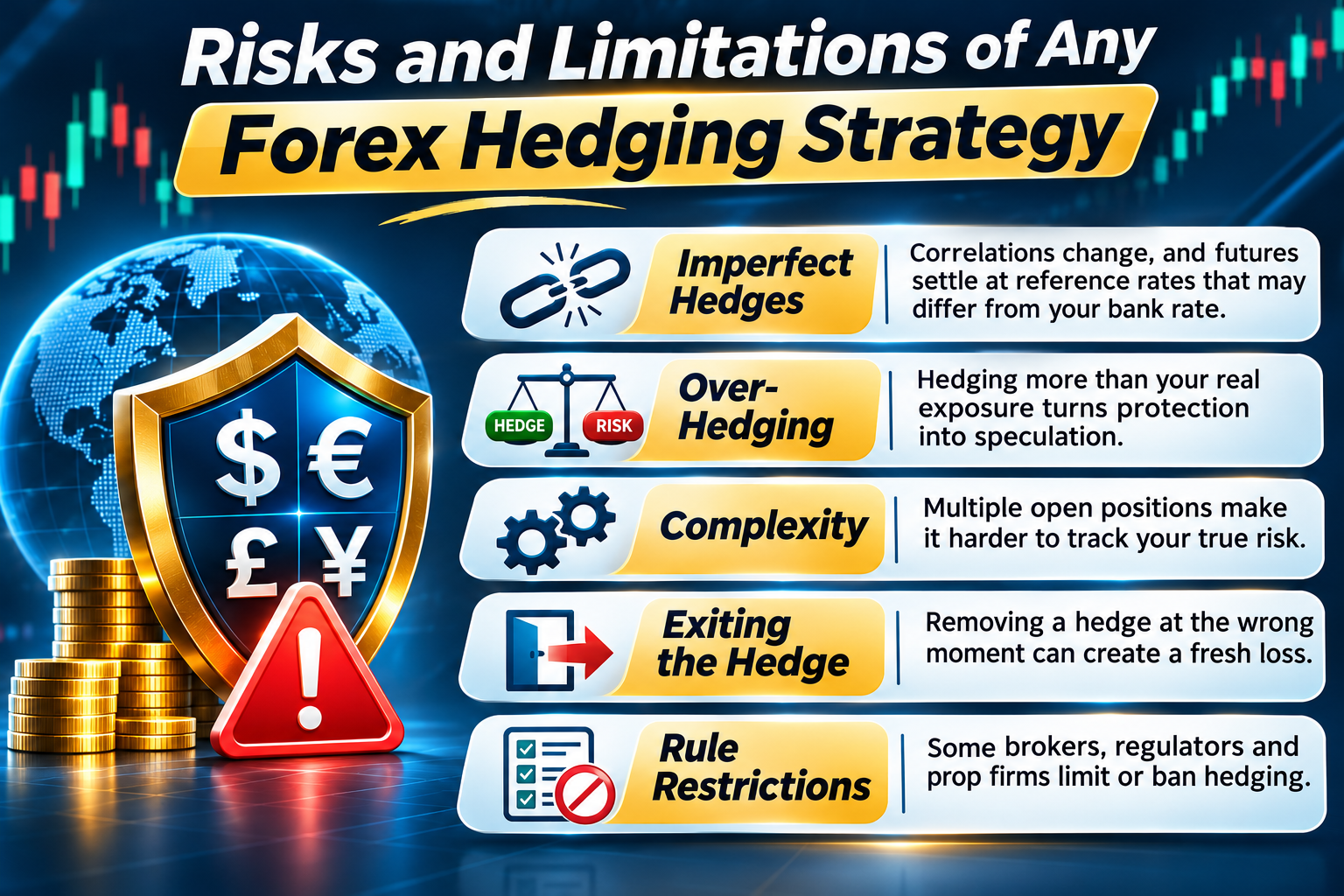
- Imperfect hedges: Correlations change, and futures settle at reference rates that may differ from your bank rate.
- Over-hedging: Hedging more than your real exposure turns protection into speculation.
- Complexity: Multiple open positions make it harder to track your true risk.
- Exiting the hedge: Removing a hedge at the wrong moment can create a fresh loss.
- Rule restrictions: Some brokers, regulators and prop firms limit or ban hedging.
Hedging and Prop Firms
Many prop firms allow hedging within one account but prohibit hedging across different accounts or between firms, as this can be used to exploit their rules. Some also restrict hedged grids or martingale-style systems. Read your firm’s rules carefully before using any forex hedging strategy on an evaluation or funded account.
Forex Hedging Strategy for Indian Traders and Businesses
- Legal route: Indian residents may not trade leveraged forex on offshore platforms under the Foreign Exchange Management Act (FEMA), and the RBI publishes an Alert List of unauthorised platforms. Hedging should be done through recognised exchanges or authorised banks.
- Exchange tools: NSE and BSE offer futures and options on USD/INR, EUR/INR, GBP/INR and JPY/INR, along with cross-currency contracts on EUR/USD, GBP/USD and USD/JPY, through SEBI-registered brokers. Rupee pairs trade from 9:00am to 5:00pm IST.
- Bank forwards: Importers and exporters can book forward contracts with their bank, usually with documentation of the underlying trade.
- RBI limits: The RBI allows positions up to a set limit without proof of underlying exposure. From 10 October 2026, that limit was reduced from $100 million to $5 million. Larger hedgers may need to establish their exposure with their broker.
- Tax: Gains and losses on exchange-traded currency derivatives are generally treated as non-speculative business income. Consult a chartered accountant on how hedging gains and losses fit with your business income.
Common Forex Hedging Strategy Mistakes
- Using a direct hedge instead of simply closing or reducing the trade.
- Hedging without a clear plan for when to remove the hedge.
- Relying on correlations that have weakened.
- Ignoring swap and premium costs.
- Judging a hedge only by whether the hedge itself made money, rather than by the combined result.
- Hedging uncertain future amounts in full.
Forex Hedging Strategy Checklist
- What exactly am I protecting, and for how long?
- Which method best fits: options, forwards, futures, partial or correlation hedge?
- What will the hedge cost in spreads, swaps or premium?
- How much of the exposure will I hedge?
- When and how will I remove the hedge?
- Do my broker, regulator or prop firm rules allow this approach?
- Have I recorded the link between the hedge and the exposure?
FAQs
What is a forex hedging strategy?
It is a plan to reduce currency risk by taking an offsetting position, such as an opposite trade, an option, a forward contract or a futures contract.
Is forex hedging profitable?
Hedging is designed to reduce risk, not to make money. A good hedge limits losses and makes results more predictable, usually at some cost.
What is the best forex hedging strategy for beginners?
For traders, reducing position size or using a stop-loss is often simpler than hedging. For businesses, forward contracts or exchange-traded futures are the most common choices.
Is direct hedging allowed?
It depends on the broker and regulator. US brokers generally do not allow it, while many other brokers do. Prop firms may restrict it.
How can Indian businesses hedge currency risk?
Through bank forward contracts or USD/INR and other currency futures and options on NSE and BSE via SEBI-registered brokers.
Conclusion
A forex hedging strategy is a risk management tool, not a profit engine. Direct and partial hedges, correlation hedges, options, forwards and futures each offer different balances of cost, flexibility and protection. Traders often use options or simply reduce position size around events, while businesses rely on forwards and exchange-traded futures to stabilise cash flows.
Choose the method that matches your exposure, understand its costs, decide in advance how you will remove the hedge, and keep clear records. Used carefully, hedging can turn unpredictable currency moves into manageable, planned risk.