
Introduction
If you trade futures and options (F&O) or currency derivatives, one number decides a lot about your tax filing: your turnover. It determines whether you need a tax audit, which deadline applies and how your return is checked.
Yet “turnover” in trading does not mean what most people think. It is not the total value of contracts you traded, and it is not your net profit. Many traders get it wrong and end up either paying for an unnecessary audit or missing one they needed.
This guide explains how to calculate turnover F&O traders must report, step by step. We cover:
- What trading turnover means for tax purposes
- The ICAI method for futures, options and currency derivatives
- Intraday and delivery equity turnover
- Tax audit limits and when they apply
- A worked example and common mistakes
Why Knowing How to Calculate Turnover F&O Matters
F&O and currency derivative trading on recognised exchanges is usually treated as non-speculative business income. That means you file ITR-3 and must check whether your business turnover crosses the tax audit limit.
Turnover affects:
- Tax audit: Whether your accounts must be audited by a chartered accountant.
- Filing deadline: Non-audit ITR-3 returns for AY 2026-27 were due on 31 August 2026, while audit cases have later deadlines.
- Presumptive taxation: Eligibility for the presumptive scheme (section 44AD under the old Act) depends on turnover.
- Accuracy of your return: Turnover is reported in the return, and mismatches with broker data can lead to notices.
So knowing how to calculate turnover F&O correctly is not just a formality; it shapes your entire filing.
How to Calculate Turnover F&O: The Basic Rule
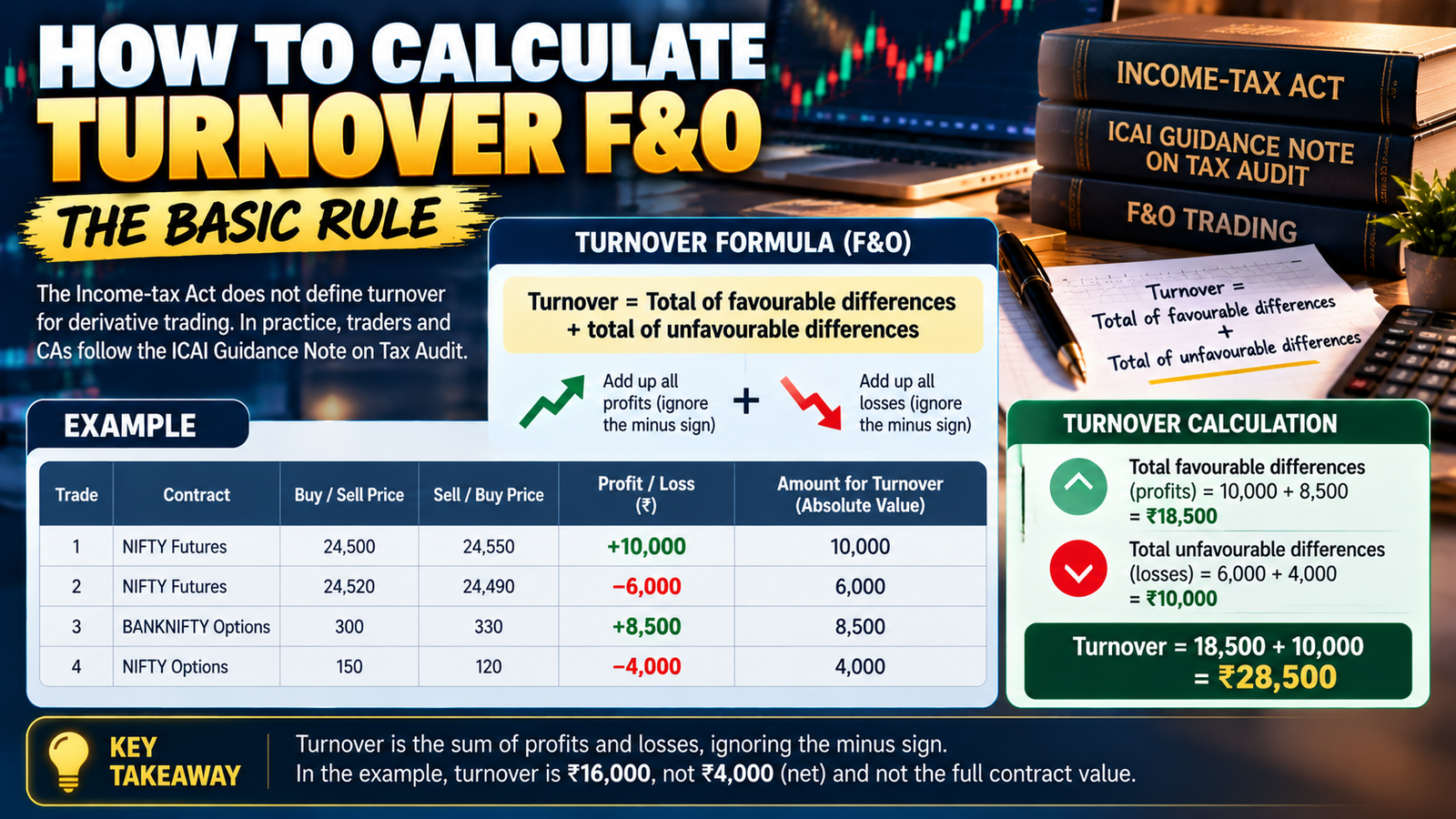
The Income-tax Act does not define turnover for derivative trading. In practice, traders and chartered accountants follow the ICAI Guidance Note on Tax Audit. Under this approach:
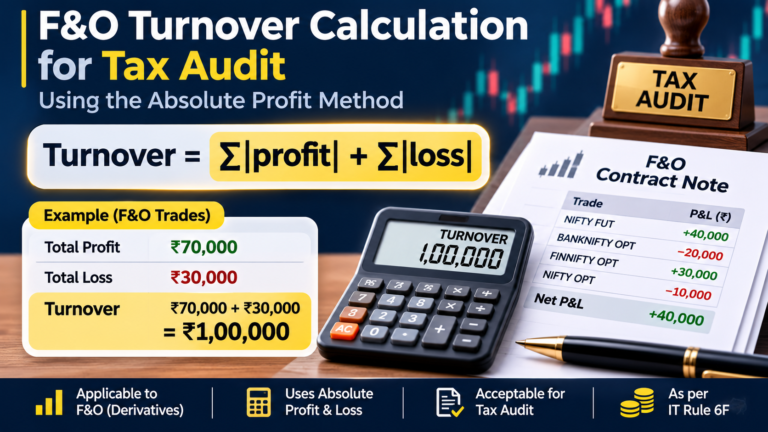
Turnover = Total of favourable differences + total of unfavourable differences
In simple terms, you add up the profit on each trade and the loss on each trade, ignoring the minus sign. This is often called the absolute profit method.
For example, if one trade made ₹10,000 profit and another lost ₹6,000, turnover is ₹16,000, not ₹4,000 (net) and not the full contract value.
This single rule is the heart of how to calculate turnover F&O and currency trades.
How to Calculate Turnover F&O for Futures
For futures, each squared-off position produces a profit or loss. Turnover is the absolute value of each result, added together.
| Trade | Profit / loss | Turnover (absolute) |
|---|---|---|
| Nifty futures | +₹25,000 | ₹25,000 |
| Bank Nifty futures | −₹18,000 | ₹18,000 |
| Reliance futures | +₹7,000 | ₹7,000 |
| Total | +₹14,000 net | ₹50,000 |
Positions still open at the end of the financial year are counted in the year they are squared off or settled.
How to Calculate Turnover F&O for Options
Options follow the same principle: take the profit or loss on each options trade and add the absolute values.
- Bought options squared off: The difference between buy and sell premium is the profit or loss.
- Bought options that expire worthless: The premium paid is a loss and counts in turnover.
- Sold options squared off or expired: The difference between premium received and premium paid (or zero at expiry) is the profit or loss.
What about premium on sold options?
Older practice added the premium received on options sold to turnover as a separate item. The ICAI Guidance Note, as revised in 2022, removed that separate inclusion, because the premium is already part of the profit or loss on the trade. Many chartered accountants now follow the revised approach, but some still use the older method. Agree the approach with your CA, since it can change whether you cross the audit limit.
Currency Derivatives Turnover
Currency futures and options on NSE and BSE, such as USD/INR, EUR/INR, GBP/INR and JPY/INR contracts, are treated the same way as equity F&O. Use the absolute sum of profits and losses on each squared-off trade. In other words, the method for how to calculate turnover F&O applies equally to currency contracts.
For example, if a trader closes six USD/INR futures trades during the year with profits of ₹3,000, ₹2,500 and ₹4,000, and losses of ₹1,500, ₹2,000 and ₹1,000, turnover is ₹14,000 (the sum of all six as positive numbers), even though net profit is only ₹5,000.
Currency derivatives do not attract STT, but exchange charges, stamp duty and GST still apply. These are expenses and do not change the turnover calculation.
How to Calculate Turnover F&O for Expiry and Physical Settlement
Stock F&O contracts that remain open at expiry are physically settled, which means shares are delivered or received. This changes the calculation slightly.
- Derivative leg: The difference between your trade price and the final settlement price is a profit or loss on the derivative, and its absolute value goes into turnover.
- Delivered shares: Shares you receive are then held as investment or stock-in-trade. If you later sell them as a business, the full sale value can count as turnover; if held as investment, the sale is a capital gain.
- Index and currency contracts: These are cash-settled, so only the profit or loss counts.
When working out how to calculate turnover F&O positions that went to physical settlement, separate the derivative result from the later share sale so neither is counted twice.
Tools That Make Turnover Calculation Easier
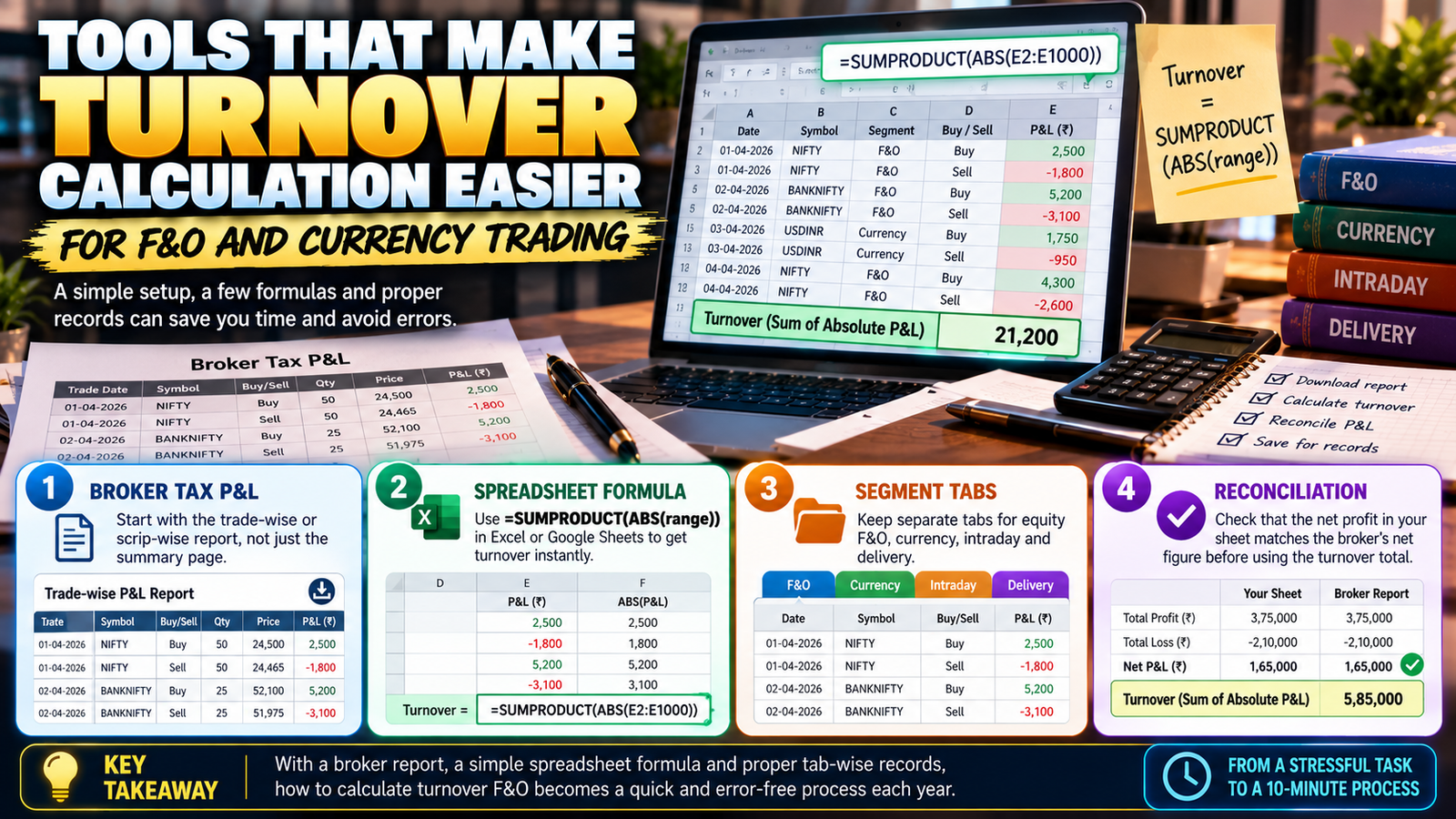
You do not need special software, but a simple setup avoids errors:
- Broker tax P&L: Start with the trade-wise or scrip-wise report rather than the summary page.
- Spreadsheet formula: In Excel or Google Sheets, put each trade’s profit or loss in a column and use =SUMPRODUCT(ABS(range)) to get turnover instantly.
- Segment tabs: Keep separate tabs for equity F&O, currency, intraday and delivery.
- Reconciliation: Check that net profit in your sheet matches the broker’s net figure before relying on the turnover total.
A reusable template means how to calculate turnover F&O each year becomes a ten-minute task rather than a stressful one in August.
Intraday and Delivery Equity Turnover
Many F&O traders also trade shares. These are handled differently:
| Type of trade | Income head | How turnover is calculated |
|---|---|---|
| F&O (equity and currency) | Non-speculative business income | Absolute sum of profits and losses |
| Intraday equity | Speculative business income | Absolute sum of profits and losses |
| Delivery shares held as investment | Capital gains | Not counted as business turnover |
| Delivery shares held as stock-in-trade | Business income | Full sale value |
If you trade both intraday and F&O, the turnover from both businesses is generally added together when checking the audit limit.
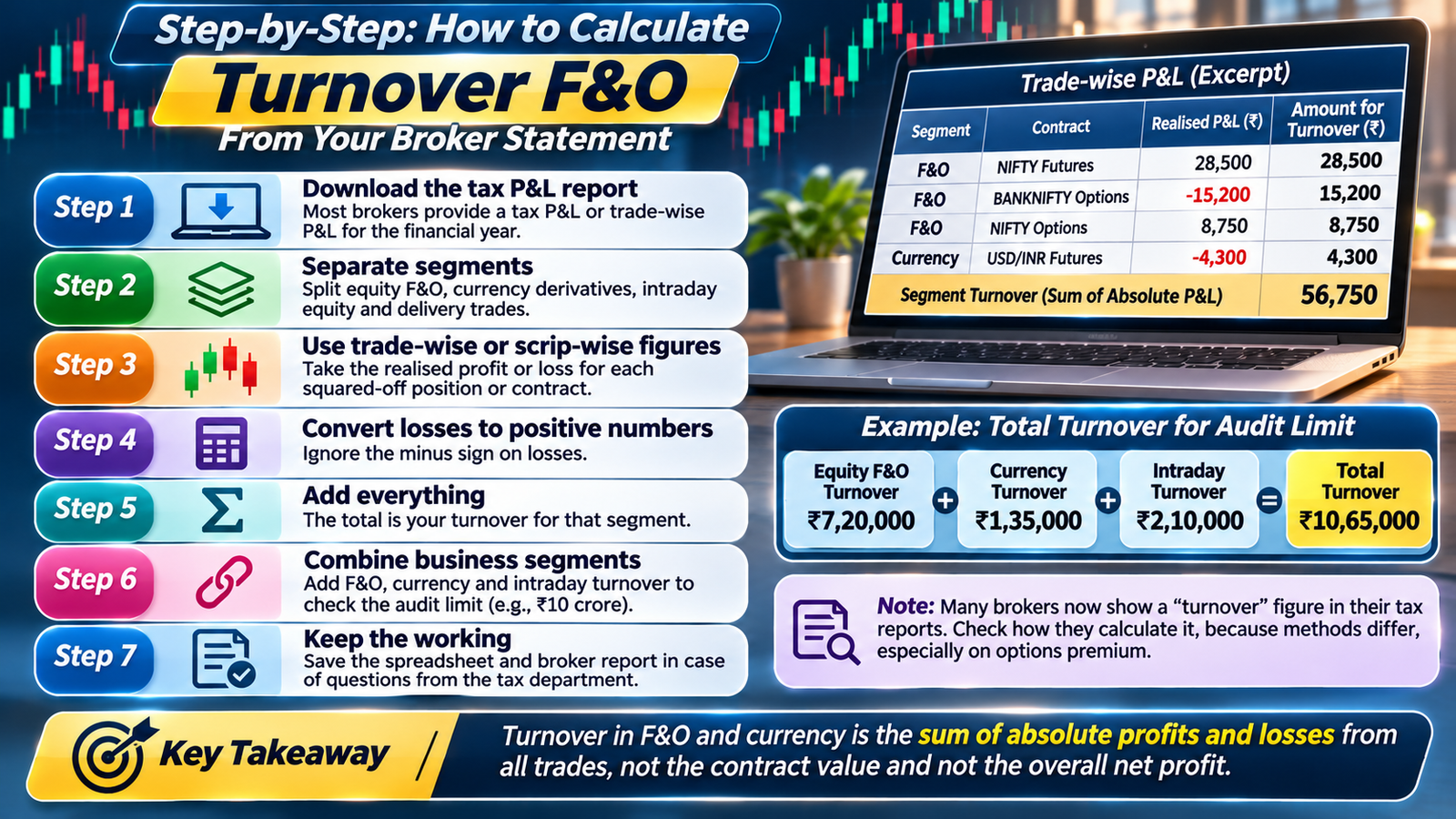
Step-by-Step: How to Calculate Turnover F&O From Your Broker Statement
Here is a practical routine for how to calculate turnover F&O and currency figures from the reports your broker already provides.
- Download the tax P&L report: Most brokers provide a tax P&L or trade-wise P&L for the financial year.
- Separate segments: Split equity F&O, currency derivatives, intraday equity and delivery trades.
- Use trade-wise or scrip-wise figures: Take the realised profit or loss for each squared-off position or contract.
- Convert losses to positive numbers: Ignore the minus sign on losses.
- Add everything: The total is your turnover for that segment.
- Combine business segments: Add F&O, currency and intraday turnover to check the audit limit.
- Keep the working: Save the spreadsheet in case of questions from the tax department.
Many brokers now show a “turnover” figure in their tax reports. Check how they calculate it, because methods differ, especially on options premium.
Tax Audit Limits for Traders
Once you know how to calculate turnover F&O, compare it with the tax audit limits (section 44AB under the 1961 Act, carried into the new Act):
| Situation | Audit required? |
|---|---|
| Turnover up to ₹10 crore, with cash transactions within 5% | Not required on turnover grounds alone |
| Turnover above ₹10 crore | Required |
| Turnover above ₹1 crore where cash transactions exceed 5% | Required |
| Opted out of presumptive taxation within the lock-in, with profit below the deemed rate and income above the basic exemption limit | May be required regardless of turnover |
Because F&O and currency trades are settled through banks and brokers, cash transactions are almost always nil, so the ₹10 crore limit normally applies on turnover grounds. The presumptive-scheme trigger catches more traders in practice, especially those with losses. Check your history with a CA.
Worked Example: How to Calculate Turnover F&O and Currency
Suppose a trader has the following results for the year:
| Segment | Total profits | Total losses | Turnover | Net result |
|---|---|---|---|---|
| Equity futures | ₹1,80,000 | ₹1,20,000 | ₹3,00,000 | +₹60,000 |
| Equity options | ₹2,40,000 | ₹3,10,000 | ₹5,50,000 | −₹70,000 |
| Currency futures | ₹40,000 | ₹25,000 | ₹65,000 | +₹15,000 |
| Intraday equity | ₹30,000 | ₹45,000 | ₹75,000 | −₹15,000 |
| Total | ₹9,90,000 | −₹10,000 |
Total turnover is ₹9.9 lakh, far below ₹10 crore, so no audit is required on turnover grounds. However, the trader has a net loss. If they had opted for presumptive taxation in an earlier year and are now inside the lock-in period, they should check whether an audit is still needed to carry the loss forward.
Note also that the intraday loss is speculative and can only be set off against speculative income, while the F&O loss is non-speculative.
This example is illustrative. Actual treatment depends on your full income and history.
Common Mistakes in How to Calculate Turnover F&O
- Using contract value: Adding the full notional value of futures or options contracts massively overstates turnover.
- Using net profit: Netting profits and losses understates turnover.
- Double-counting option premium: Adding premium separately on top of trade profit or loss, unless your CA follows the older method.
- Ignoring expired options: Worthless expiries are losses and count in turnover.
- Mixing capital gains with business turnover: Delivery investments are not business turnover.
- Relying blindly on broker figures: Broker “turnover” may use a different method.
- Skipping the return because of a loss: Losses can only be carried forward if you file on time.
 Reporting Turnover in ITR-3
Traders with F&O or currency derivative income generally file ITR-3. Turnover and profit or loss are reported in the business income sections, along with the nature of business. Speculative intraday income is reported separately from non-speculative F&O income. If an audit applies, the audit report must be filed before the return.
Whatever method you use for how to calculate turnover F&O, the figure in your return should match your working and your broker statements. Keep your broker contract notes, tax P&L reports, ledger and turnover working for at least the period the law requires, in case your return is selected for scrutiny.
FAQs
How to calculate turnover F&O in simple terms?
Add the profit on every profitable trade and the loss on every losing trade, treating losses as positive numbers. That total is your turnover.
Is options premium included in turnover?
Under the ICAI Guidance Note as revised in 2022, premium is not added separately because it is already reflected in the trade’s profit or loss. Some CAs still follow the older method, so confirm with yours.
Is currency trading turnover calculated the same way?
Yes. Exchange-traded currency futures and options use the same absolute profit method.
Do I need a tax audit if I made a loss?
Not because of the loss alone. But if you are within the presumptive taxation lock-in and your income exceeds the basic exemption limit, an audit may be needed. Ask your CA.
Does how to calculate turnover F&O change under the Income-tax Act, 2025?
The new Act did not introduce a separate turnover formula for derivatives, so the ICAI absolute-profit method continues to be followed in practice. Section numbers have changed, so check the current references with your CA.
Is intraday equity turnover added to F&O turnover?
For checking the audit limit, business turnover from intraday and F&O is generally combined, though the income heads differ.
Conclusion
Learning how to calculate turnover F&O and currency trades properly saves money and stress. The rule is simple: add the absolute values of every profit and loss, do not use contract value and do not net profits against losses. Then compare the result with the tax audit limits and check the presumptive-scheme rules.
Because details such as options premium treatment still vary in practice, keep clear records and work with a chartered accountant who understands trading income.