
Key points on FII flows rupee
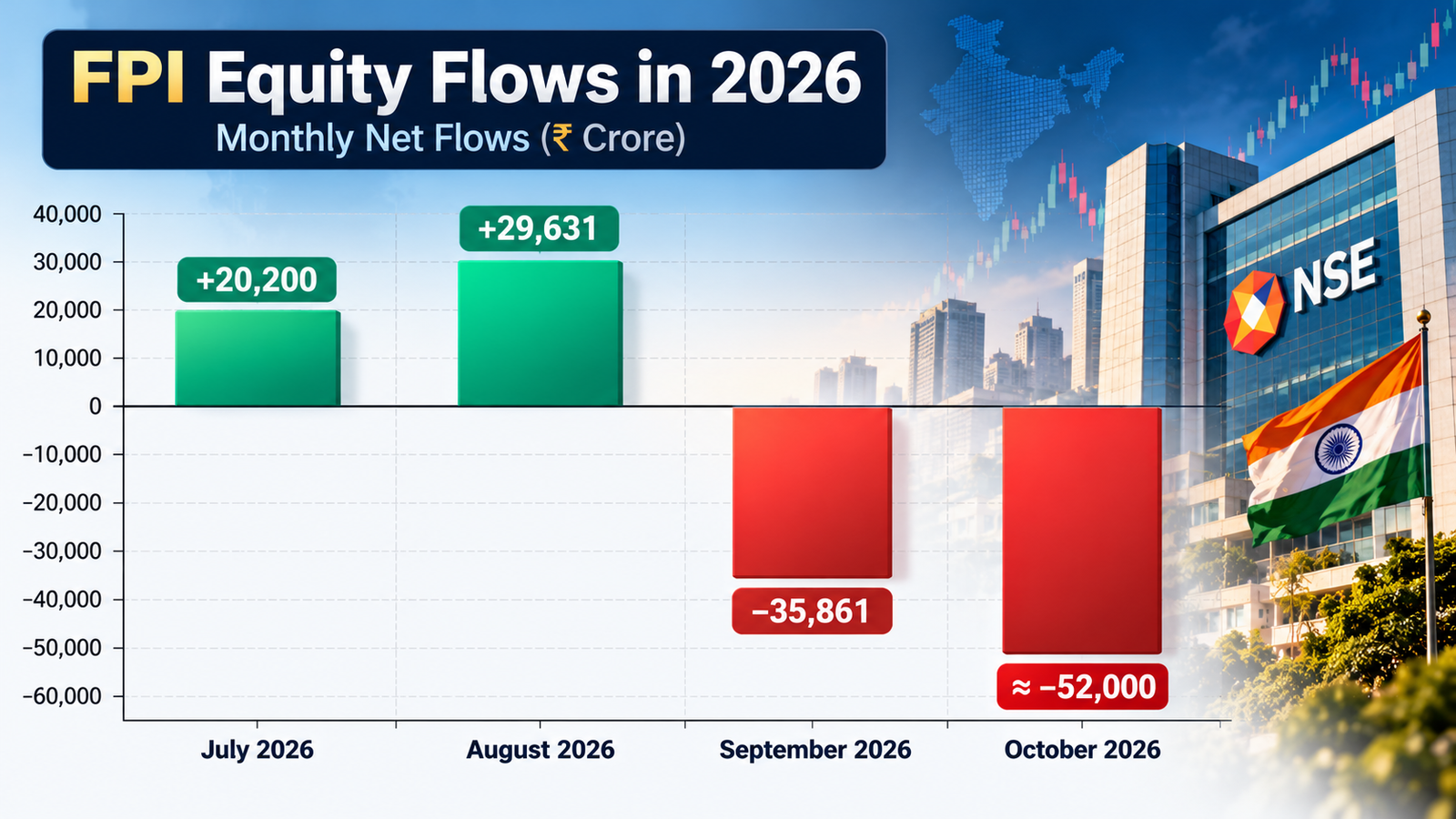
- Foreign investors (FIIs/FPIs) sold about ₹52,000 crore of Indian equities in October through 19 October, after a ₹35,861 crore outflow in September.
- Total 2026 outflows have passed ₹3 lakh crore, nearly double the ₹1.66 lakh crore for all of 2025.
- Even so, the rupee recovered from close to 97 per dollar early in the month to about 94.4, helped by Jio IPO inflows and RBI measures.
- Next up: Jio’s listing and the Fed decision on 28 October, plus full-month NSDL data in early November.
A note on terms: FII (foreign institutional investor) is the older name. SEBI now uses FPI (foreign portfolio investor). Both refer to the same overseas funds buying and selling Indian stocks and bonds.
What happened
Foreign selling has sped up sharply. FPIs withdrew ₹47,417 crore from Indian equities in just the first 12 days of October. By 19 October, the month’s outflow had reached about ₹52,000 crore. In dollar terms, FPIs pulled out $5.04 billion in the first fortnight of October, compared with $1.47 billion in the first half of September.
| Month (2026) | FPI net equity flow (NSDL) |
|---|---|
| July | +₹20,200 crore |
| August | +₹29,631 crore |
| September | −₹35,861 crore |
| October (to 19 Oct) | ≈ −₹52,000 crore |
| 2026 year to date | ≈ −₹3.1 lakh crore |
Monthly figures differ slightly between NSDL, CDSL and exchange provisional data. Use one source consistently.
The selling has been broad. 18 of the 23 sectors tracked by NSDL saw net selling. FPI equity assets under custody fell to $694 billion by mid-October. One bright spot: FPIs have kept investing in IPOs, with ₹56,485 crore of net primary-market investment this year, even as they sold heavily in the secondary market.
Why it matters
Why foreigners are selling. Analysts point to three pressures: rising US Treasury yields, high crude oil prices and a global shift into AI and semiconductor stocks. Centrum Broking’s Jignesh Desai said global money is chasing the AI trade in the US, Taiwan and Korea.
Domestic investors are absorbing the selling. Domestic institutional investors (DIIs) have bought a net ₹6.83 lakh crore of Indian equities in 2026. Strong SIP inflows mean the market can absorb large foreign sales. Even so, Indian equities have fallen nearly 12% this year, and Finance Minister Nirmala Sitharaman has flagged sustained foreign outflows as a key risk.
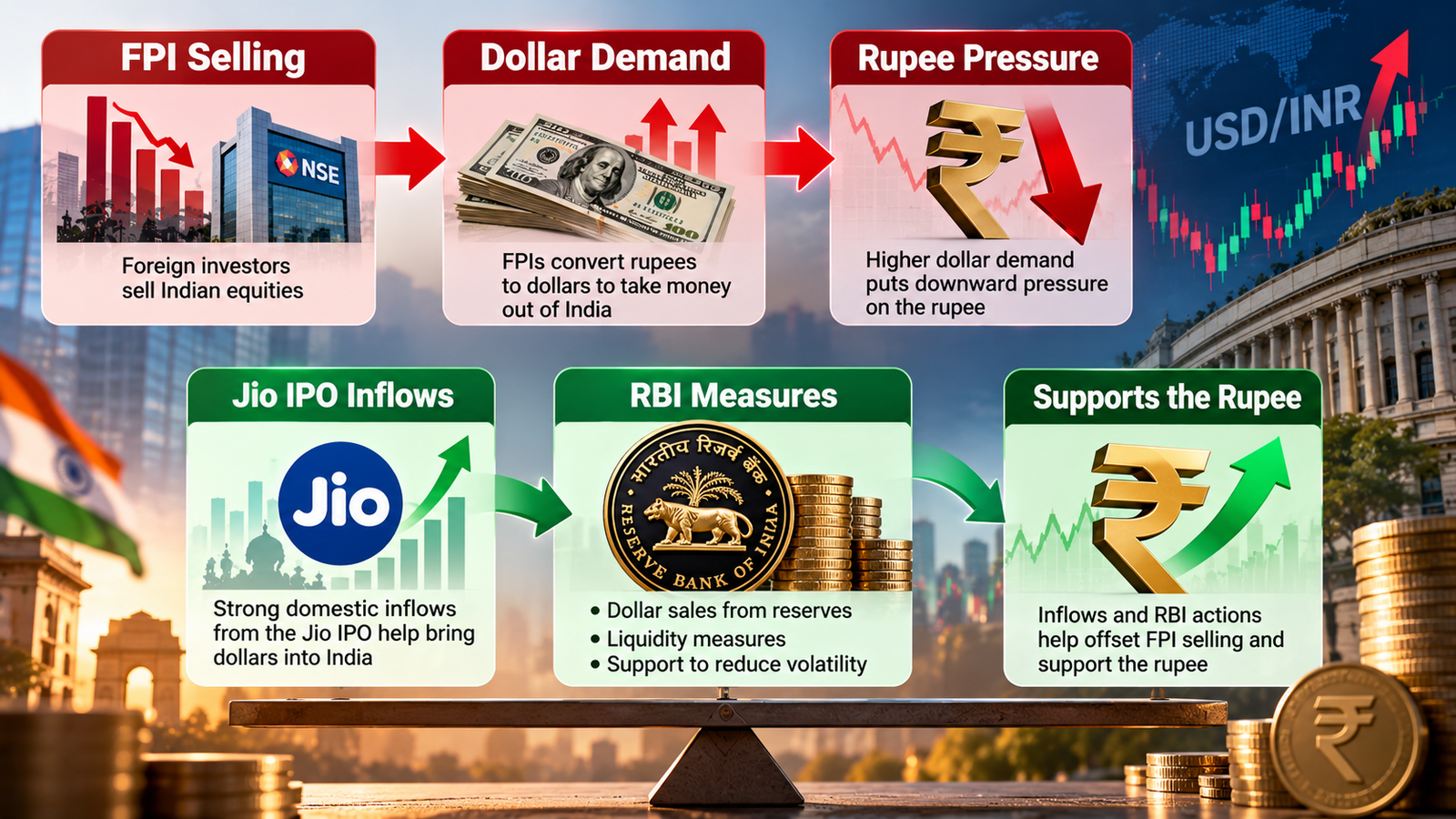
Why this matters for the rupee. When FPIs sell Indian stocks, they convert rupees back into dollars. Heavy outflows therefore increase demand for dollars and put pressure on the rupee. That is why FPI flows are one of the main drivers of USD/INR, alongside crude oil and the US dollar.
Market reaction: why the rupee rose despite outflows
The rupee had a weak start to October, moving close to 97 per dollar, near record lows. It then staged a sharp recovery. On 21 October, it closed around 94.4–94.5, its strongest finish since 4 September. On Thursday, 22 October, it slipped 44 paise to close at 94.82 (provisional) as crude oil rose and domestic stocks fell.
Three factors offset the equity outflows:
- Jio IPO dollar inflows: Jio Platforms’ ₹30,213 crore IPO, India’s largest, drew foreign money that came in through dollar sales in the spot market. That temporarily added to dollar supply.
- RBI measures: Measures announced earlier in October, described as the RBI’s strongest action since the 2013 currency crisis, included a dollar window for state oil companies, a ban on rebooking cancelled rupee derivative contracts, and a new Foreign Exchange Risk Reserve for banks.
- Trade deal hopes: Comments from US and Indian officials that a trade deal is close also supported sentiment.
| Indicator | Latest |
|---|---|
| USD/INR close (22 Oct) | 94.82 (provisional) |
| Rupee, 2026 year to date | Down about 5.1% |
| Brent crude | About $110/barrel |
| Dollar index | About 101.6 |
| USD/INR 2026 range | 89.65 (7 Jan) to 97.11 (19 May) |
Impact on Indian traders
USD/INR: The IPO-related support may fade once the swaps used by foreign investors settle. If equity outflows continue and crude stays above $110, USD/INR could face renewed upward pressure. The RBI has said it will keep currency moves orderly, so sharp swings may meet intervention.
EUR/INR, GBP/INR, JPY/INR: FPI outflows weaken the rupee against all major currencies, not just the dollar. Each cross also depends on its own central bank: the ECB (29 October), the BoJ (30 October) and the BoE (5 November).
Cross pairs on NSE: NSE also lists EUR/USD, GBP/USD and USD/JPY. Trading forex with unauthorised offshore platforms is not permitted under FEMA.
FPI flows often follow global risk appetite. When US yields rise or risk aversion spikes, emerging markets like India tend to see outflows. Our Risk-On / Risk-Off Meter can help you track that mood before you trade INR pairs.
What to watch next
| Date (IST) | Event | Why it matters for flows and the rupee |
|---|---|---|
| Fri, 23 Oct | Jio IPO closes | A test of foreign demand for Indian assets |
| Mon, 26 Oct | Jio IPO allotment | Unused IPO funds may be refunded, and the related swaps begin to settle |
| Wed, 28 Oct | Jio listing on NSE/BSE | Listing-day flows |
| Wed, 28 Oct, ~23:30 | FOMC decision | Higher US rates could deepen outflows |
| Weekly (Fridays) | RBI forex reserves data | Shows how much the RBI is intervening |
| Early Nov | NSDL full-month October FPI data | The final October number |
| Fri, 4 Dec, 10:00 | RBI MPC decision | Rate differential and rupee policy |
Possible scenarios:
- If a US–India trade deal is signed and crude eases, FPI selling may slow, which is likely to support the rupee.
- If the Fed signals more hikes and Brent stays above $110, outflows could continue and USD/INR may move back toward 95.5–96.
- Either way, the RBI’s stated commitment to orderly moves is likely to limit extreme swings.
Track all release times on our Economic Calendar, and find more coverage in Market Analysis & News.
FAQs
How much have FIIs sold in October 2026?
FPIs sold about ₹52,000 crore of Indian equities from 1 to 19 October, according to depository data. That follows a ₹35,861 crore outflow in September.
Why do FII outflows weaken the rupee?
When foreign investors sell Indian shares, they convert rupees back into dollars to take money out. That increases demand for dollars and puts pressure on the rupee.
Why did the rupee rise in October despite FII selling?
Dollar inflows linked to the Jio IPO, strong RBI measures to curb speculation, and hopes of a US–India trade deal offset the equity outflows for now.