

Introduction
Most currency trading involves the US dollar. According to the Bank for International Settlements, the dollar was on one side of about 89% of all forex trades in April 2025. But traders, businesses and travellers often need exchange rates between two currencies that do not include the dollar, such as the euro against the yen, or the British pound against the Indian rupee. These are called cross rates.
Understanding the cross rate forex calculation lets you work out the price of any currency pair from the dollar rates you already know. It also helps you check whether a quoted price is fair, understand how cross pairs move and spot when two pairs are telling you the same story.
This guide explains what a cross rate is, the three simple formulas for calculating one, how to handle bid and ask prices, worked examples including rupee pairs, triangular arbitrage and practical tips for traders.
What Is a Cross Rate?
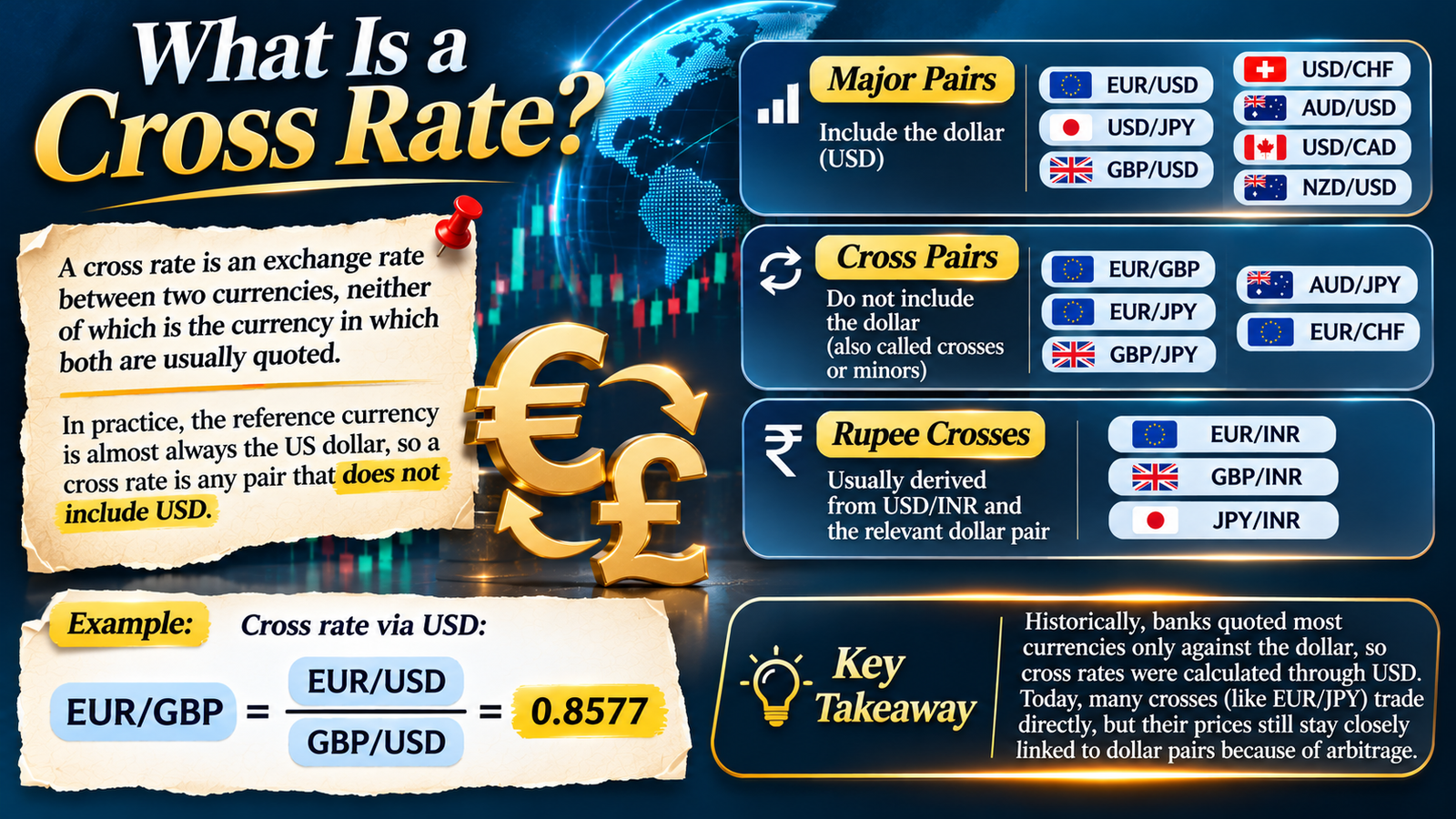
A cross rate is an exchange rate between two currencies, neither of which is the currency in which both are usually quoted. In practice, the reference currency is almost always the US dollar, so a cross rate is any pair that does not include USD.
- Major pairs include the dollar: EUR/USD, USD/JPY, GBP/USD, USD/CHF, AUD/USD, USD/CAD and NZD/USD.
- Cross pairs (also called crosses or minors) do not: EUR/GBP, EUR/JPY, GBP/JPY, AUD/JPY and EUR/CHF are popular examples.
- Rupee crosses such as EUR/INR, GBP/INR and JPY/INR are usually derived from USD/INR and the relevant dollar pair.
Historically, banks quoted most currencies only against the dollar, so a cross rate forex price had to be calculated through the dollar. Today, popular crosses like EUR/JPY trade directly, but their prices still stay closely linked to the dollar pairs because of arbitrage.
Why Cross Rate Forex Calculations Matter
- Pricing any pair: if you know two dollar rates, you can calculate the third.
- Checking quotes: you can verify whether a broker’s or bank’s cross rate is reasonable.
- Understanding moves: a rise in EUR/JPY can come from a stronger euro, a weaker yen, or both.
- Business payments: Indian importers paying in euros or yen need EUR/INR and JPY/INR rates, which are usually derived from USD/INR.
- Exchange settlement: in India, rupee cross reference rates are derived from the USD/INR reference rate and international cross rates.
The Three Cross Rate Forex Formulas
Every cross rate forex calculation falls into one of three cases, depending on where the US dollar sits in the two pairs you are combining.
Case 1: USD is the quote currency in one pair and the base in the other → multiply
Example: to find EUR/JPY from EUR/USD and USD/JPY.
EUR/JPY = EUR/USD × USD/JPY
The US dollar cancels out: (dollars per euro) × (yen per dollar) = yen per euro.
Case 2: USD is the quote currency in both pairs → divide
Example: to find EUR/GBP from EUR/USD and GBP/USD.
EUR/GBP = EUR/USD ÷ GBP/USD
Case 3: USD is the base currency in both pairs → divide
Example: to find JPY/INR from USD/JPY and USD/INR.
JPY/INR = USD/INR ÷ USD/JPY
Note the order: the currency you want as the quote currency (INR) goes in the numerator pair.
| Where USD sits | Operation | Example |
|---|---|---|
| Quote in one pair, base in the other | Multiply | EUR/JPY = EUR/USD × USD/JPY |
| Quote in both pairs | Divide | EUR/GBP = EUR/USD ÷ GBP/USD |
| Base in both pairs | Divide | JPY/INR = USD/INR ÷ USD/JPY |
A simple check: write each pair as a fraction (for example, EUR/USD as “USD per EUR”) and make sure the US dollar cancels out, leaving the currencies you want.
Cross Rate Forex Examples Using Mid-Market Rates
All rates in these examples are hypothetical and chosen for illustration.
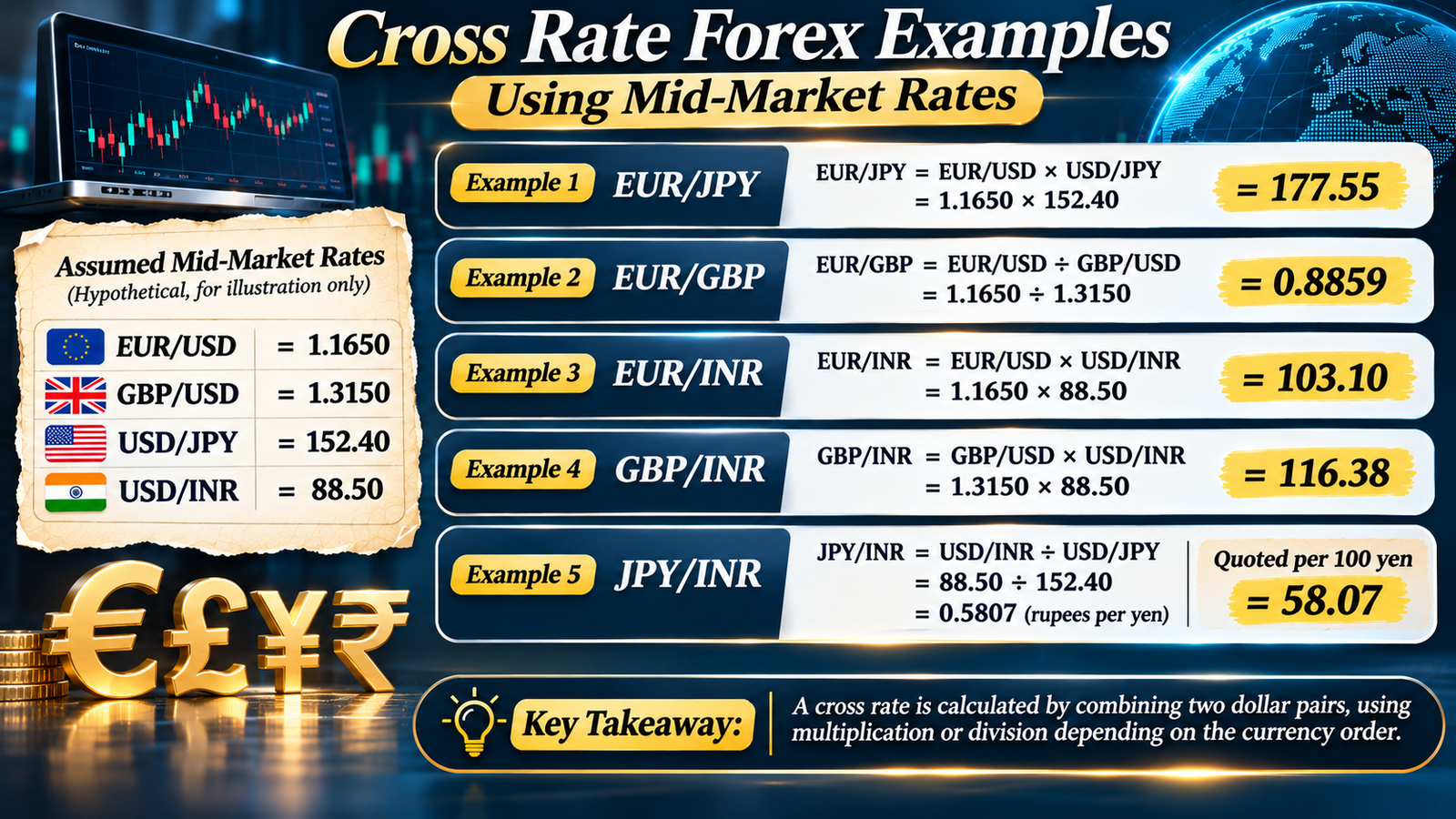
Assume the following mid-market rates:
- EUR/USD = 1.1650
- GBP/USD = 1.3150
- USD/JPY = 152.40
- USD/INR = 88.50
Example 1: EUR/JPY
EUR/JPY = 1.1650 × 152.40 = 177.55
Example 2: EUR/GBP
EUR/GBP = 1.1650 ÷ 1.3150 = 0.8859
Example 3: EUR/INR
EUR/INR = EUR/USD × USD/INR = 1.1650 × 88.50 = 103.10
Example 4: GBP/INR
GBP/INR = GBP/USD × USD/INR = 1.3150 × 88.50 = 116.38
Example 5: JPY/INR
JPY/INR = USD/INR ÷ USD/JPY = 88.50 ÷ 152.40 = 0.5807 rupees per yen. Because the yen has a small unit value, Indian markets usually quote JPY/INR per 100 yen, so this would be 58.07.
A Step-by-Step Cross Rate Forex Method
If you are unsure which formula to use, follow these steps for any cross rate forex problem:
- Write down the pair you want, for example GBP/JPY.
- Find each currency’s rate against the US dollar, for example GBP/USD and USD/JPY.
- Write each rate as “units of quote currency per one unit of base currency”: GBP/USD is dollars per pound; USD/JPY is yen per dollar.
- Arrange them so the dollar cancels: (dollars per pound) × (yen per dollar) = yen per pound.
- Calculate and sense-check: with GBP/USD at 1.3150 and USD/JPY at 152.40, GBP/JPY is about 200.41. Since a pound is worth more than a dollar, GBP/JPY should be higher than USD/JPY, which it is.
This cancellation method works for every cross rate forex calculation, so you never need to memorise the three cases.
Calculating Bid and Ask Cross Rates
Real quotes have a bid (the price at which you can sell) and an ask (the price at which you can buy). A correct cross rate forex calculation must use the right side of each quote, so that the spread of the cross includes the spreads of both legs.
Multiplication case (EUR/JPY)
- EUR/JPY bid = EUR/USD bid × USD/JPY bid
- EUR/JPY ask = EUR/USD ask × USD/JPY ask
With EUR/USD at 1.1648/1.1650 and USD/JPY at 152.38/152.40:
- Bid = 1.1648 × 152.38 = 177.49
- Ask = 1.1650 × 152.40 = 177.55
Division case (EUR/GBP)
- EUR/GBP bid = EUR/USD bid ÷ GBP/USD ask
- EUR/GBP ask = EUR/USD ask ÷ GBP/USD bid
With EUR/USD at 1.1648/1.1650 and GBP/USD at 1.3150/1.3152:
- Bid = 1.1648 ÷ 1.3152 = 0.8856
- Ask = 1.1650 ÷ 1.3150 = 0.8859
The logic: to sell euros for pounds via the dollar, you sell euros for dollars (at the EUR/USD bid) and then buy pounds with those dollars (at the GBP/USD ask). Using the less favourable side each time explains why cross pairs often have wider spreads than major pairs.
Cross Rate Forex in India
In India, rupee cross rates are closely linked to USD/INR:
- The official reference rates for EUR/INR, GBP/INR and JPY/INR, published daily by Financial Benchmarks India (FBIL), are derived from the USD/INR reference rate combined with international EUR/USD, GBP/USD and USD/JPY rates.
- NSE and BSE offer currency futures and options on EUR/INR, GBP/INR and JPY/INR, as well as on the cross-currency pairs EUR/USD, GBP/USD and USD/JPY. The cross-currency contracts are settled using a rate derived from the reference rates.
- Banks quoting EUR/INR or GBP/INR to customers usually build the rate from USD/INR and the relevant dollar pair, then add their margin.
So when the rupee weakens against the dollar, it usually weakens against the euro and pound too, unless EUR/USD or GBP/USD move enough to offset it.
Cross Rate Forex Table for Rupee Pairs
Using the same hypothetical rates, here is how the main rupee crosses are derived:
| Pair | Formula | Result |
|---|---|---|
| EUR/INR | EUR/USD × USD/INR | 103.10 |
| GBP/INR | GBP/USD × USD/INR | 116.38 |
| JPY/INR (per 100 yen) | (USD/INR ÷ USD/JPY) × 100 | 58.07 |
A quick cross rate forex table like this helps Indian importers, exporters and travellers check whether the rates they are quoted are reasonable.
Triangular Arbitrage
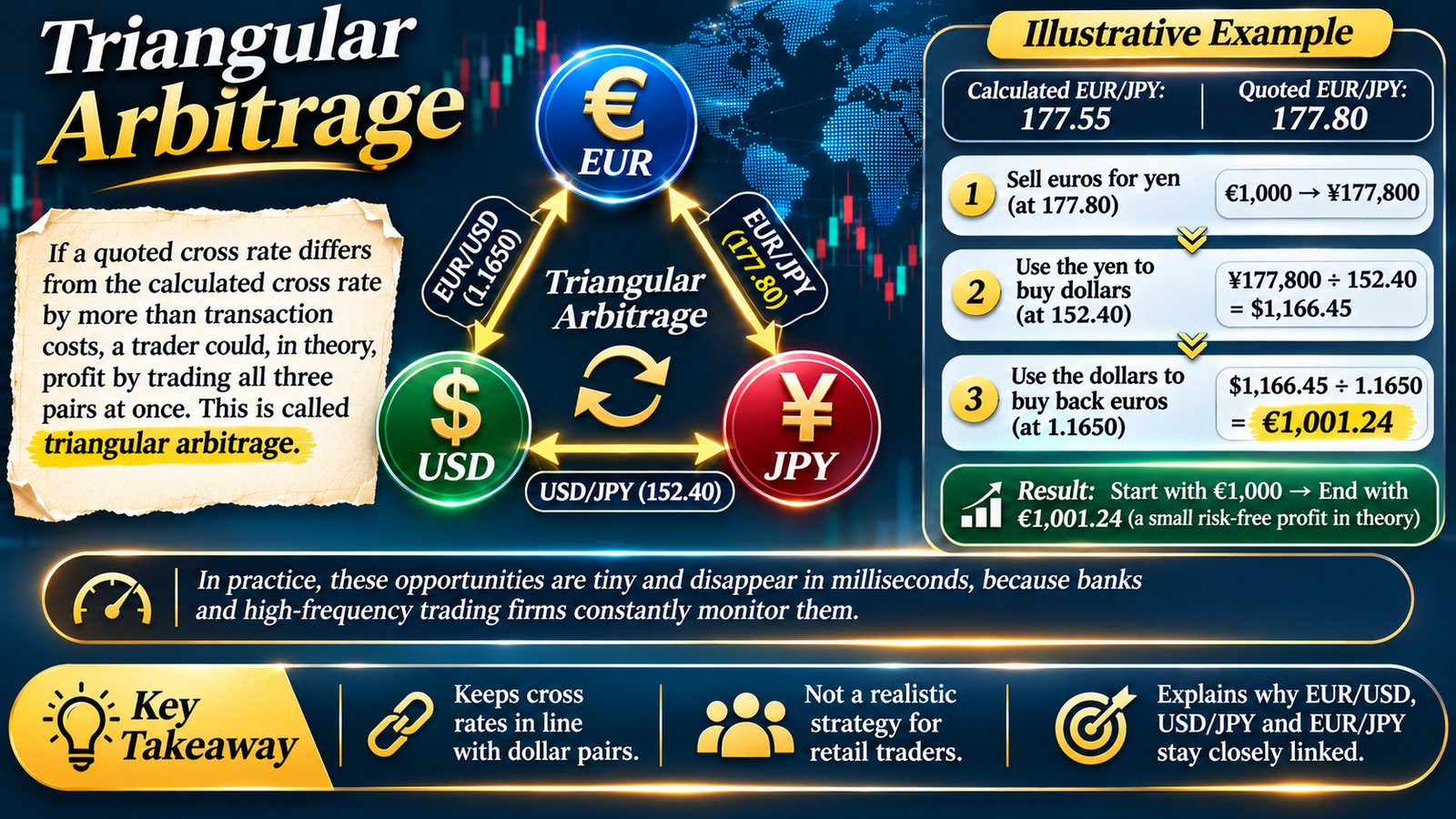
If a quoted cross rate differs from the calculated cross rate by more than transaction costs, a trader could, in theory, profit by trading all three pairs at once. This is called triangular arbitrage.
Illustrative example: suppose the calculated EUR/JPY is 177.55, but a dealer quotes EUR/JPY at 177.80. A trader could sell euros for yen at 177.80, use the yen to buy dollars, and use the dollars to buy back euros, ending with more euros than they started with.
In practice, these opportunities are tiny and disappear in milliseconds, because banks and high-frequency trading firms constantly monitor them. That is why cross rate forex prices stay closely in line with the dollar pairs. For retail traders, triangular arbitrage is not a realistic strategy, but understanding it explains why the three rates stay linked.
How Cross Rate Forex Prices Move
A cross pair reflects the relative strength of two non-dollar currencies. Breaking it down helps you understand the move:
- If EUR/USD rises 1% and USD/JPY is unchanged, EUR/JPY rises about 1%.
- If EUR/USD is unchanged and USD/JPY rises 1%, EUR/JPY also rises about 1%.
- If EUR/USD falls 1% and USD/JPY rises 1%, EUR/JPY may be roughly unchanged.
This is why traders sometimes trade crosses to take a view on two currencies without taking a direct view on the dollar.
Practical Tips for Traders
- Watch both legs: before trading EUR/JPY, check what EUR/USD and USD/JPY are doing.
- Check spreads: cross pairs, especially less common ones, often have wider spreads than majors.
- Mind correlation: holding EUR/USD long and EUR/JPY long doubles your euro exposure.
- Use the right side of quotes: when calculating costs, use bid and ask, not just mid-prices.
- Use a spreadsheet: set up the three formulas once to check cross rate forex quotes quickly.
Indian residents should note that leveraged forex trading on offshore platforms is not permitted under the Foreign Exchange Management Act (FEMA). Exchange-traded currency derivatives on NSE and BSE, through SEBI-registered brokers, are the legal route for trading rupee and cross-currency pairs.
Common Cross Rate Forex Mistakes
- Multiplying when you should divide, or the reverse.
- Using mid-rates when calculating real trading costs.
- Forgetting that JPY/INR is usually quoted per 100 yen in India.
- Assuming a cross pair moves independently of the dollar pairs.
- Ignoring wider spreads on less liquid crosses.
FAQs
What is a cross rate in forex?
It is an exchange rate between two currencies that does not involve the US dollar, such as EUR/JPY or GBP/INR, usually calculated from each currency’s rate against the dollar.
How do you calculate a cross rate?
Multiply when the dollar is the quote currency in one pair and the base in the other; divide when the dollar is in the same position in both pairs.
How is EUR/INR calculated?
EUR/INR = EUR/USD × USD/INR. For example, 1.1650 × 88.50 = 103.10.
Do I need to calculate cross rate forex prices myself?
Most platforms show cross rates directly, but knowing how to calculate cross rate forex prices helps you check quotes, understand moves and estimate costs.
Why do cross pairs have wider spreads?
Because the cross rate combines the spreads of two pairs, and many crosses are less liquid than major pairs.
What is triangular arbitrage?
Profiting from a mismatch between a quoted cross rate and the rate implied by two dollar pairs. Such gaps are tiny and close almost instantly.
Conclusion
Cross rates let you price any currency pair from the dollar rates you already have. The cross rate forex method comes down to three simple cases: multiply when the dollar sits on opposite sides, and divide when it sits on the same side in both pairs. Adding bid and ask prices shows why crosses often cost more to trade.
For Indian traders and businesses, cross rates explain how EUR/INR, GBP/INR and JPY/INR are linked to USD/INR. Master the formulas, check both legs before trading a cross, and remember that arbitrage keeps all three rates closely aligned.